|

|
|
AGENDA
Ordinary Council Meeting
|
|
Date:
|
Wednesday, 13 May 2026
|
|
Time:
|
1:00 pm
|
|
Location:
|
Carterton Events Centre
50 Holloway St
Carterton
|
|
Mayor S Cretney
Deputy Mayor G
Ayling
L Newman
Cr B Deller
Cr S Laurence
|
Cr S Gallon
Cr J Burns
Cr S Casey
Cr R Round
|
|
Ordinary Council Meeting Agenda
|
13 May 2026
|
7 Confirmation
of the Minutes

7.1 Minutes
of the Ordinary Council Meeting held on 1 April 2026
1. Recommendation
1. That
the Minutes of the Ordinary Council Meeting held on 1 April 2026 are true and
correct.
File
Number: 520945
Author: Robyn
Blue, Democratic Services Officer
Attachments: 1. Minutes
of the Ordinary Council Meeting held on 1 April 2026
|
Ordinary Council Meeting Minutes
|
1
April 2026
|

MINUTES OF Carterton
District Council
Ordinary Council Meeting
HELD AT THE Carterton Events Centre, 50
Holloway St, Carterton
ON Wednesday, 1 April 2026 AT 4:45 pm
PRESENT: Mayor
Steve Cretney, Deputy Mayor Grace Ayling, Cr Brian Deller, Cr Steve Laurence,
Cr Lou Newman, Cr Steve Gallon, Cr Rachel Round, Cr Jane Burns, Cr Simon Casey
IN
ATTENDANCE: Staff
Geoff
Hamilton (Chief Executive), Geri Brooking (Group Manager People and Corporate),
Marc Ferguson (Chief Financial Officer), Solitaire Robertson (Group Manager
Planning and Regulatory), Glenda Seville (Group Manager Community and
Facilities), Lawrence Stephenson (Group Manager Infrastructure), Sara Renall
(Senior Communications and Engagement Advisor) via videoconference, Robyn Blue
(Democratic Services Officer)
Youth
Council
Josephine
Kumeroa, Duncan Allen-Alloway, Latoria Reiri, Rory Pike, Brooke Ah-Wong
1 Karakia
Timatanga
The meeting opened with a karakia by all members.
2 Apologies
NOTED
·
An apology was received from Joel Ngātuere.
3 Conflicts
of Interests Declaration
There were no conflicts of interest declared.
4 Public
Forum
Jason
Markham provided an update on the Carterton Indoor Pool redevelopment, the
evolution of design options, and the challenges of rising costs and securing
sufficient financial support.
5 Discussion
of Public Forum
The
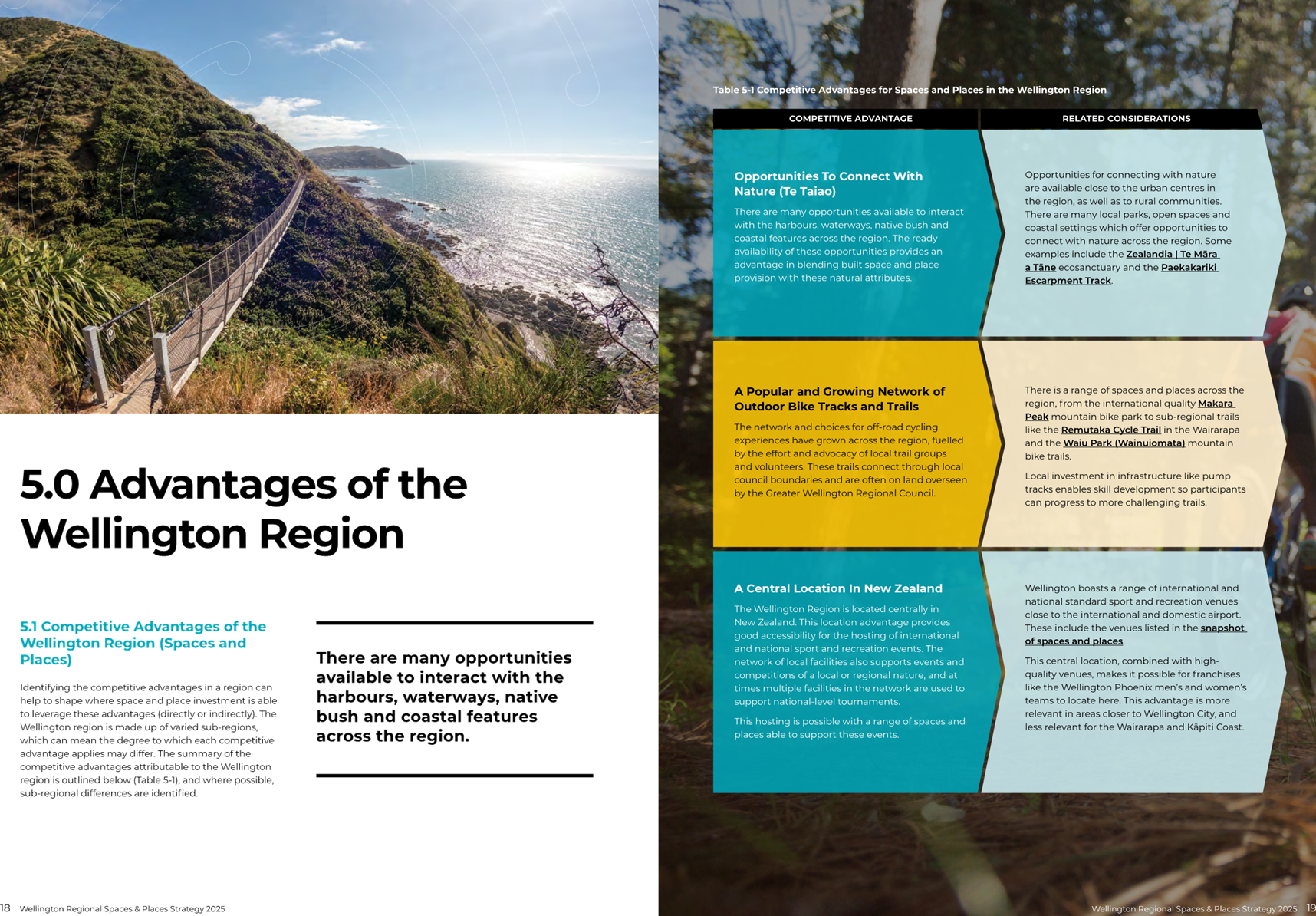
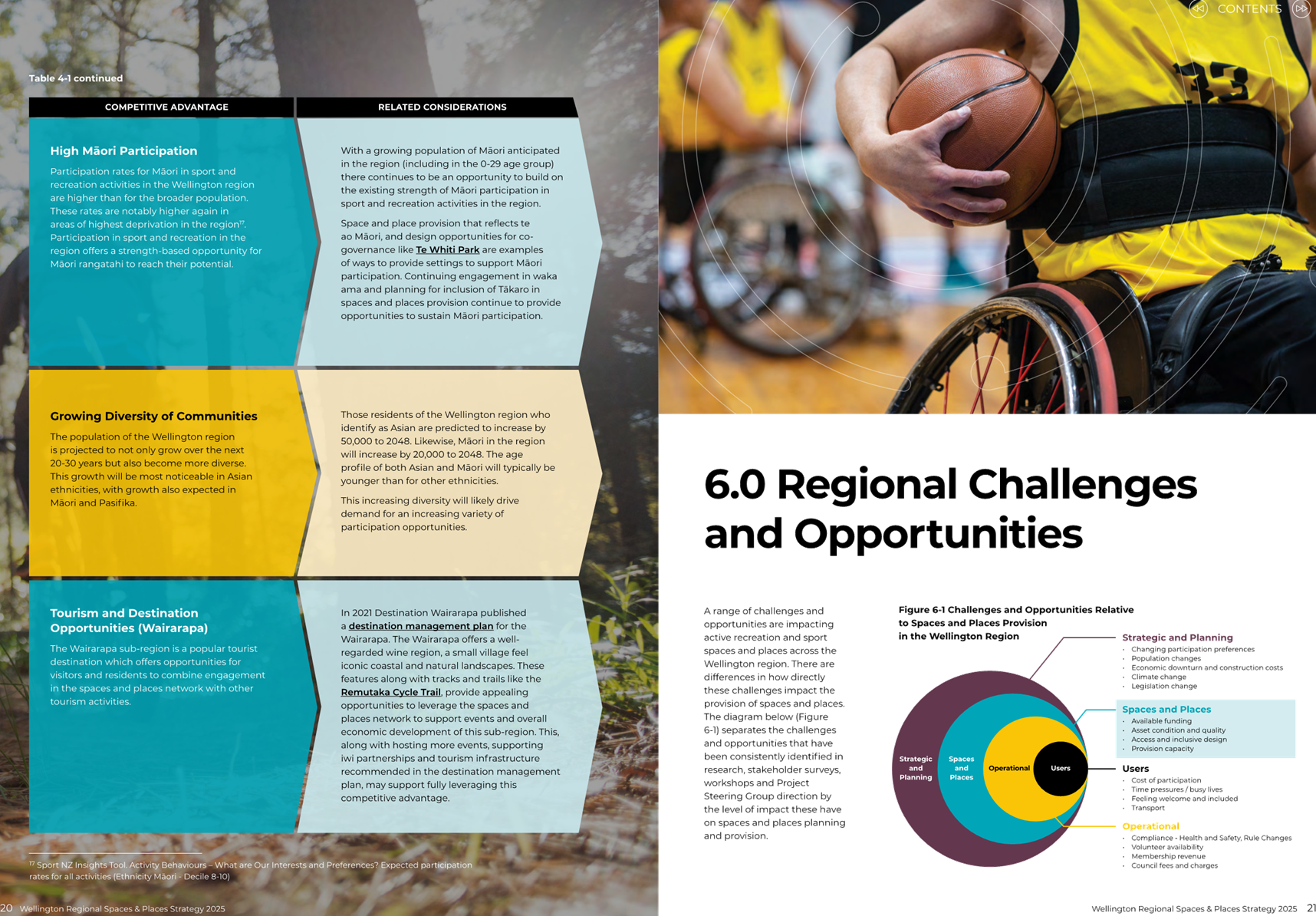
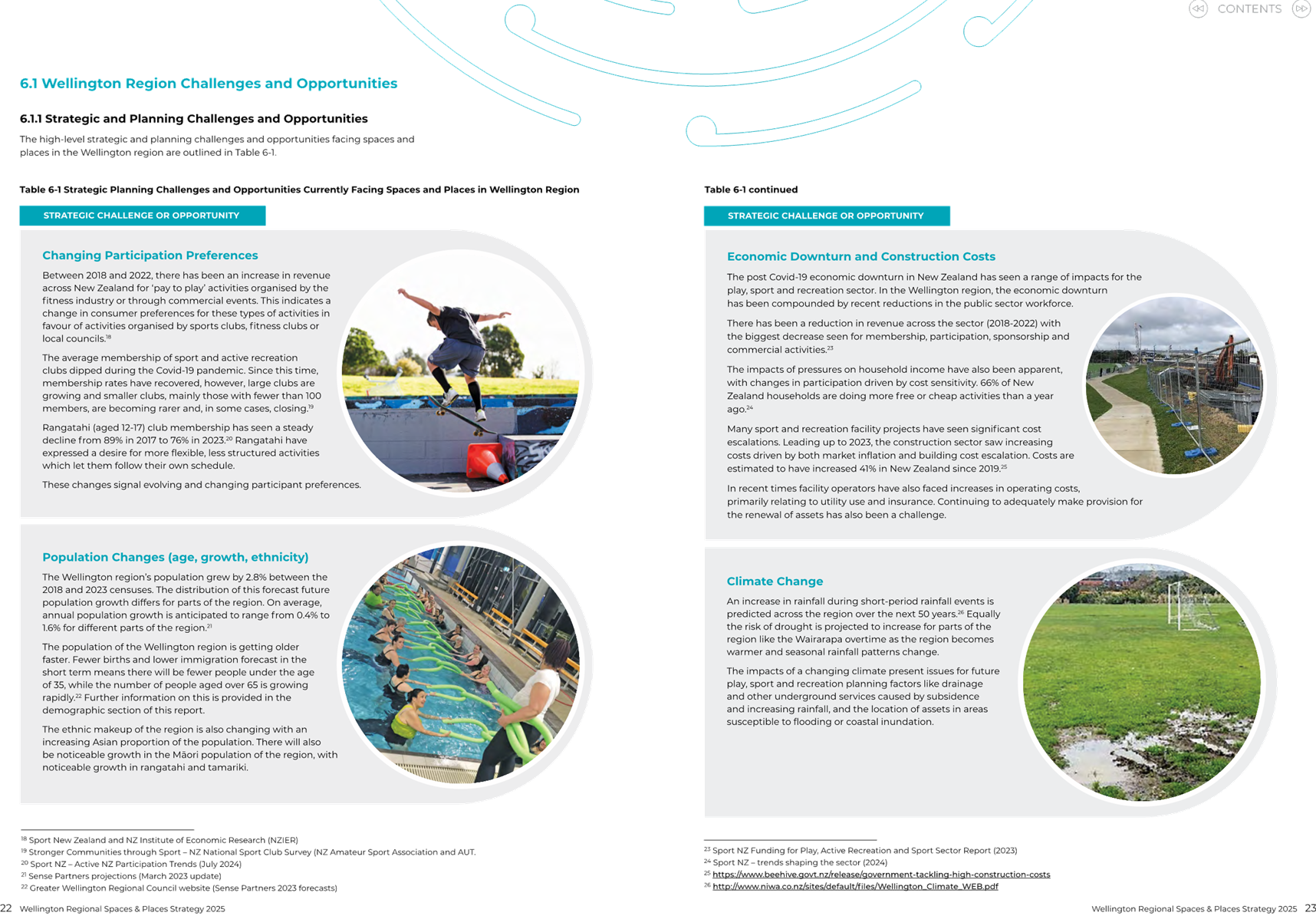
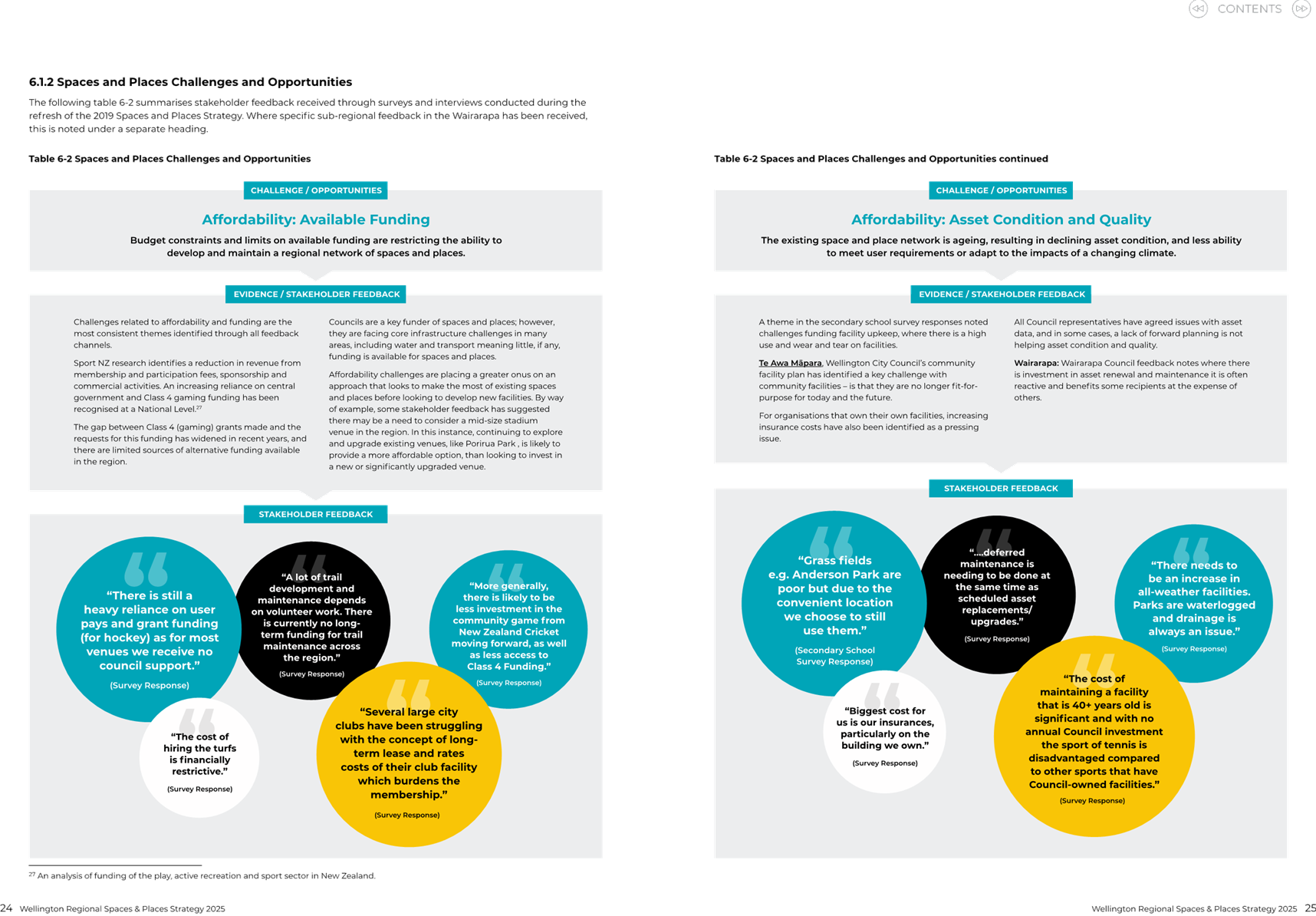
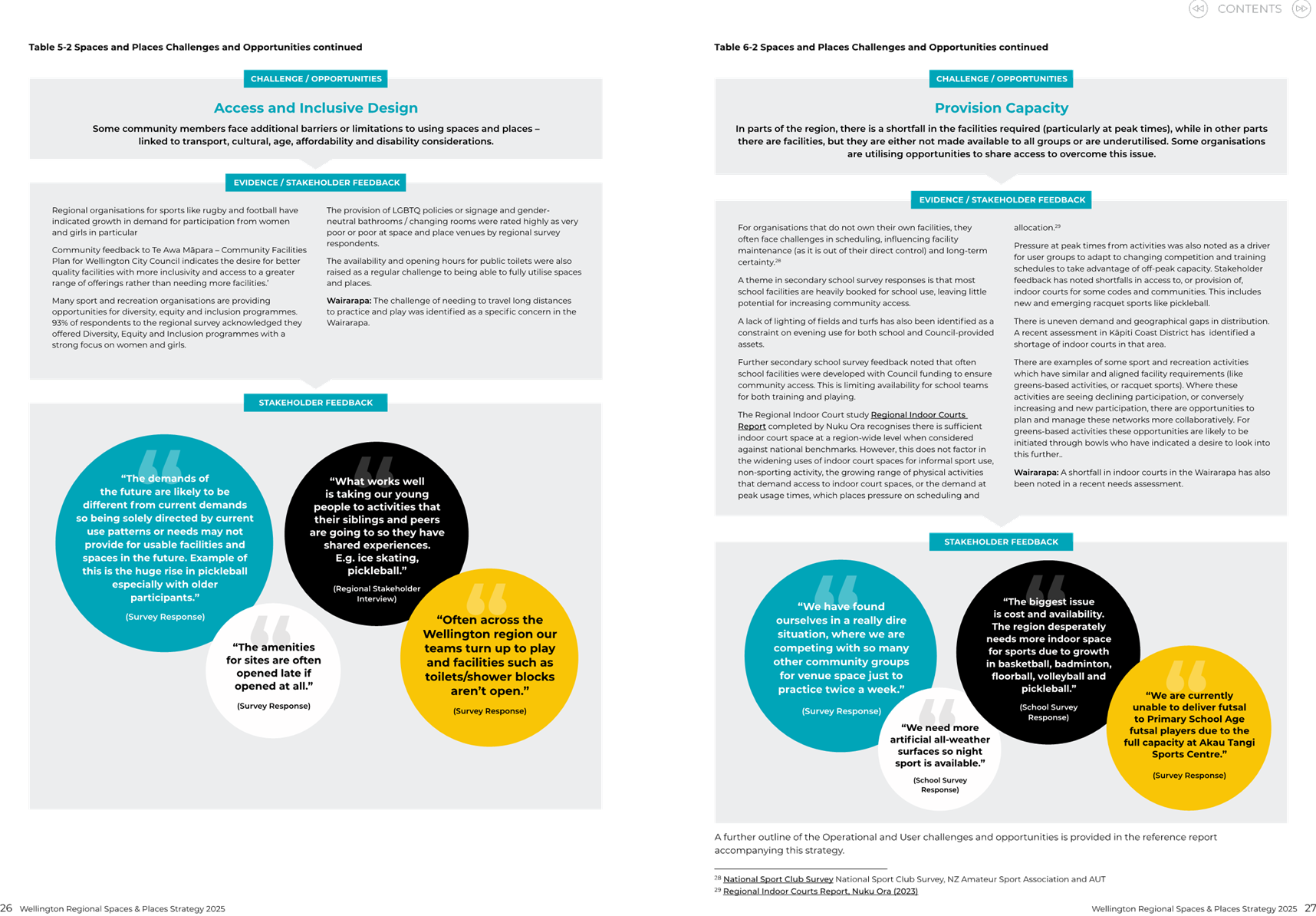
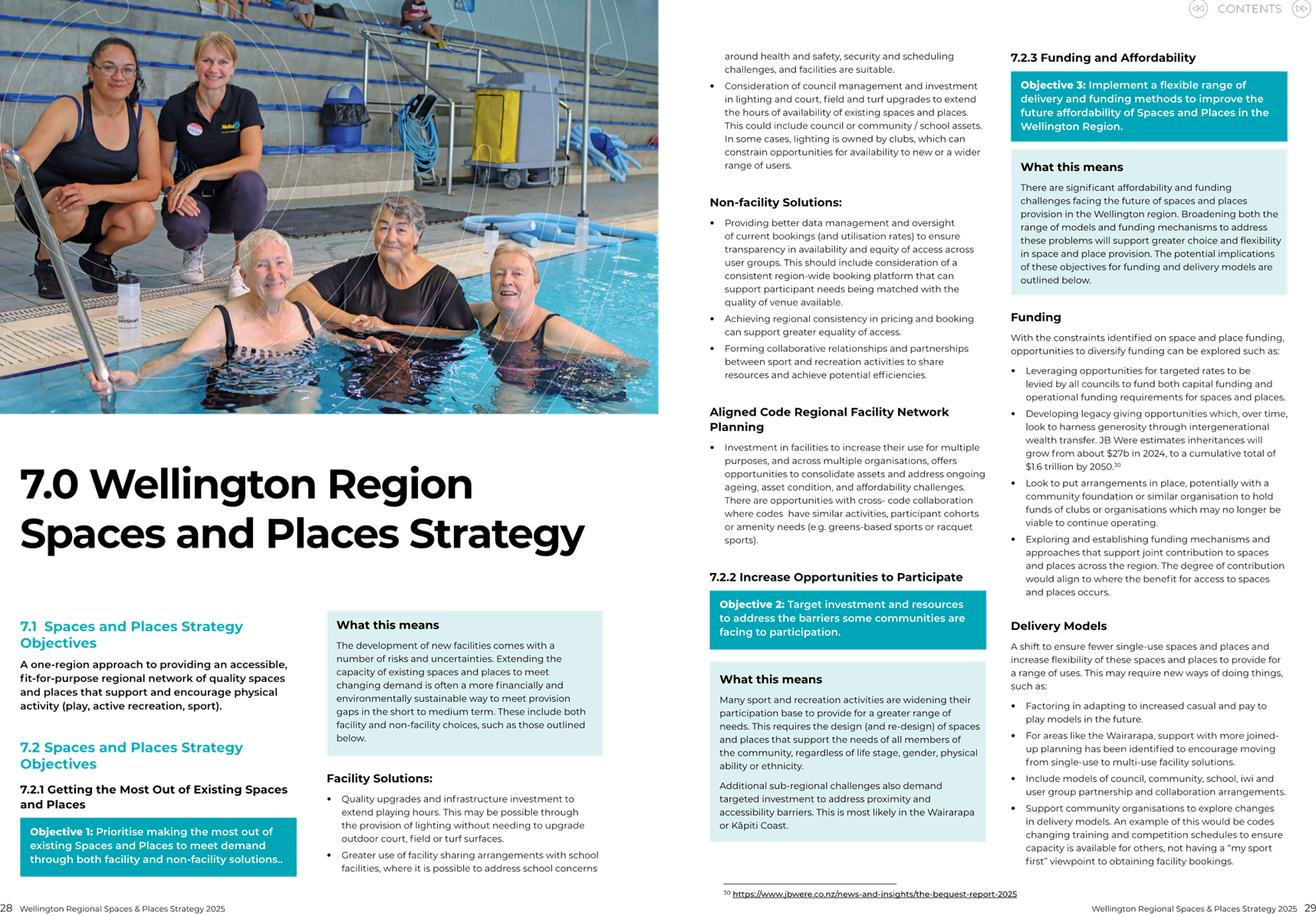
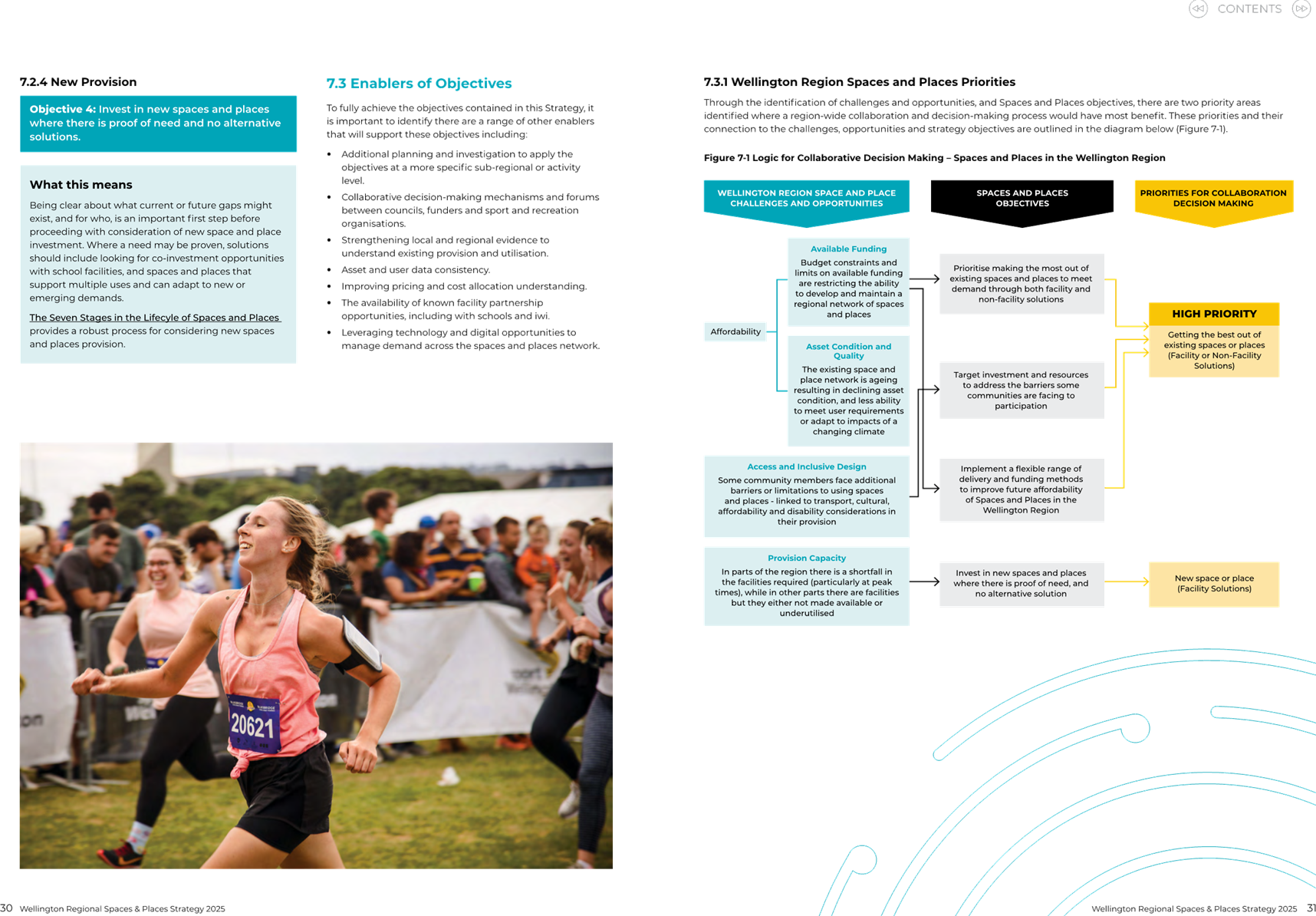
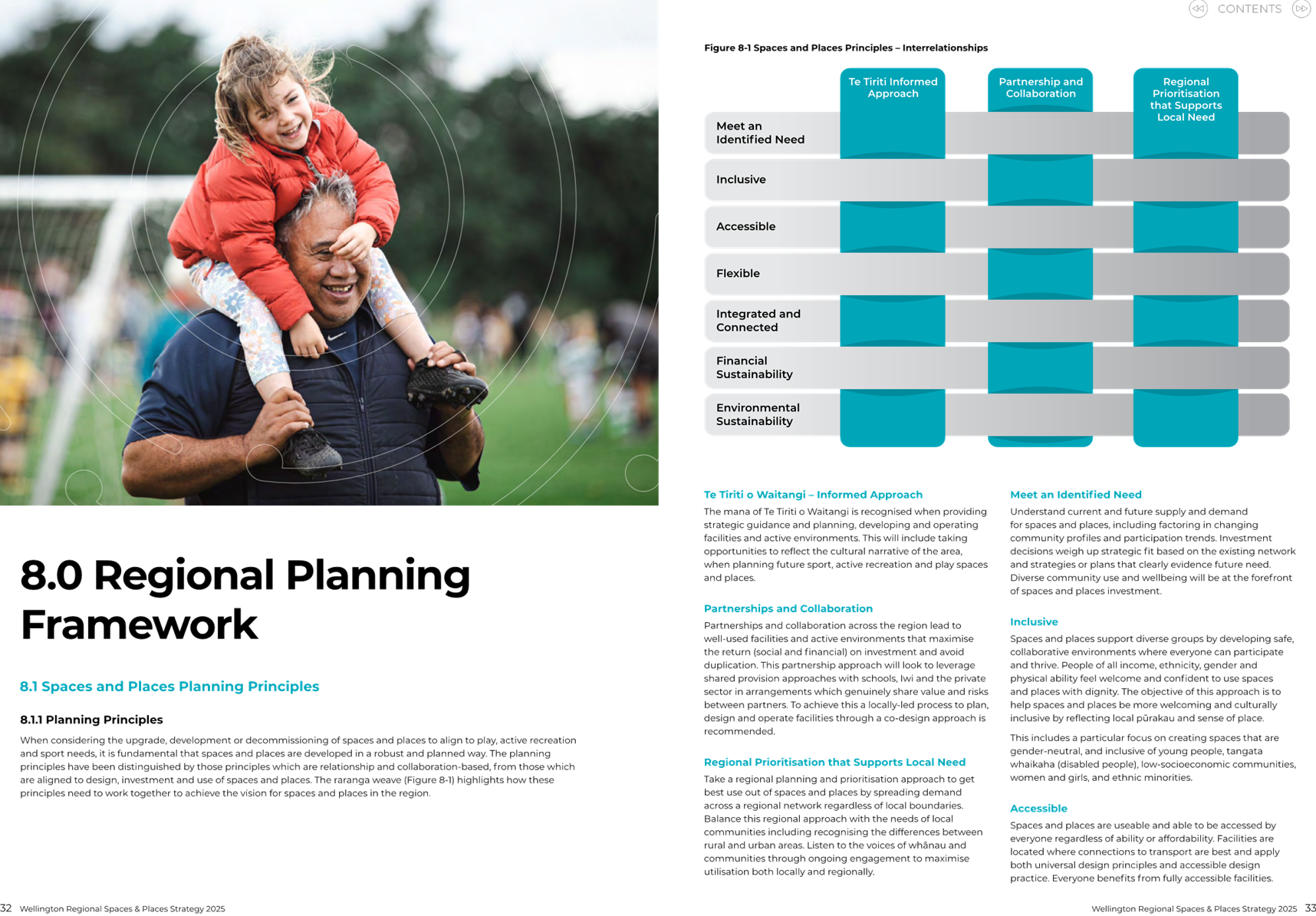
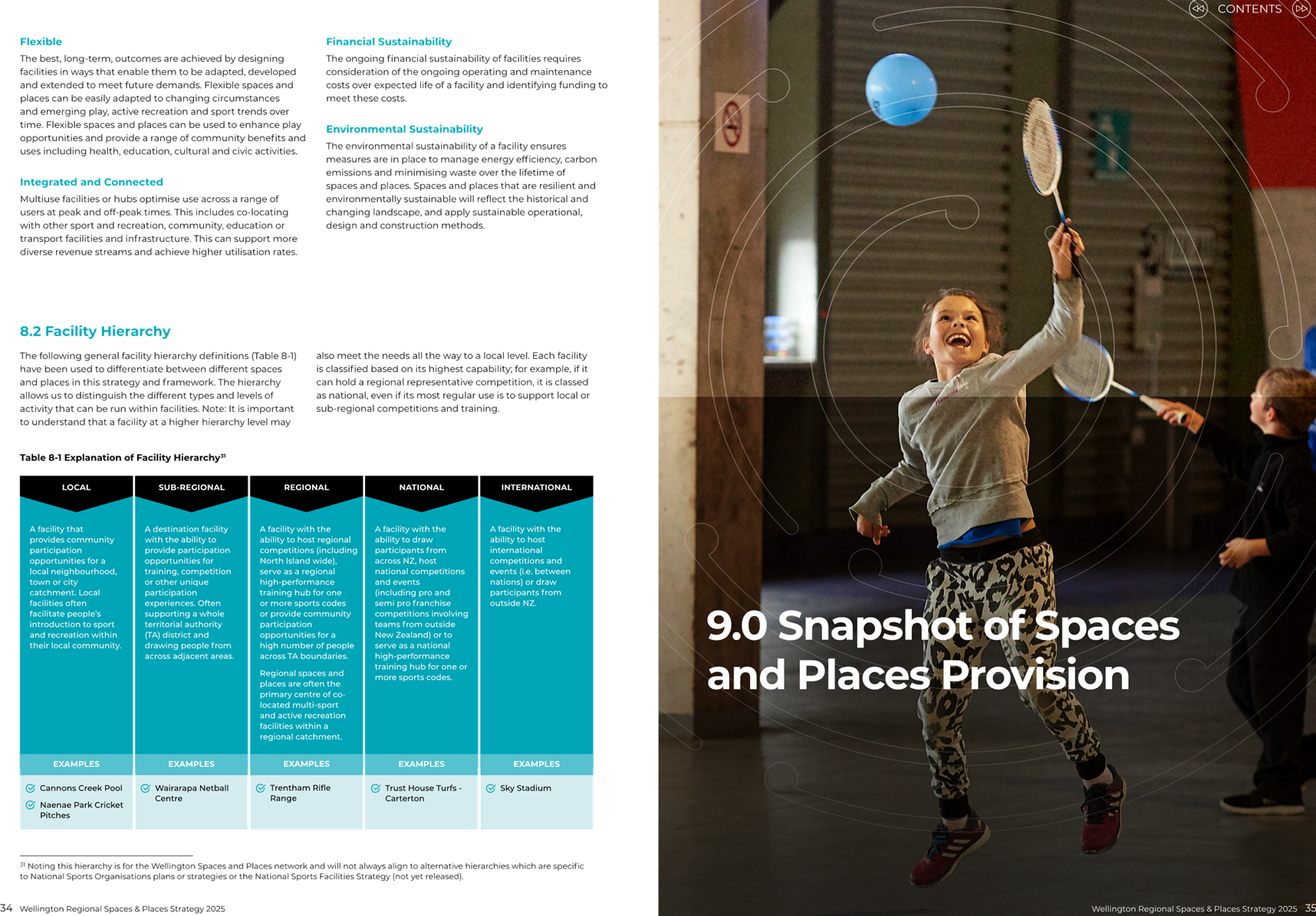
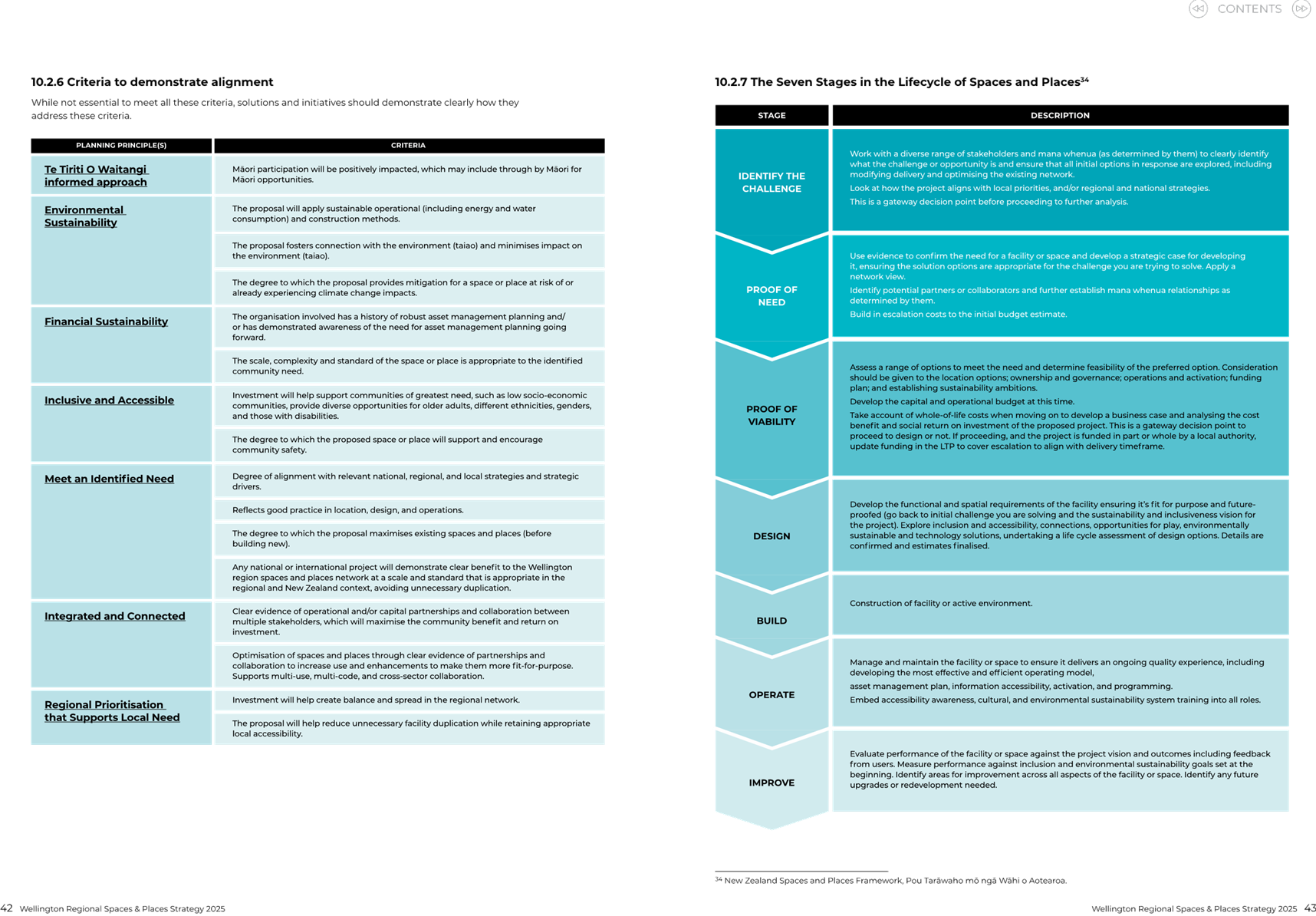
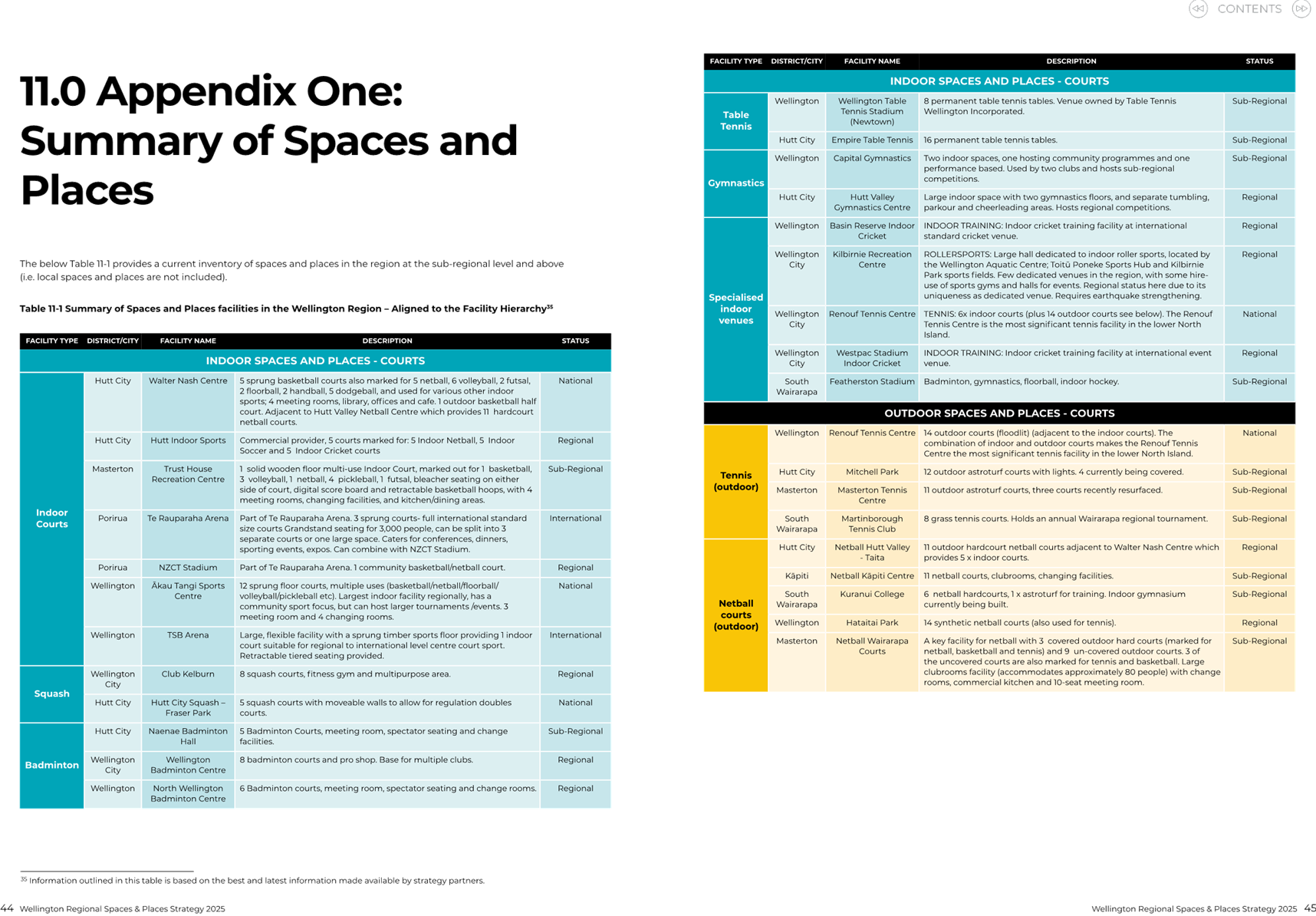
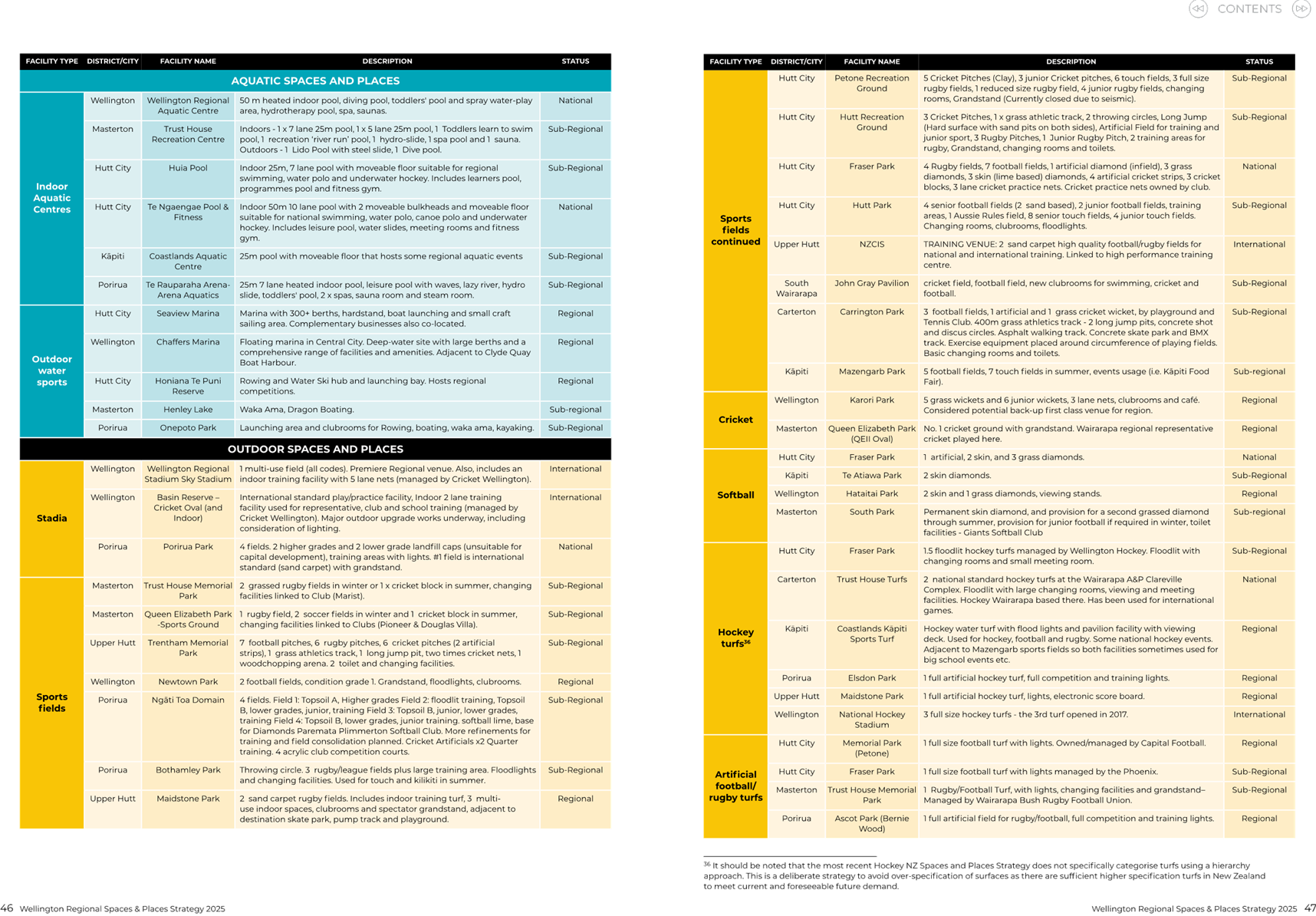
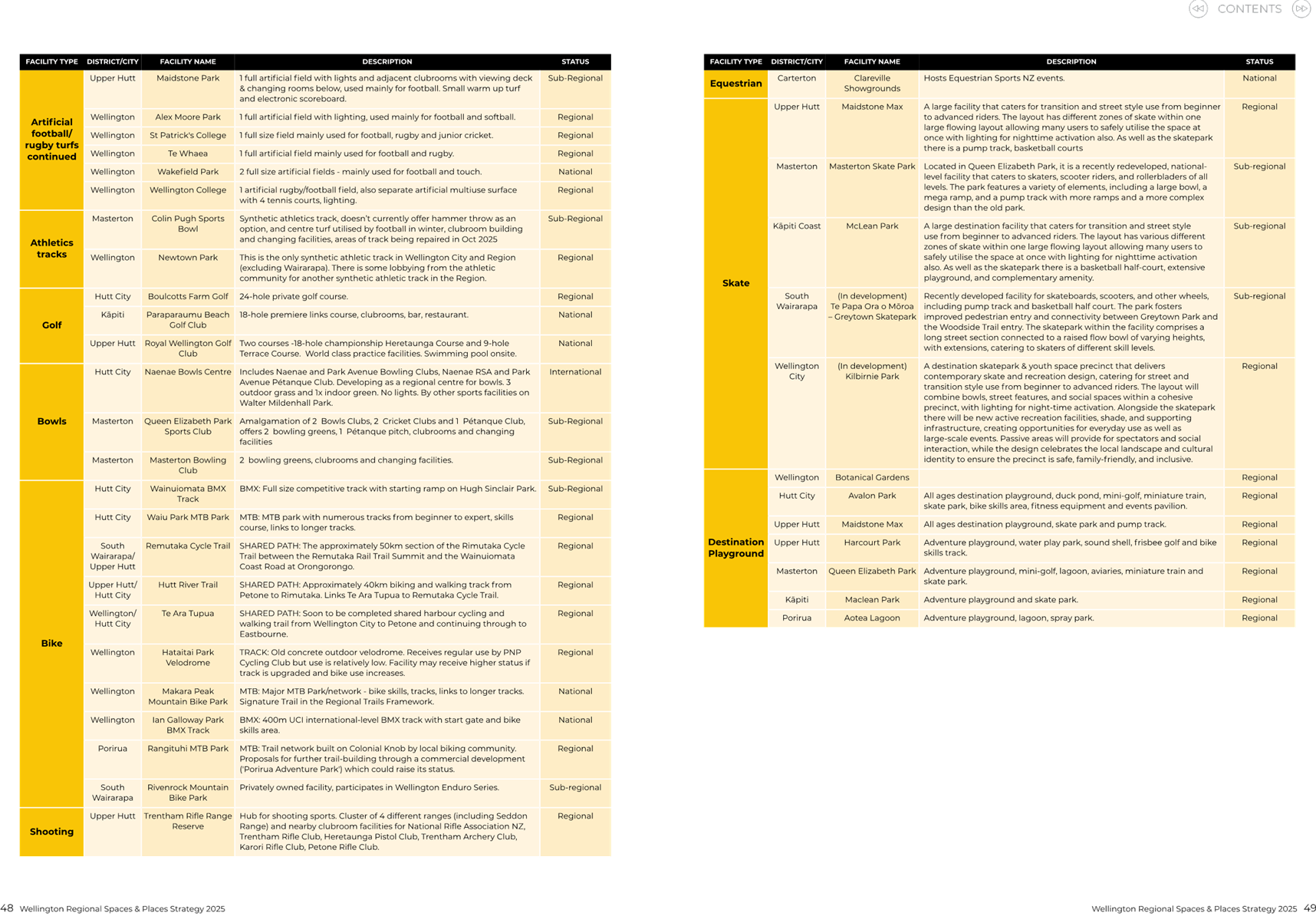
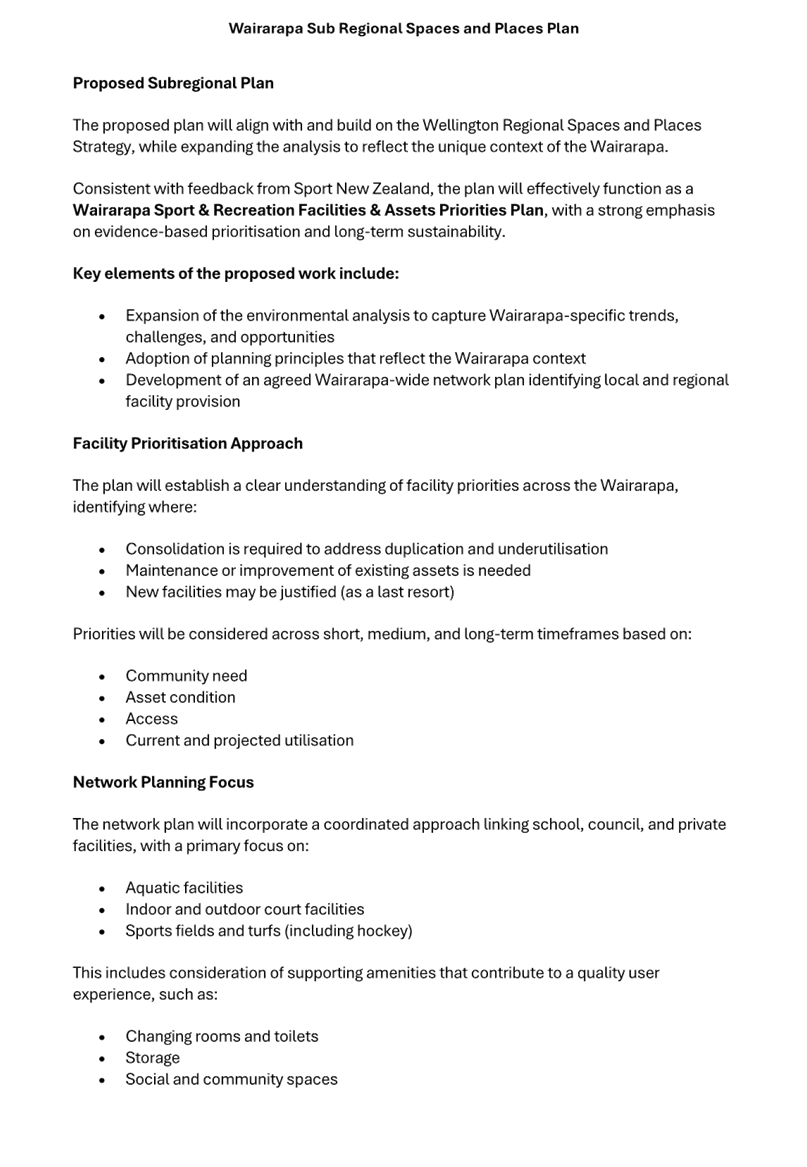
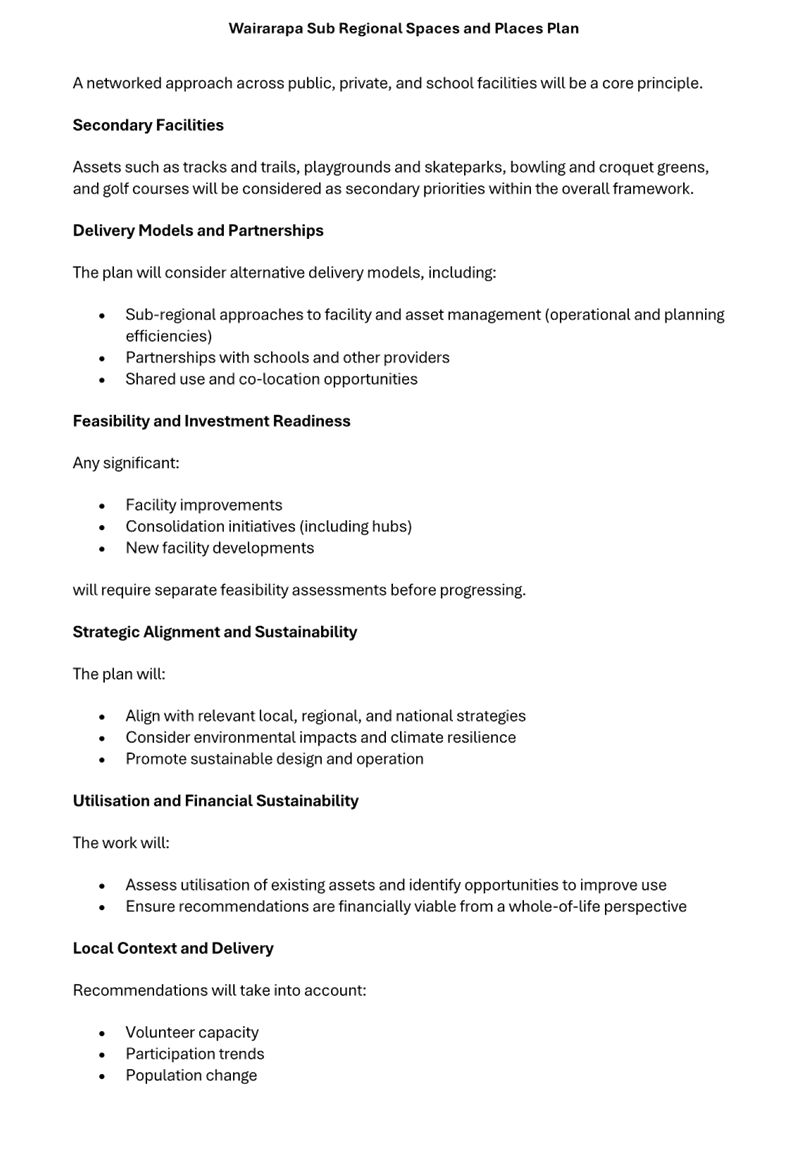
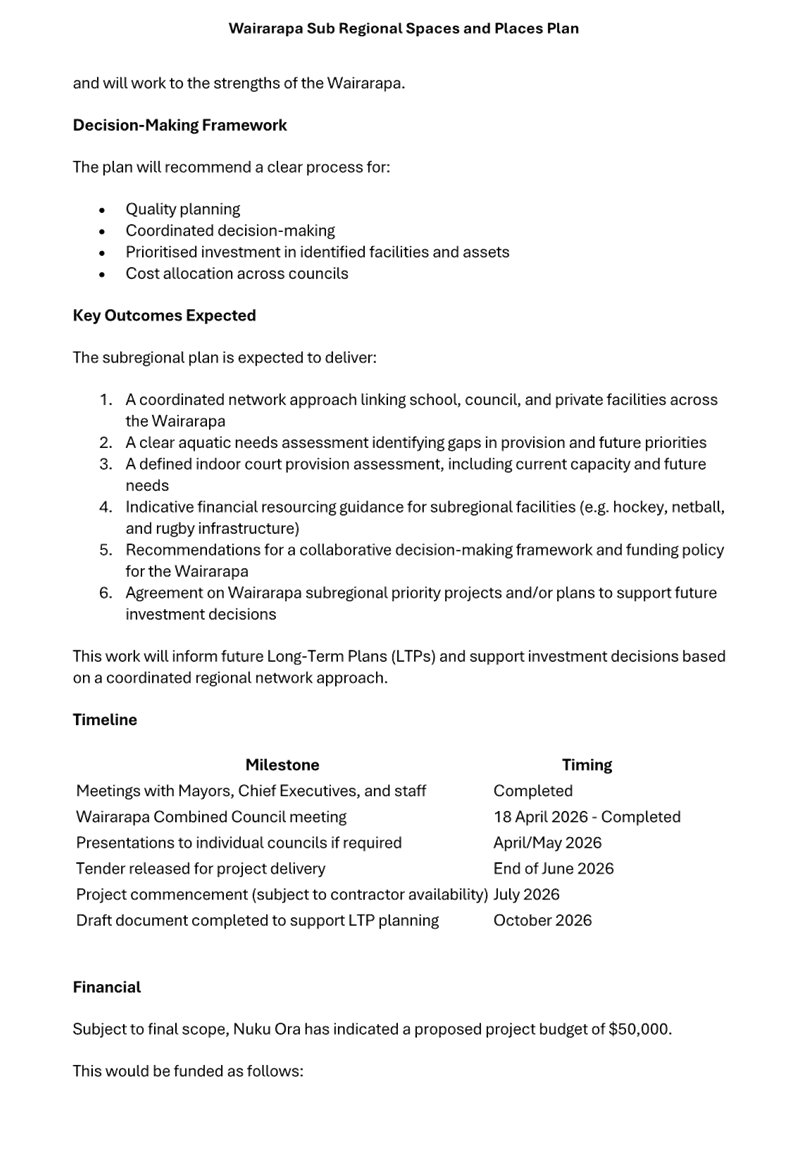
Council acknowledged the Nuku Ora Regional Spaces and Places Strategy which
plans to assess future sporting and aquatic needs across the Wairarapa region.
The strategy may influence decisions on whether to pursue a Carterton-specific
pool or a regional aquatic centre.
A
workshop will be held for Council to have an up-to-date briefing on the
project.
6 Youth
Council views on agenda items
NOTED
·
At their recent Youth Council meeting members discussed the draft
Annual Plan 26/27 (a report on the Agenda of this meeting). In their view, the
Plan is well-presented. Specific feedback was provided that consideration could
be given to improving linkages of the Annual Plan 26/27 to the Long-Term
Plan 2024-2034.
·
The Mayor acknowledged the Youth Council's input and the
importance of accommodating youth schedules and perspectives in Council
meetings and planning processes.
7 Confirmation
of the Minutes
|
7.1 Minutes
of the Ordinary Council Meeting held on 18 February 2026
|
|
MOVED
1.
That the Minutes of the Ordinary Council Meeting held on 18 February
2026 are true and correct.
Deputy
Mayor G Ayling / Cr S Laurence
CARRIED
|
8 Reports
|
8.1 Chief
Executive Report
|
|
1. Purpose
For Council to be
informed on planned Council operational activities, major projects, and other
matters of importance and interest.
|
|
MOVED
That the Council:
1. Receives
the report.
Mayor S Cretney / Cr L Newman
CARRIED
|
|
8.2 Adoption
of Economic Development Committee Terms of Reference and Draft Economic
Development Action Plan.
|
|
1. Purpose
For Council to approve the Terms of Reference for the Economic Development
Committee and the Draft Economic Development Action plan 2026 – 2027 as
the basis for the initial delivery and stakeholder engagement.
|
|
NOTED
·
Expressions
of interest will be sought for the community members on the group.
·
A key
aspect of the group will be working with the other Wairarapa councils and
partners to achieve goals.
MOVED
That the Council:
1.
Receives the report.
Mayor S
Cretney / Cr S Gallon
CARRIED
2.
Adopts the Draft Terms of Reference for the Economic
Development Committee, noting that the new Economic Development Committee
will finalise these when they meet.
Deputy
Mayor Ayling / Cr B Deller
CARRIED
3.
Approves the Draft Economic Development Action Plan as a
starting point for the next 12-month work programme.
Cr S Casey / Cr L Newman
CARRIED
4.
Agreed by consensus to use the First Past the Post system of
voting for identifying the Chair of the Economic Development Committee.
5.
Nominates Cr Simon Casey as the Chair of the Economic
Development Committee.
Cr S Casey
/ Cr S Gallon
MOTION
FAILED
6.
Nominates Cr L Newman as the Chair of the Economic
Development Committee.
Deputy
Mayor G Ayling / Cr R Round
CARRIED
For
– Cr L Newman, Deputy Mayor G Ayling, Cr B Deller, Cr R Round, Cr S
Gallon (5)
Against
– Mayor S Cretney, Cr J Burns, Cr S Laurence (3)
Abstain
– Cr S Casey (1)
7.
Nominates Cr S Laurence as the Chair of the Economic
Development Committee.
Cr L
Newman / Cr J Burns
MOTION FAILED
8.
Agrees that Cr L Newman, Cr S Laurence and Cr S Casey are the
elected member representatives on the Economic Development Committee.
Cr L
Newman / Cr S Gallon
CARRIED
9.
Delegates authority to the Economic Development Committee to
spend a budget of up to $30,000 for the year ending 30 June 2027.
Cr L
Newman / Mayor S Cretney
CARRIED
|
|
8.3 Draft
Annual Plan 2026/2027
|
|
1. Purpose
To provide the
Council with the first draft of the Annual Plan 2026/27 for review and
discussion (Attachment 1).
|
|
NOTED
·
Over the next year, Council officers will investigate potential
areas of budget improvement in the LTP 2027-37.
MOVED
That the Committee:
1. Receives
the report.
2. Notes
the Draft Annual Plan 2026/27 is forecasting an average rate
increase of 3.9%.
3. Notes
the Final Annual Plan 2026/27 is expected to be presented to Council for
consideration on 13 May 2026.
Mayor S Cretney / Cr S Gallon
CARRIED
|
|
8.4 Wairarapa
Emergency Management Capability Strategy 2025-2030
|
|
1. Purpose
For the Council to
adopt the Wairarapa Emergency Management (EM) Capability Strategy 2025-2030.
|
|
MOVED
That the Council:
1. Receives
the report.
2. Adopts
the Wairarapa Emergency Management Capability Strategy 2025-2030.
3. Notes
that South Wairarapa and Masterton District Councils will consider
the adoption of the Strategy at their next Ordinary Council Meetings.
Mayor S Cretney / Cr J Burns
CARRIED
|
|
8.5 Introduction
of the 2027-2037 Long-Term Plan Project
|
|
1. Purpose
To introduce the
project plan for the development of the Long-Term Plan 2027-37 (LTP) to the
Council.
|
|
MOVED
That the Council:
1. Receives
the report.
2. Endorses
the project plan for the development of the Long-Term Plan 2027-2037.
Cr L Newman / Cr B Deller
CARRIED
|
|
8.6 Delegation
to Carterton District Council's representative on the Stakeholder Forum of
the Wairarapa-Tararua Water Services Organisation
|
|
1. Purpose
This paper seeks
Council’s decision on delegated authority for Carterton District
Council’s appointment on the Stakeholder Forum for the new Wairarapa -
Tararua Water Services Organisation (WSO).
|
|
MOVED
That the Council:
1. Receives
the report.
2. Notes
that Carterton District Council agreed by an email vote on 3 March 2026
to extend the delegated authority to the CDC representative on the
Stakeholder Forum of the Wairarapa – Tararua Water Services
Organisation, or the alternative representative if required, to:
(a) Approve
director recruitment, appointment and removal (if required); and
(b) Approve
the remuneration of the directors of the Company.
Mayor S Cretney / Deputy Mayor G Ayling
CARRIED
|
|
8.7 Local
Government Official Information and Meetings Act Requests
|
|
1. Purpose
To inform the
Council of the number of requests under the Local Government Official
Information and Meetings Act (LGOIMA) 1987 (the Act) 2 February 2026 to 17
March 2026.
|
|
MOVED
That the Council:
1. Receives
the report.
Cr B Deller / Cr J Burns
CARRIED
|
|
8.8 Service
Requests and Complaints
|
|
1. Purpose
For the Council to
be informed on Service Requests and Complaints received 2 February 2026 to 24
March 2026.
|
|
MOVED
That the Council:
1. Receives
the report.
Cr L Newman / Cr S Casey
CARRIED
|
9 Exclusion
of the Public
Nil
10 Karakia
Whakamutunga
The meeting closed with a karakia by all members.
The Meeting closed
at 7.06 pm
Minutes confirmed:
…………………………………………………
Date:
...................................................
|
Ordinary Council Meeting Agenda
|
13 May 2026
|
8 Reports

8.1 Waitī
Waters Establishment Update
1. Purpose
This report is an
information update for the Council on the Waitī Waters establishment and
transition programme.
2. Significance
The
matters for decision in this report are not considered to be of significance
under the Significance and Engagement Policy.
3. Executive
Summary
This is part of a
regular series of updates for the Council on the Waitī Waters
establishment and transition programme. It updates the Council on progress made
since the last update in February 2026.
The establishment
programme reached a major milestone on 17 April, with the completion of the
stand up of the governance of the new company, and announcement of the Board
members and company name, Waitī Waters. Following the launch,
Waitī Waters has now been incorporated and Shareholders’ Agreement
signed. This completes stage 1 of the programme.
Board induction has
been completed, and the Board has had their first two meetings and made several
critical decisions to keep the next stage of the programme on track.
Substantial work is
underway in all six programme workstreams and this report provides an update on
activity in each workstream.
4. Background
Following the
Government’s approval of the four Councils’ Water Service Deliver
Plans (WSDPs) in October last year, the transition programme for Waitī
Waters was established.
Regular updates are
set up for each Council over the course of the programme to ensure all elected
members are kept up to date with progress.
There are two major
stages to the establishment of the new company:
Stage 1 –
legal establishment (September 2025 to March 2026): This stage of the
programme is focused on the establishment of company governance structures,
preparation for Board member arrival and company incorporation.
Stage 2 –
operational transition (April 2026 to June 2027): This stage of the
programme is focused on detailed design and set up of the new organisation and
transition of Council services, assets, debt, staff and operations prior to go
live. It will be complete by 30 June 2027.
The Programme has been
set up in six key workstreams to support delivery:
· Governance,
regulatory and partnerships
· Organisation,
people and change
· Finance and
commercial
· Digital and
systems
· Service delivery
and operations
· Communications and
customer.
Discussion
Stage 1 delivery
progress
Delivery of Stage 1 of
the programme has been successfully completed, with the completion of the stand
up of the governance of the new company, and announcement of the new Board
members and company name. The Shareholders’ Agreement and Partnering Agreement
between Councils and iwi have been signed enabling company incorporation.
Board induction has
been completed, and the Board has been received briefings and advice on key
areas of the programme where early decisions are necessary to keep the
programme on track.
Programme
workstream updates
Following is a summary
of key progress updates in each workstream as at mid-May 2026.
Governance,
Regulatory and Partnerships
· The Waitī
Waters five-member board is in place. Across the group they bring
high-calibre governance experience across infrastructure, public and private
sectors, balance sheet and commercial management, strong connections with the
region’s communities and iwi, and deep understanding of water services
and infrastructure operations. Board member bios are available here Director Profiles | Waiti Waters for the
Council’s information.
· The Board
programme of meetings for the year ahead is set and the Board will move around
the region’s four districts for its monthly meetings, to enable the Board
to visit key sites, and meet staff and stakeholders. To date they have met in
Carterton and Martinborough (including visiting key water assets in each
location).
· The Board Chair
has had initial meetings with Mayors and Chief Executives at Carterton, Tararua
and South Wairarapa to understand the issues in each district (with Masterton
scheduled for June) and has regular meetings scheduled with the Chair of the
Stakeholders’ Forum.
· The Stakeholder
Forum is well advanced in the development of the Statement of Expectations. The
Statement will be developed between April and July, according to the process
below, and the Council will be briefed on the draft in late June:
· April –
Stakeholder Forum begins the process to develop the Statement
· May –
Stakeholder Forum to consider two drafts of the document and issue draft to the
Board by the end of May
· June –
Stakeholder Forum and Board meet to discuss the draft, and the Board provides
written feedback. Councils will be briefed on the work-in-progress draft
at this point
· July –
Stakeholder Forum approves the final statement and recommends its adoption to
shareholding Councils
· July/early August
– four Council meetings to adopt final Statement and issue to Board.
Organisation, People and Change
· Major components
of work are underway in this workstream, and the Board has taken several
significant early decisions to keep the programme on track. Key areas of
current work include:
· The Board has
approved the role description for the Chief Executive in April, and the search
process is underway. Applications close at the end of May and an appointment is
expected to be made by end of July. Depending on notice periods, the successful
candidate is expected to be in role by September or early October.
· Guidelines for
staff transfer have been developed and approved by the Board in April. These
guidelines provide four pathways for staff to move into roles at Waitī
Waters and aim to provide as much certainty as possible to Council staff about
the transition and how it will affect them. The guidelines were released to
staff on 6 May, and the programme team and HR leads at each Council have run
staff briefings on the guidelines to provide staff with the opportunity to ask
any questions. These are now available for staff to review and provide
feedback on by 20 May.
· Requirements have
been developed for the company office location, which have been approved by the
Board in May, and the search is underway for a suitable location.
Finance and
Commercial
· Major components
of work are underway in this workstream, and the Board has taken several
significant early decisions to keep the programme on track. Key areas of
current work include:
· The Board has
agreed on two approaches to explore further to the transfer of debt from
Councils to Waitī Waters. Discussions with the LGFA are occurring as part
of this work and we are seeking an option that enables straightforward and
efficient execution of the transfer and provides necessary flexibility for
Councils with respect to the management of their existing debt portfolios
(i.e., avoiding costs to unwind or break arrangements).
· The Board has
initiated the process of joining the LGFA in May and anticipate that Waitī
Waters will have completed this process by September 2026.
· Determination of
the approach to pricing, in particular developing the detailed approach to
implementing cost-to-serve pricing and determining how to transition from the
many different pricing structures in the four Councils to a common basis or
structure of pricing.
Digital and
Systems
· The
Board has been briefed on options for the digital transition, which could
include some of reuse of existing Council systems, reconfiguration of new
instances of existing Council systems, and going to market for new systems in
some cases. We are also exploring the opportunities of sharing systems
with other water transitions ahead of further Board consideration of the
preferred approach in June.
· Key
areas of preparatory work are underway, which include:
· Gathering
detailed requirements that systems will need to meet (e.g., for finance,
billing and HR systems) to support procurement and engagement with vendors
· Developing
procurement documentation to be ready to go to market for those systems (if
any) where the Board decides a new system is the most appropriate solution
· Implementation
of core corporate technology set up
· Exploratory
work on the options for operational technology (e.g. SCADA systems).
Operations,
Service Delivery and Risk
· This workstream is
working closely with the organisational workstream to develop the service
delivery models for the new organisation. Once the service delivery model is
agreed (along with the approach to staff transfer (above)), this enables
detailed work on the organisational structure and roles to begin.
· An important early
deliverable in this workstream is a combined approach to asset management and a
combined (regional) capital investment programme. This was a priority piece of
work identified by DIA in their assessment of our Water Services Delivery Plans.
We have contracted AECOM to carry out this work, which will be completed by
September.
· We are beginning
the work on the delivery model for stormwater services, which will require
close collaboration between Councils and Waitī Waters. While
transfer of stormwater to Waitī Waters will involve the transfer of urban
stormwater assets, legal ownership and control of other parts of the stormwater
infrastructure (e.g., roading related infrastructure) is required to remain
with the roading manager. This will mean Councils and Waitī Waters
will need to put in place relationship or service level agreements to clarify
who does what.
· Due diligence work
is also underway on Councils’ contracts, resource consents, assets, and
property as the first step in the development of Councils’ Transfer
Agreements.
Communications
and customer
· This workstream
completed a successful launch of Waitī Waters in April, along with the
development of the Waitī Waters website, name and brand. This marked
the completion of stage one of the programme and planning is now underway for a
programme of customer, community and stakeholder communications for stage two
of the programme to ensure customers and the community are ready for
operational transition next year.
· Development of
advice on the customer strategy for day one is underway – this work will
determine the key aspects of the customer experience that must be in place for
day one to ensure customers have confidence in the company, understand how to
make contact, pay bills, lodge jobs and make complaints.
5. Recommendation
That the Council:
1. Receives
the report.
File
Number: 520910
Author: Katherine
Meerman, Programme Director, Waitī Waters Establishment
Attachments: Nil
|
Ordinary
Council Meeting Agenda
|
13
May 2026
|

8.2 Destination
Wairarapa Quarterly Report
1. Purpose
For Council to receive
a report of activities for the quarter ending March 2026.
2. Significance
The
matters for decision in this report are not considered to be of significance
under the Significance and Engagement Policy.
3. Background
The
three Wairarapa Territorial Authorities collectively invest in Destination
Wairarapa as the Regional Tourism Organisation.
4. Discussion
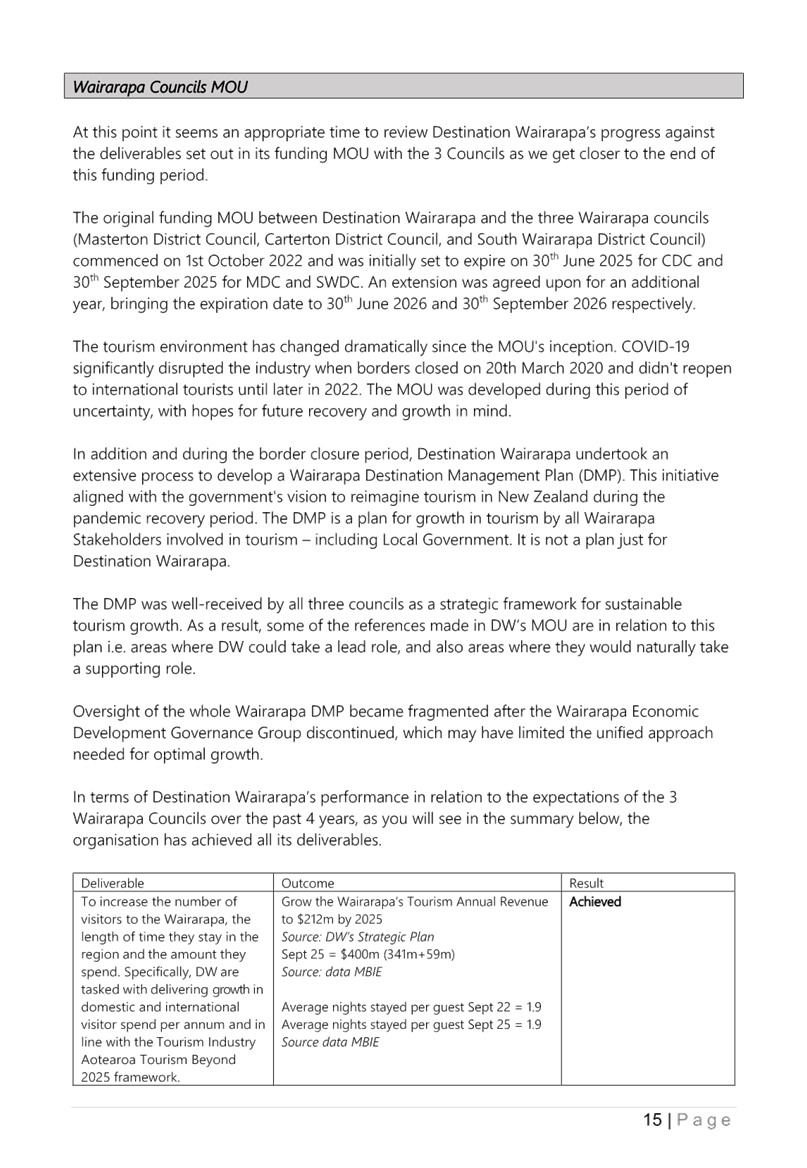
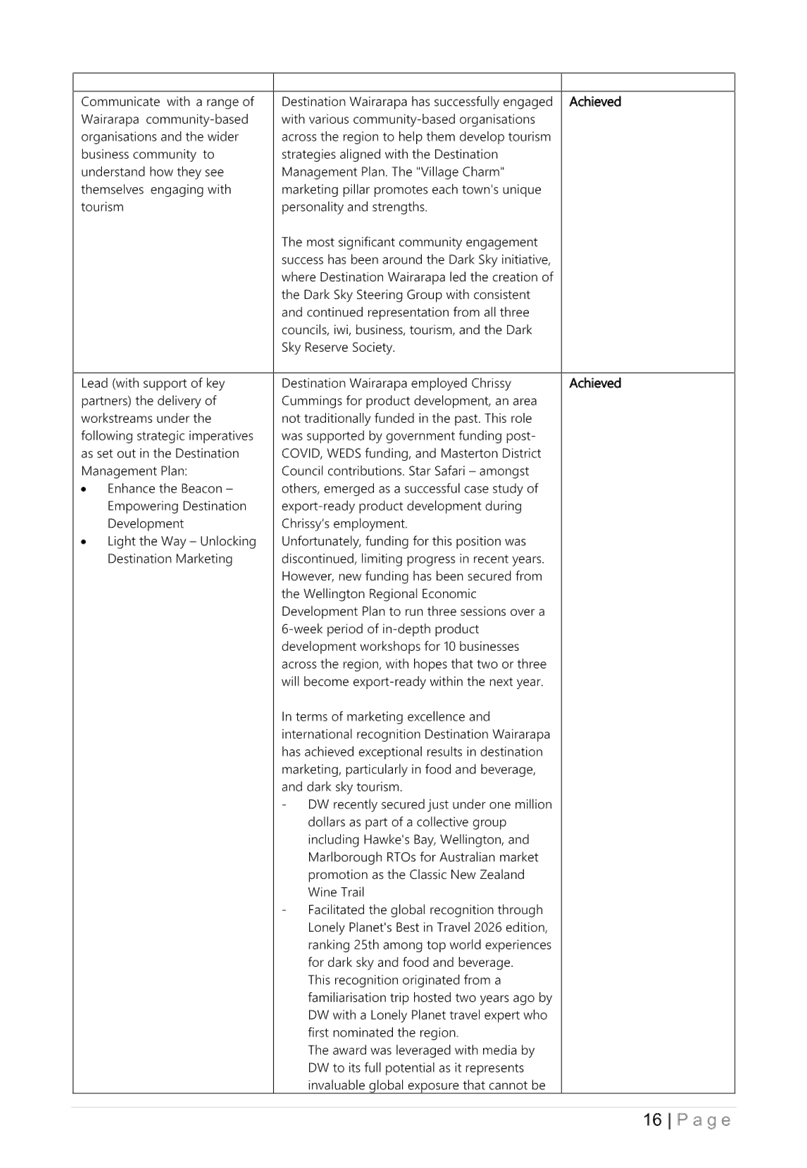
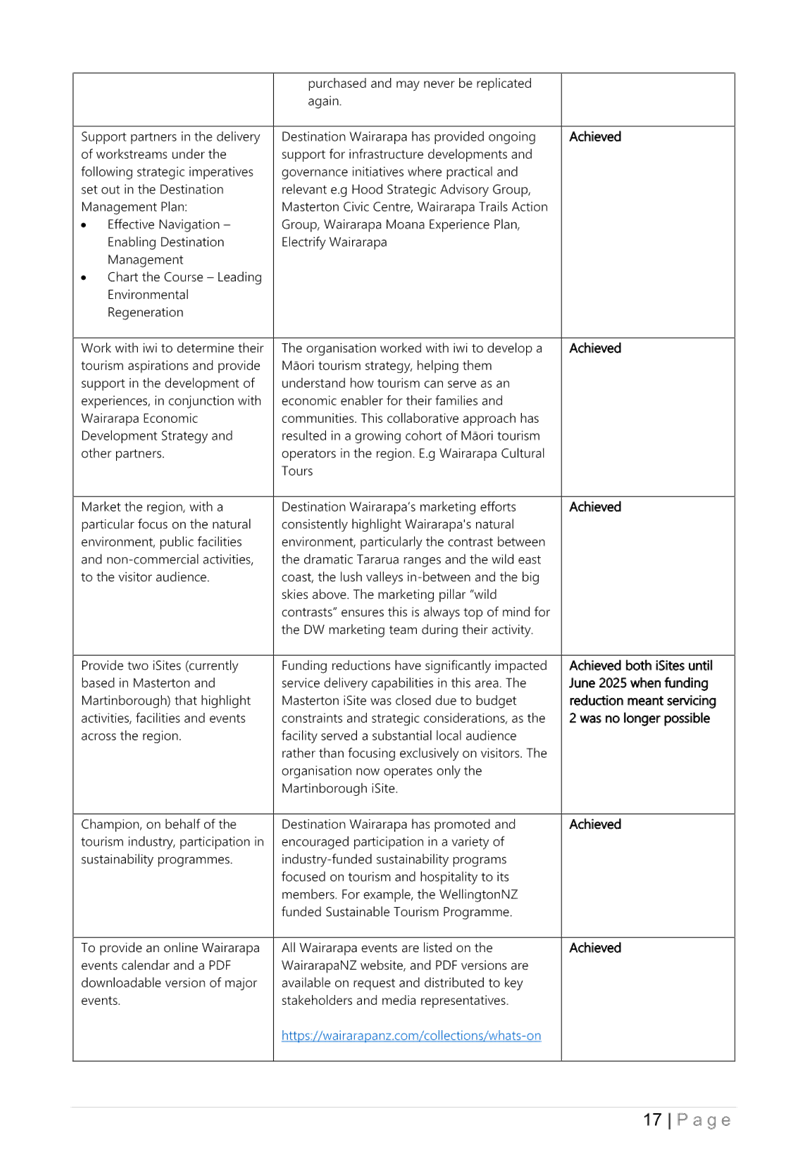
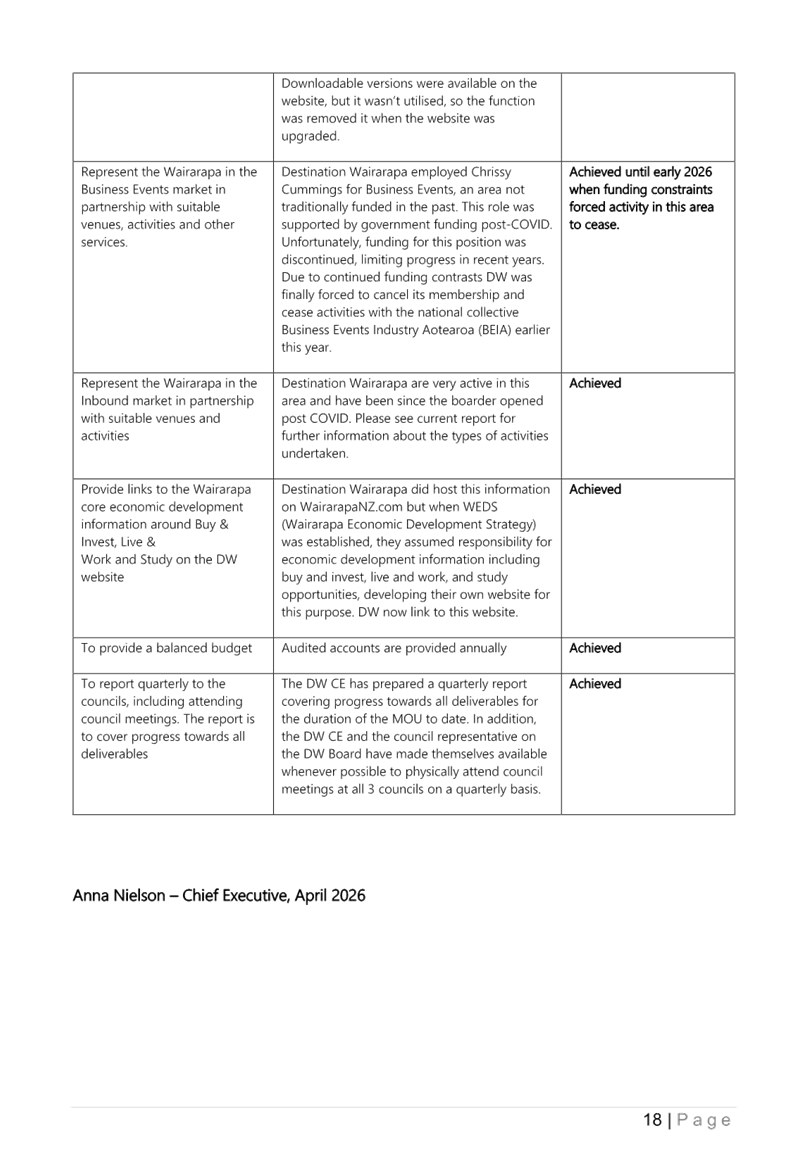
Attached
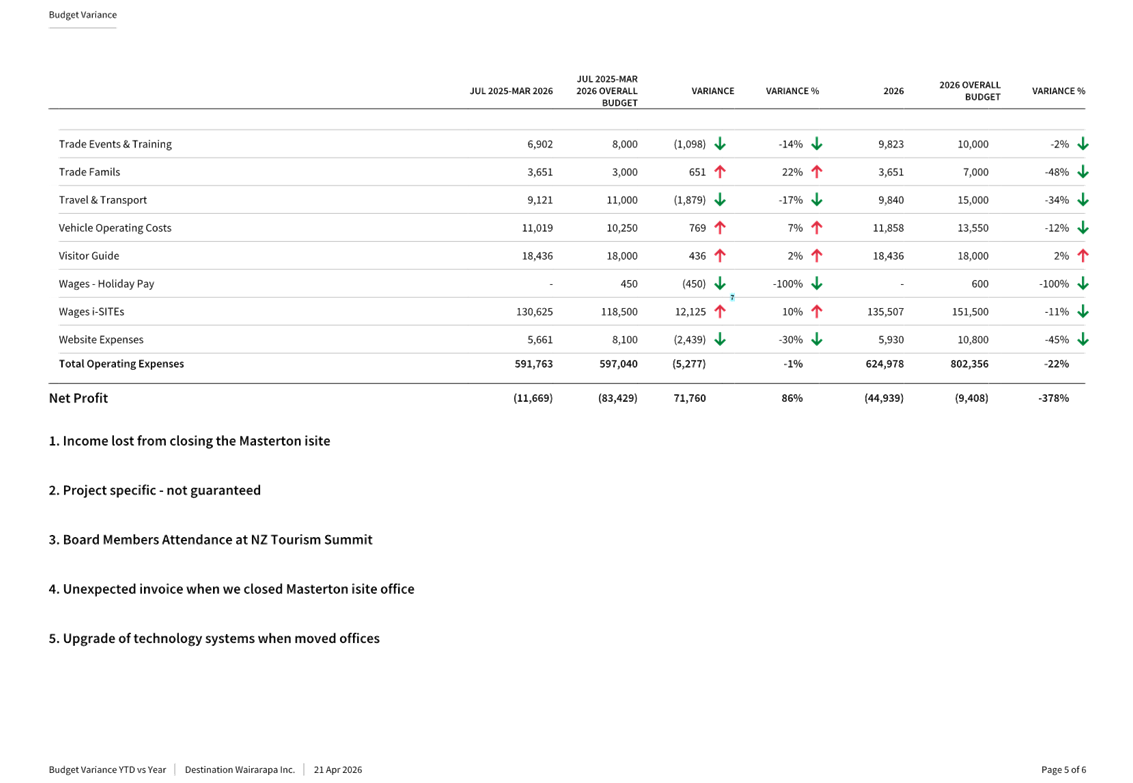
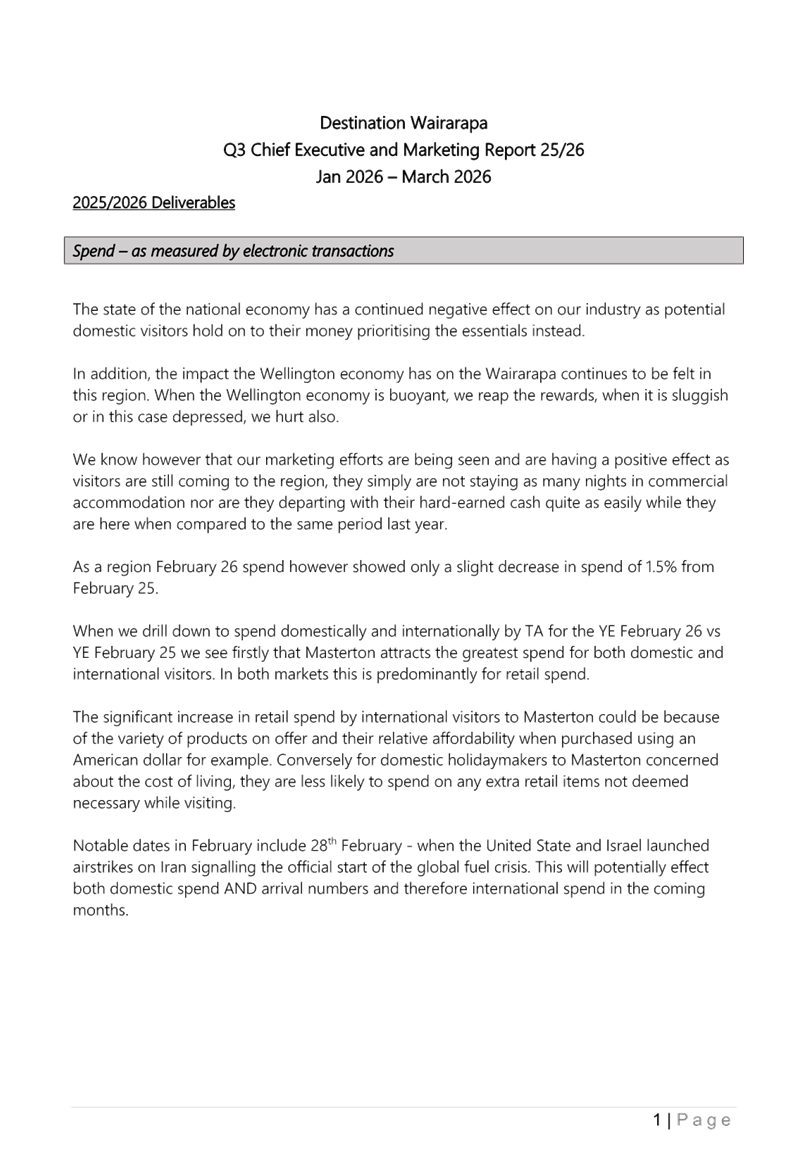
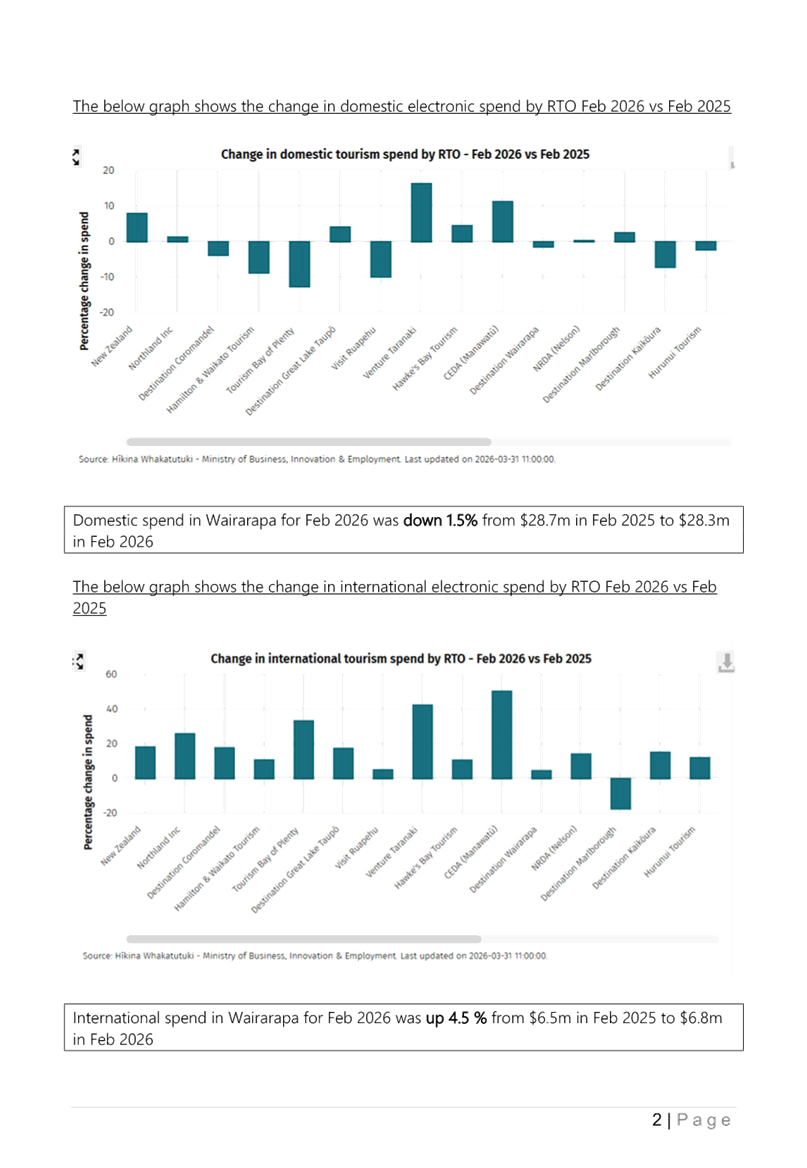
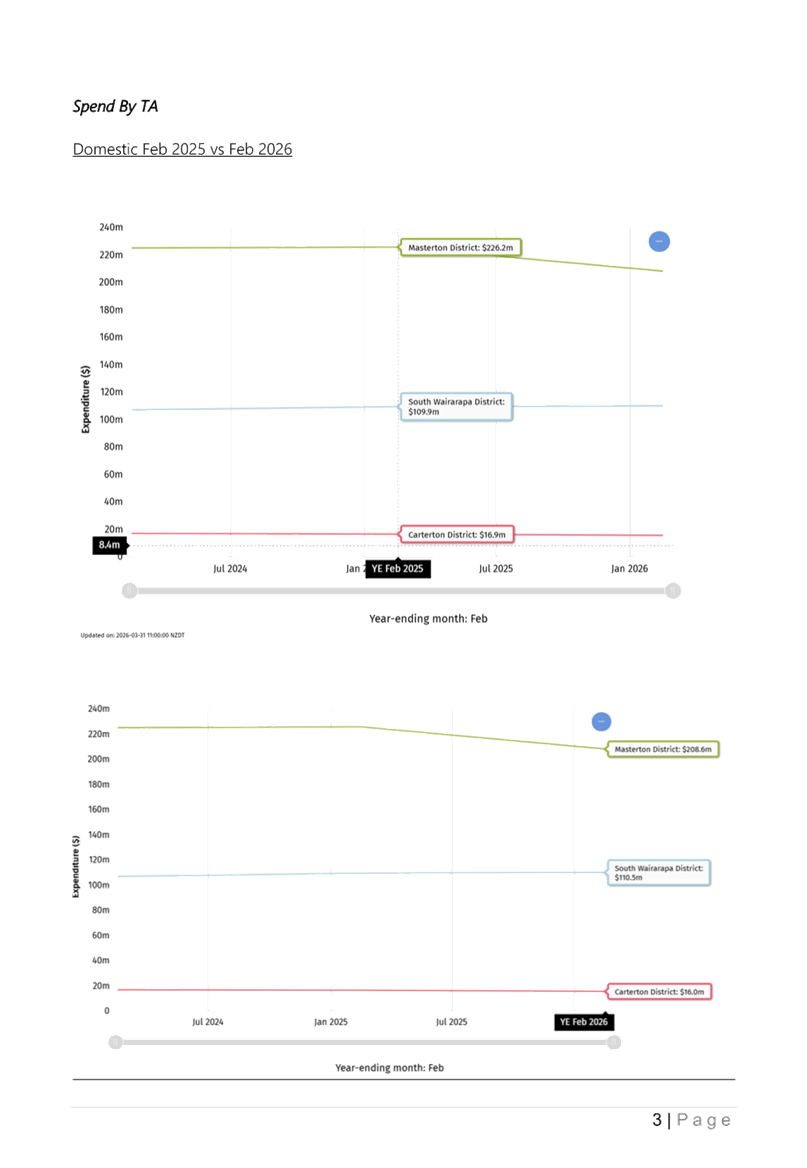
to this report are the following documents:
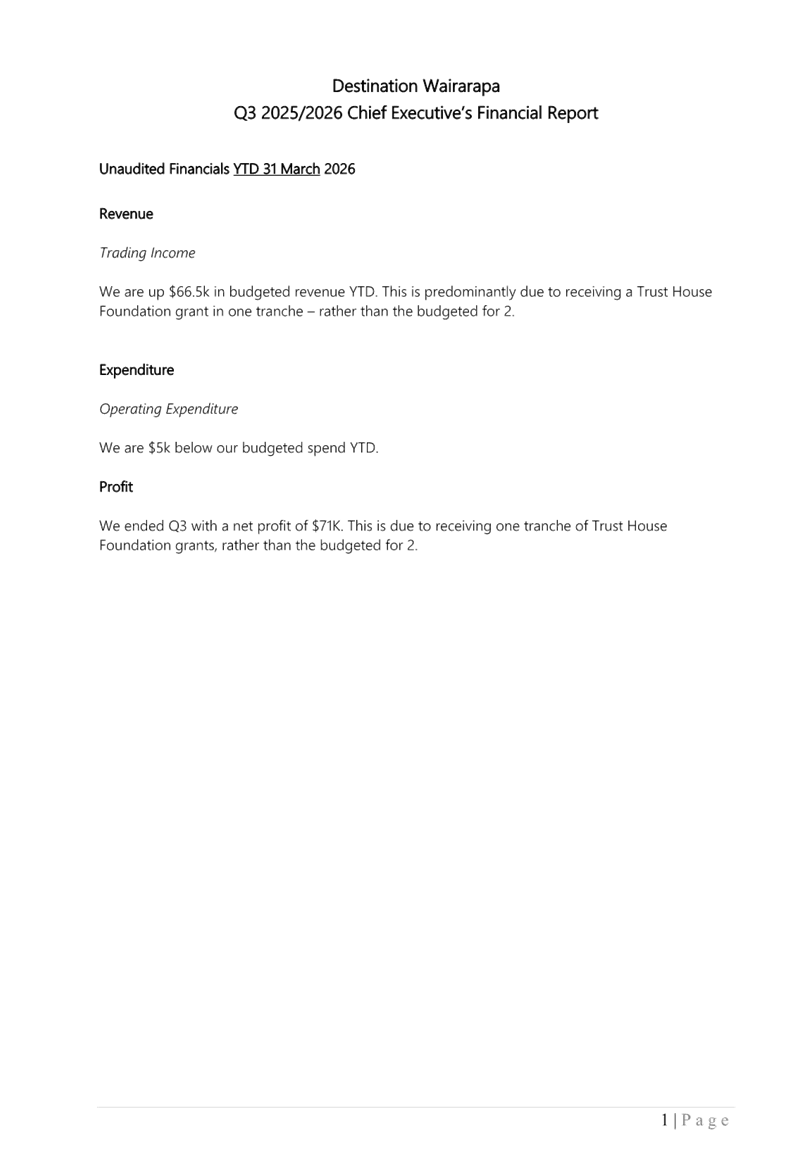
· The Financial Report for Destination Wairarapa is included as
Attachment 1
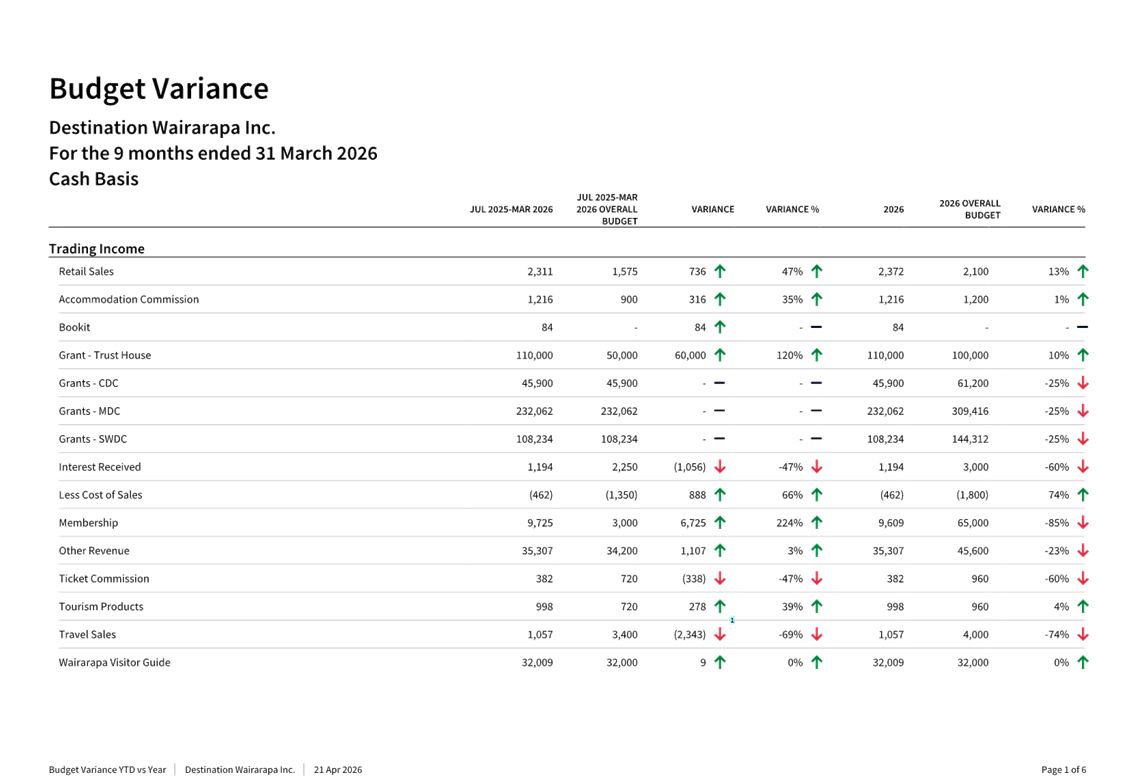
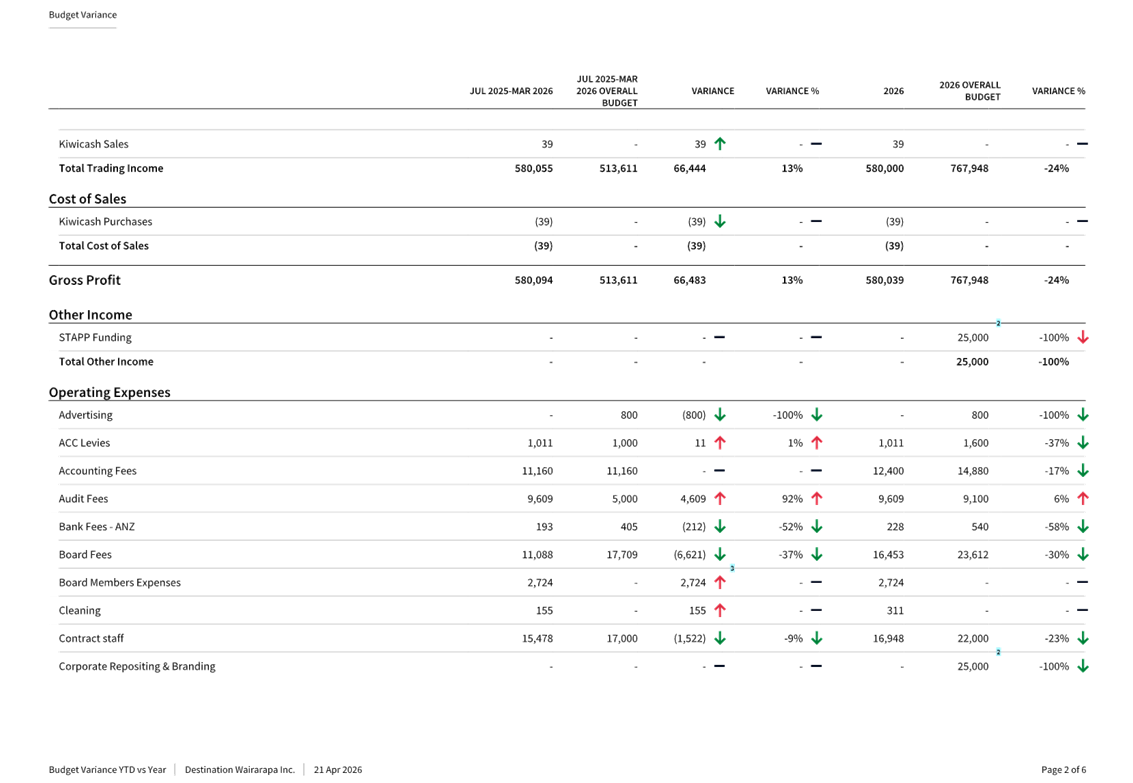
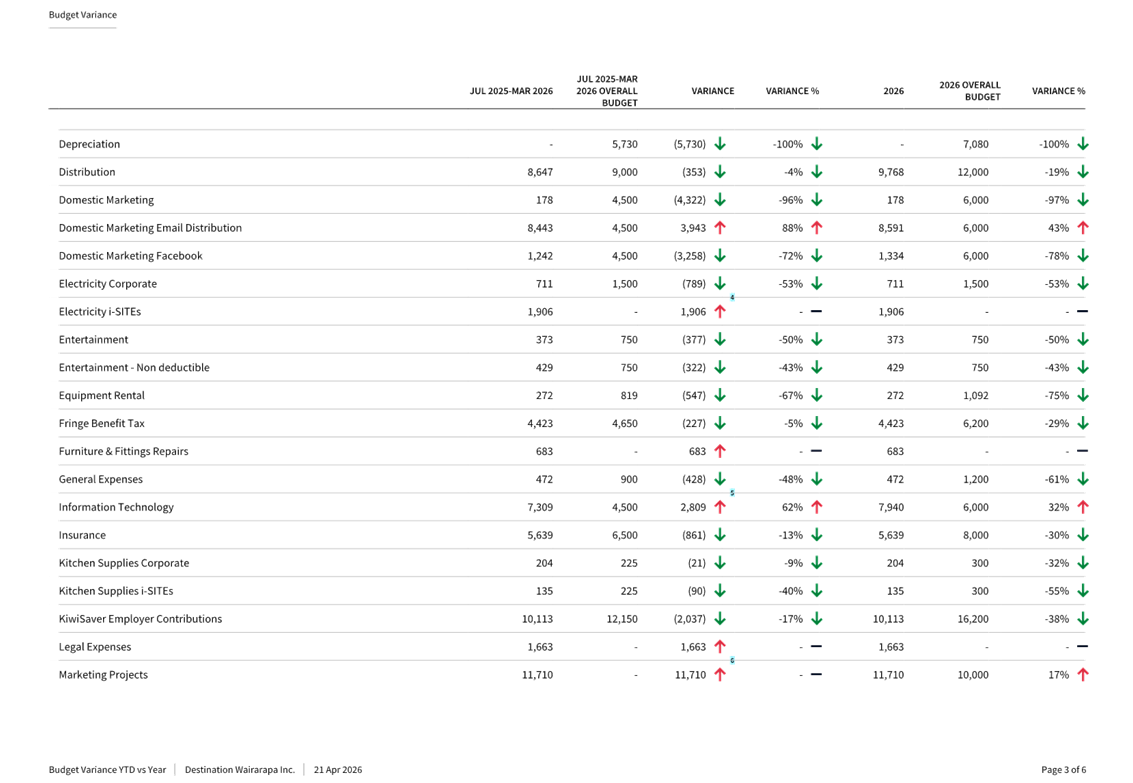
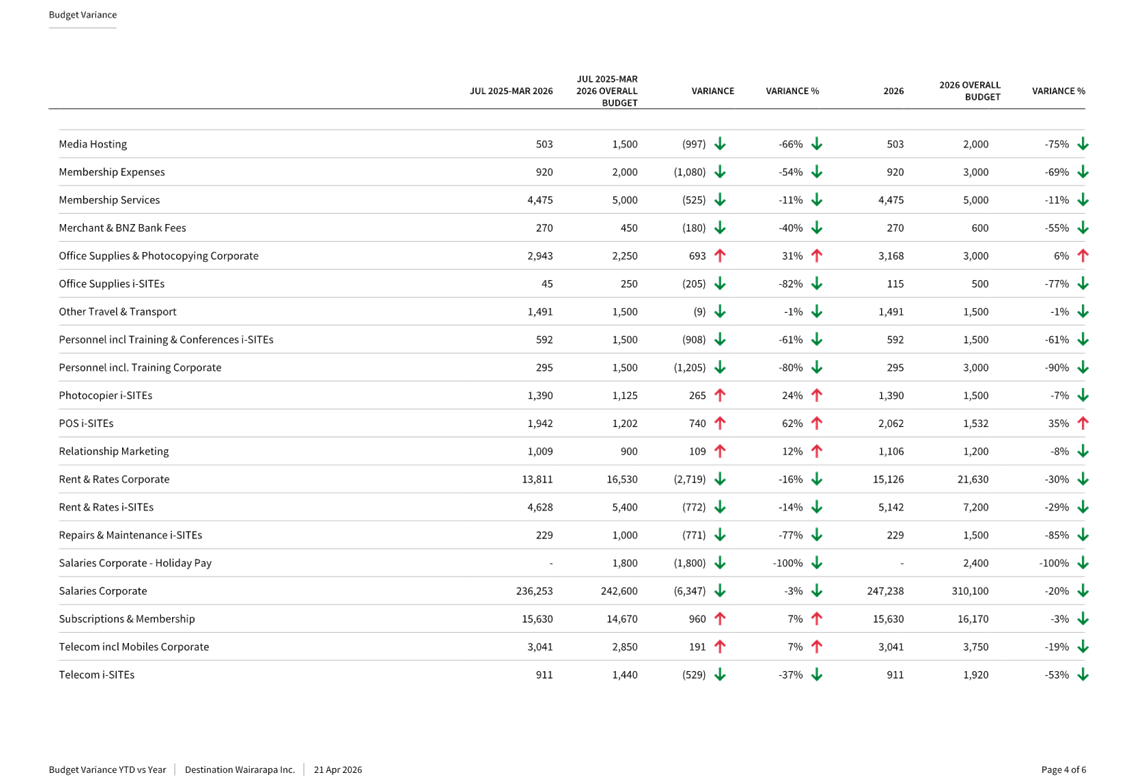
· The Budget Variance Report is included as Attachment 2.
· The DW CE and Marketing report is included as Attachment 3.
5. Recommendation
That the Council:
1. Receives
the report.
File
Number: 520881
Author: Glenda
Seville, Group Manager Community and Facilities
Attachments: 1. Q3
DW Financial Report ⇩
2. DW
Budget Variance Report ⇩
3. DW
DQ CE and Marketing Report ⇩

8.3 Wellington
NZ Quarterly report
1. Purpose
For Council to receive
a report of activities for the quarter 1 January 2026 on the delivery of the
Wairarapa Economic Development Strategy.
2. Significance
The
matters for decision in this report are not considered to be of significance
under the Significance and Engagement Policy.
3. Background
The
three Wairarapa Territorial Authorities collectively invest in Wellington NZ to
deliver on the Wairarapa Economic Development Strategy.
4. Activities
of wellington nz
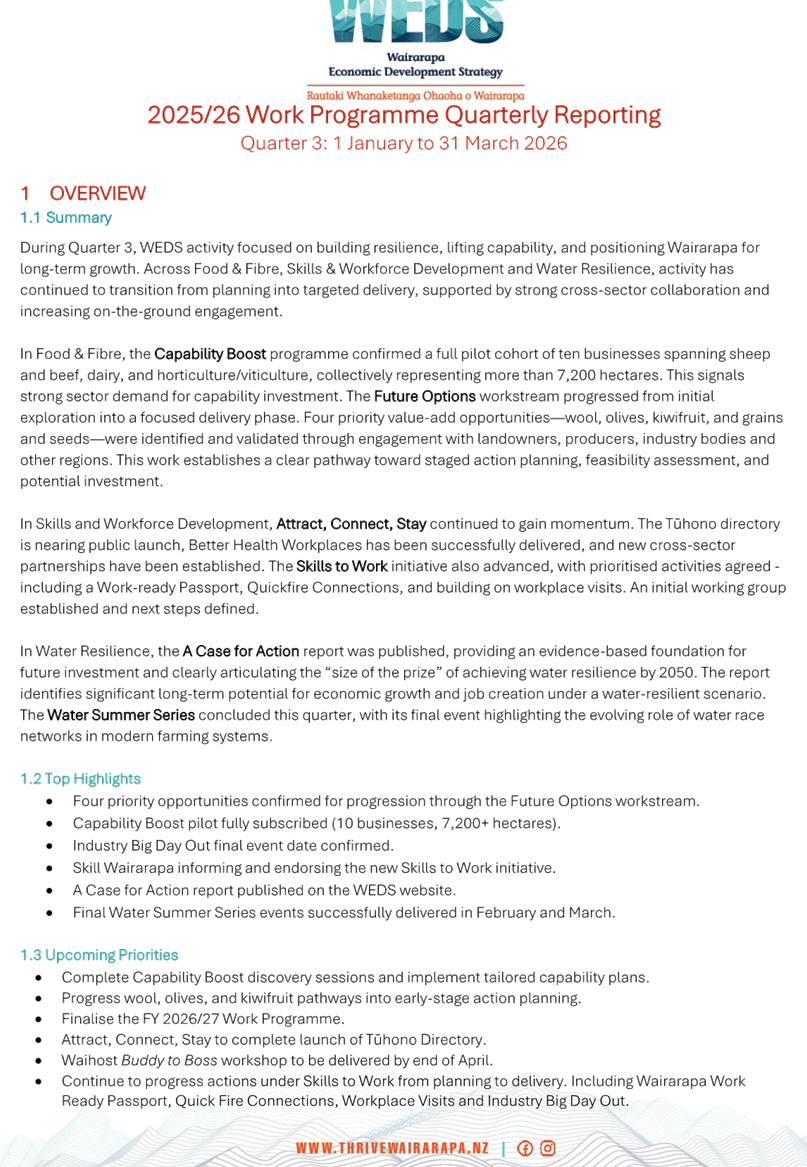
Attached
to this report are the following:
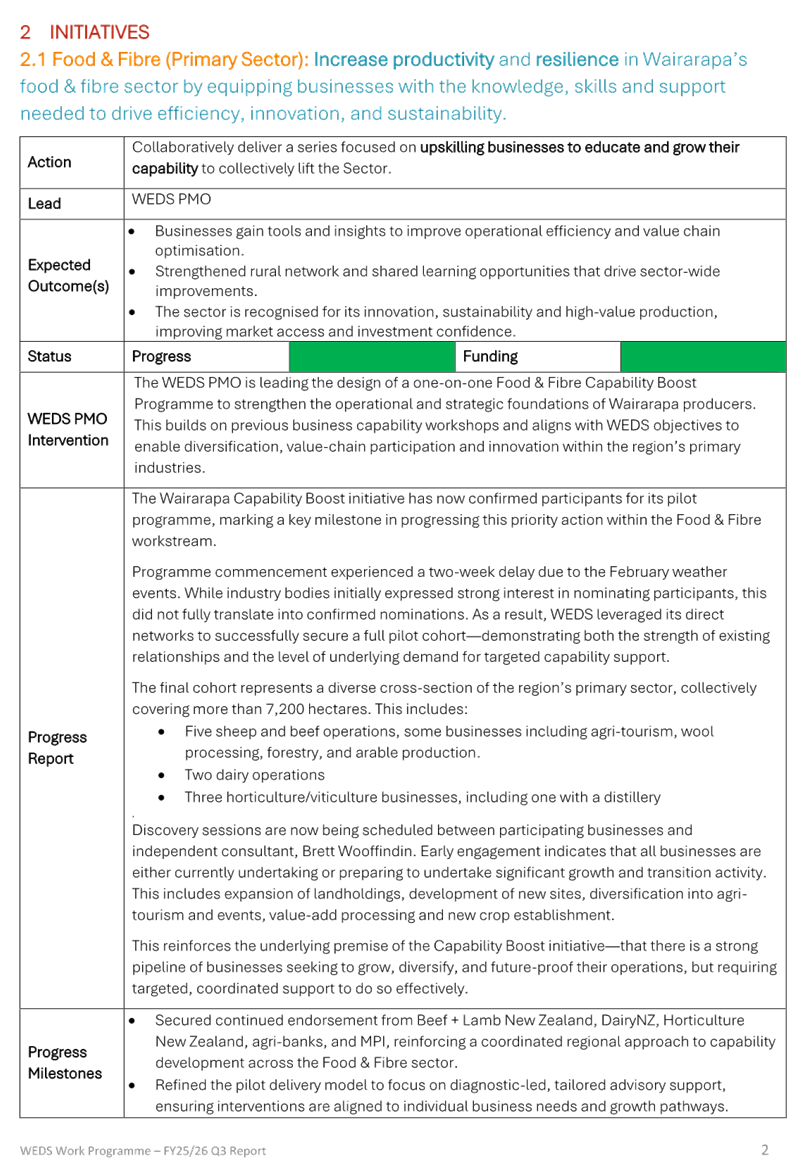
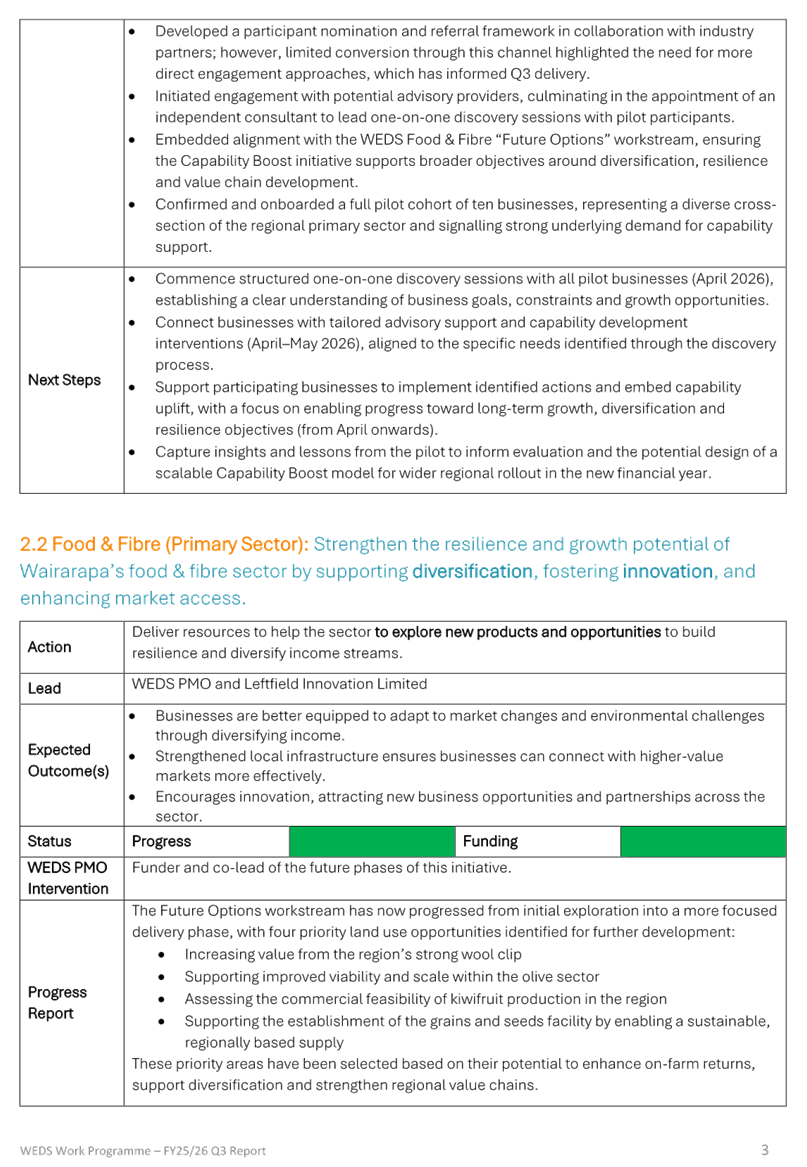
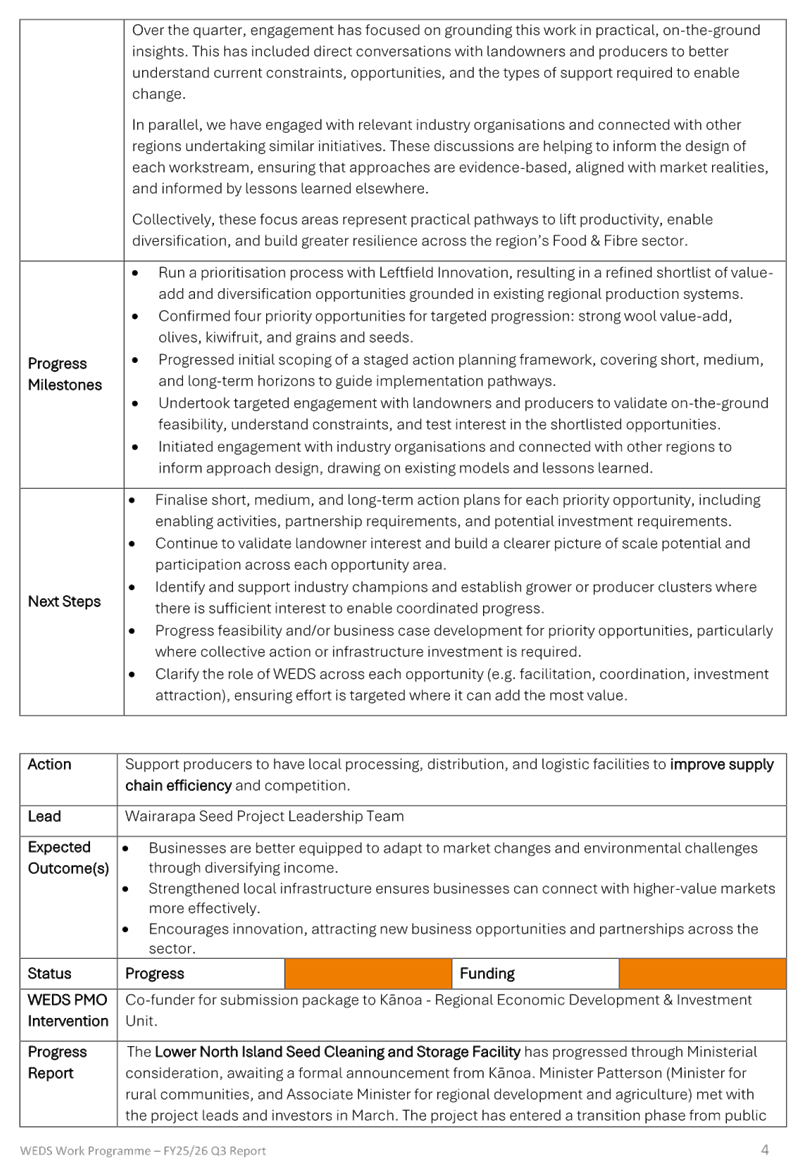
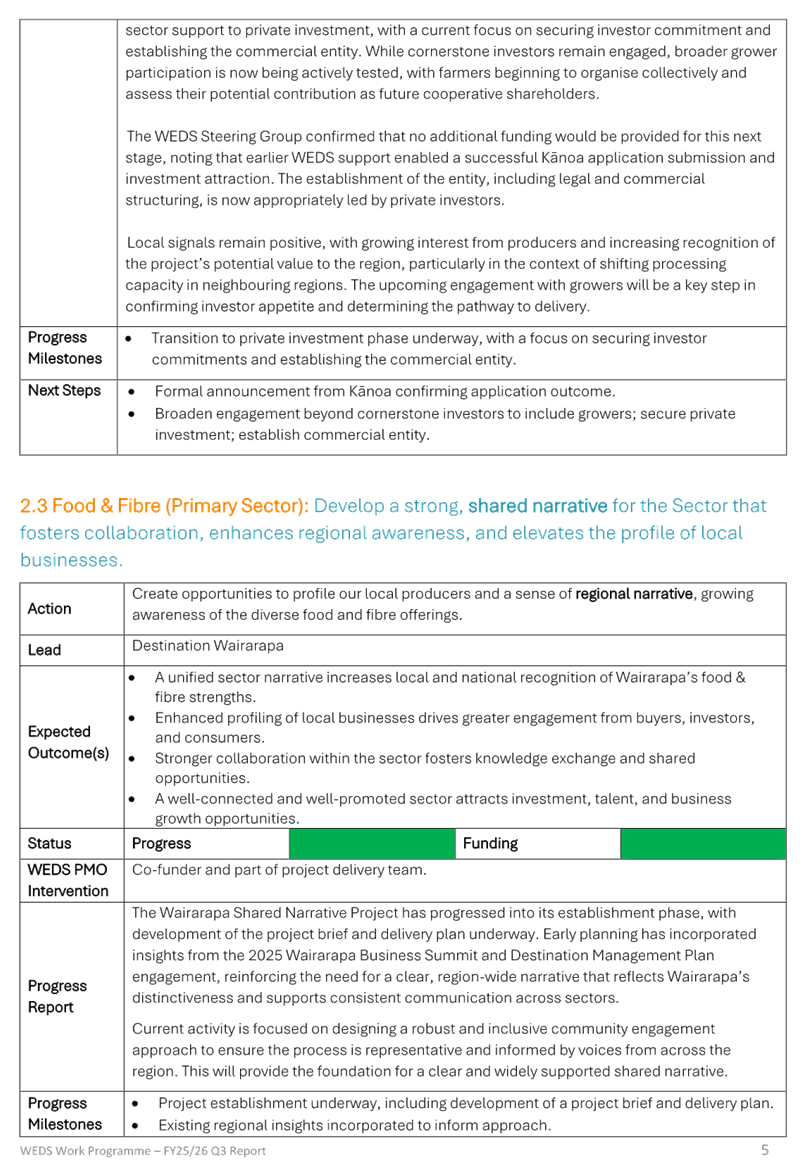
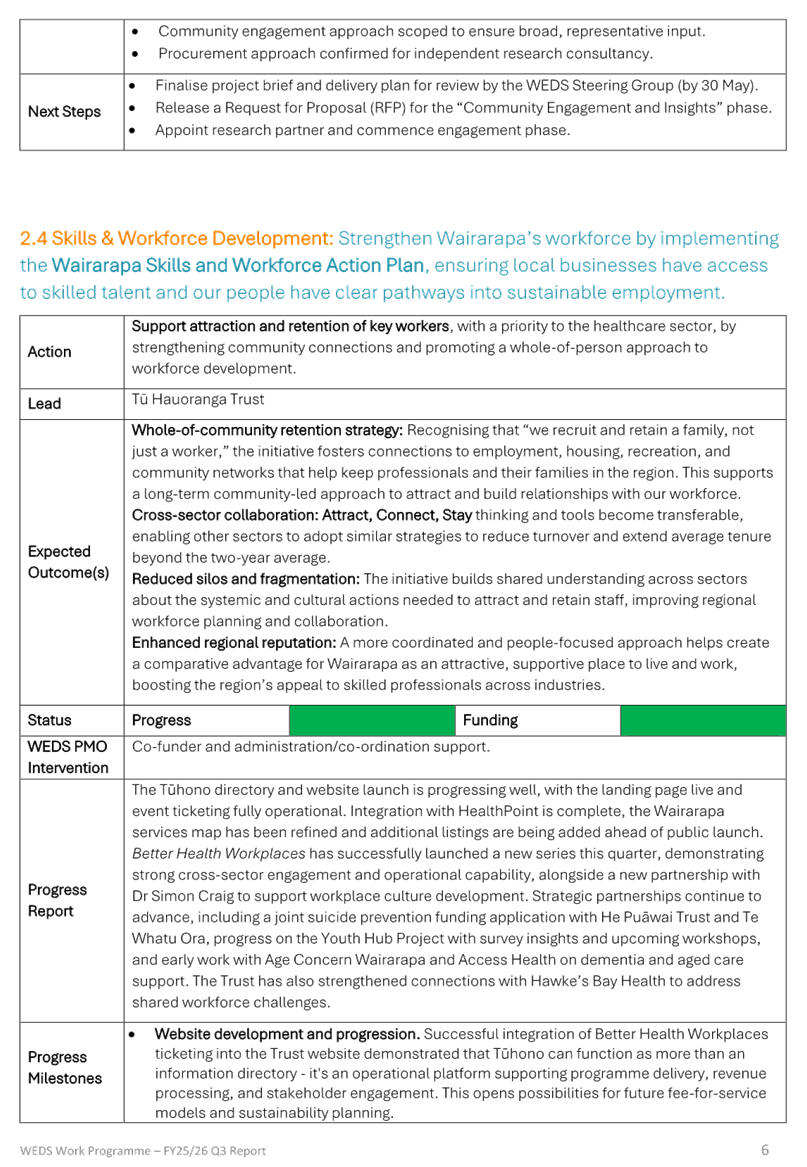
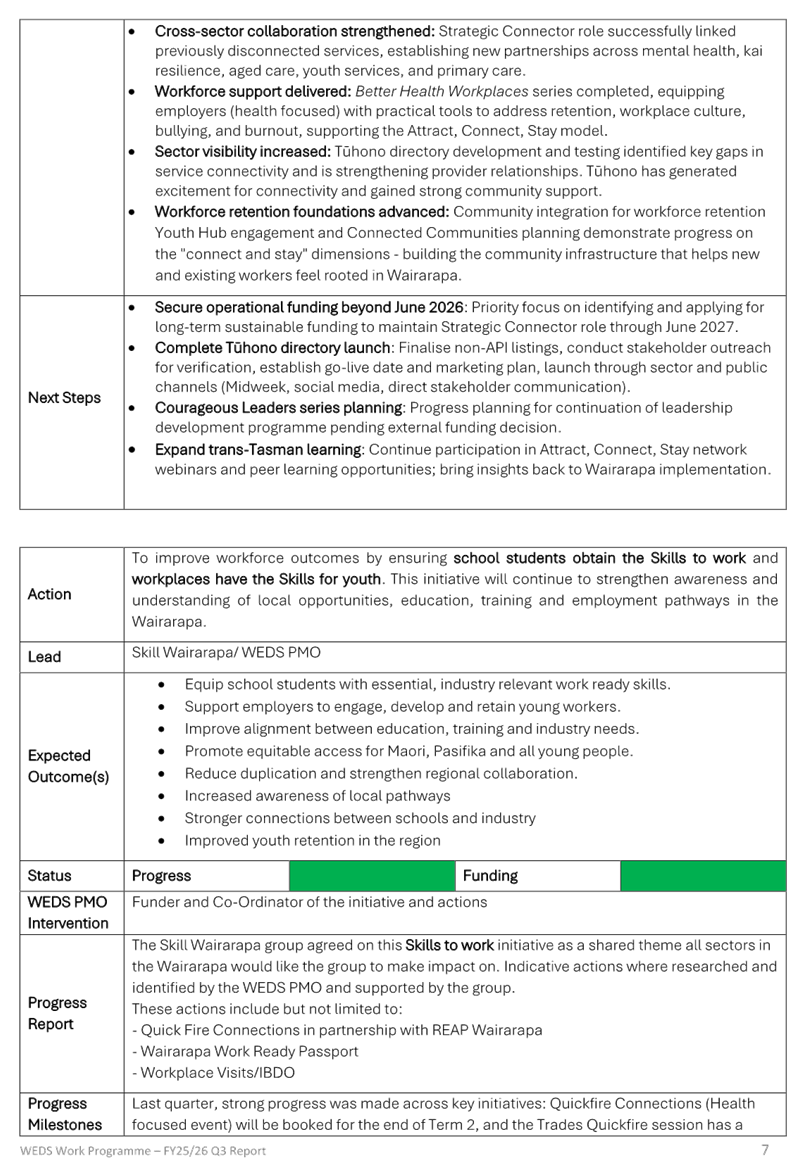
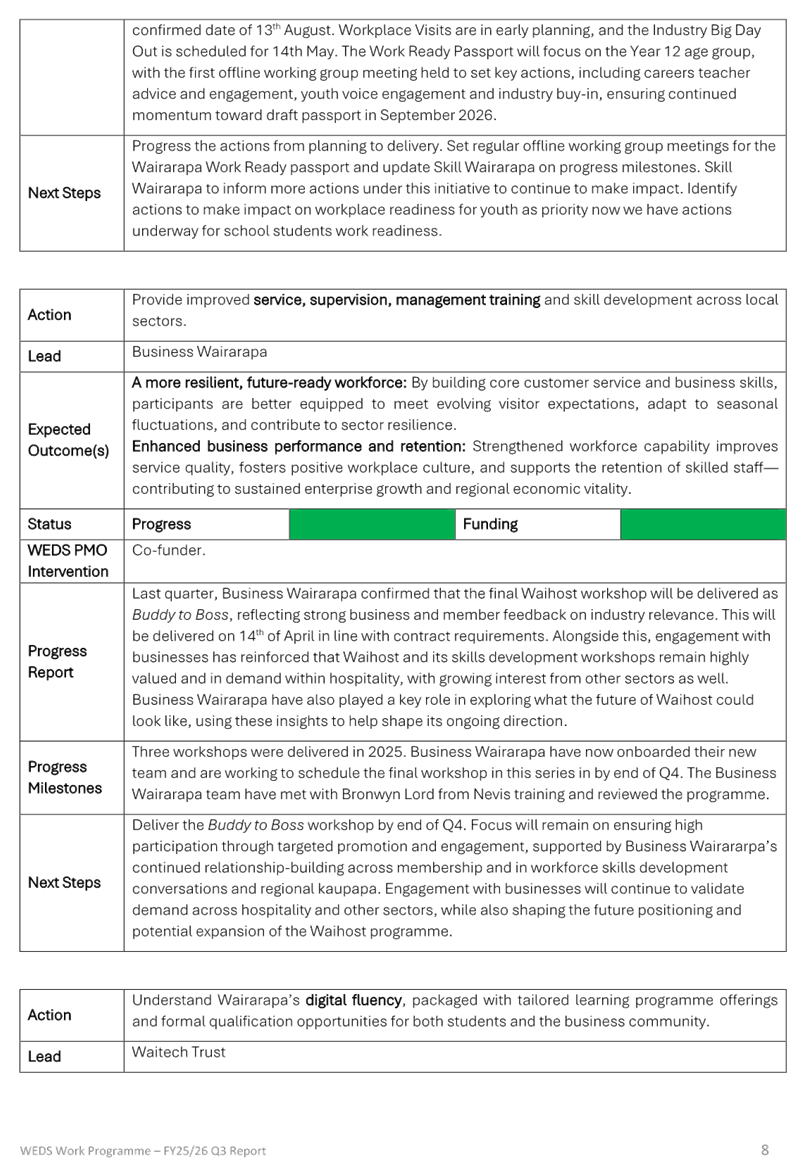
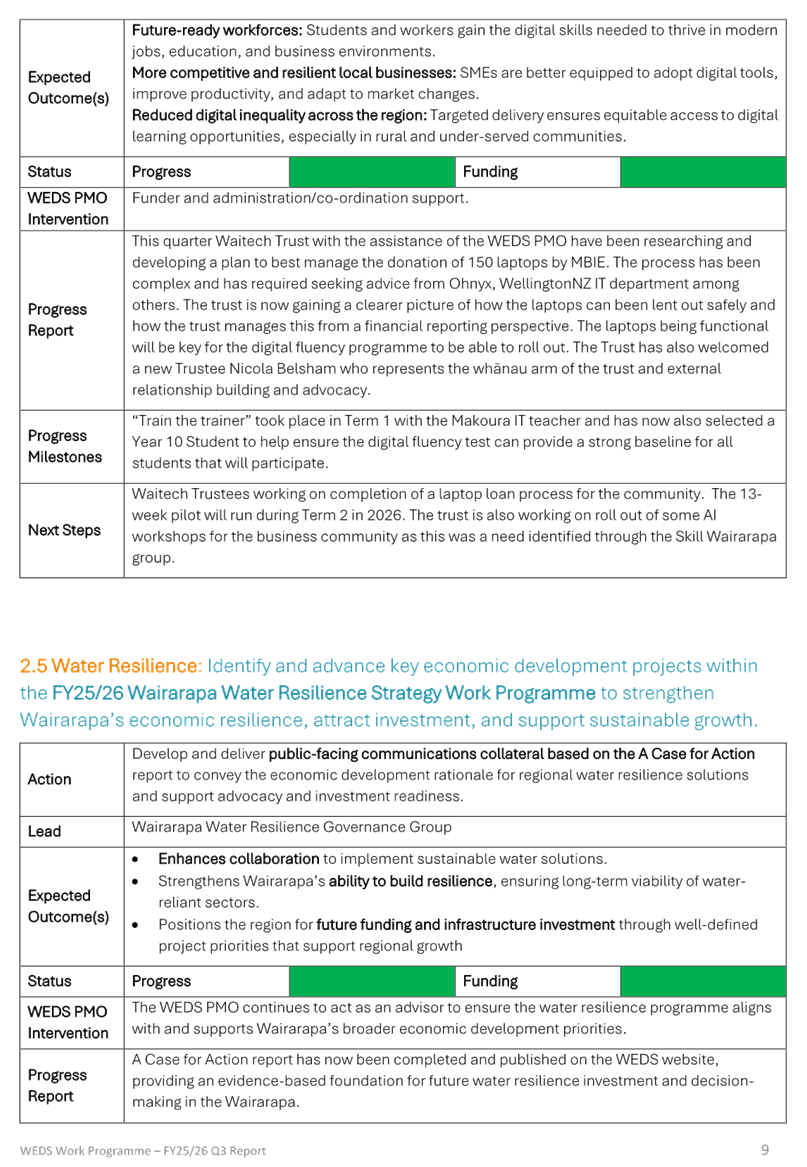
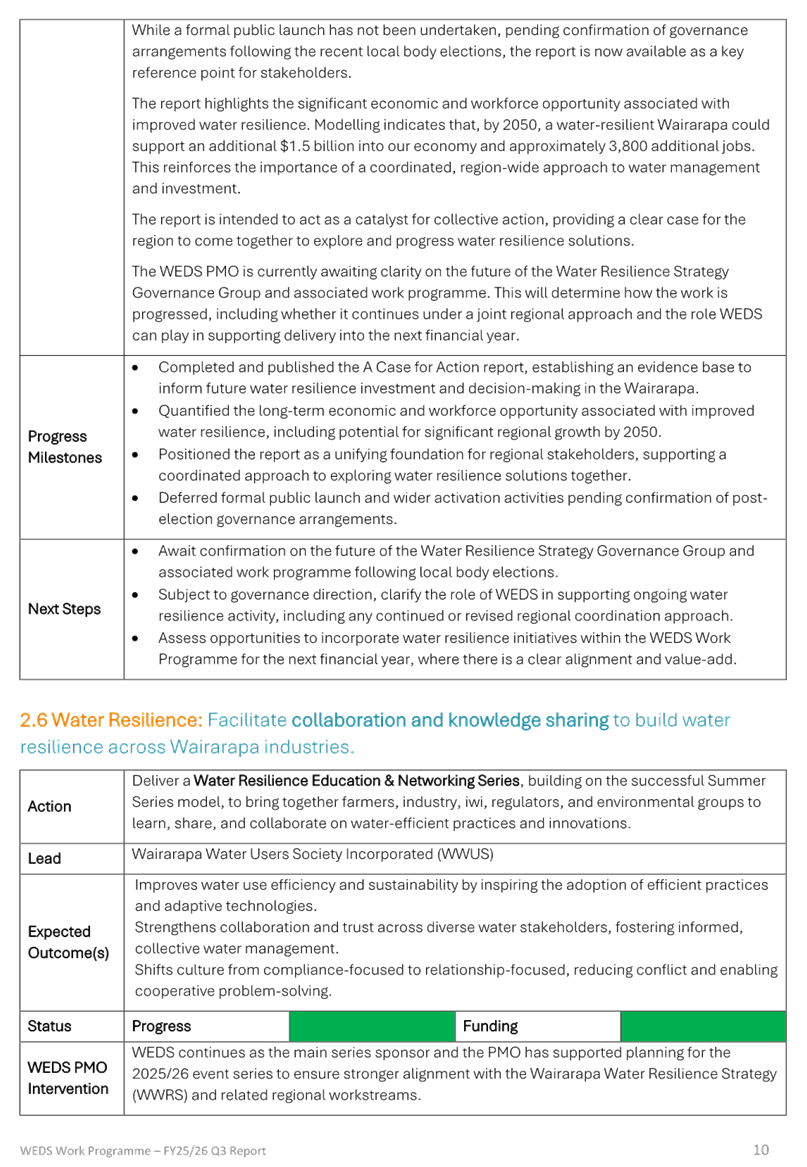
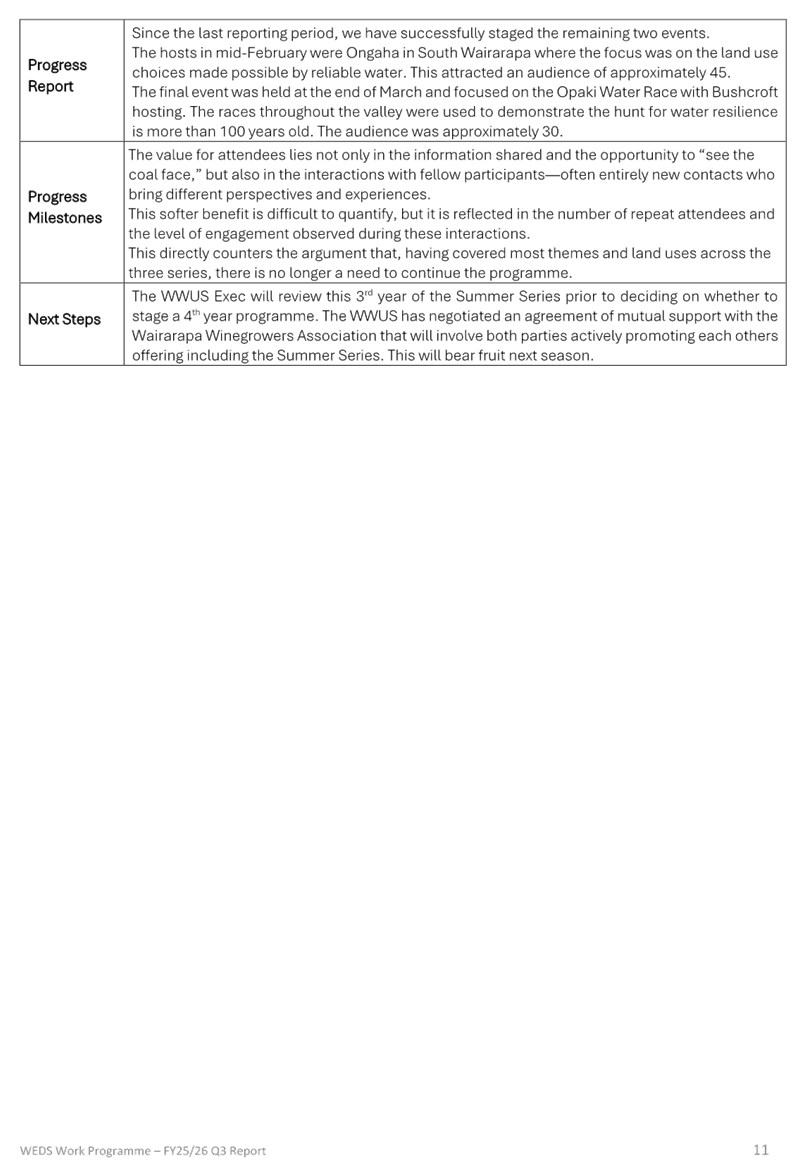
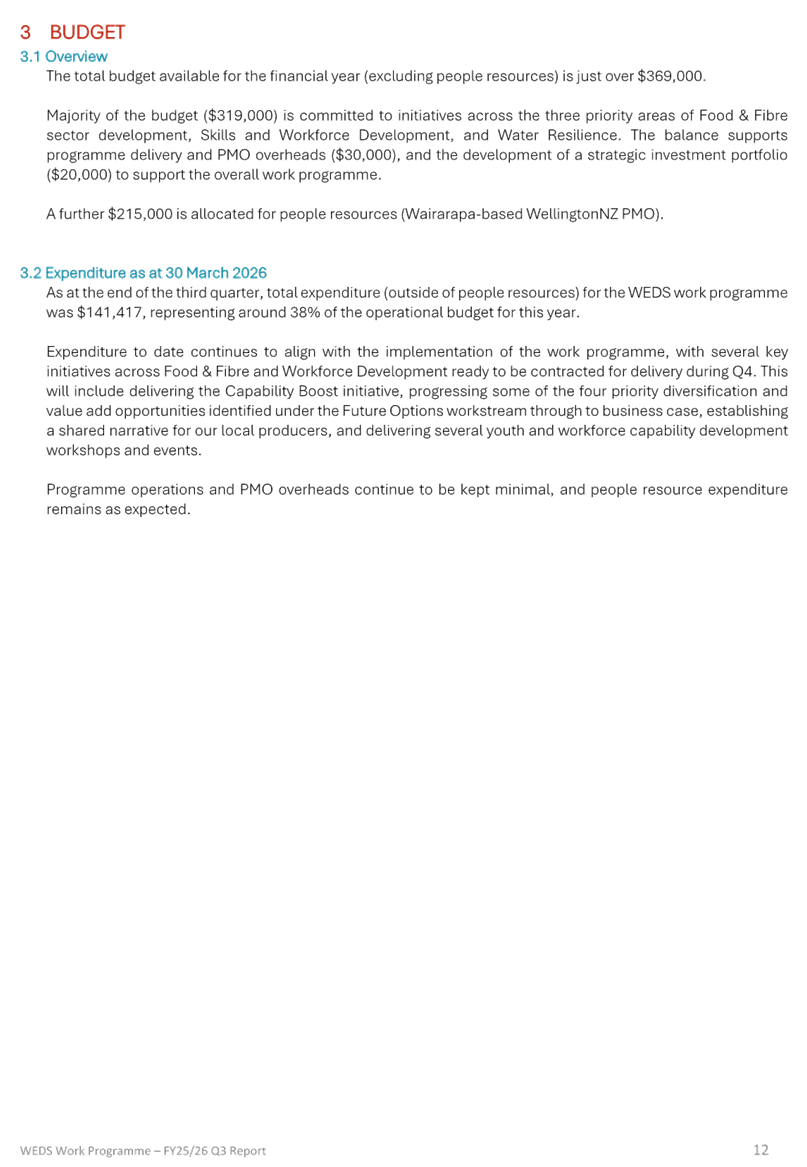
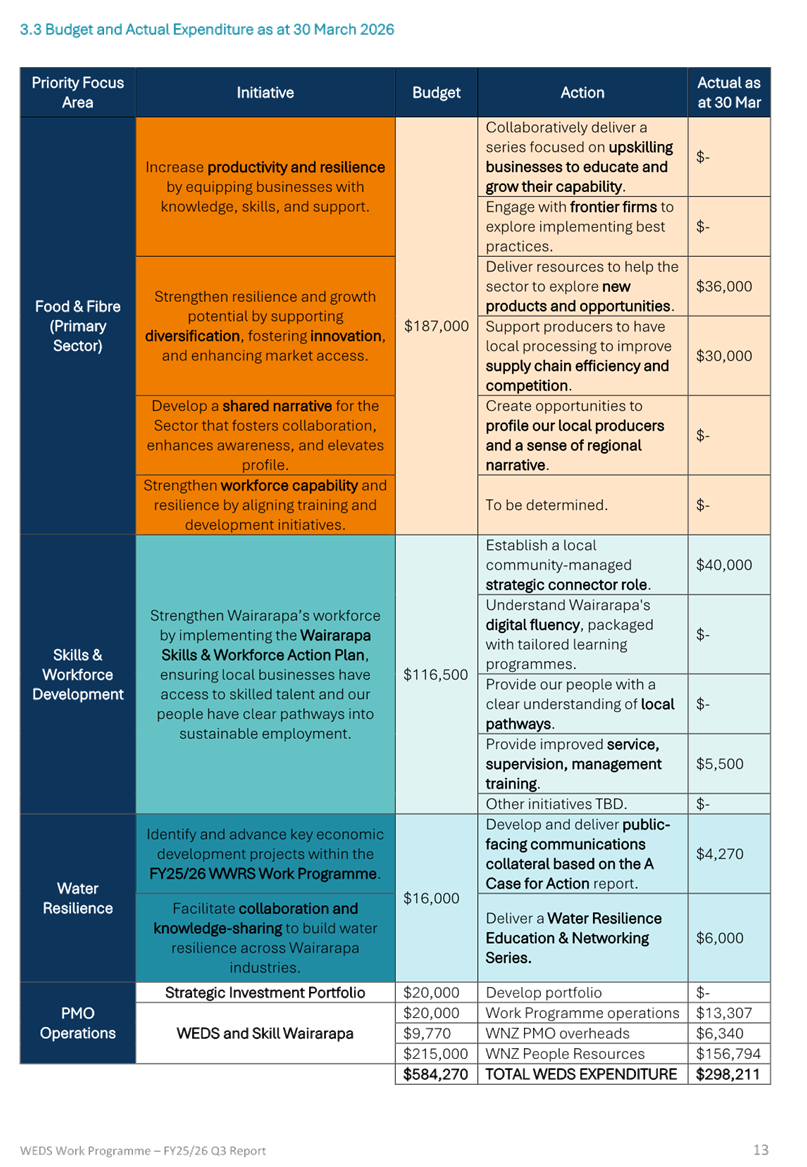
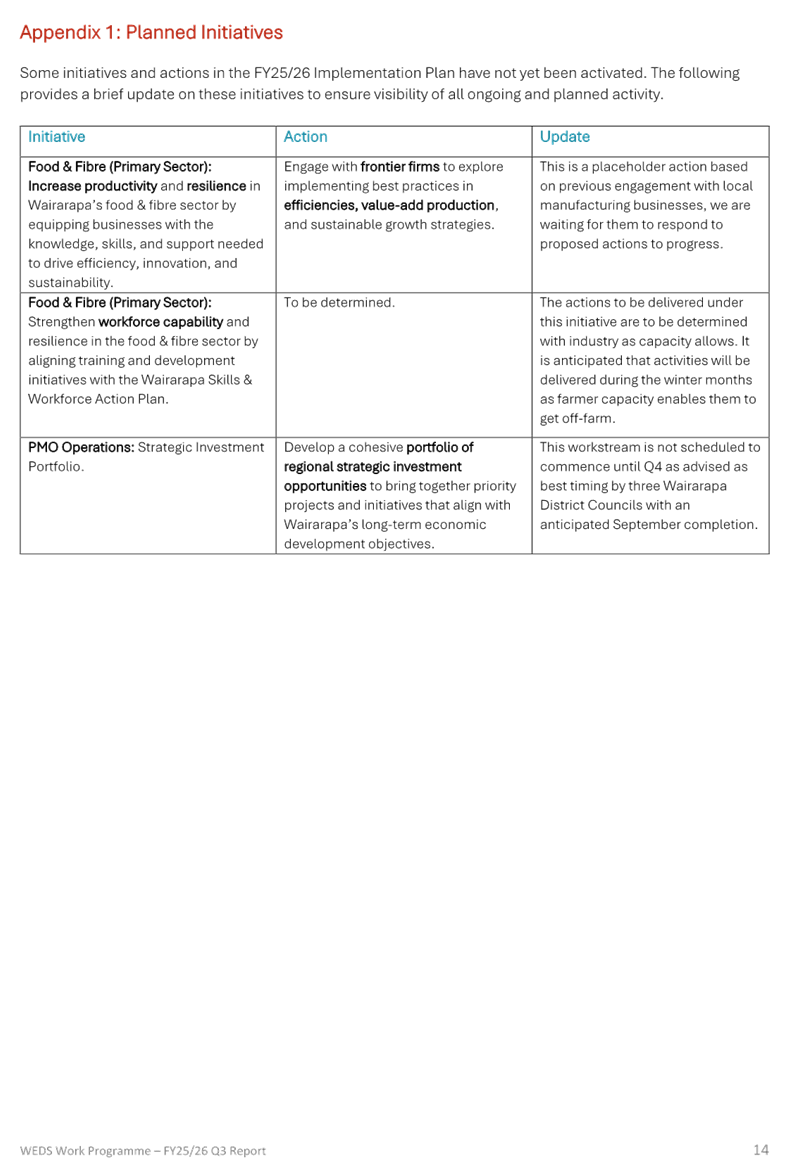
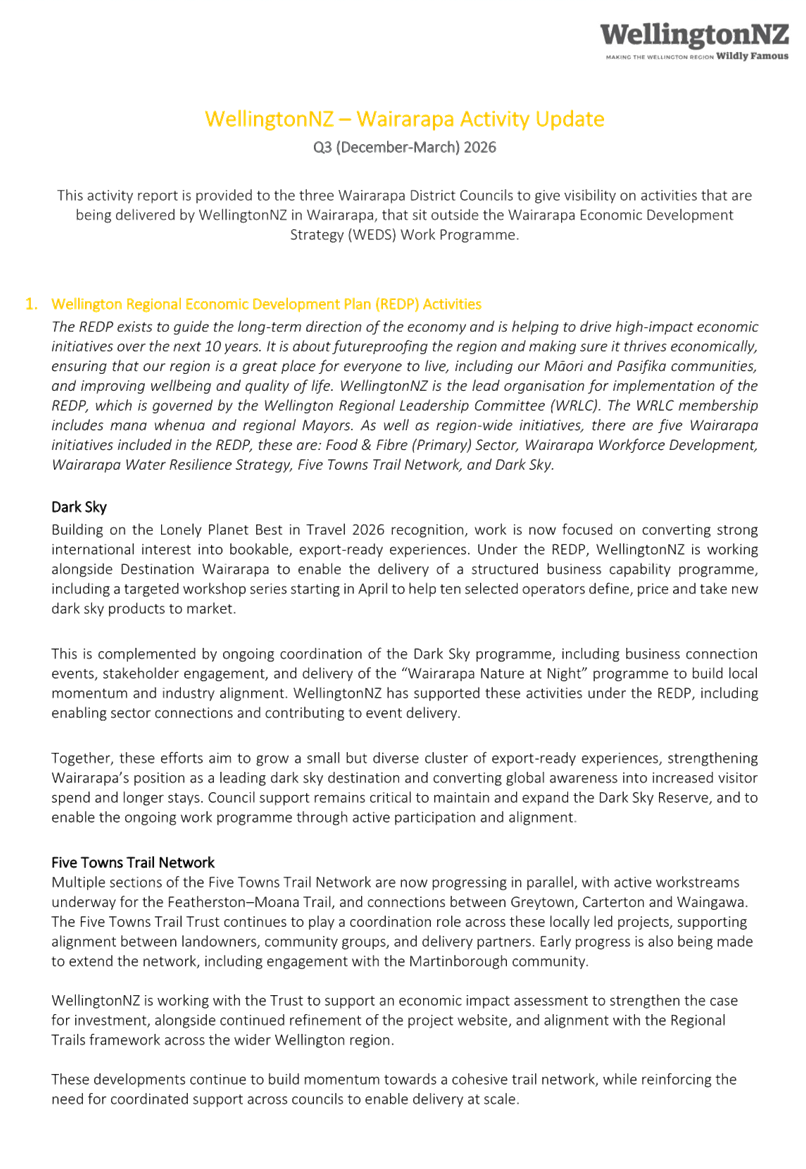
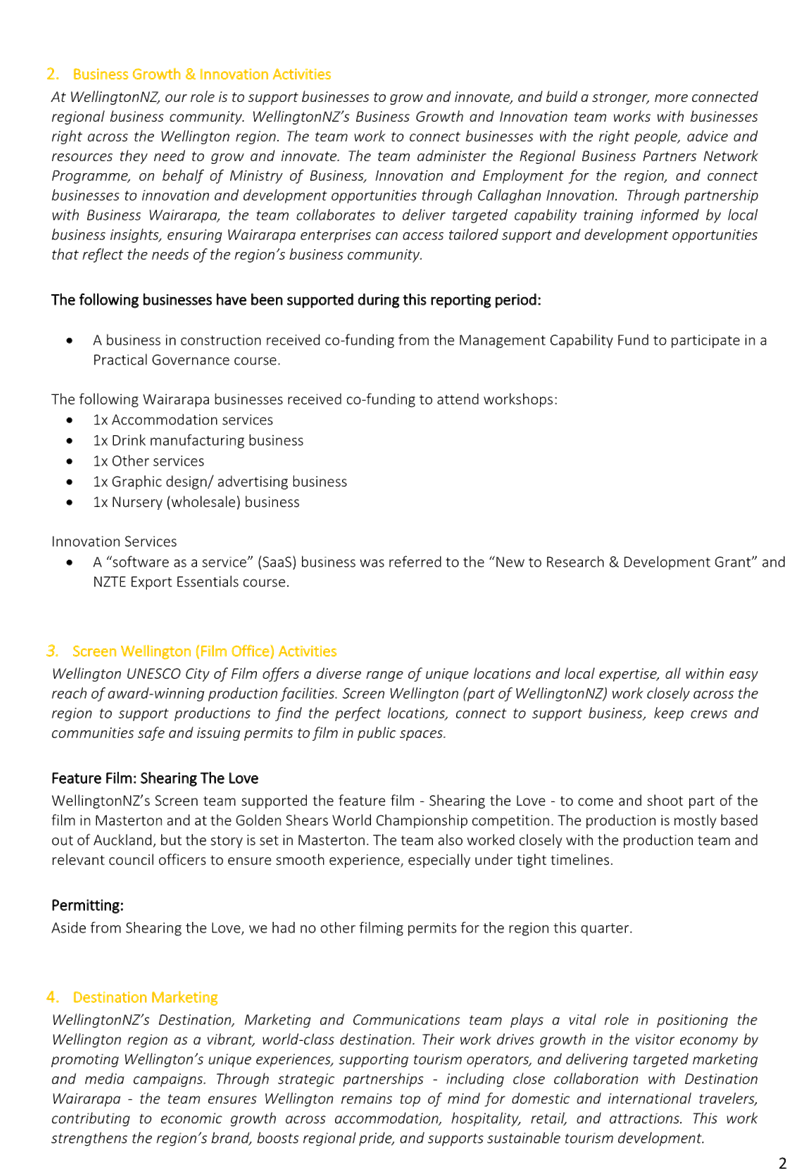
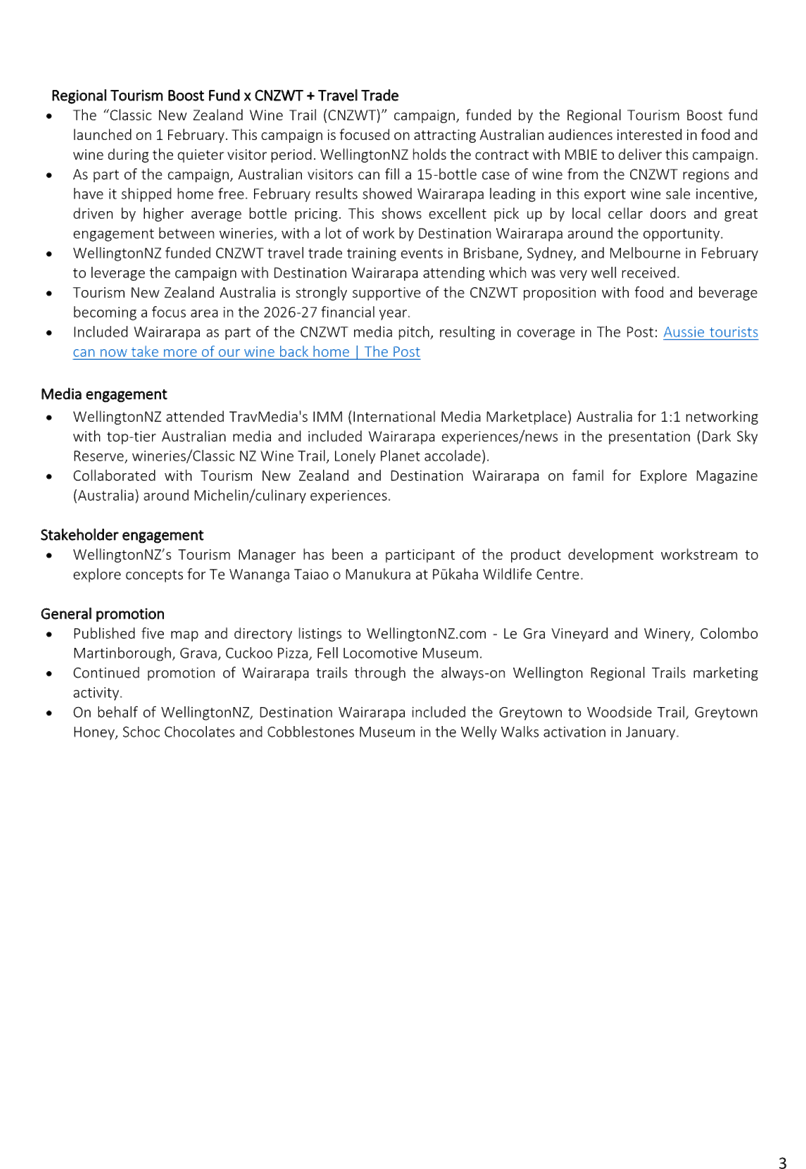
· WEDS Work Programme Report for the period 1 January 2026 – 30
March 2026.
· Wellington NZ Wairarapa Activity Update.
Wellington
NZ has provided the Wairarapa Activity Update. This update provides visibility
on activities that are being delivered by Wellington NZ Business and Innovation
team in the Wairarapa, that sits outside the Wairarapa Economic Development
Strategy programme.
Wellington
NZ will speak to this report.
5. Recommendation
That the Council:
1. Receives
the report.
File
Number: 520639
Author: Glenda
Seville, Group Manager Community and Facilities
Attachments: 1. WEDS
Q3 Report ⇩
2. WNZ
Activity Report December - March 2026 ⇩

8.4 Chief
Executive Report
1. Purpose
For Council to be
informed on planned Council operational activities, major projects, and other
matters of importance and interest.
2. Significance
The
matters for decision in this report are not considered to be of significance
under the Significance and Engagement Policy.
3. Significance
Unless
otherwise stated the matters for decision in this report are not considered to
be of significance under the Significance and Engagement Policy.
4. Community
services
Community
& Partnerships Team
Neighbourhood Support
Weekly newsletters
continue to be distributed to all Neighbourhood Support groups, providing
community updates and NZ Police crime data specific to Wairarapa towns. These
updates, along with associated crime prevention and security messaging,
continue to be positively received by residents.
A new street group
leader has been confirmed for Broadway following resident engagement through a
letterbox drop initiative. To support awareness and participation,
Neighbourhood Support signage has been installed in both Broadway and De Lacy
Lane.
The Neighbourhood
Support Coordinator attended the Welfare and Rural Emergency Management
meeting, as well as a multi‑agency coordination meeting with New Zealand
Police, Fire and Emergency New Zealand (FENZ), Wairarapa Fire Authority (WFA),
and Wairarapa Emergency Management Office (WREMO). These meetings support
ongoing inter‑agency collaboration and strengthened community
preparedness.
 Walking / Cycling / wellbeing / Out and Active
A new story has been
installed at the Carrington Park StoryWalk©. The Rascally Hedgehog.
The story incorporates a road safety theme, aligning with the promotion of Road
Safety Week (4–10 May). Additional StoryWalk stations have been used to
further reinforce this key message.
 In addition, a display is being established in the Wairarapa Events
Centre foyer to support public awareness and engagement during Road Safety
Week.
In addition, a display is being established in the Wairarapa Events
Centre foyer to support public awareness and engagement during Road Safety
Week.
Community
Funding and Support
Support was provided to
the Returned and Services Grants Committee, which allocated a total of $4,200
in tertiary grants to eight Carterton applicants.
Support was also
provided to the Rural Travel Fund Committee, which allocated a total of $6,800
in Sport NZ grants to four Carterton sports club or school applicants.
In addition, support was
provided to the Creative Communities Scheme Committee, which allocated a total
of $14,305 in Creative New Zealand funding to eight recipients.
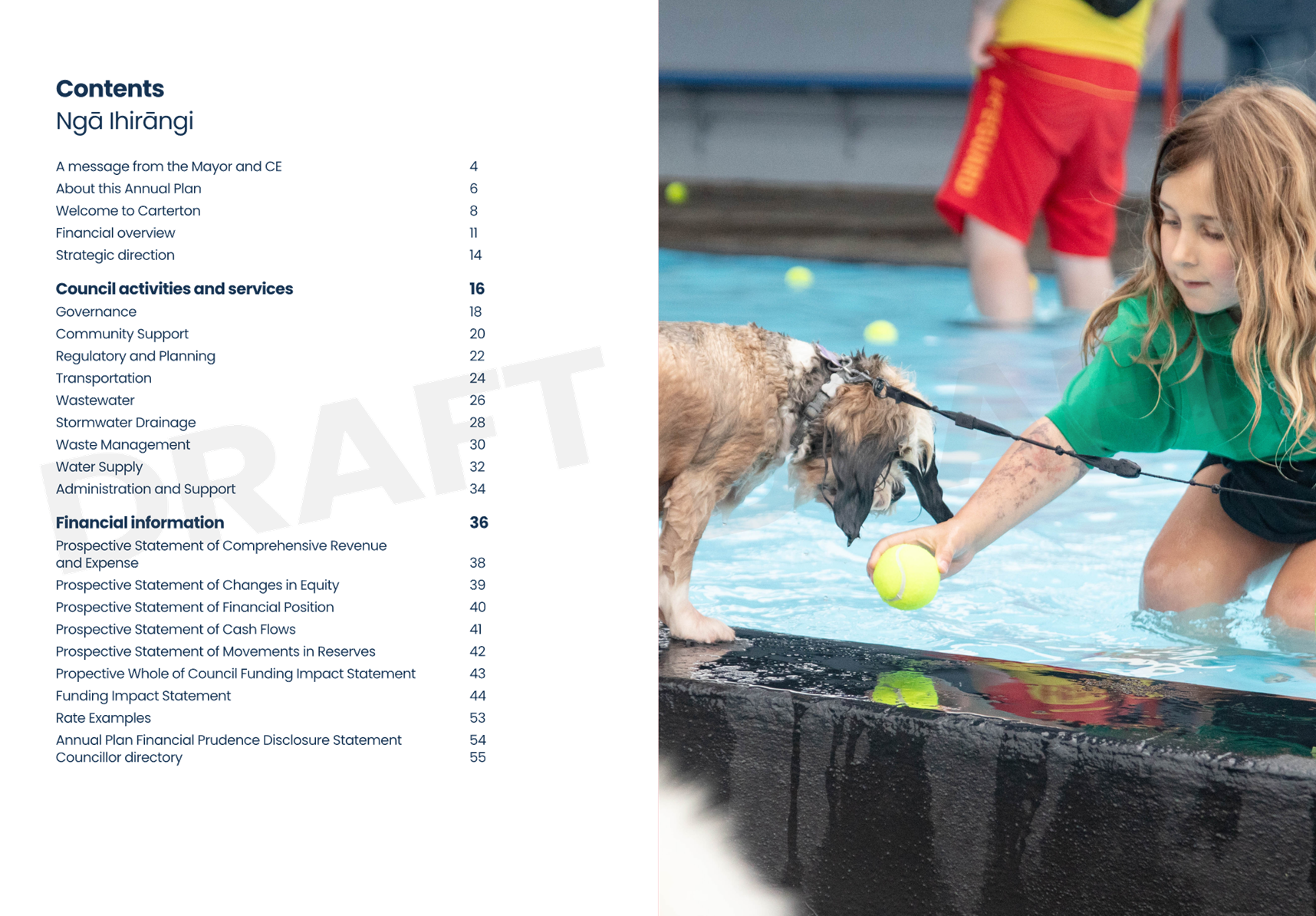
Events
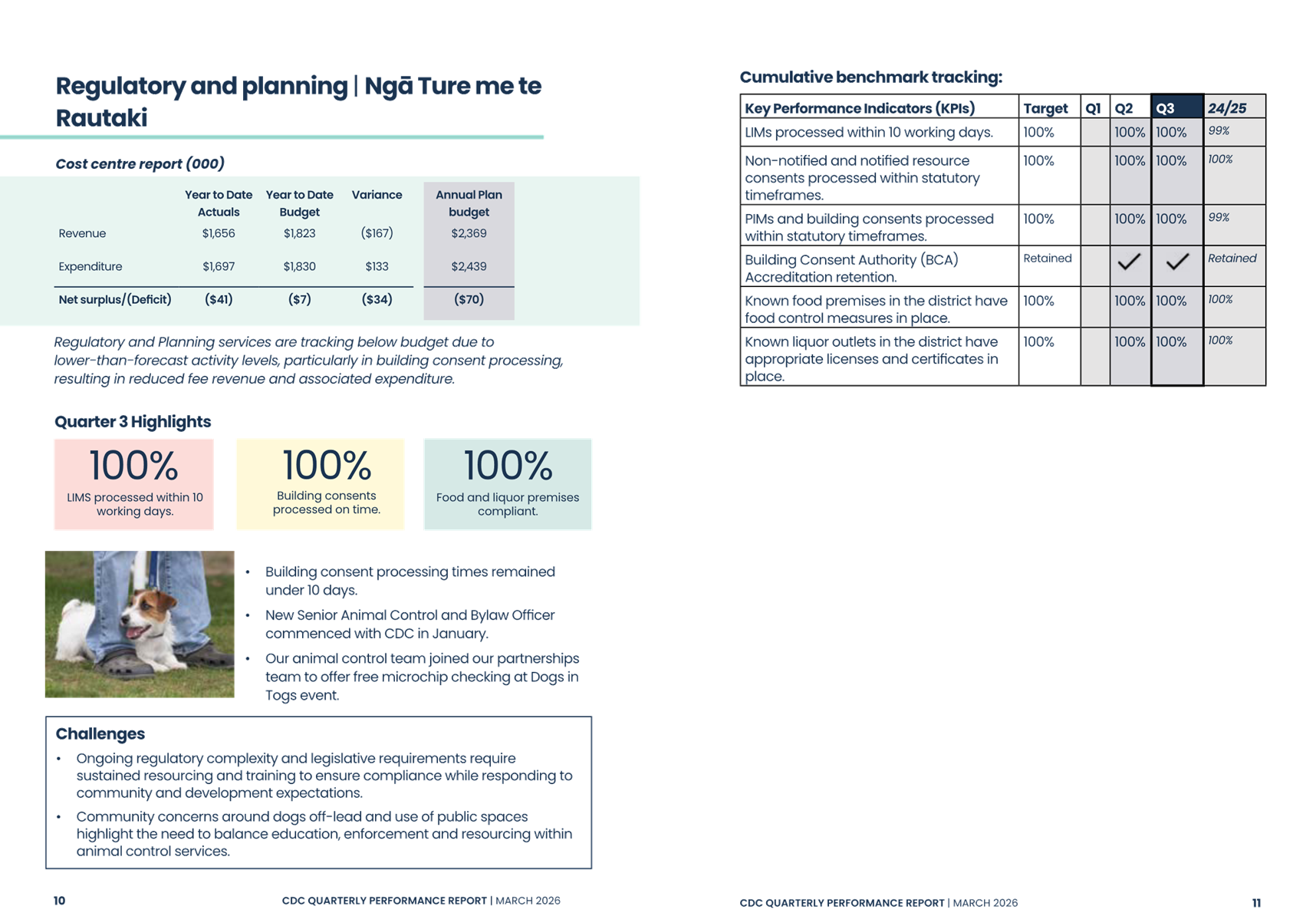
 Dogs
in Togs – 19 March 2026
Dogs
in Togs – 19 March 2026
Over 40 dogs and their
owners attended the 2026 Dogs in Togs event, which continues to be a
popular community initiative celebrating responsible dog ownership and animal
wellbeing. The event was supported through sponsorship from Black Hawk, who
provided goody bags for participants. Animal Control staff were also present,
offering microchip checks and providing microchipping services at a reduced
cost.
 Community
feedback was overwhelmingly positive, with attendees highlighting the social
nature of the event, the enjoyment for pets, and the added value of on-site
microchip checking. The event is regarded as an effective and well-received
opportunity for community engagement and animal welfare promotion.
Community
feedback was overwhelmingly positive, with attendees highlighting the social
nature of the event, the enjoyment for pets, and the added value of on-site
microchip checking. The event is regarded as an effective and well-received
opportunity for community engagement and animal welfare promotion.
ANZAC Day – 25th
April 2026

 Approximately 1,000 people attended the Carterton ANZAC Day Parade
and Service to commemorate and honour our veterans. In addition to strong local
community participation, the service was attended by invited representatives,
including Captain John Sellwood of the Royal New Zealand Navy as guest speaker,
along with representatives from the Australian High Commission, the British
High Commission, and the United States Embassy.
Approximately 1,000 people attended the Carterton ANZAC Day Parade
and Service to commemorate and honour our veterans. In addition to strong local
community participation, the service was attended by invited representatives,
including Captain John Sellwood of the Royal New Zealand Navy as guest speaker,
along with representatives from the Australian High Commission, the British
High Commission, and the United States Embassy.
Other community
events information
The Community Events
information page on the Carterton District Council website for our Community
which outlines information about the Events Approval Process.
Community Events | Carterton District Council
(cdc.govt.nz)
Upcoming Events
· 27 May –
Citizenship Ceremony
· 6 June
– Miriama Kamo – Less Waste; Greater Place
Charles Rooking
Carter Community Awards
We have received over 30
nominations this year and judging has taken place. Finalists will be announced
shortly, and we look forward to celebrating with our community at the gala
dinner in June.
Older
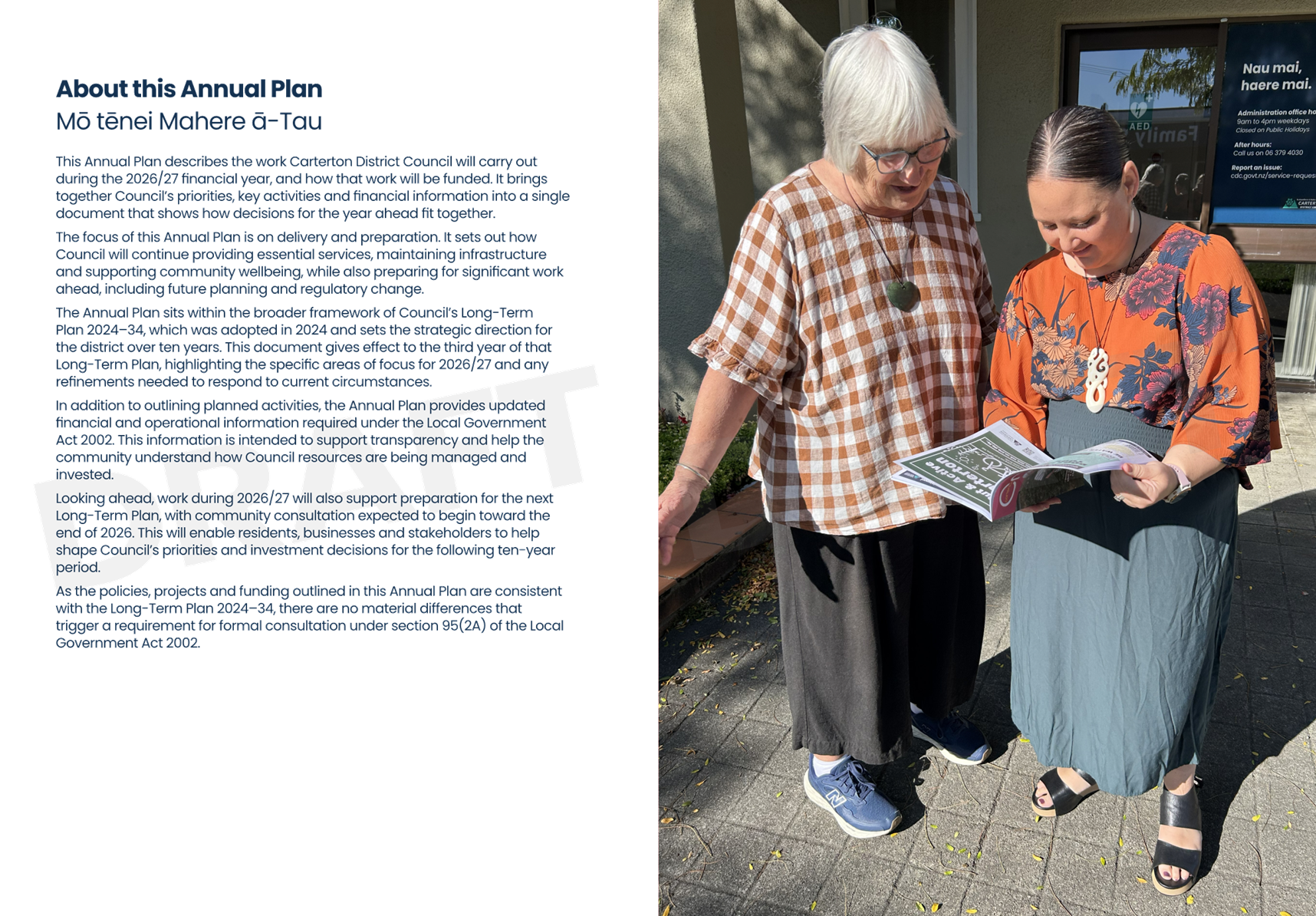
persons – Te Hōkai Nuku Wairarapa Region Positive Ageing Strategy
 A meet‑and‑greet was organised between one of
Carterton’s Over the Fence Ambassadors and Wairarapa Time Age to
promote the benefits of the Over the Fence campaign. Through a shared
interest in quilting, Pauline and Danielle were able to establish a meaningful
connection, enabling conversation and relationship‑building that reflects
the campaign’s aim of reducing social isolation and strengthening
community connections.
A meet‑and‑greet was organised between one of
Carterton’s Over the Fence Ambassadors and Wairarapa Time Age to
promote the benefits of the Over the Fence campaign. Through a shared
interest in quilting, Pauline and Danielle were able to establish a meaningful
connection, enabling conversation and relationship‑building that reflects
the campaign’s aim of reducing social isolation and strengthening
community connections.
Climate Change
Engagement with elected members
A
two-hour workshop on climate change was held with elected members on
1 April that covered the basics of climate change in the district.
The
2024/25 CDC emissions inventory was presented at the Policy and Projects
committee meeting on 22 April, that included discussion on emissions
reduction.
 The Policy and Projects Committee also discussed options
for adding solar generation capacity at two additional sites where electricity
consumption matches solar generation potential. The primary goal of the investment being to
reduce ongoing electricity costs.
The Policy and Projects Committee also discussed options
for adding solar generation capacity at two additional sites where electricity
consumption matches solar generation potential. The primary goal of the investment being to
reduce ongoing electricity costs.
Community engagement

 A pilot series of climate community forums
was delivered to test community interest, build climate literacy, and inform
future engagement approaches. The pilot covered a range of topics including
Donut Economics, youth climate action, climate litigation, and practical
emissions reduction through a biochar workshop. Across the series, participants
demonstrated increased awareness of climate issues relevant to the district,
opportunities for collective action, and interest in continued discussion.
Feedback indicates support for ongoing forums, with evaluation underway to
assess participation, effectiveness, and alignment with Council’s climate
resilience and community wellbeing objectives before determining next steps.
A pilot series of climate community forums
was delivered to test community interest, build climate literacy, and inform
future engagement approaches. The pilot covered a range of topics including
Donut Economics, youth climate action, climate litigation, and practical
emissions reduction through a biochar workshop. Across the series, participants
demonstrated increased awareness of climate issues relevant to the district,
opportunities for collective action, and interest in continued discussion.
Feedback indicates support for ongoing forums, with evaluation underway to
assess participation, effectiveness, and alignment with Council’s climate
resilience and community wellbeing objectives before determining next steps.
What’s coming up?
A
Community Preparedness meeting will be held on Sunday 24 to support
residents’ understanding of how to prepare for emergency events and what
to expect if an event occurs. The session will focus on strengthening
individual and community readiness through shared information and coordinated
planning.
A
public discussion with climate writer Nadine Hura will take place on 7 June in
the Carterton Library in association with WaiWord and the Library on
the theme 'Hope is a shovel’.
Other
Initial
planning is underway on a two-day sustainability symposium in late
September in the Events Centre. Initial ideas revolve around food, water,
and energy sustainability with a mix of speakers, stalls, and hands on
workshops.
Mayors Taskforce for
Jobs (MTFJ) Wairarapa
As of 30 April 2026,
seven months into the programme for new staff, MTFJ Wairarapa has achieved 38
placements of rangatahi into employment pathways, including work experience,
part-time, and full-time roles. These include:
· 20 MSD outcomes at
the contractual 30 hours per week
· 10 candidates in
part-time work, with three transitioning to full-time employment
· 4 walk-in outcomes
at the contractual 30 hours per week,
· 2 candidates with
part-time work obligations meeting contractual outcomes
· 2 candidates
placed into volunteer or work experience opportunities (no part- or full-time
work obligations)
MTFJ Wairarapa is on
track to meet its contractual obligations of placing 30 benefit recipients into
work and five walk-in candidates into work.
Employer Engagement
Employer engagement
remains strong, with placements achieved through both direct employer enquiries
and proactive business outreach. Workplace visits continue to provide
candidates with practical insight into roles across key sectors, with recent
engagement resulting in multiple site visits during March.
As candidates approach
six months in employment, increased pastoral support is being provided to
assist with workplace adjustment and confidence‑building, with employers
remaining supportive of these efforts. Additional practical support has been
provided to remove barriers to employment, including assistance with transport
to interviews and initial work requirements.
Programme Highlights
 Momentum
continued across the March - April period, with 5 candidates placed into work
in March and 7 in April.
Momentum
continued across the March - April period, with 5 candidates placed into work
in March and 7 in April.
Future Demand Likely
to Increase
At the end of 2025,
fewer than 50% of Wairarapa rangatahi held NCEA Level 3, and this may decline
further as curriculum changes take effect. This is likely to increase demand
for MTFJ support, particularly among 16–17-year-olds, including those with
neurodiversity or learning challenges.
Upcoming Activities
· Business After 5 with Tupu Ana Business Masterton
at Masterton Trust Lands Trust, Tuesday 12 May.
· Masterton District
Council morning tea hosted by MTFJ Wairarapa.
· Following the
success of the pilot Ready, Set, Go programme in March 2025, MTFJ Wairarapa
will launch a more tailored workshop for small cohorts of four to six job
seekers who are not yet job-ready. The workshop will focus on essential life
skills, confidence-building, self-reflection, and practical guidance to help
participants develop the mindset, habits, and skills needed to gain and retain
employment.

Carterton
Library
|
Month
|
Physical issues
|
Ebook/Emagazine/Audiobook issues on Libby
|
Launches of Library App
|
New Members
|
|
December
2025
|
4120
|
727
|
3156
|
21
|
|
January
2026
|
4345
|
904
|
3461
|
25
|
|
February
2026
|
4755
|
829
|
3265
|
30
|
|
March
2026
|
4781
|
961
|
3009
|
21
|
*Statistics for
April 2026 are not yet available
Programming
April was a busy month
for programming in the library.
Children’s
Programming: During term time, Stories & Songs continued, and sustainable
events were planned for the Easter school holidays. A highlight was a
collaboration with Indigo & Thyme and South Wairarapa Libraries, where
participants of all ages created Easter Bunny portraits from recycled
materials. The event had a great turnout.
Additionally, the
library offered a workshop where participants could make bookmarks from
recycled and found materials.
Two holiday sessions
focused on building with Lego were held. These sessions coincided with Digital
Seniors, showcasing how the library’s shared spaces accommodate the
diverse needs of the Carterton community.
Adult Programming:
Regular sessions of Knit & Give, Books Alive (a book club for older
people), Digital Seniors, and JP sessions continue to be well-attended.
The library hosted a
special after-hours event on 23 April, Deadly Under Dark Skies, as part of the
Ngaio Marsh Awards New Zealand circuit. Although attendance was lower than last
year, probably due to red weather warnings earlier in the week, the writers
were entertaining and the event was very enjoyable.
A pilot has been
launched in conjunction with Indigo & Thyme and South Wairarapa Libraries
for monthly Mindful Stitching Sessions. The first session took place on 29
April and was very successful.
New Initiative
In April, the library
launched an initiative called “Staff Picks” to offer passive book
recommendations. Staff members will place “Staff Pick” stickers and
gold stars on books they have read and recommend. This initiative gives patrons
confidence in their choices as they browse the library and highlights hidden
gems in the collection that might otherwise be overlooked, ultimately
increasing book turnover.
Feedback
About Read & Reuse bookmark workshop:
‘Wonderful thoughtful, fun, purposeful
learning activity  Nicely
facilitated. Ngā mihi nui to the kaiwhakahaere/facilitator.
Perfect.’
Nicely
facilitated. Ngā mihi nui to the kaiwhakahaere/facilitator.
Perfect.’
About Deadly Under Dark Skies:
“Lovely evening. Thank you to everyone
involved.”
“Thank you for a great night!
Brick Build shares space
with Digital Seniors. / Deadly Under Dark Skies crime writer’s panel

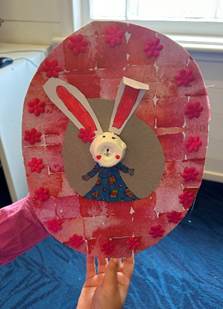
Read & Reuse bookmark workshop. / Easter Bunny
Portrait workshop.
Parks
and Reserves
Parks
Maintenance
The lime path
extension at Howard Booth Park has been completed, along with resealing works
at the Wyndham Street entrance to the park. Seasonal annual bedding changeovers
are currently underway across key garden areas, and routine maintenance
activities such as mowing, edging, and vegetation control have been carried out
across all urban parks and rural reserves. Lime path maintenance was also
undertaken at Sparks Park to ensure pathway integrity, and the rear access ramp
at the Event Centre was treated and cleaned to help reduce slip risk.
Preparations for ANZAC
Day were completed at both Memorial Square and the Maungaraki War Memorial. A
community planting day at Sparks Park was delivered successfully, resulting in
substantial riparian planting. Playground inspections have been completed, with
minor repairs undertaken at Howard Booth Park and Carrington Park. Service
requests were actioned where possible within allocated timeframes, supporting
responsive maintenance across the network.

 Works are also being undertaken to reinstate the power at the
pavilion in Carrington Park.
Works are also being undertaken to reinstate the power at the
pavilion in Carrington Park.
Photos of the team at the community planting day at
Sparks Park
Projects
Carrington
Park Toilet Upgrade
Project progressing
well. Roof and exterior works are completed. We are working with contractors to
finalise designs for the interior fit out.

Waikekeno
Pouwhenua
Base construction has
been completed and ready for installation of the Pou. The Pou will be unvailed
at a ceremony on Matariki.
Volunteer
and Community Group Activity
The
Keep Carterton Beautiful Group continued regular contributions to public space
enhancement. For April their focus areas included the Victoria Street
walkway, refuse station, Wyndham Street Reserve, and Moreton Road Reserve.
Volunteer
pest control activities continued at Kaipatangata Forest and Sparks Park,
primarily undertaken by the Bat Restoration Group.
5. Regulatory
and Planning
Building services
March and April have seen a definite decrease in the number
of building consents and the value of the work compared to previous
years. What this has allowed us to do is release one of our staff members
to provide support to South Wairarapa District Council for 2 day per week on an
initial three-month trial basis. Seeing our Councils working together
better has been a desire of the elected members and we are pleased to be able
to take some small steps forward.
Animal Control
Fees and Charges
A separate paper is being presented to council to adopt the
recommended fees for the 26/27 year. It should be noted that we have not
increased the fees in this area for a number of years, however officers
considered it appropriate to make some adjustments this year.
Microchipping
We have made good progress in updating dog records in MagiQ, successfully
adding microchip numbers to a significant number of animals. Feedback from the
general public has been very positive, with many expressing appreciation for
the proactive approach to ensuring dog details are accurate and up to date.
This initiative provides reassurance to owners in the event their dogs go
missing. Our Animal Control officer is providing discounted microchipping at
Sparks Park, the first of this was held on Thursday 30 April.
Noise
In March, the Noise Control team responded to 11 callouts,
this is down on the 20 we responded to in February. These callouts resulted in
the issuing of three Excessive Noise Direction (END) notices and one seizure.
April continued to show a downward trend with only 3 call outs resulting in 2
END notices being served.
6. Infrastructure
services
Water Operations
Water operations have been going smoothly over summer, the
number of leaks recorded is down compared to previous years. The
frequency of the rain events meant that demand is easily managed by the system.
The daily peak water demand was 2933m³/d for the past six months, well
below historic levels.
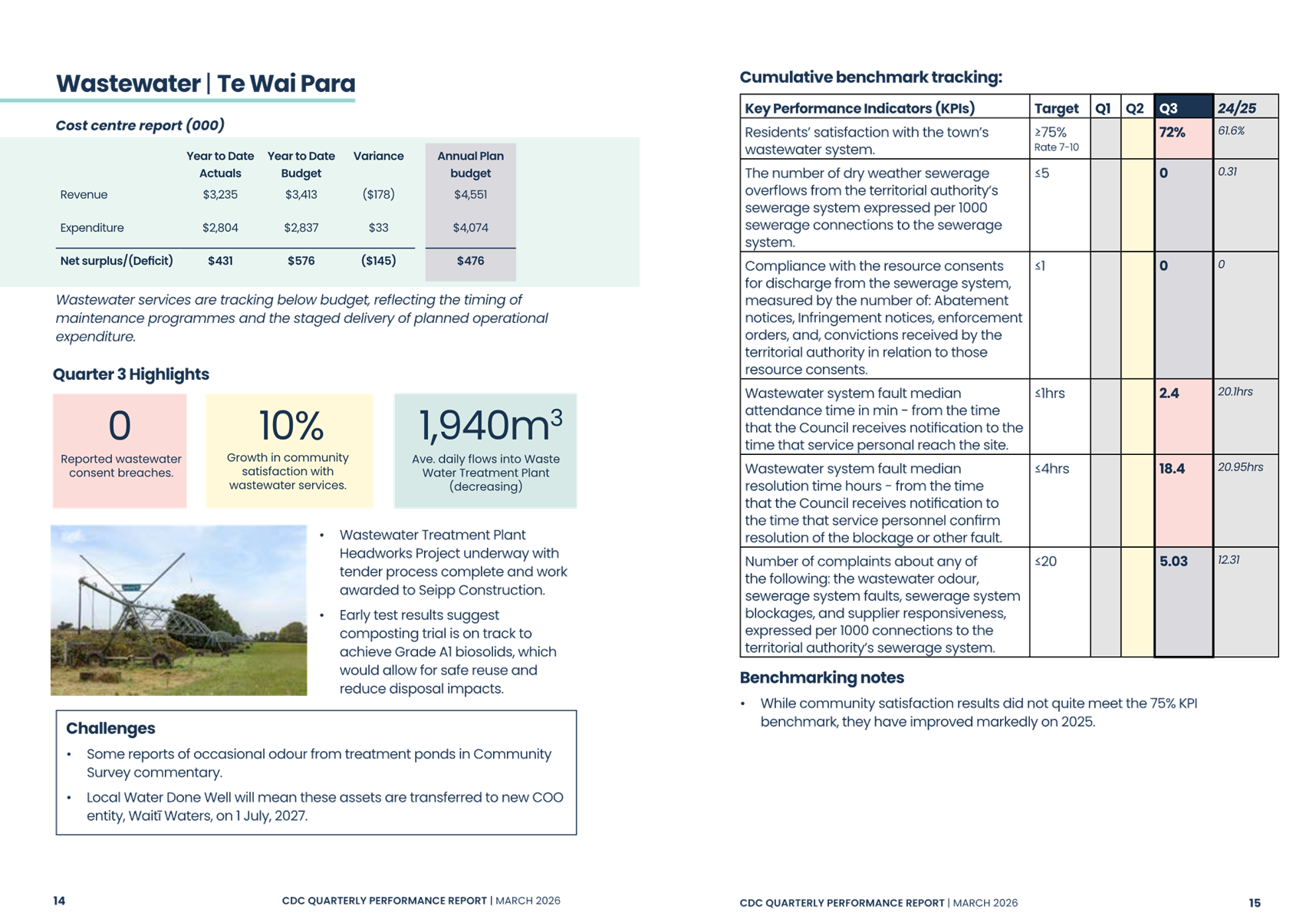
Wastewater operations have also been going smoothly over
summer. The frequency of the rain events has kept the soil moisture levels
higher than average so there were not as many irrigation days. The reservoirs
levels have been managed without any difficulty.
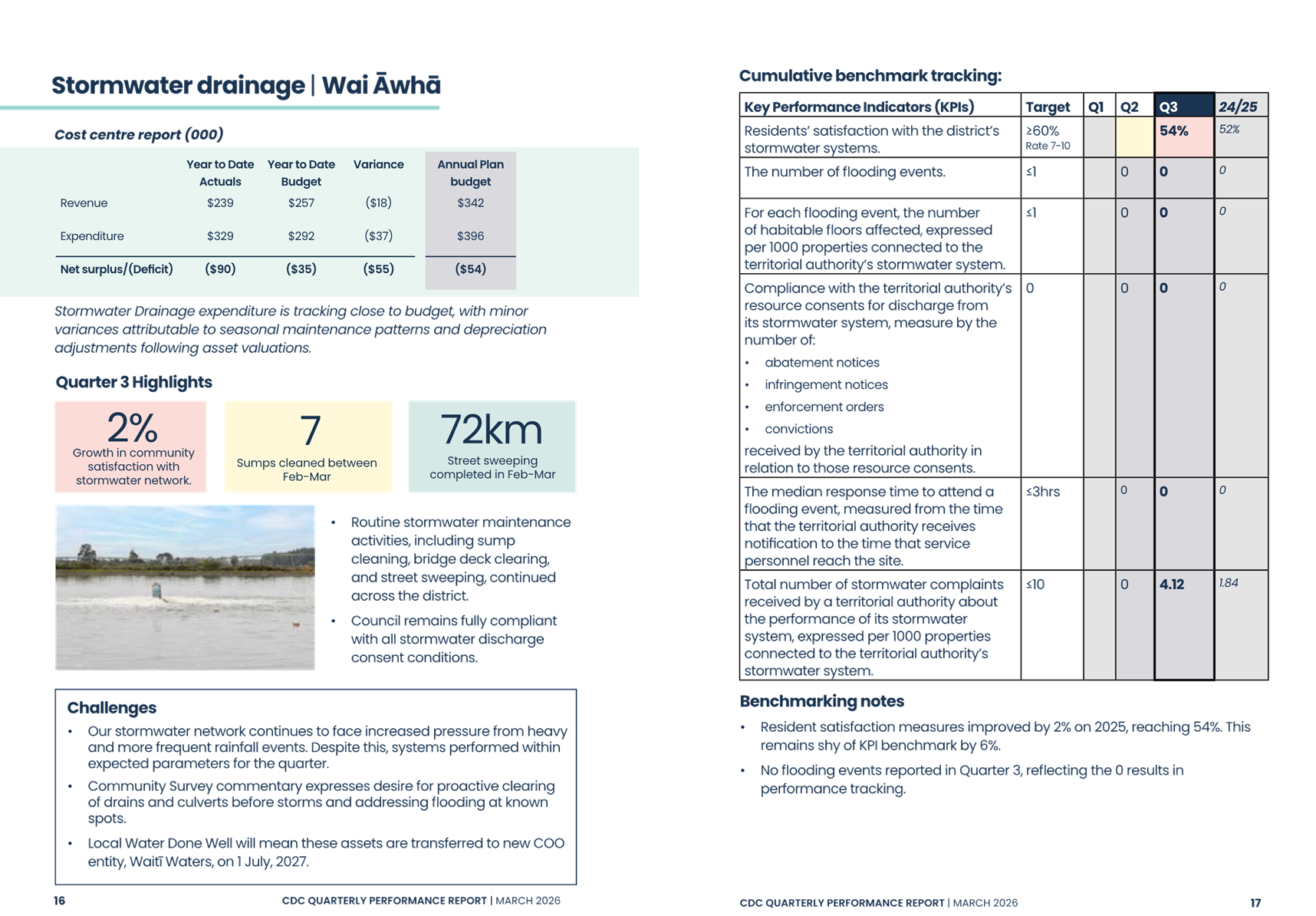
There was some surface flooding during the rain events, but
no reported incidents in town with any houses at risk, indicating that the town
drainage has functioned adequately.
Roading
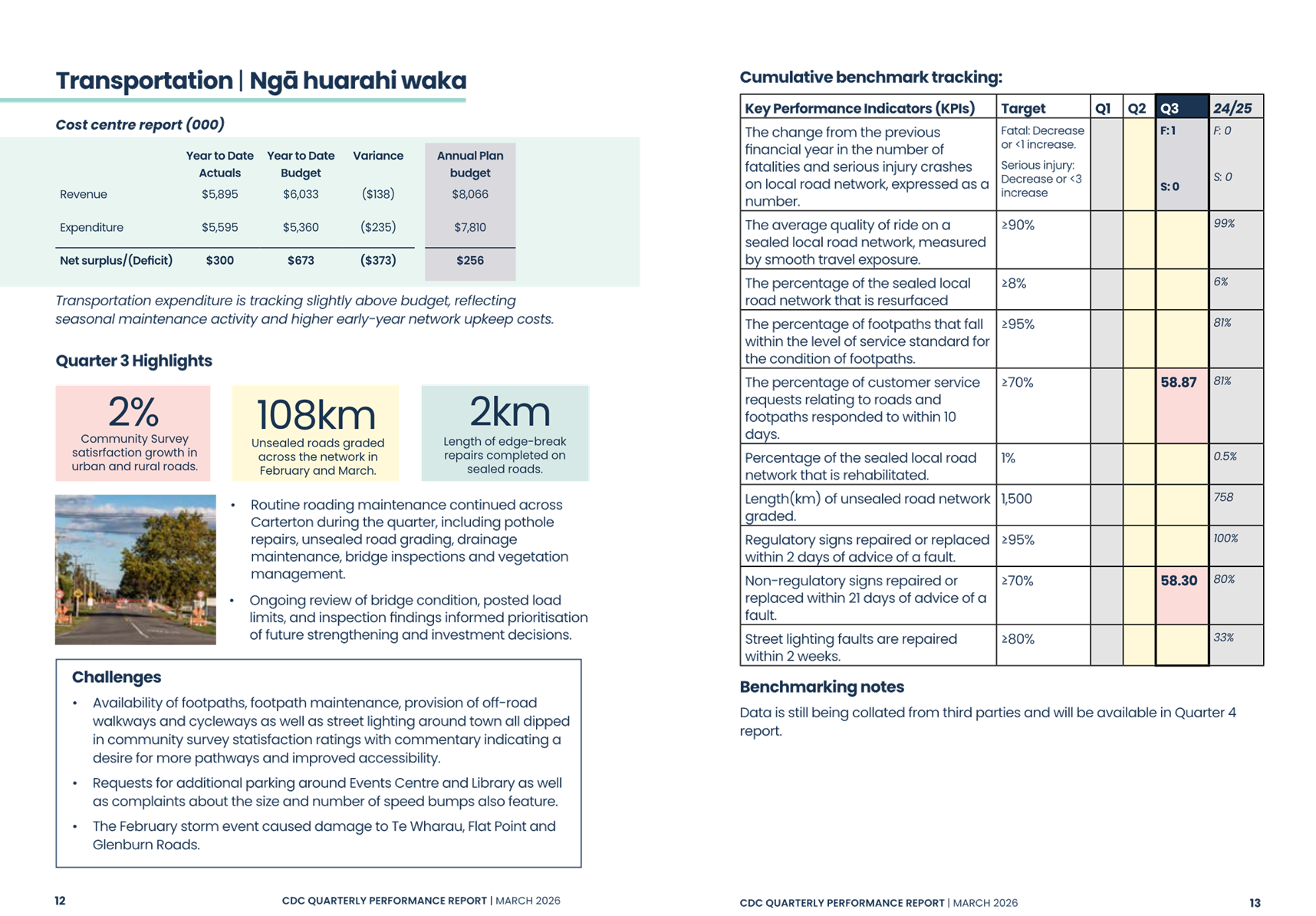
Ruamahanga Roads has been progressing well though there has
been pressure to manage the budgets with the weather events recently and
continue covering business as usual. The section 17A review report that was
discussed during the Policy and Projects Committee meeting on 22 April
indicated that the operation is functioning well and delivering a
cost-effective service.
It is planned to roll-over the combined maintenance
contract with Fulton Hogan for the final two-year period when it expires in
July 2027.
Emergency Events
There have been 2 emergency events in February and April
which has caused pressure for staff.
In the rain and winds on the 15-16 February, damage in
Carterton was only on these roads:
• Te Wharau Rd was worst affected with a road
closure for 3 days
• Flat Point
• Glenburn Road
The repairs were able to be accommodated within existing
budgets.
In the event on 20 April, the heavy rain caused damage in
Carterton on a number of roads, with an estimated response cost of $108,355.
This has triggered an emergency event funding claim with NZTA. The main roads
affected with flooding and slips were:
• Tea Creek Rd – significant erosion to the
abutment of the bridge crossing the Mangatarere River
• Te Wharau Rd
• Clifton Grove Road
• Ponatahi Road
• Dalefield Road
• Longbush Road
• Chester Road
• Te Kopi Road
• Mangatarere Valley Road
• Mt Holdsworth Road.
Waste
Minimisation
The
solid waste and minimisation operation continues to function as expected, with
no reported problems.
The
Solid Waste collection contract for the three Wairarapa Councils is due to
expire 1 July 2027. The contract renewal process is well underway with tender
responses received in March currently undergoing due diligence.
7. MAJOR
PROJECT UPDATES
The major projects
were discussed in more detail for the Policy and Projects Committee meeting on
22 April. There were no significant updates.
Waste
Water Treatment Plant: Sewage Sludge Composting Pilot Trial
The composting
programme has now entered the verification stage. Preliminary results have
shown that the process is expected to achieve Grade A1 biosolids and is on
track to be completed by June.
High
Street South Water Renewal
G&C Contractors
have completed 306m of 300mm Pipe and 492m of 50mm rider main, which takes them
up to Costley St. The available budget is scheduled for the pipe renewal to
progress to the intersection with Clifton Avenue (approximately a further 190m)
over the next 4 months.
Waste
Water Treatment Plant Inlet Works Upgrade
The project's scope is
to renew the inlet works to improve the effluent treatment processes before it
feeds into the oxidation ponds. The project is progressing well for the
detailed design phase with planned onsite construction scheduled to start in
September.
8. Corporate
Services
Corporate Planning
2027-2037 Long Term
Plan (LTP)
We have commenced
delivery of our LTP project with 82% of Phase 1 completed including the
following key activities:
• Project
establishment completed
• Councillor
workshops delivered:
o Environmental Scan
o Introduction to the LTP
o Strategic Direction, Growth
Projects & Significant Forecasting Assumptions
• Quality
Assurance review completed – project establishment
• Introduction
report to the Risk & Assurance Committee
Upcoming workshops for
May:
• Engagement
and Consultation Approach
• Business
Cases
• Fees
and Charges
Democratic Services
Local Government
Reform
On 5 May Ministers
Watts and Bishop announced a fast-track process to introduce local government
reform. The process seeks to speed up Council amalgamation processes with
a view to:
• Combining
regional and local council functions into a single organisation
• Reducing
duplication and simplifying decision-making
• Creating
a structure that works better at a regional or subregional level.
The announcement
provides a timeframe of three months for groups of Councils to submit a Fast
Track proposal to the DIA.
Carterton District
Council has been involved in ongoing discussions with neighbouring councils
about what potential amalgamation could look like, including both Wairarapa and
Wellington based options. The Fast Track announcement provides a clear timeline
to complete proposals and align District, City and Regional councils with the
upcoming legislative changes in Resource Management, Planning, Building and
Infrastructure.
As part of this,
Council will seek to better understand what Regional Council functions may be
affected with upcoming changes to the Resource Management Act. We will
also continue to engage with our neighbours in Masterton, South Wairarapa,
Wellington and Tararua as appropriate.
Wairarapa
Constituency Representative By-Election
A by-election will be
held due to the sudden passing of the GWRC Wairarapa Constituency
representative, Adrienne Staples.
Nominations open
Thursday 14 May and will close 11 June, and voting (if required) from Monday 20
July to Friday 21 August. Polling day will be Friday 21 August 2026.
This is a postal vote
with the additional use of orange voting bin(s) to deposit votes – one
will definitely be at the main council office.
Democratic Services
staff will receive nominations and issue special votes for those not on the
Electoral Roll, or who didn’t receive voting documents in the mail.
Customer
Services
We have now completed
a reorganisation of our customer services team and are currently undergoing
improvements to the front counter area at 28 Holloway Street to create
additional space and enable more streamlined, efficient service delivery for
our hapori (community). Our team will be based in the Events Centre while
the changes to the front counter areas are completed which is expected to be 3
weeks.
Māori
Liaison
In July the
Waikēkeno (Flat Point) Pou Whenua will be unveiled acknowledging the deep
cultural and historical significance of Waikēkeno to Ngāti Maahu,
recognising generations of occupation, connection, and kaitiakitanga in our
District.
Waikēkeno is a
place of long‑standing importance to Ngāti Maahu. Recognised as an
historic area, it once included a papakāinga, extensive gardens, and a
pā site of particular significance. The papakāinga was occupied until
the early 1940s, and the pā site was the location of an important battle
involving local iwi and iwi from the Wairarapa lakes area.
As with the Ngā
Tāwhai Reserve project, Carterton District Council staff worked closely
with Ngāti Maahu to ensure the history and significance of Waikēkeno
are properly recognised. This work sits within Council’s Telling Māori
Stories kaupapa and supports delivery of the Māori
Responsiveness Action Plan.
Throughout the
project, Ngāti Maahu were supported to connect with current landowners,
strengthening relationships and shared understanding of the whenua.
The Pou was designed
by Wayne Pitau. Due to the site conditions, alternative materials were
explored, leading to collaboration with Lower Hutt–based specialists
Tilley and Patton. Following extensive hui and designer discussions, the Pou
was produced using laser‑cut steel techniques.
The completed
Pou Whenua is a strong example of collaboration, combining cultural narrative,
contemporary design, and committed relationships. It stands as an enduring
acknowledgement of Ngāti Maahu history and ongoing kaitiakitanga at Waikēkeno.
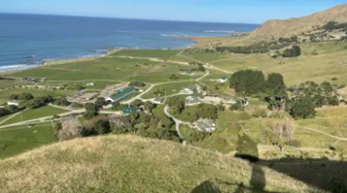
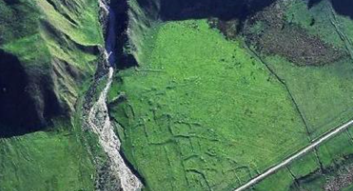
Waikēkeno (Flatpoint)
Waikēkeno
(Flatpoint) Historic Area
Information Systems
Information Systems
are current working producing efficiencies though the use of people and
technology.
A key focus is
ensuring new technology implementation (in all areas of council operations)
integrates with the existing technology solutions. Experience indicates
new technology is more effective and cheaper to implement when our IT team are
involved at the design stage.
Currently the team are
working with Central Hawkes Bay Regional council and MAGIQ software to release
a Community Engagement Application. The App aims to provide an additional
way for the community to engage with Council. Currently the App provides
a news and alerts feed, but also enables a Service Request to be logged.
Future developments will lead to additional online services for the community.
Emergency Management
Wairarapa Emergency
Management Capability Strategy
The three councils
have been working together to develop a regional strategy to lift staff
capability across the four Rs of EM. The 5year Strategy has a vision of
“a resilient Wairarapa where councils, iwi, communities, and partners
work together to prepare for, respond to, and recover from hazard or disaster
events”. It aligns with the Wellington Region EM Group Strategy, proposed
changes to the EM Bill (No.2), and using the CDEM Act 2002 and subsequent
amendments.
The Strategy has
already been adopted by Carterton and South Wairarapa District Councils, with
Masterton District Council expected to adopt in their next full council meeting
in May.
Global Fuel
Disruption
The
CDC Crisis Management Team continues to monitor the fuel disruption situation
with mitigations implemented to manage cost escalation and conserve fuel
usage. Further potential measures such as working remotely (for roles
that are able to) and delaying non-essential services may be considered should
the government escalate to higher Phase levels, however at this stage there is
no need for these.
Severe
Weather Events
Three significant
events impacted Wairarapa over the past three months:
• 16
Feb – Extreme weather event
• 12
Apr – Cyclone Vaianu
• 20
Apr – Extreme weather event
Each event required
activation of the Emergency Operations Centre (EOC) and while Cyclone Vaianu
didn’t impact Wairarapa directly, secondary impacts were still felt in
the region.
For the most recent
extreme weather event, a Wellington/Wairarapa State of Emergency was declared
at 1:30 pm on Monday 20 April and was terminated for Wairarapa on Friday 24
April at 5 pm.
The Wairarapa region
currently sits under a local transition period to allow for the transition to
recovery, enabling time to scope the full extent of the damage as the region
rebounds from another impact on our region. The transition notice lasts until
16:59 hrs on Friday 22 May 2026 and enables the Wairarapa Recovery Manager
extraordinary powers under the CDEM Act 2002 to manage, coordinate, or direct
recovery activities. These powers, designed for urgent, safe and
effective recovery, include the ability to clear roads, dispose of dangerous
materials, manage essential supplies and enter premises to examine
structures.
The Wairarapa Recovery
Office is being re-established working with key stakeholders operating in the
community to define the scope of the damage and assess what support, if any, is
required from local and central government, other funders, or other providers
to support impacted communities.
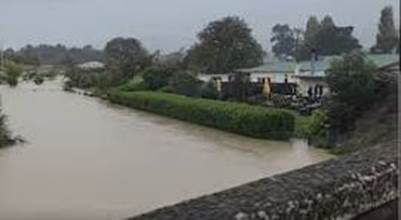
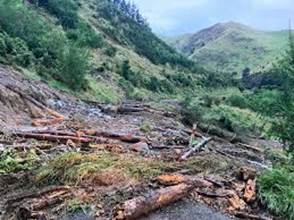
Flooding at Ruamāhanga River at Gladstone Inn Slip
at Mangatārere Valley Road
9. People
and Wellbeing
Our People
Onboarding/Offboarding:
• We
have had one person leave the council during this period to move to another
location with family.
• We
have had one person join the council during this period. Our Executive
Assistant to CE and ELT commenced 4 May 2026.
Recruitment:
• Assistant
Accountant – recruitment not yet started (pending position description
sign off).
• Events
Assistant (part-time) – currently being interviewed. To backfill internal
promotion.
Organisational structure:
The phased approach to reviewing Council’s
organisational structure continues. When a position becomes vacant, we
take the opportunity to review the role and its responsibilities thoughtfully.
This is balanced with maintaining our required levels of service.
A review has been completed of the Customer
Services/Administration Team, and a new structure commenced 4 May 2026. The new
centralised function aims to improve service levels and provide more effective
support across all of Council.
Staffing levels:
• Current
approved headcount is 81: includes 2 fixed-term roles externally funded.
• At
the time of writing, total Full Time Equivalents (FTE) is 75.26 (FTE provides a
clearer picture of the total workload by accounting for both full-time and
part-time employees, reflecting actual hours worked. This more nuanced measure
is more reflective of resource allocation).
• These
figures include any vacancies.
Current projects:
• Emergency
Management training - Under the Civil Defence Emergency Management Act 2002,
council staff have a legal obligation to support emergency readiness,
reduction, response and recovery efforts. We have put a focus on enrolling
staff to complete training at Foundation and Intermediate level to further
enable us to fulfil this obligation.
• Organisational
values review – final stage. Updated values now confirmed and the design
and roll out phase will commence this month
• Staff
training modules design and delivery, including review of online training
modules and pathways.
• Implementation
of HR software platform – data set-up phase now completed. Admin user
training will commence this month.
• Waitī
(Local Waters Done Well) transition programme - Organisation, People and Change
work group. Focus for current quarter is the development of the staff
transition guidelines (pathways into the new entity).
Health & Safety
(H&S)
The
main focus of activities for the reporting period February - April has
been creating and reviewing Standard Operating Procedures (SOP’s) with
training competency checklists, continuing the “Values” project, and
maintaining staff wellbeing.
The
HS&W Advisor has been working with the Parks & Reserves Team to review
existing and create new SOPs that align with Worksafe guidelines.
Training on the new guidelines will be provided to new staff, with refresher
training for all other staff.
The
P&W Team have led a significant project to develop organisational values. Input
from the majority of staff was gathered, and following the completion of
voting, the Executive Leadership Team (ELT) has signed off on the proposed
values. These values will soon be communicated and integrated into the
Council’s practices, establishing a shared vision for collaboration and
clear standards of expected behaviour.
Maintaining good
physical and mental wellbeing means staff can perform at their best.
Wellbeing activities included flu and COVID-19 vaccinations and a shared
‘pot luck’ curry lunch catered by staff members.
For
the reporting period a total of 13 incident reports were received:
• Seven pain and discomfort reports were received. All injuries
were of a minor nature, with no one requiring time off work.
• One damage report. A stone flicked off a tractor mower and
broke a shop window.
• Four near miss reports included two of customer abuse.
10. Communications
and engagement
11. CONSIDERATIONS
11.1 Climate change
Considerations have been noted in the
report, as appropriate.
11.2 Tāngata whenua
Considerations have been noted in the report, as appropriate.
11.3 Financial impact
Considerations
have been noted in the report, as appropriate.
11.4 Community
Engagement requirements
Considerations
have been noted in the report, as appropriate.
11.5 Risks
Considerations
have been noted in the report, as appropriate.
12. Recommendation
That the Council:
1. Receives
the report.
File
Number: 506594
Author: Geoff
Hamilton, Chief Executive
Attachments: Nil

8.5 Adoption
of Annual Plan 2026/2027
1. Purpose
For Council to
consider and adopt the draft Annual Plan 2026/27.
2. Significance
The
matters for decision in this report are not considered to be of significance
under the Significance and Engagement Policy.
3. Background
Council
adopted the 2024–2034 Long-Term Plan (LTP) in 2024 following the required
Special Consultative Procedure and extensive community engagement. Annual Plans
are then prepared in Years 2 and 3 of the LTP cycle to confirm the relevant
year’s budgets, funding impacts, and service delivery assumptions, while
incorporating any necessary updates since adoption of the LTP.
At
its meeting on 18 February 2026, Council considered the engagement approach for
the 2026/27 Annual Plan and determined that the proposed changes from the
2024–34 LTP were not sufficiently material to require formal consultation
under the Local Government Act 2002.
The
key changes reflected updated financial assumptions, revised operational and
capital programme information, and the continuation of funding waters
depreciation at 50% for 2026/27. These changes did not alter levels of service
or breach prudence benchmarks and were considered temporary in nature ahead of
the proposed transition to Waitī Waters from 1
July 2027.
Accordingly,
Council resolved to adopt an “inform only” engagement approach for
the 2026/27 Annual Plan process.
At
the Risk and Assurance Committee meeting held on 6 May 2026, the Committee
considered the Draft Annual Plan 2026/27 and recommended Council adopt the
draft Annual Plan 2026/27 at its next meeting on the 13 May 2026, subject to
final minor amendments. Those amendments have now been incorporated into the
final draft version of the Annual Plan 2026/27 (Attachment 1).
4. Discussion
Annual
Plan Position
The
review and refinement process for the Draft Annual Plan 2026/27 has been
completed and is now ready for adoption.
The
document incorporates updated financial modelling, revised assumptions, and
adjustments identified through the 2025 Annual Report process and subsequent
budget reviews. These updates ensure that Year 3 of the LTP reflects the most
current operational and financial information available.
The
principal amendments from the original LTP forecasts include:
· Resetting the financial base position following completion of the
Annual Report 2025.
· Updating opening balances for loans, reserves, and capital
programmes.
· Aligning Transportation budgets with the latest NZTA National Land
Transport Programme allocations.
· Reviewing operational expenditure across activities to identify
savings and efficiencies.
· Continuing the approach of funding waters depreciation at 50% for
2026/27.
· Updating interest rate and insurance assumptions to reflect current
market conditions.
Rates
Impact
The
2024–34 Long Term Plan provided for an average rates revenue increase of
5.8% for the 2026/27 year (4.3% after growth).
Following
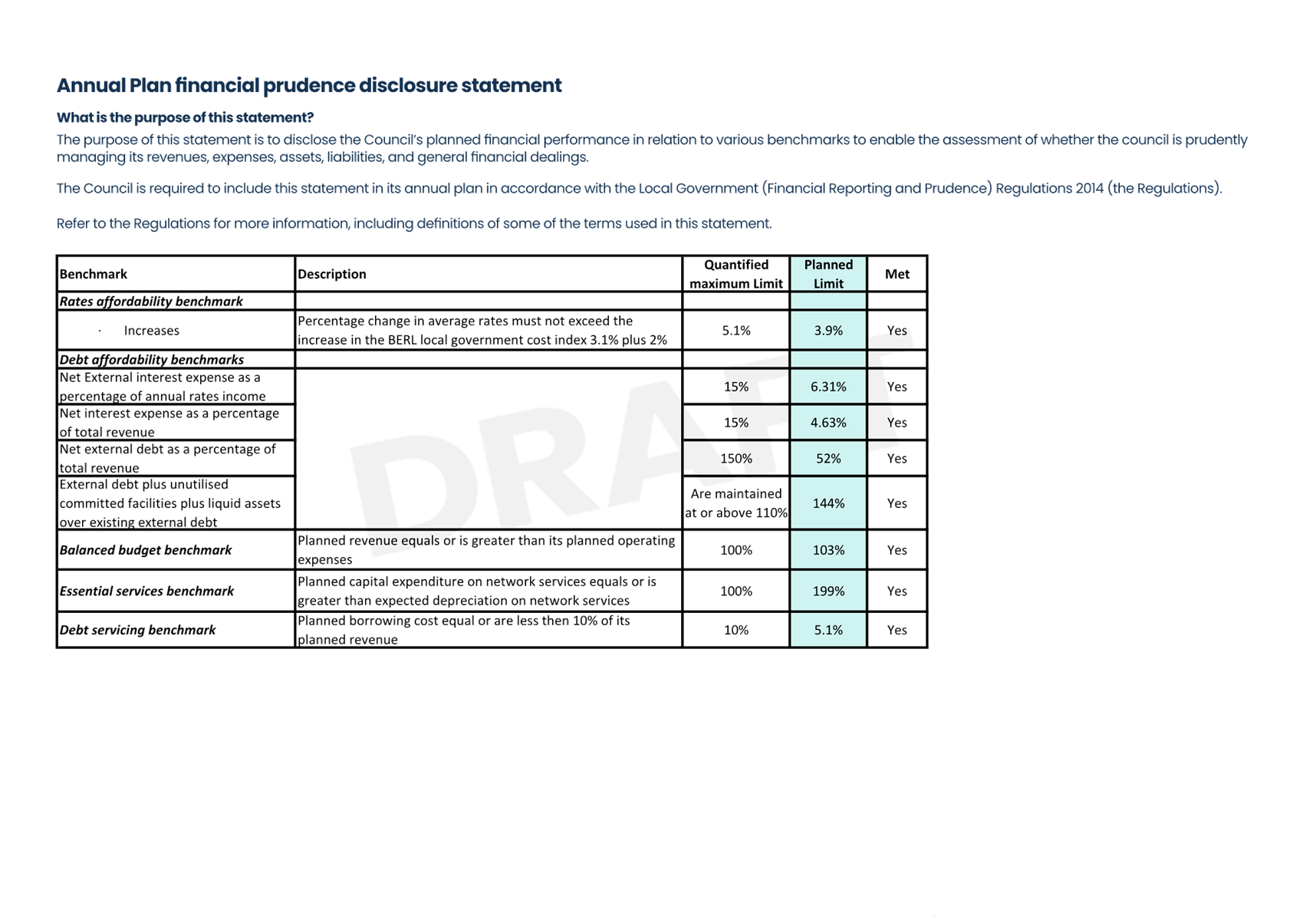
updated assumptions and budget refinements through the Annual Plan process, the
proposed Annual Plan 2026/27 forecasts an average rates revenue increase of
3.9% (3.2% after growth).
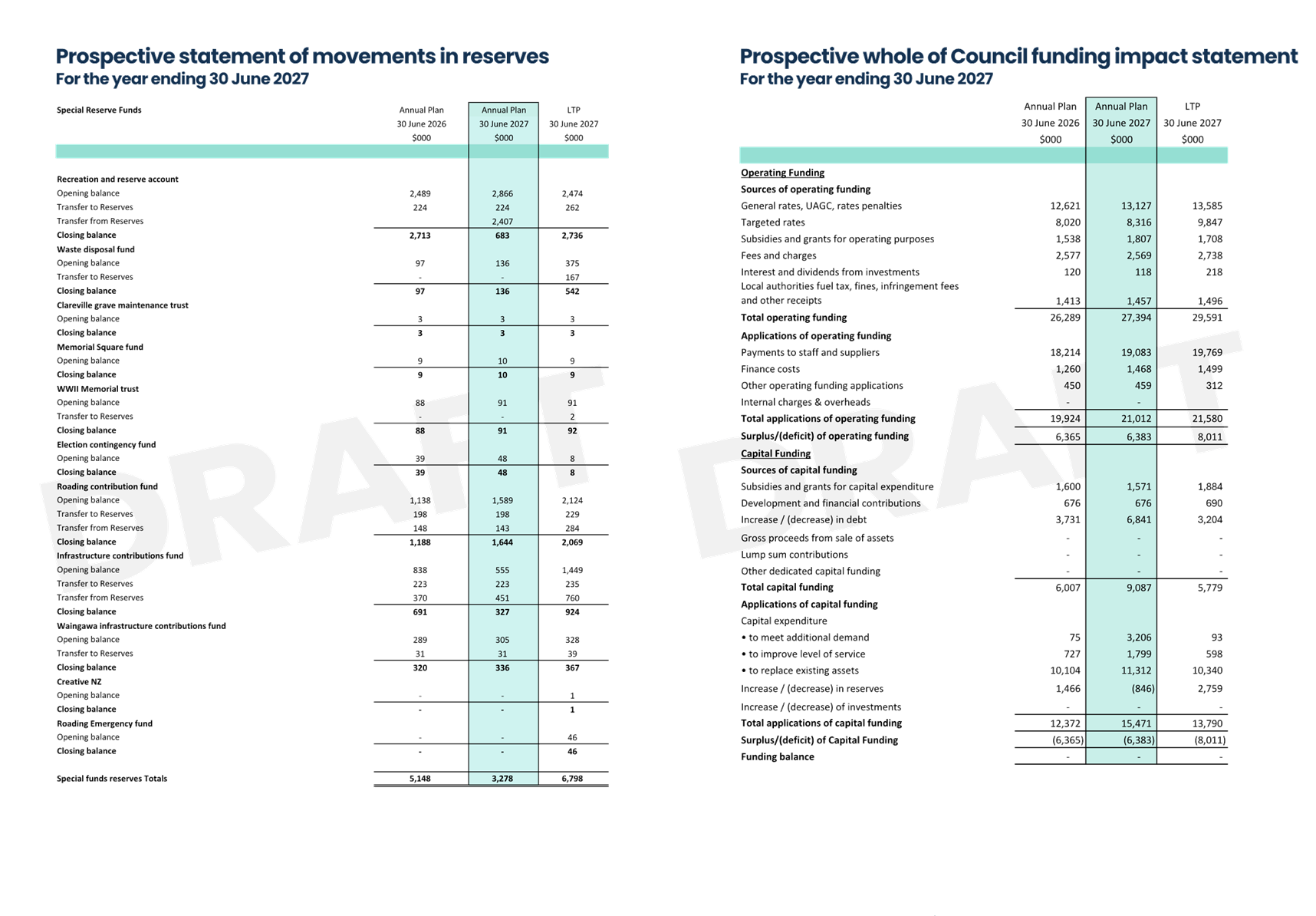
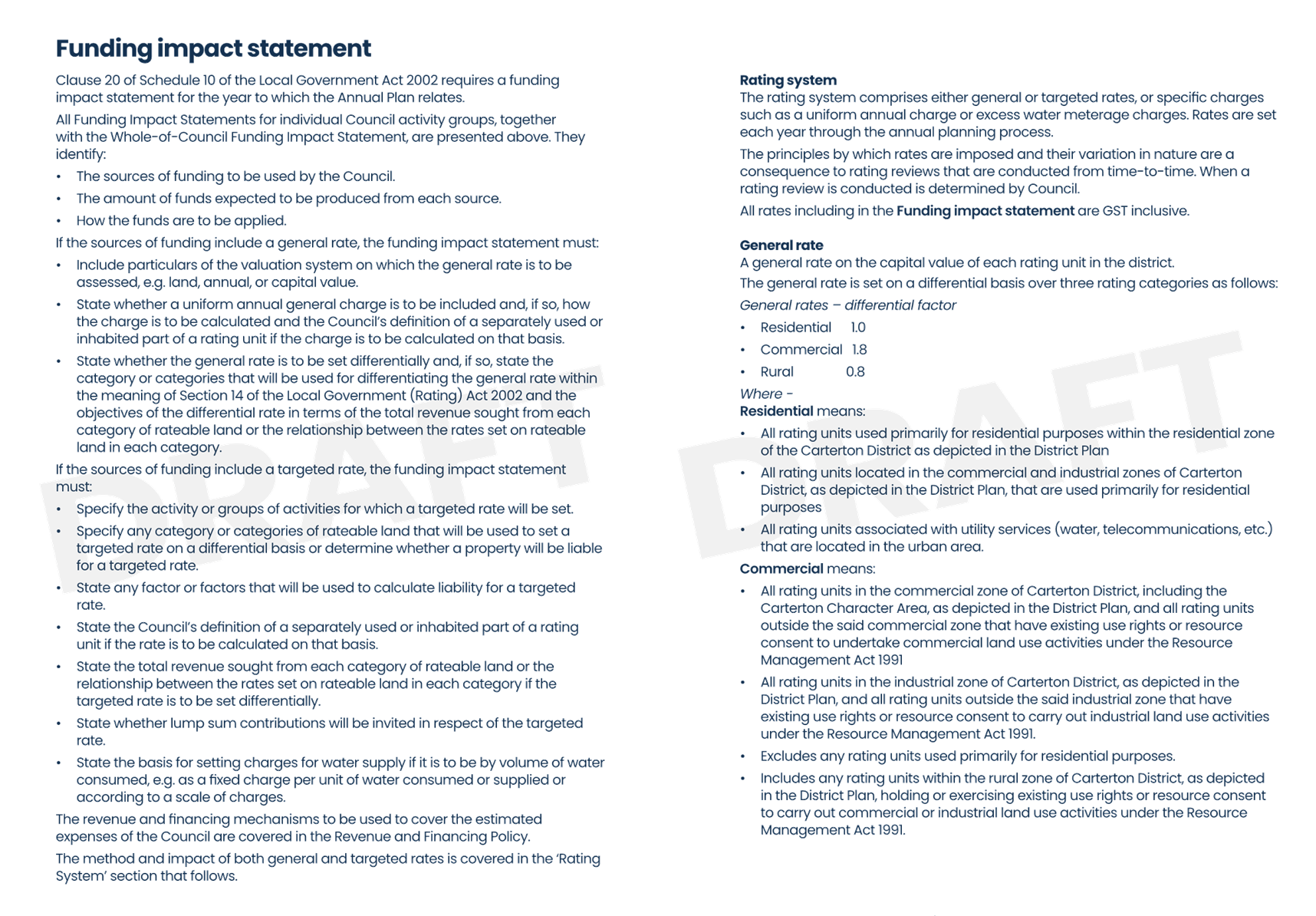
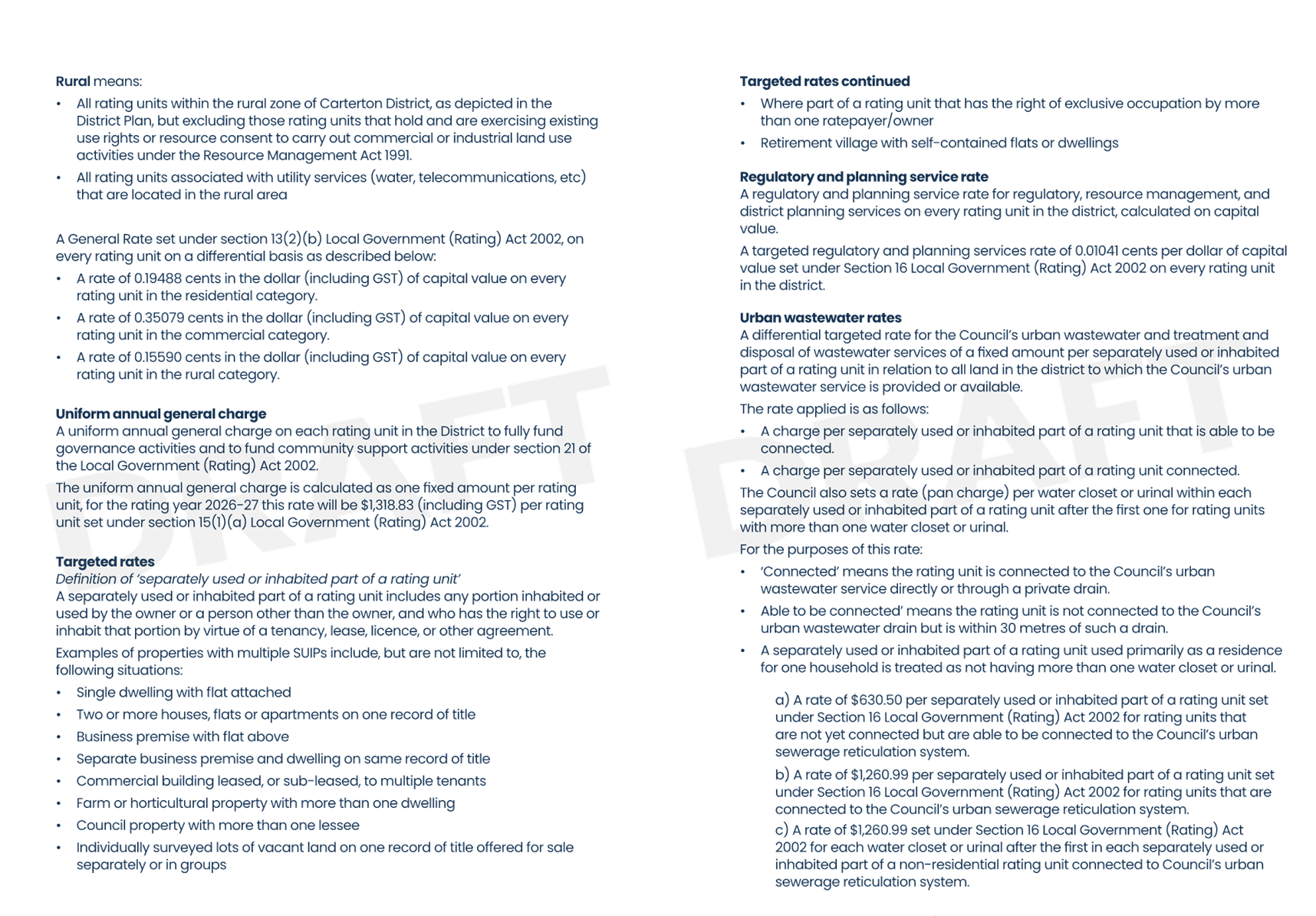
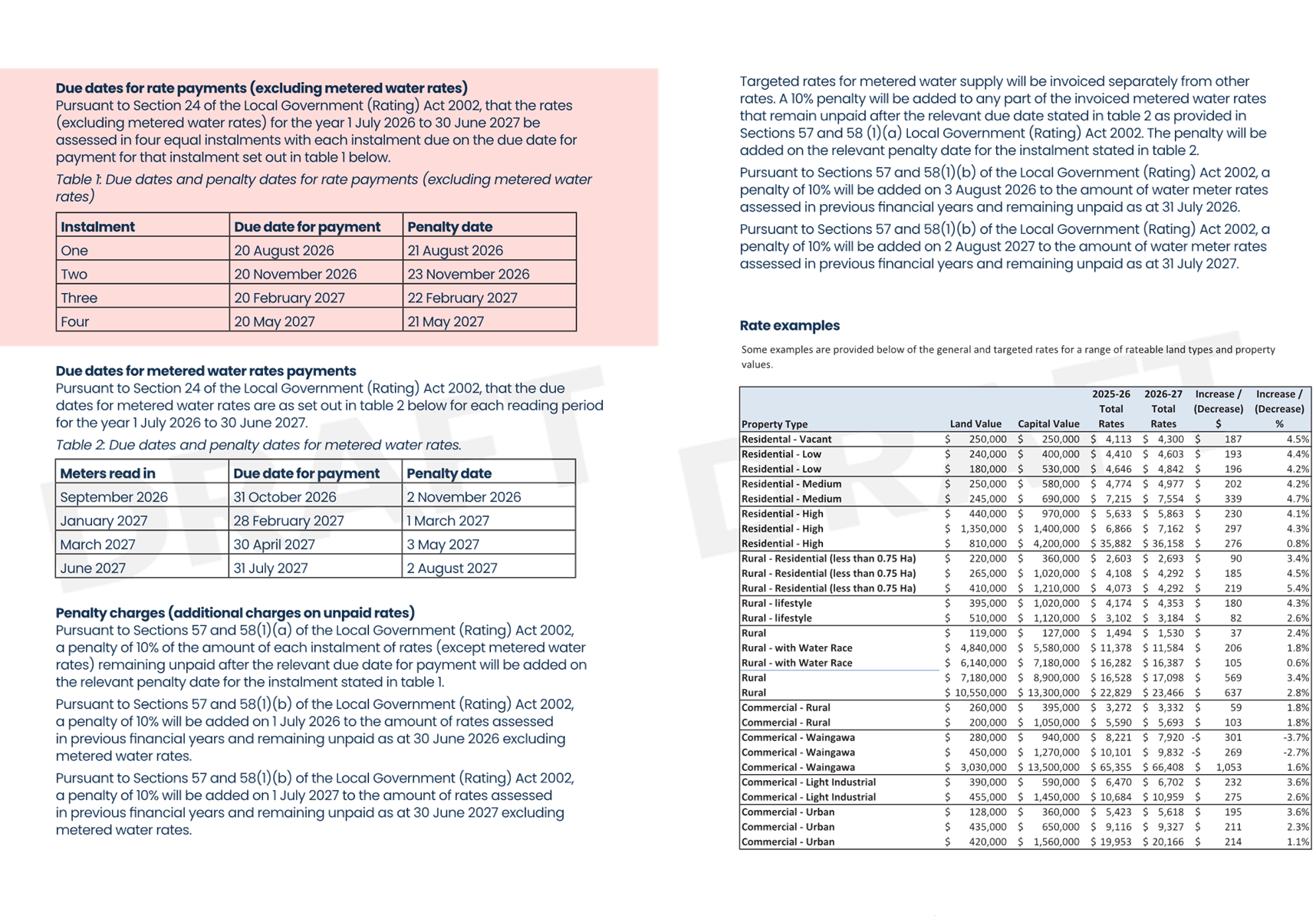
The Funding Impact Statement and rating examples are set out in Attachment
1.
As
previously noted, the rates increase outlined above excludes any Greater
Wellington Regional Council rates, which are set independently by Greater
Wellington Regional Council and collected by Carterton District Council on its
behalf.
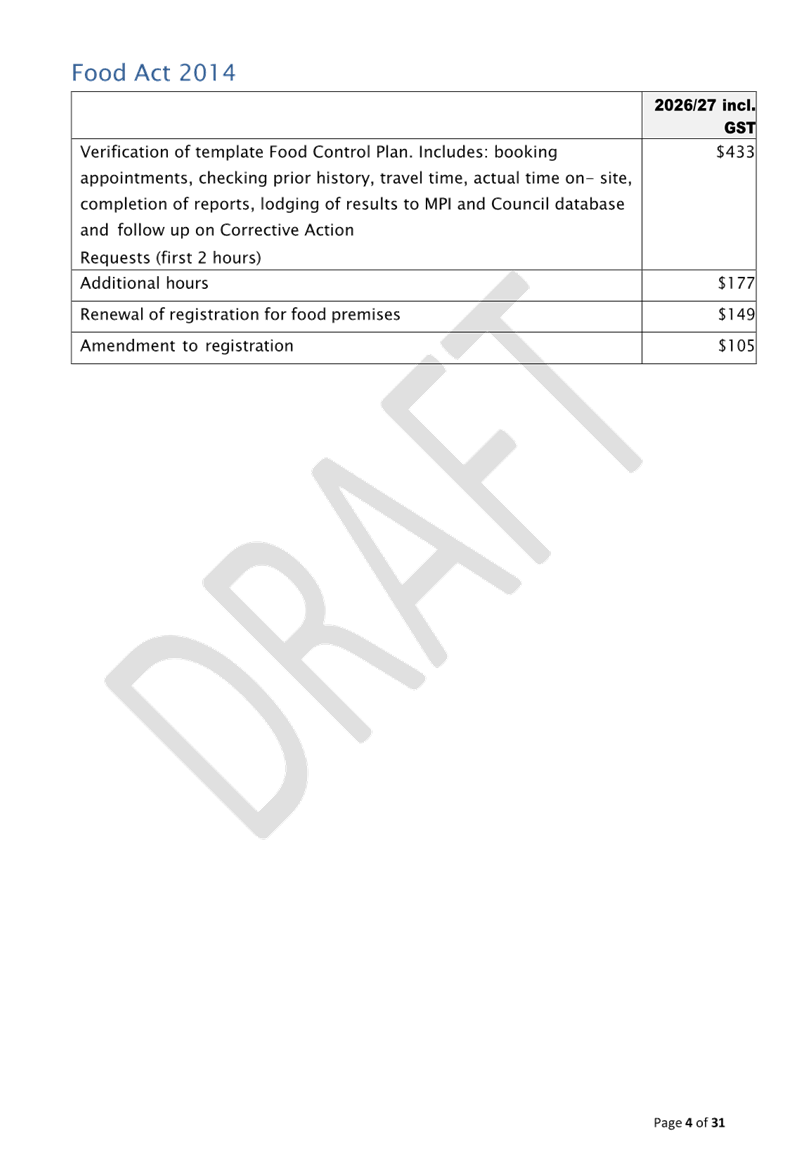
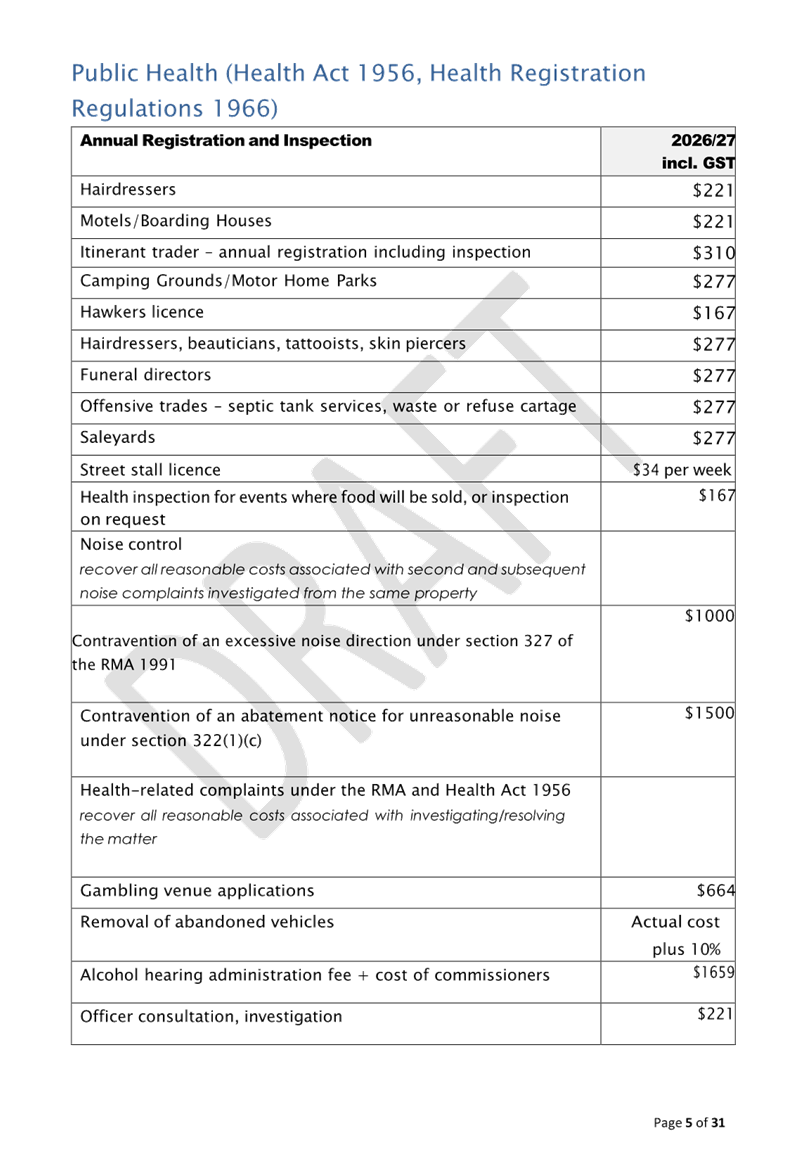
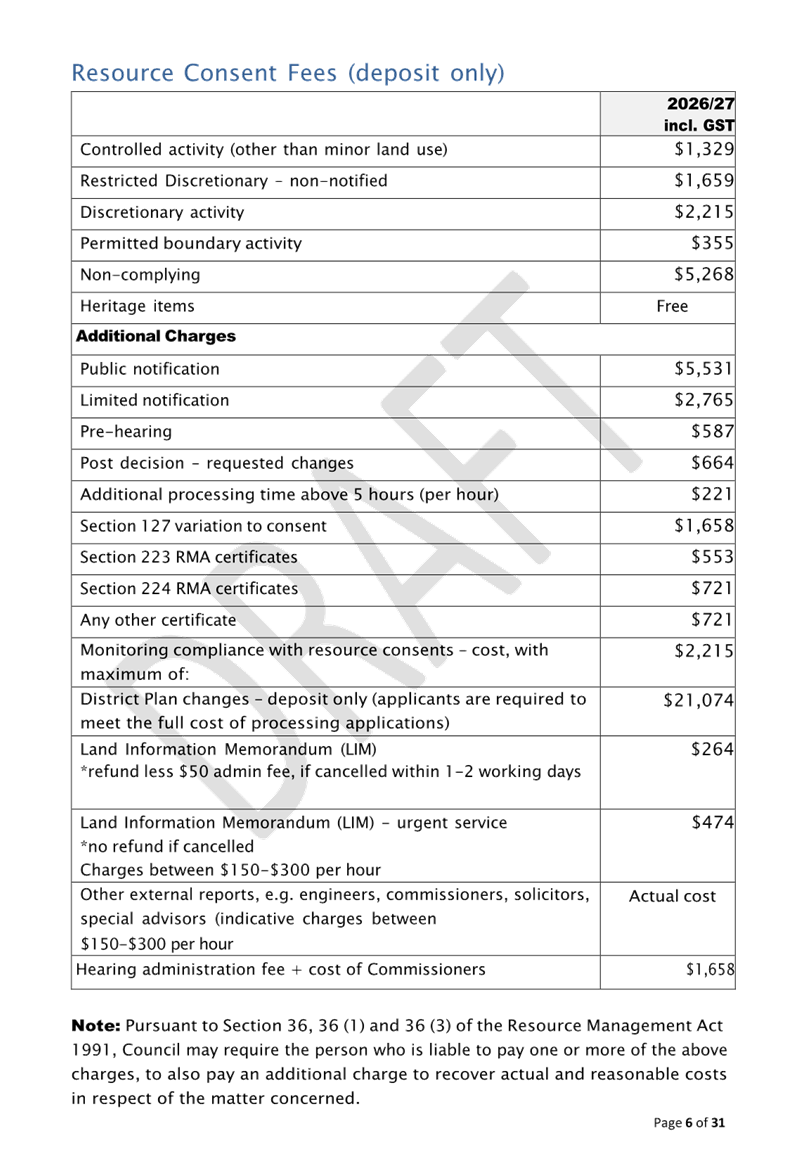
Fees and Charges
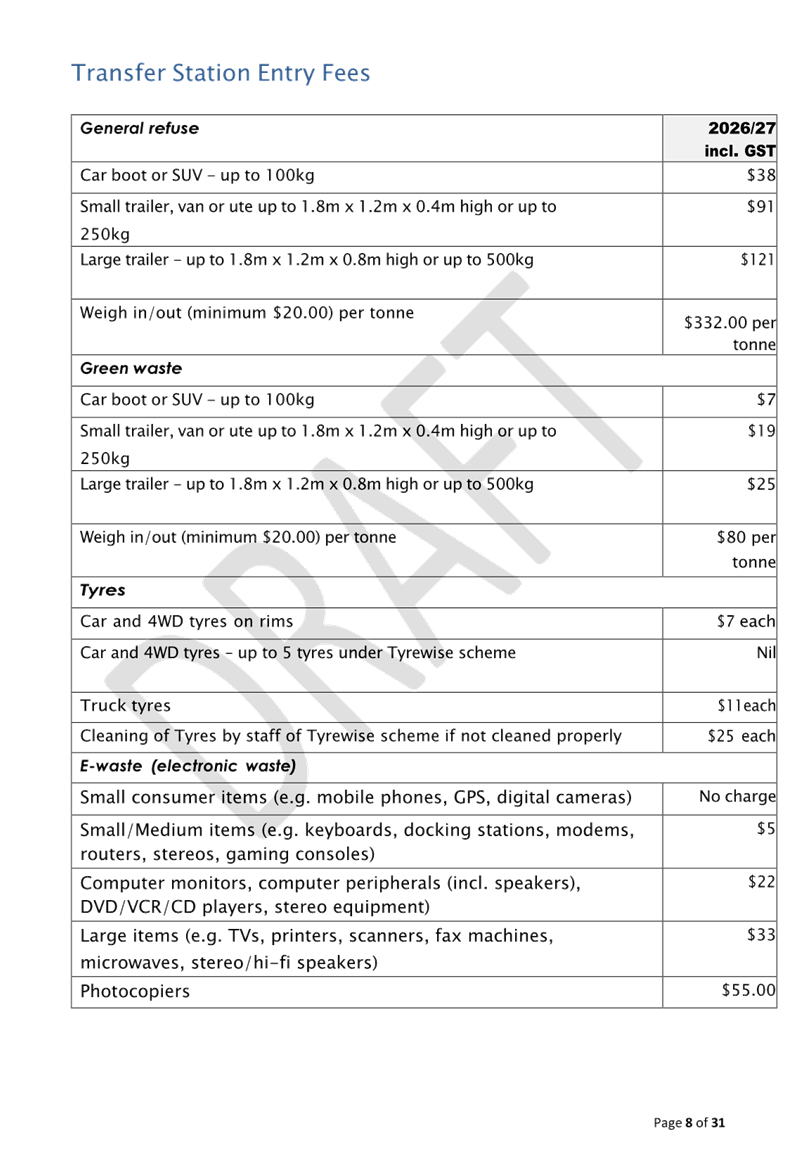
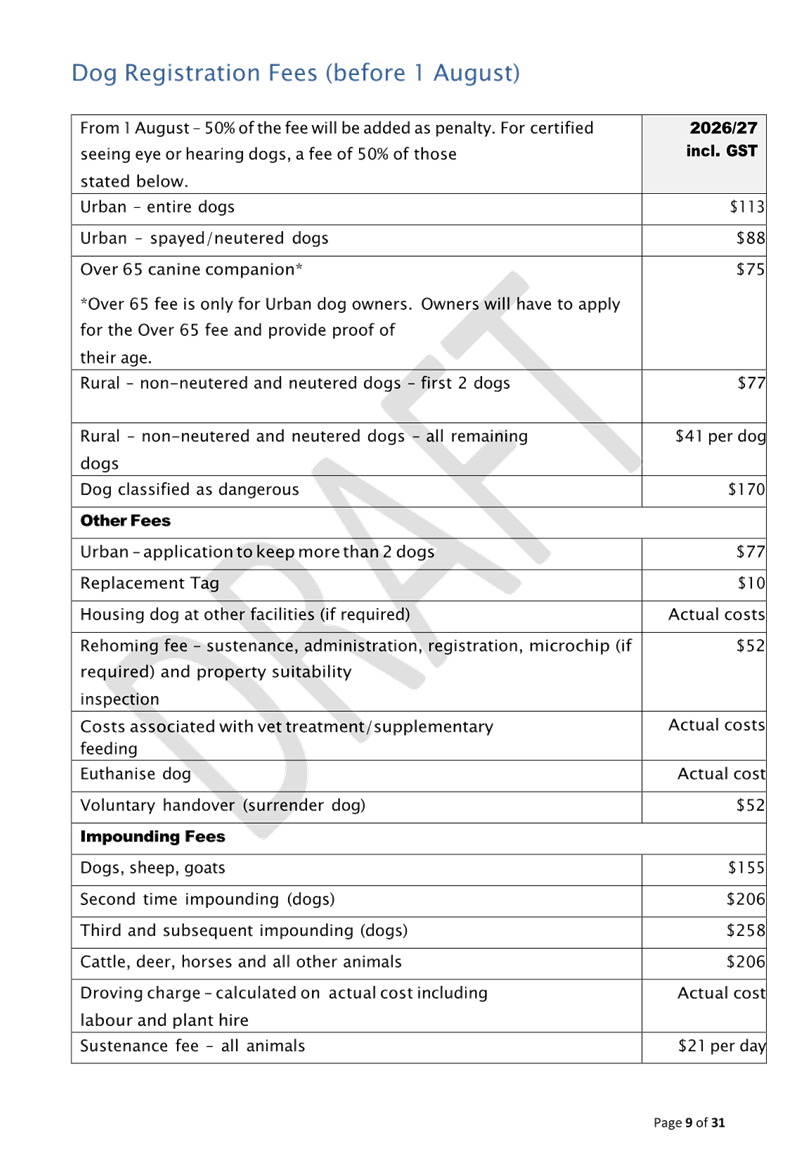
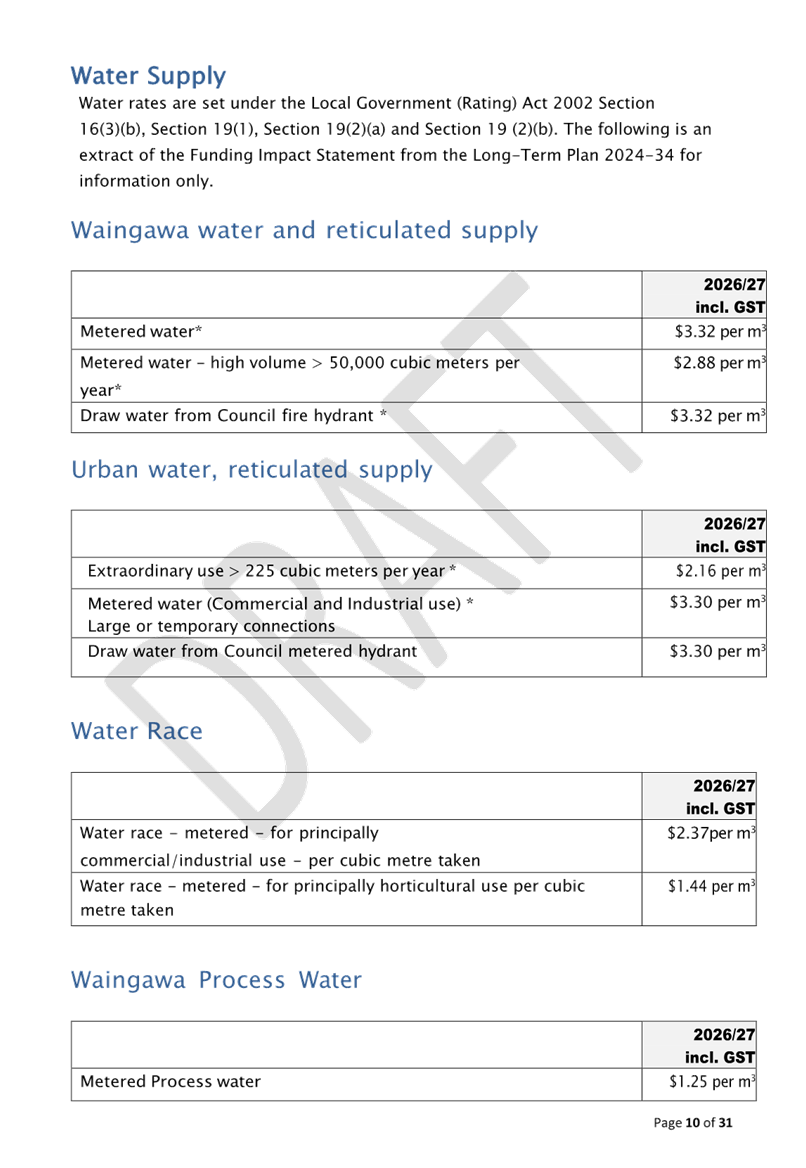
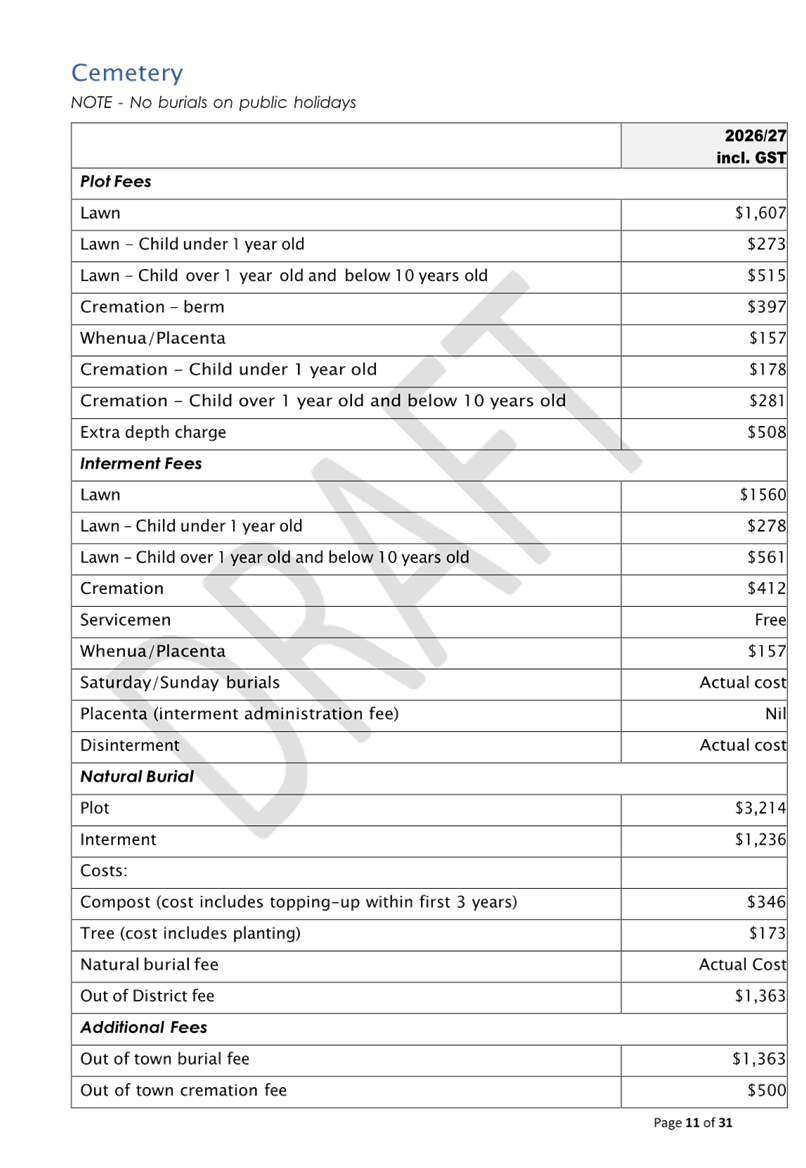
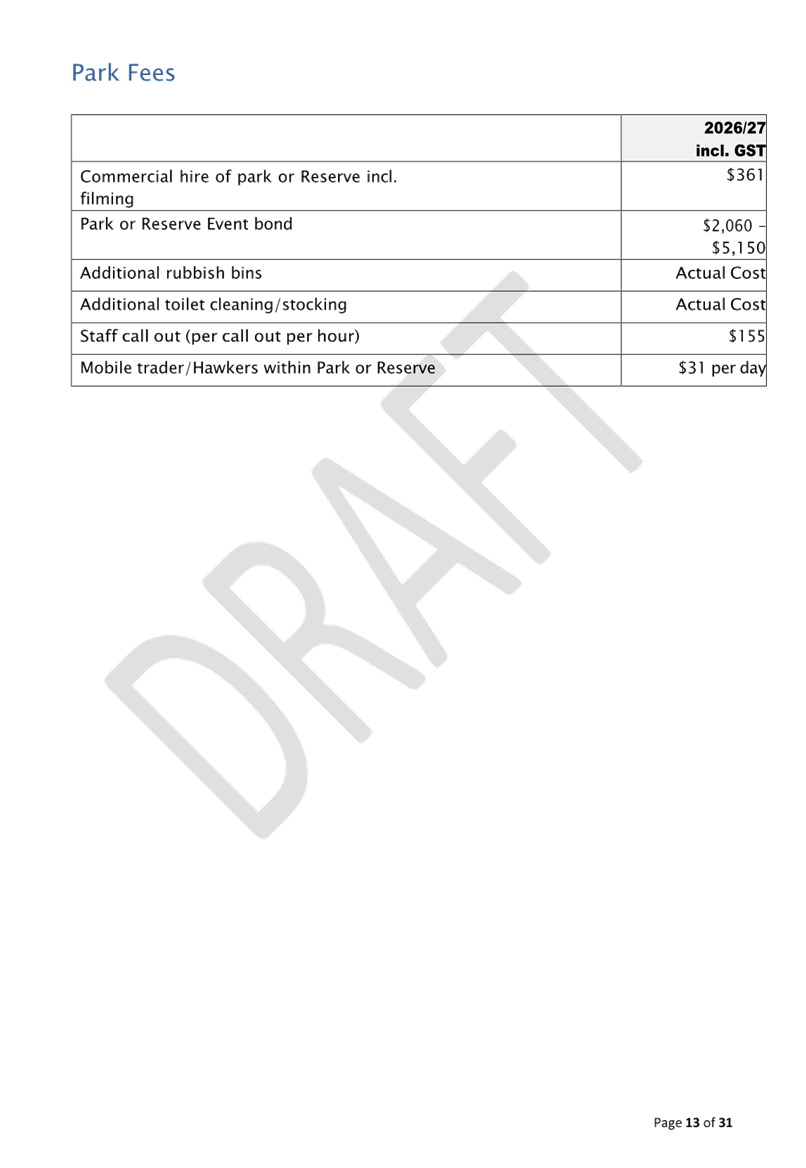
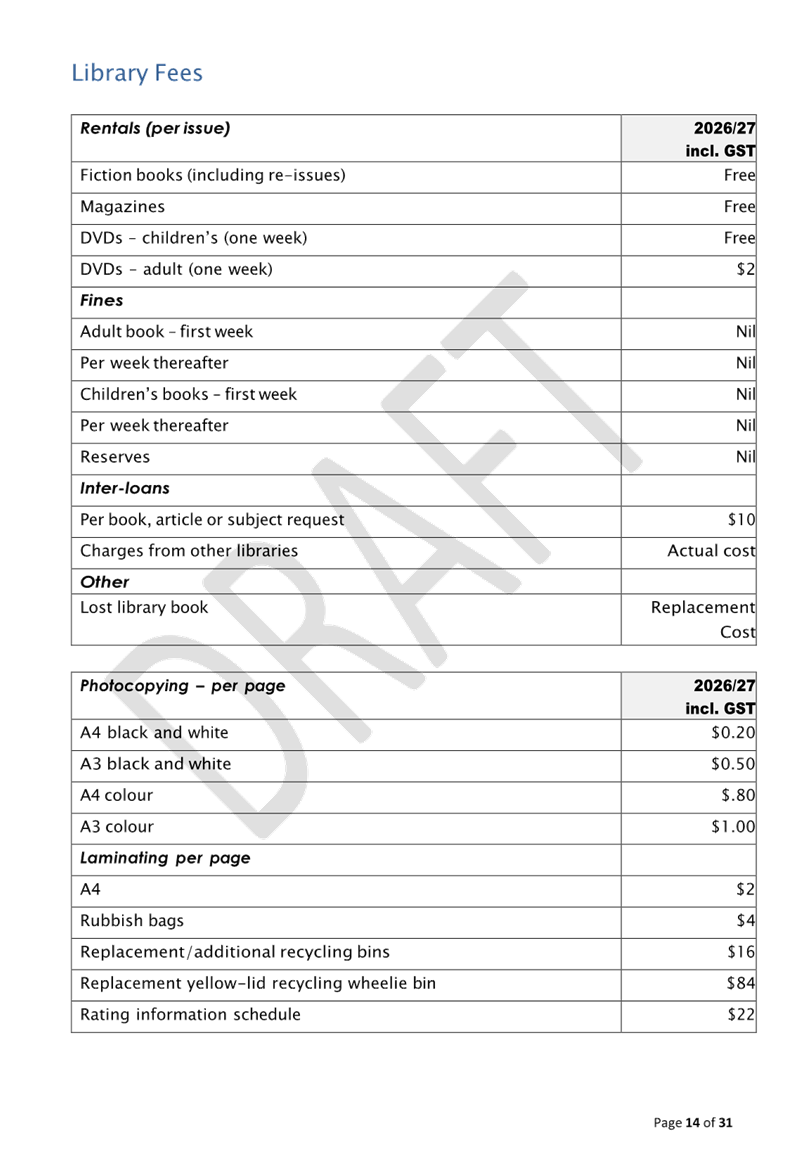
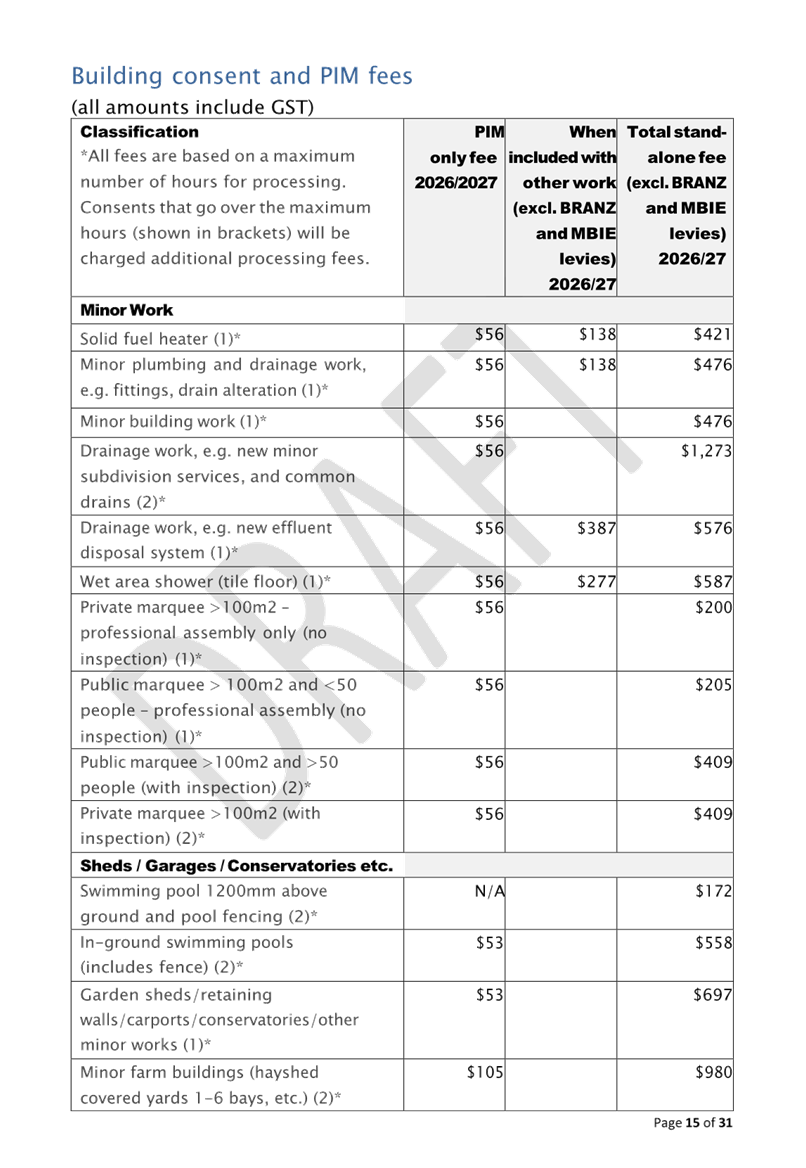
The
proposed Fees and Charges schedule has been finalised and can be found in Attachment
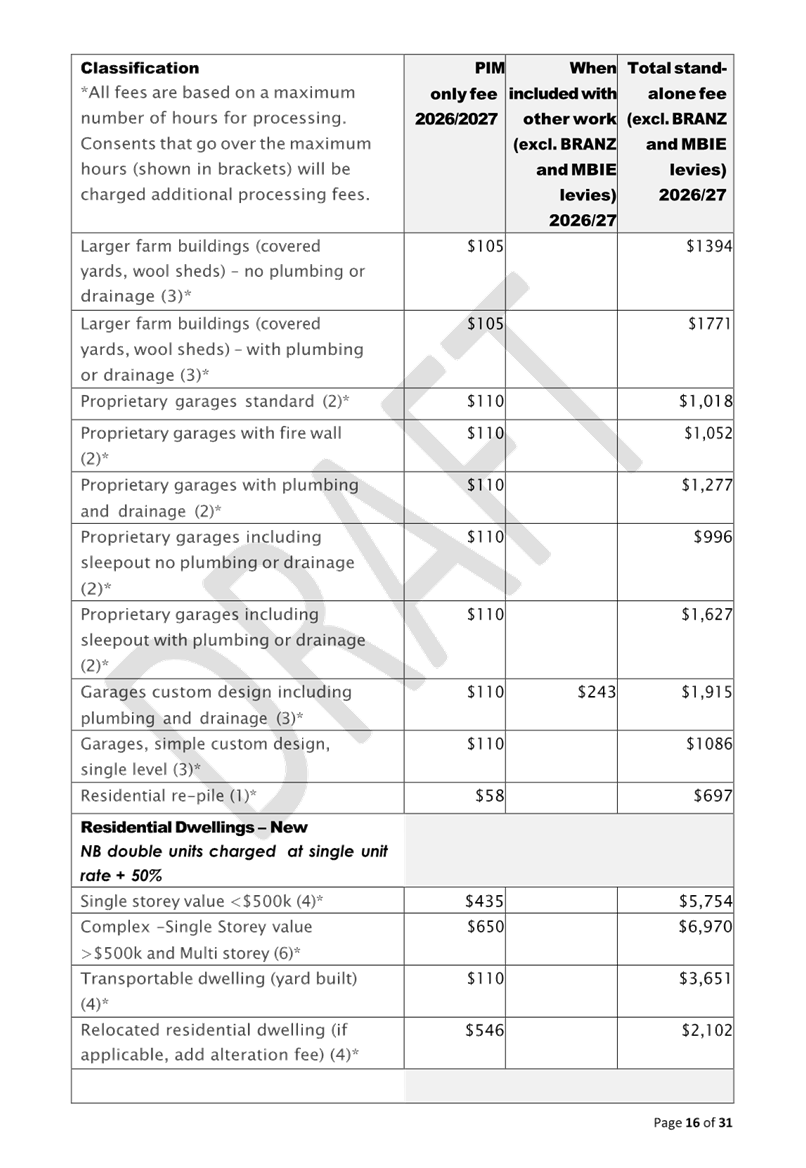
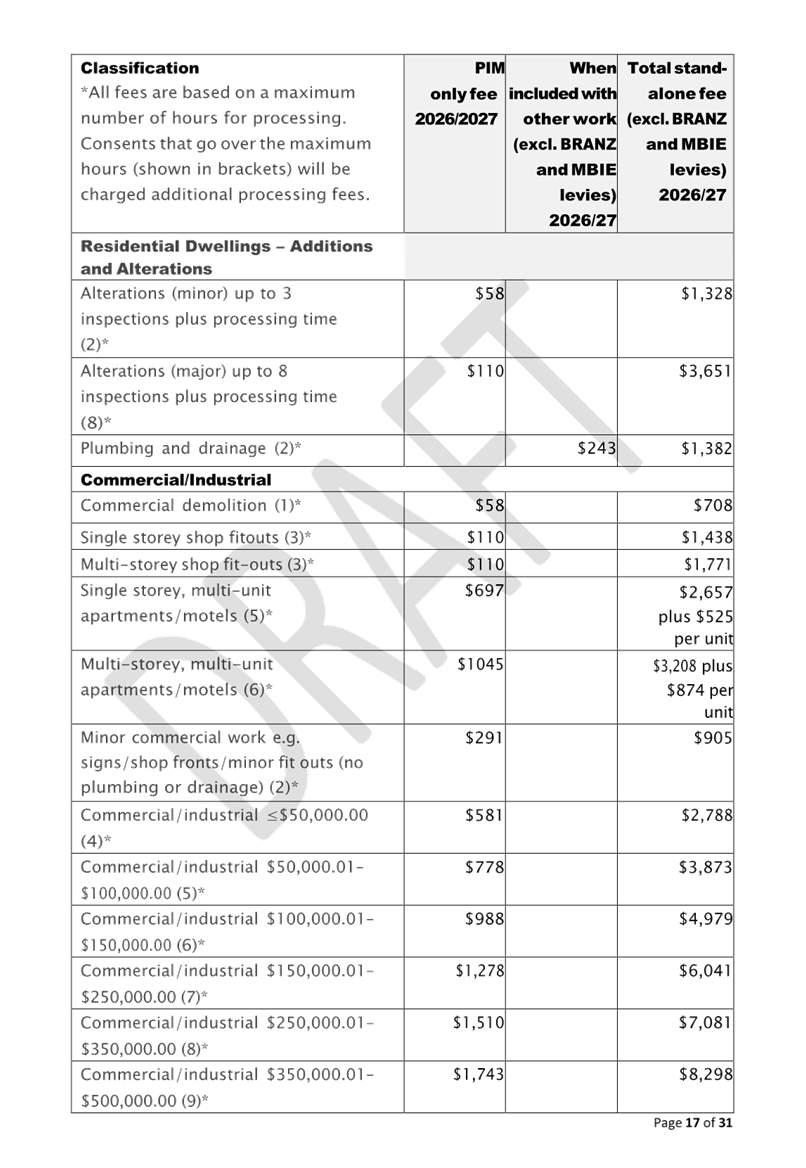
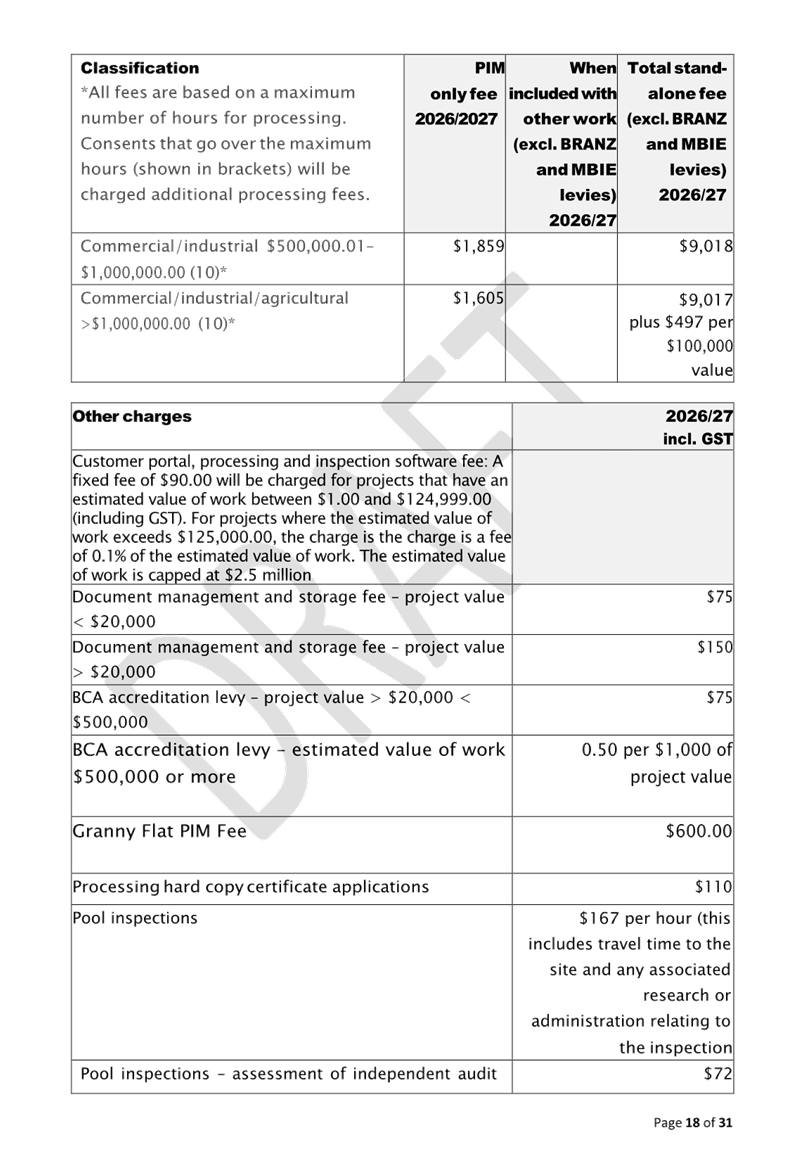
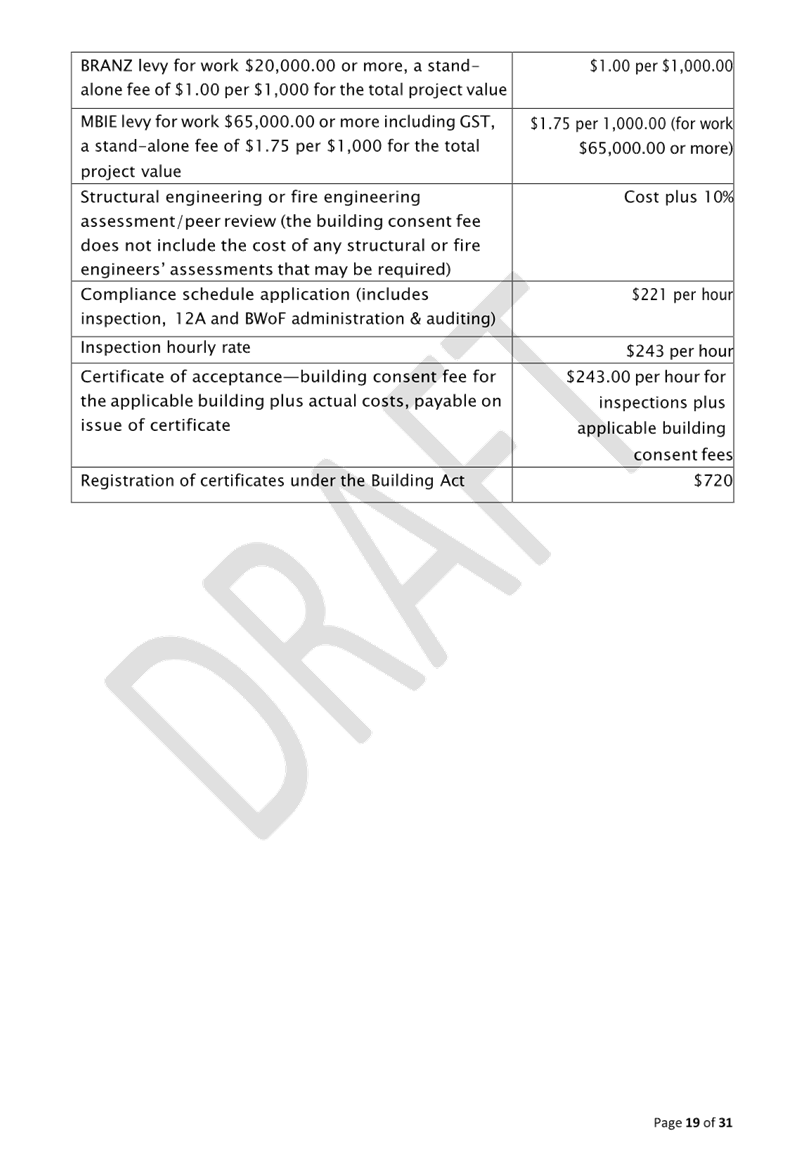
2.
In
general, fees and charges have been adjusted by approximately 3% (incl. GST) to
reflect inflationary pressures, except where charges are prescribed or
constrained by legislation, external agreements, or other regulatory
requirements.
5. Next
Steps
Consideration
and adoption by Council of the Final Draft Annual Plan 2026/27.
6. CONSIDERATIONS
6.1 Climate change
There
are no climate change considerations.
6.2 Tāngata whenua
There
are no specific considerations related to tāngata whenua arising from the
decisions in this report.
6.3 Financial impact
The
financial implications associated with the Draft Annual Plan 2026/27 are
incorporated within the document itself. No additional financial implications
arise from this report.
6.4 Community Engagement requirements
Council
previously considered community engagement requirements at its meeting on 18
February 2026 and determined that formal consultation on the 2026/27 Annual
Plan was not required.
6.5 Risks
The risks associated
with the Annual Plan process continue to be managed through Council’s
established governance, financial review, and quality assurance processes.
7. Recommendations
That the Council:
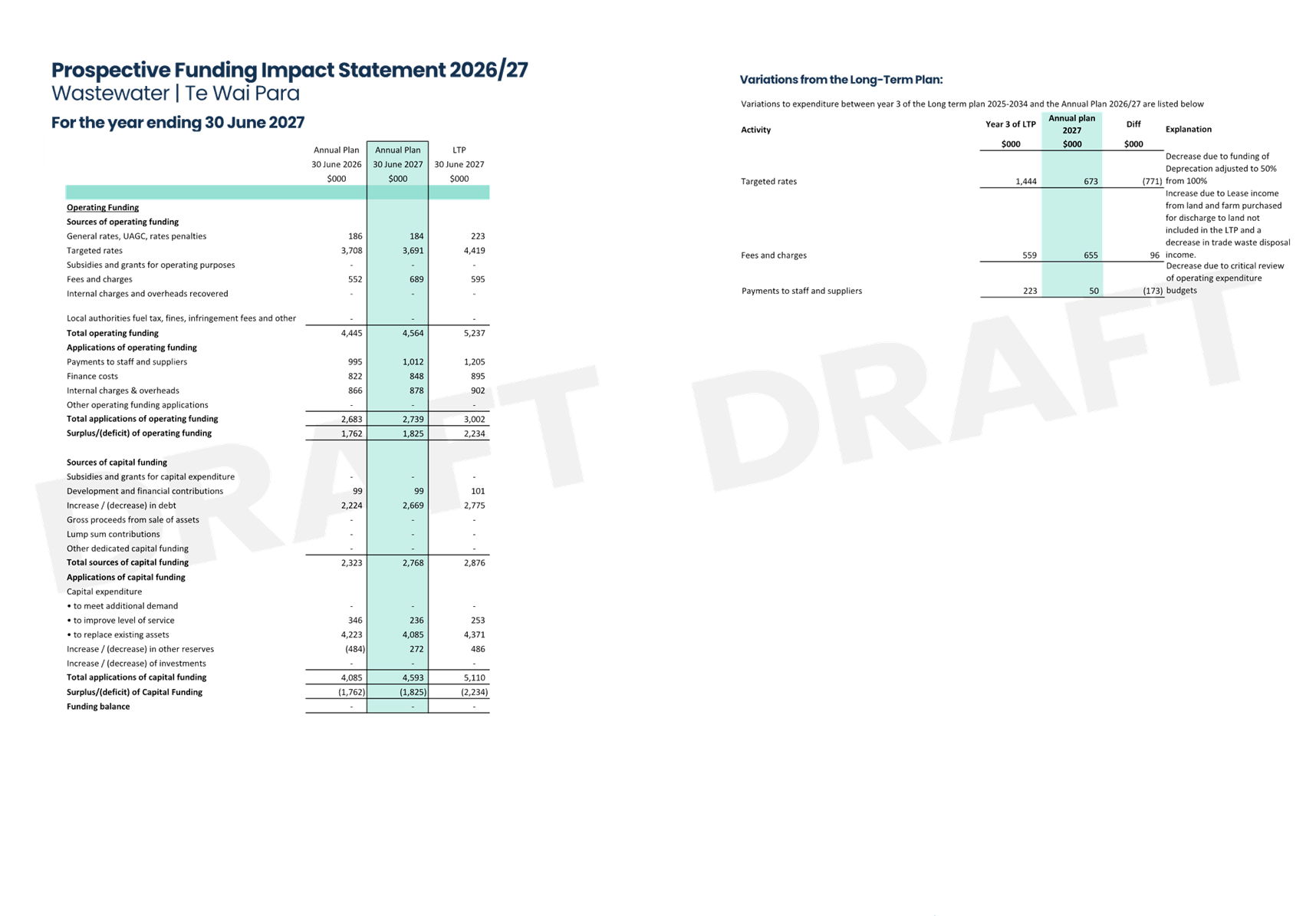
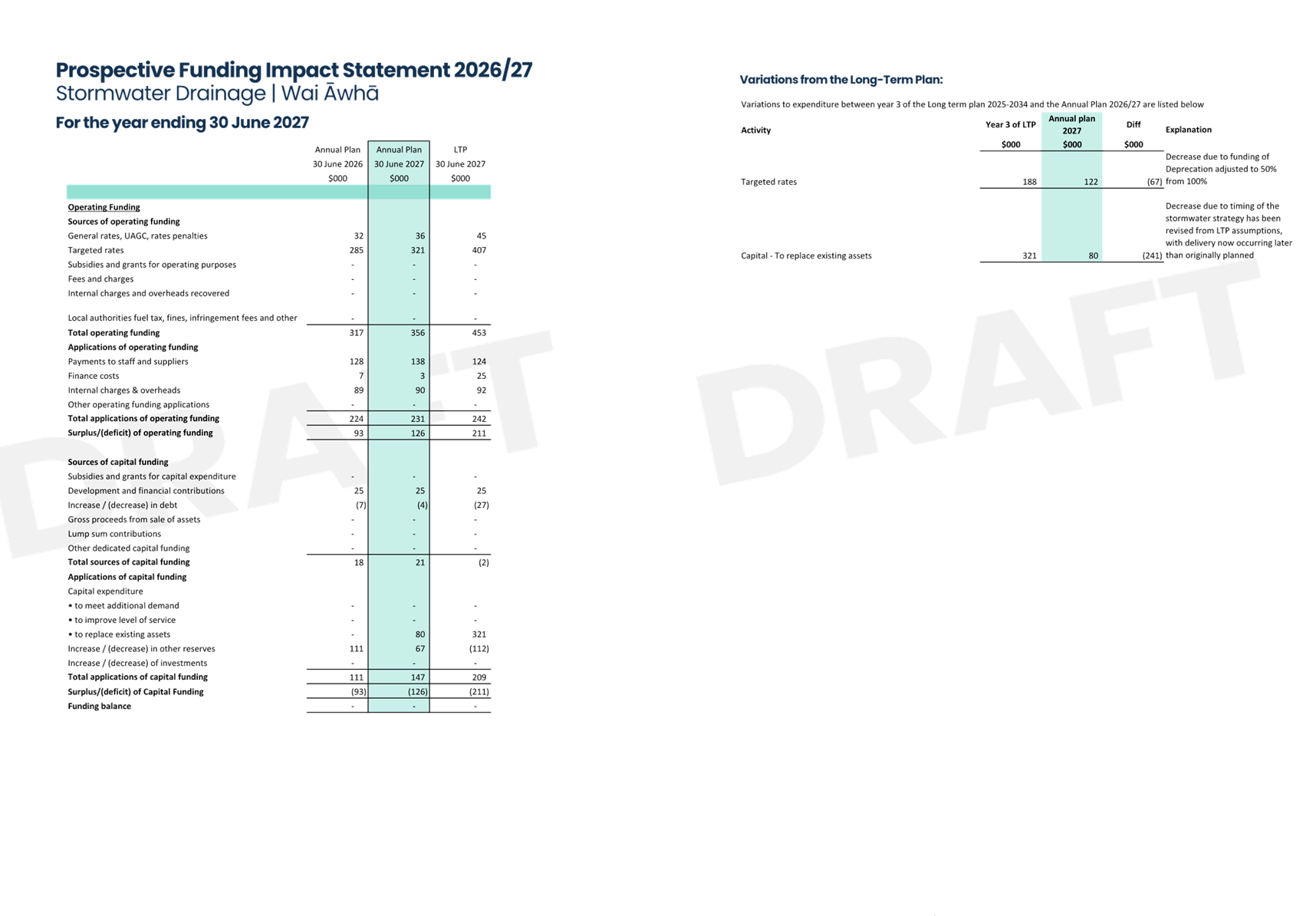
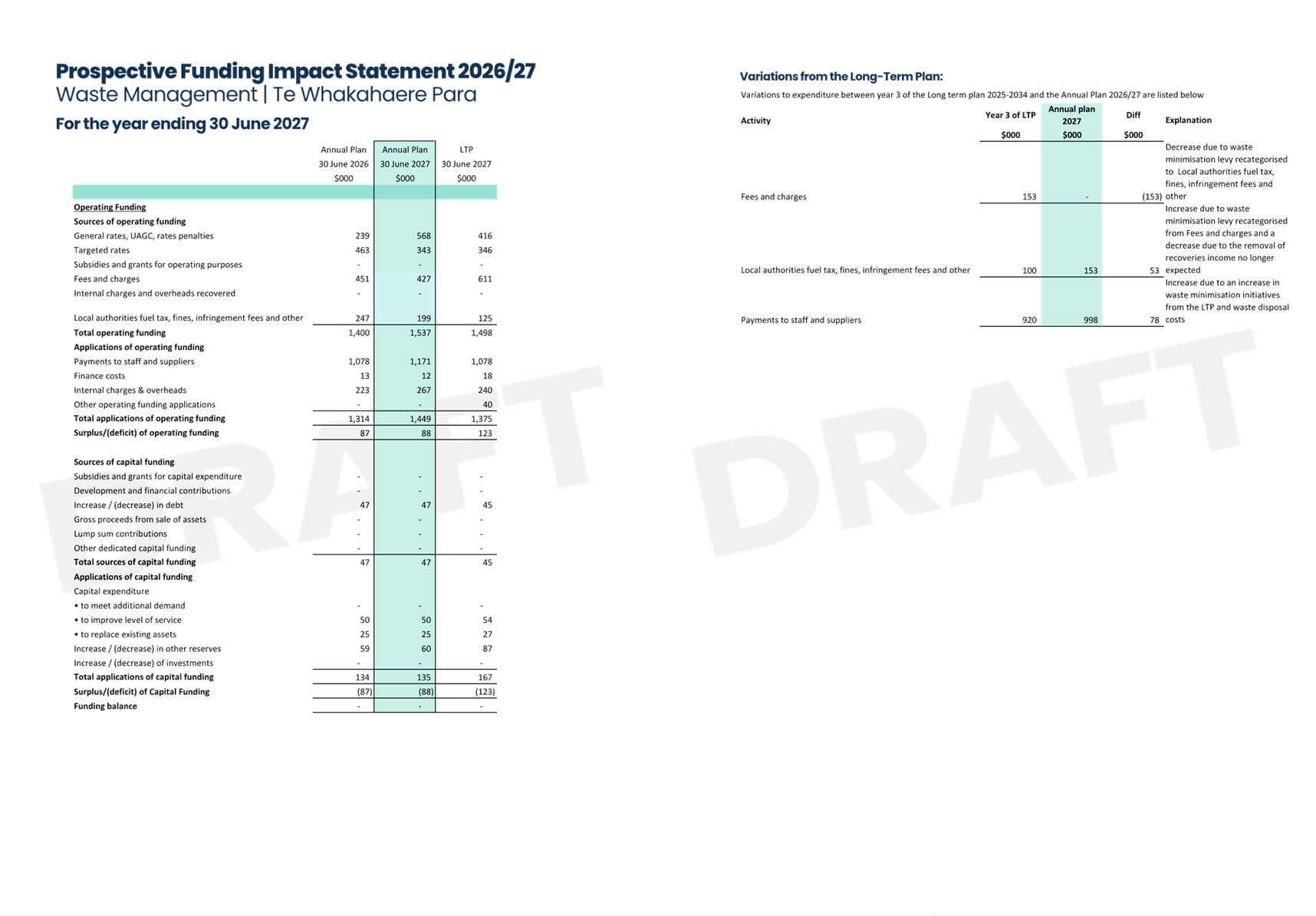
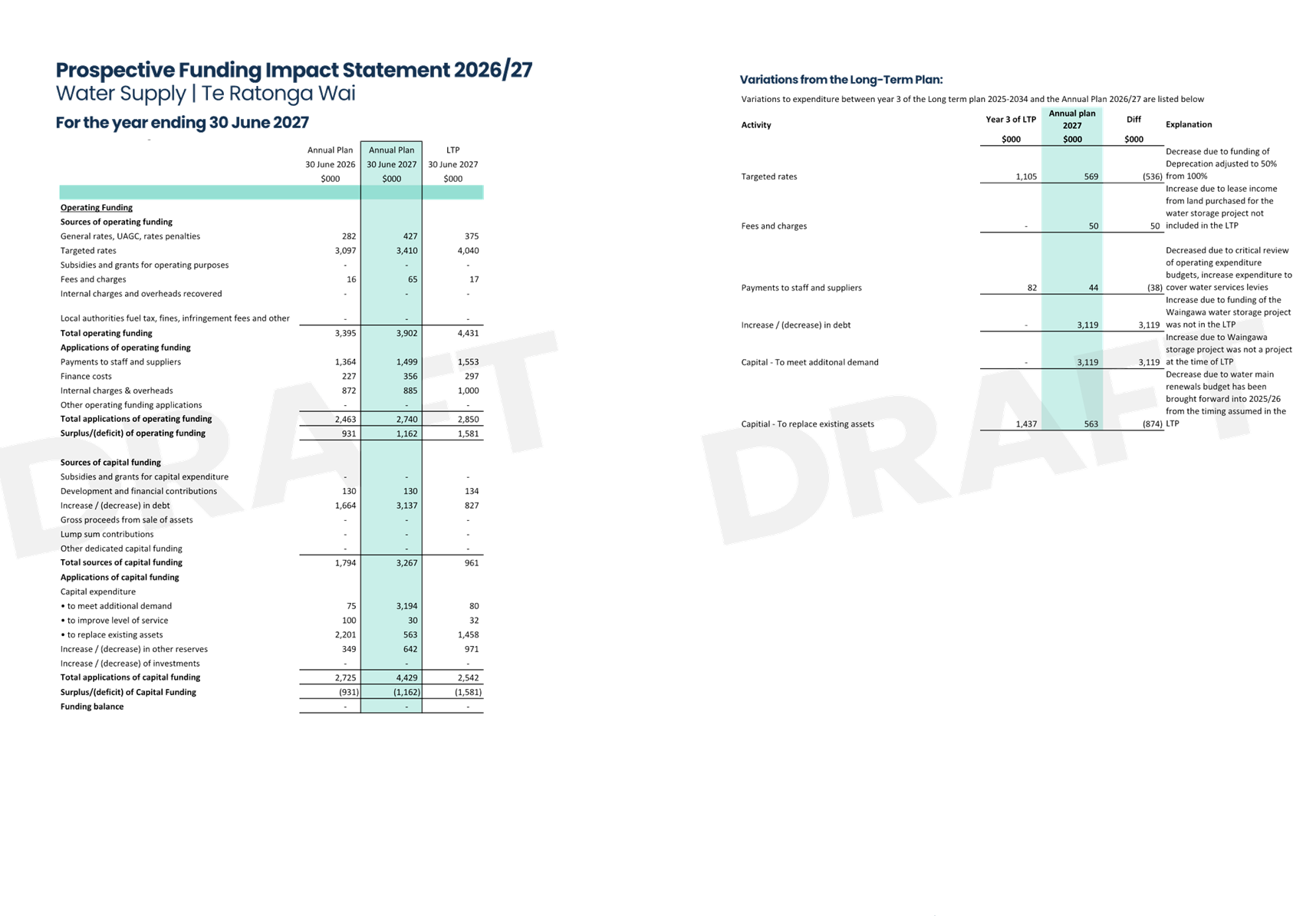
1. Receives
the report.
2. Notes
changes made to the third year of the 2024-34 Long-Term-Plan have been
reflected in the draft 2026/27 Annual Plan.
3. Notes
the Draft Annual Plan 2026/27 is forecasting an average rate increase of
3.9% (3.2% after growth).
4. Notes continuing the approach of funding
waters depreciation at 50% for 2026/27.
5. Adopts,
pursuant to section 95 of the Local Government Act 2002, the draft Annual
Plan 2026/27, including the schedule of fees and charges in Attachments 1
and 2.
File
Number: 520894
Author: Marc
Ferguson, Chief Financial Officer
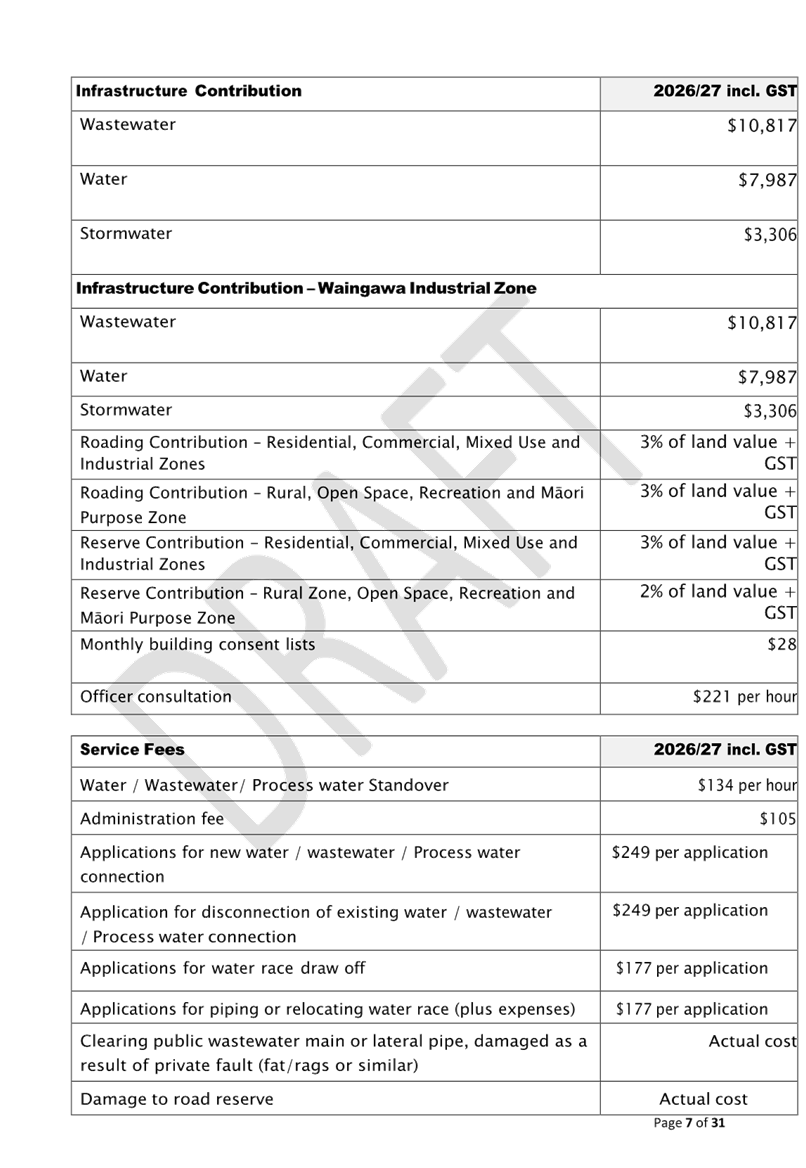
Attachments: 1. Carterton
District Council - Draft Annual Plan 2026/2027 ⇩
2. Carterton
District Council - Draft Schedule of Fees and Charges ⇩



8.6 Setting
Rates for 2026-27
1. Purpose
For Council to
consider the setting of rates for the 2026-27 financial year.
2. Significance
The
matters for decision in this report are not considered to be of significance
under the Significance and Engagement Policy.
3. INTRODUCTION
The rates included in
the report are part of the Funding Impact Statement that is included in the 2026-27
Annual Plan.
The rating system
comprises general and targeted rates, and specific charges such as the uniform
annual general charge and excess water meterage charges.
Approach to Rating
Rates are set and
assessed under the Local Government (Rating) Act 2002 on rating units.
Some rates are assessed on the value of the land and improvements, or the value
of the land alone, as supplied by Quotable Value New Zealand Limited. The last
rating valuation was dated 1 September 2023 and effective from 1 July 2024.
These are reviewed every three years.
The objectives of the
council’s rating policy are to:
· Spread the
incidence of rates as fairly as possible
· Be consistent in
charging rates
· Ensure all
ratepayers pay their fair share for council services
· Provide the income
needs to meet the council’s goals.
The Carterton District
Council’s rating system provides for all user charges and other income to
be taken into account first, with the rates providing the balance needed to
meet council’s objectives.
4. RISK
Assessment
Setting
of the rates is a requirement of the Local Government Act 2002 (LGA) and
Section 23 of Local Government (Rating) Act 2002 (LGRA). Council is required to
set the rates in accordance with these Acts to ensure they are lawful and can
be collected from ratepayers.
5. Next
steps
Following
the setting of Rates, Council Officers will set the rates within the Council
rating system and following 1 July 2026, the first rates assessment will be
sent to ratepayers in July 2026.
6. Recommendation
That the Council:
1.
Receives the report:
Pursuant
to sections 23, 24 and 57 of the Local Government (Rating) Act 2002, resolves
to set the rates, due dates, and penalties regime for the 2026/27 financial
year as follows:
All rate
amounts stated are GST inclusive.
a) General rate
A general rate on the capital value of each rating unit in
the district.
The general rate is set on a differential basis over three
rating categories as follows:
|
General rates – differential factor
|
|
|
Residential
|
1.0
|
|
Commercial
|
1.8
|
|
Rural
|
0.8
|
Where –
· Residential means:
- all rating units used primarily for residential purposes
within the residential zone of the Carterton District as depicted in the
District Plan
- all rating units located in the commercial and industrial
zones of Carterton District, as depicted in the District Plan, that are used
primarily for residential purposes
- all rating units associated with utility services (water,
telecommunications, etc.) that are located in the urban area.
· Commercial means:
- all rating units in the commercial zone of Carterton
District, including the Carterton Character Area, as depicted in the District
Plan, and all rating units outside the said commercial zone that have existing
use rights or resource consent to undertake commercial land use activities
under the Resource Management Act 1991
- all rating units in the industrial zone of Carterton
District, as depicted in the District Plan, and all rating units outside the
said industrial zone that have existing use rights or resource consent to carry
out industrial land use activities under the Resource Management Act 1991.
- Excludes any rating units used primarily for residential
purposes
- Includes any rating units within the rural zone of
Carterton District, as depicted in the District Plan, holding or exercising
existing use rights or resource consent to carry out commercial or industrial
land use activities under the Resource Management Act 1991
· Rural means:
- all rating units within the rural zone of Carterton
District, as depicted in the District Plan, but excluding those rating units
that hold and are exercising existing use rights or resource consent to carry
out commercial or industrial land use activities under the Resource Management
Act 1991
- all rating units associated with utility services (water,
telecommunications, etc) that are located in the rural area.
(a)
A General Rate set under section
13(2)(b) Local Government (Rating) Act 2002, on every rating unit on a
differential basis as described below:
2.
• a
rate of 0.19488 cents in the dollar (including GST) of capital value on every
rating unit in the Residential category
3.
• a
rate of 0.35079 cents in the dollar (including GST) of capital value on every
rating unit in the Commercial category
4.
• a
rate of 0.15590 cents in the dollar (including GST) of capital value on every
rating unit in the Rural category
b) Uniform Annual General
Charge
A Uniform Annual General Charge on
each rating unit in the district to fully fund governance activities and to
fund community support activities within the maximum possible under section 21
of the Local Government (Rating) Act 2002.
The
Uniform Annual General Charge is calculated as one fixed amount per rating
unit, for the rating year 2026/27 this rate will be $1,318.83 (including GST)
per rating unit set under section 15(1)(a) Local Government (Rating) Act 2002.
c) Targeted rates
Definition of ‘separately used or inhabited part of a
rating unit’
A separately used or inhabited part of a rating unit includes any
portion inhabited or used by the owner or a person other than the owner, and
who has the right to use or inhabit that portion by virtue of a tenancy, lease,
licence, or other agreement.
Examples of properties with multiple SUIPs include, but are not
limited to, the following situations:
· Single dwelling with flat attached
· Two or more houses, flats or apartments on one record of
title
· Business premise with flat above
· Separate business premise and dwelling on same record of
title
· Commercial building leased, or sub-leased, to multiple
tenants
· Farm or horticultural property with more than one dwelling
· Council property with more than one lessee
· Individually
surveyed lots of vacant land on one record of title offered for sale separately
or in groups
· Where
part of a rating unit that has the right of exclusive occupation by more than
one ratepayer/owner
· Retirement village with self-contained flats or dwellings
Regulatory and planning
service rate
A regulatory and planning service rate for regulatory,
resource management, and district planning services on every rating unit in the
district, calculated on capital value.
(a)
A targeted regulatory
and planning Services Rate of 0.01041 cents per dollar of capital value set
under Section 16 Local Government (Rating) Act 2002 on every rating unit in the
district.
Urban
wastewater rates
A differential targeted rate for the Council’s urban wastewater
and treatment and disposal of wastewater services of a fixed amount per
separately used or inhabited part of a rating unit in relation to all land in
the district to which the Council’s urban wastewater service is provided
or available.
The rate applied is as follows:
· A charge per separately used or inhabited part of a rating
unit that is able to be connected
· A charge per separately used or inhabited part of a rating
unit connected
The Council also sets a rate (pan charge) per water closet or urinal
within each separately used or inhabited part of a rating unit after the first
one for rating units with more than one water closet or urinal.
For the purposes of this rate:
· ‘Connected’ means the rating unit is connected
to the Council’s urban wastewater service directly or through a private
drain.
· ‘Able to be connected’ means the rating unit is
not connected to the Council’s urban wastewater drain but is within 30
metres of such a drain.
· A separately used or inhabited part of a rating unit used
primarily as a residence for one household is treated as not having more than
one water closet or urinal.
a. A rate of $630.50
per separately used or inhabited part of a rating unit set under Section 16
Local Government (Rating) Act 2002 for rating units that are not yet connected
but are able to be connected to the Council’s urban sewerage reticulation
system.
b. a
rate of $1,260.99 per separately used or inhabited part of a rating unit set
under Section 16 Local Government (Rating) Act 2002 for rating units that are
connected to the Council’s urban sewerage reticulation system.
c. a rate of $1,260.99
set under Section 16 Local Government (Rating) Act 2002 for each water closet
or urinal after the first in each separately used or inhabited part of a
non-residential rating unit connected to Council’s urban sewerage
reticulation system.
Waingawa wastewater rates
A targeted rate of a fixed amount on every separately used
or inhabited part of a rating unit that is connected to the Waingawa wastewater
service.
And
A differential targeted rate on capital value on all
properties connected or able to be connected to the Waingawa wastewater
service. The rate will be set on a differential basis over two rating
categories:
· All rating units located in the Waingawa industrial zone of
Carterton District, as depicted in the District Plan, that are used primarily
for residential purposes
· All other rating units in the Waingawa industrial zone of
Carterton District.
For the purposes of these rates:
· ‘Connected’ means a rating unit that is
connected to the reticulated wastewater service.
· ‘Able to be connected’ means a rating unit that
can be connected to the wastewater service, but is not, and is a property
situated within 30 metres of such a drain.
The purpose of these rates is to fund the operation and maintenance of
the Waingawa wastewater service.
a. a targeted
Waingawa Sewerage Rate of $184.16 set under Section 16 Local Government
(Rating) Act 2002 on every separately used or inhabited part of a rating unit
that is connected to the Waingawa Sewerage Service located in the Waingawa
industrial zone of Carterton District.
b. a rate of 0.21901
cents per dollar of capital value set under Section 16 Local Government
(Rating) Act 2002 on all rating units connected or able to be connected to the
Waingawa Sewerage Service, in the Waingawa industrial zone of Carterton
District that are not used primarily for residential purposes.
c. a rate of 0.10950
cents per dollar of capital value set under Section 16 Local Government
(Rating) Act 2002 on all properties used primarily for residential purposes
connected or able to be connected to the Waingawa Sewerage Service located in
the Waingawa industrial zone of Carterton District.
Stormwater rate
A stormwater rate on all rating units within the urban area calculated
on land value. For the purposes of this rate the ‘urban area’ is
rating units:
· Within the residential zone of the Carterton District as
depicted in the District Plan,
· Adjacent to the residential zone where stormwater from the
property drains to the Council’s urban stormwater system.
a. a targeted Stormwater Rate of 0.04589 cents per dollar of
land value set under Section 16 Local Government (Rating) Act 2002 on all
rating units within the urban area.
Refuse collection and kerbside recycling rate
A refuse collection and kerbside recycling rate for
kerbside refuse and recycling collection on every separately used or inhabited
part of a rating unit to which the Council’s collection service is
provided or available.
a. a targeted
Refuse Collection and Kerbside Recycling Rate of $134.24 set under Section 16
Local Government (Rating) Act 2002 on every separately used or inhabited part
of a rating unit where Council provides the service, or the service is
available.
Urban water rates
A differential targeted urban water rate of:
· a fixed amount on every separately used or inhabited part
of a rating unit that has been fitted with a water meter or meters and is
connected to the Council’s urban water supply system.
· a fixed amount per separately used or inhabited part of a
rating unit for rating units that are not yet connected but are able to be
connected to the urban water supply.
Additionally, a targeted metered water rate per cubic metre
of water supplied, as measured by meter, for water consumed over 225 cubic
metres per year. This rate will be invoiced separately from land rates.
For the purposes of the
differential targeted rate:
· ‘Connected’ means a rating unit to which water
is supplied.
· ‘Able to be connected’ means a rating unit to
which water can be, but is not, supplied being a property situated within 100
metres of the water supply.
The purpose of these rates is to fund the operation and maintenance of
the urban water supply.
a. a rate of $958.79
set under section 16 Local Government (Rating) Act 2002 on every separately
used or inhabited part of a rating unit that has been fitted with a water meter
or meters and is connected to the Council’s urban water supply system.
b. a rate of $479.40
per separately used or inhabited part of a rating unit set under Section 16
Local Government (Rating) Act 2002 for rating units that are not yet connected
but are able to be connected to the urban water supply system.
c. a targeted
Metered Water Rate of $2.16 per cubic metre set under section 19(2)(a) Local
Government (Rating) Act 2002 for each cubic metre of water supplied, as
measured by meter, over 225 cubic metres per year.
d. A targeted
Metered Water Rate of $3.30 per cubic metre set under section 19(2)(a) Local
Government (Rating) Act 2002 for each cubic metre of water supplied, for
temporary connections for Commercial and Industrial rating units as defined by
the differential for General Rate.
Carterton Water Race
Systems targeted rates
A targeted rate on a differential basis, calculated on land
area, on rating units within the Carrington or Taratahi water race system
classified areas as follows:
· Class A land area 200 metres either
side of the centreline of the water race
· Class B land area from 200 to 500
metres either side of the centreline of the water race
· Class C land area able to be
irrigated from water drawn from natural watercourses fed from the Water Race
System, calculated from conditions of the applicable resource consent.
Additionally, a rural water services rate on every rating
unit situated in the Carrington or Taratahi Water Race Classified Areas for
provision of the service. The amount is a rate per rating unit. For the
purposes of this rate ‘provision of the service’ means the
provision of water for stock or domestic use, including where:
· The water race channel passes over the ratepayer’s
property
· The water race is piped through the ratepayer’s
property
· Water is extracted from the water race on a neighbouring
property.
a. a targeted
Rural Water Race Rate of $288.35 set under Section 16 Local Government (Rating)
Act 2002 per rating unit on land situated in the Carrington and Taratahi Water
Race System Classified Areas that has provision of the service.
b. a targeted
Rural Water Race Rate set under Section 16 Local Government (Rating) Act 2002,
calculated on land area on rating units within the Carrington and Taratahi
Water Race System Classified Areas as follows:
• Class
A $ 34.05444
per hectare
• Class
B $
7.81435 per hectare
• Class
C $209.40164 per
hectare
c. a targeted
metered Water Race Rate for principally commercial / industrial use of $2.37
per cubic metre set under section 19(2)(a) Local Government (Rating) Act 2002
for each cubic metre of water supplied.
d. a targeted
metered Water Race Rate for principally horticultural use of $1.44 per cubic
metre set under section 19(2)(a) Local Government (Rating) Act 2002 for each
cubic metre of water supplied.
5.
Waingawa water rates
A
targeted rate of a fixed amount on every separately used or inhabited part of a
rating unit that has been fitted with a water meter or meters and is connected
to the Waingawa Water Supply service.
For the purposes of this
rate:
· ‘Connected’ means a rating unit to which water
is supplied.
Additionally,
a targeted rate per cubic meter of water supplied, as measured by meter.
The purpose of these rates
is to fund the operation and maintenance of the Waingawa Water Supply service.
a. a targeted
Waingawa Water Rate of $380.56 per separately used or inhabited part of a
rating unit set under Section 16 Local Government (Rating) Act 2002 on all
rating units that are connected to the Waingawa reticulated water service.
b. a targeted
metered Waingawa Water Rate of $3.32 per cubic metre set under Section 19(2)(b)
Local Government (Rating) Act 2002, as measured by meter, for all water
supplied to each rating unit which has been fitted with a meter or meters with
consumption up to and including 50,000 cubic metres per year and is connected
to the Waingawa reticulated water service.
c. a targeted
metered Waingawa Water Rate of $2.88 per cubic metre set under Section 19(2)(b)
Local Government (Rating) Act 2002, as measured by meter, for all water
supplied to each rating unit with consumption over 50,000 cubic meters per
year, which has been fitted with a meter or meters and is connected to the
Waingawa reticulated water service.
d. a targeted
metered Waingawa Process Water Rate of $1.25 per cubic metre set under section
19(2)(a) Local Government (Rating) Act 2002 for each cubic metre of water
supplied.
Economic
Development Rate
The
economic development rate is primarily used to fund regional and local economic
development initiatives.
· a targeted Economic Development Rate of $588.66 per rating
unit on all Commercial and Industrial rating units as defined by the
differential for General Rate.
d) Due
Dates for Rate Payments (excluding metered water rates)
Pursuant to Section 24 of the Local
Government (Rating) Act 2002, that the rates (excluding metered water rates)
for the year 1 July 2026 to 30 June 2027 be assessed in four equal instalments
with each instalment due on the due date for payment for that instalment set
out in table 1 below.
Table 1: due dates and penalty
dates for rate payments (excluding metered water rates)
|
Instalment
|
Due date for payment
|
Penalty date
|
|
One
|
20 August 2026
|
21 August 2026
|
|
Two
|
20 November 2026
|
23 November 2026
|
|
Three
|
20 February 2027
|
22 February 2027
|
|
Four
|
20 May 2027
|
21 May 2027
|
e) Due
Dates for Metered Water Rate Payments
Pursuant to Section 24 of the Local
Government (Rating) Act 2002, that the due dates for metered water rates are as
set out in table 2 below for each reading period for the year 1 July 2026 to 30
June 2027.
Table 2: due dates and penalty
dates for metered water rates
|
Meters read in
|
Due date for payment
|
Penalty date
|
|
September 2026
|
31 October 2026
|
2 November 2026
|
|
January 2027
|
28 February 2027
|
1 March 2027
|
|
March 2027
|
30 April 2027
|
3 May 2027
|
|
June 2027
|
31 July 2027
|
2 August 2027
|
f) Penalty
Charges (Additional Charges on Unpaid Rates)
Pursuant to Sections 57 and 58(1)(a) of the
Local Government (Rating) Act 2002, a penalty of 10% of the amount of each
instalment of rates (except metered water rates) remaining unpaid after the
relevant due date for payment will be added on the relevant penalty date for
the instalment stated in table 1.
Pursuant to Sections 57 and 58(1)(b) of the
Local Government (Rating) Act 2002, a penalty of 10% will be added on 1 July
2026 to the amount of rates assessed in previous financial years and remaining
unpaid as at 30 June 2026 excluding metered water rates.
Pursuant to Sections 57 and 58(1)(b) of the
Local Government (Rating) Act 2002, a penalty of 10% will be added on 1 July
2027 to the amount of rates assessed in previous financial years and remaining
unpaid as at 30 June 2027 excluding metered water rates.
Targeted rates for metered water supply will be
invoiced separately from other rates. A 10% penalty will be added to any part
of the invoiced metered water rates that remain unpaid after the relevant due
date stated in table 2 as provided in Sections 57 and 58 (1)(a) Local
Government (Rating) Act 2002. The penalty will be added on the relevant penalty
date for the instalment stated in table 2.
Pursuant to Sections 57 and 58(1)(b) of the
Local Government (Rating) Act 2002, a penalty of 10% will be added on 3 August 2026
to the amount of water meter rates assessed in previous financial years and
remaining unpaid as at 31 July 2026.
Pursuant to Sections 57 and 58(1)(b) of the
Local Government (Rating) Act 2002, a penalty of 10% will be added on 2 August
2027 to the amount of water meter rates assessed in previous financial years
and remaining unpaid as at 31 July 2027.
File
Number: 511669
Author: Natascha
Anderson, Financial Accountant
Attachments: Nil
8.7 Community
Survey 2026 results
1. Purpose
For Council to receive
the results of the 2026 Community Survey.
2. Significance
The
matters for decision in this report are not considered to be of significance
under the Significance and Engagement Policy.
3. Background
The Community Survey is conducted annually to gauge community sentiment.
It asks the same questions each year to provide year-on-year comparison data
that can be used to inform community priorities and planning decisions.
Opportunities
to provide commentary across service areas are provided throughout the survey.
Commentary is summarised via an AI tool and presented in themes to Council.
Council
moved to an in-house community survey model in 2025 to improve cost efficiency,
data access and longevity, and inclusive participation, while maintaining alignment
with Long-Term Plan performance measures. This approach continues to be
successful.
In
2025 PwC reviewed our survey methodology and concluded it is
well aligned with our Long-Term Plan, methodologically sound, and supported by
strong governance controls. They also provided recommended enhancements for
future cycles, and these were incorporated in our 2026 methodology and
process.
4. Discussion
4.1 Overview
demographics
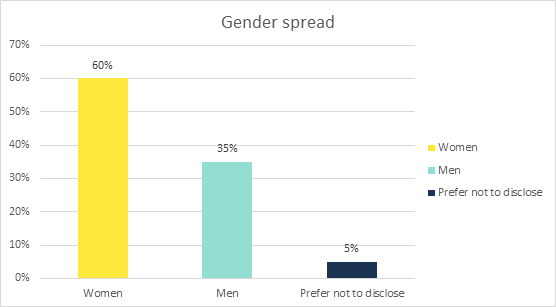
A total of 760
responses were received in 2026:
· 60% of those were submitted by women
· 35% as men
· 5% opted not to disclose
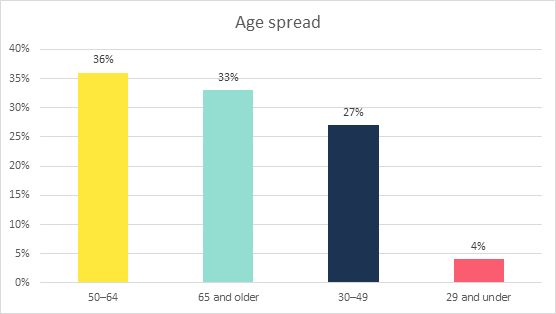
In terms of
age spread:
· 36% of responses came from those aged between 50 and 64
· 33% from those aged 65 and older
· 27% of responses came from 30-49 year olds
· 4% of responses came from those aged 29 and under
More than 98% of respondents completed the survey online with 14
paper copies returned.
New to the 2026 promotional campaign was:
· The
inclusion of large (and reuseable) posters at New World Carterton,
· A
presence at Holloway Hoopla community event
· Increased
door-stopping around local businesses.
· Video
campaign with Councillors that demonstrated the work we have completed, or plan
to complete, as a result of feedback received in 2025.
It is
important to consider while interpreting these results that a significant
weather event was underway as the survey officially opened. We held off digital
promotion of the survey until this was completed (approx. one week).
Results
are summarised as ‘satisfied’ where respondents provide a
satisfaction score of between 7 and 10 (inclusive) out of 10.
4.2 Highest
satisfaction scores
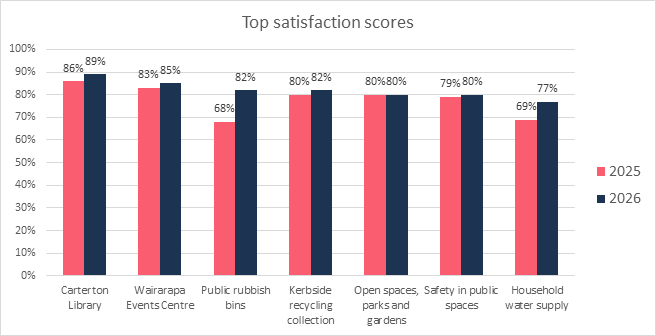
Commentary
notes:
• The library and Events Centre key community assets —
welcoming, well used, and contributing positively to Carterton’s sense of
connection, culture and activity.
• Kerbside recycling and public rubbish bins are regarded as reliable
and improving. “There is appreciation for cleanliness, dog‑waste
facilities and visible effort around town.
• Residents consistently praise maintenance and appearance,
particularly Carrington Park and Sparks Park, while also calling for more
shade, seating and refreshed play facilities.
• Many people feel safe during the day, but concerns remain about
night‑time lighting, vandalism (especially public toilets), and
antisocial behaviour in some locations.
• Reliability and performance of water supply during adverse weather was
acknowledged. The remaining concerns focused on chlorine taste, water pressure
in some areas, and long‑term resilience as the district grows.
4.3 Lowest
satisfaction scores
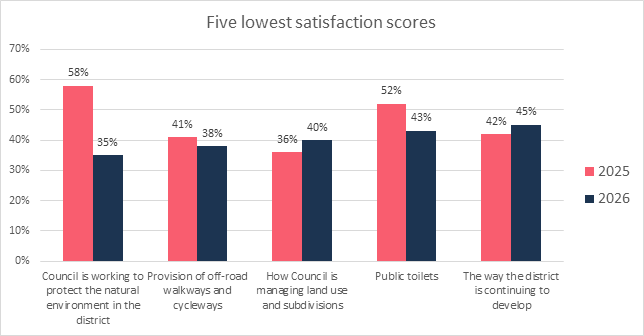
Commentary notes:
• Protecting the natural environment is an area of clear concern, with
many residents wanting stronger, more visible environmental leadership. Feedback
reflects both frustration after recent severe weather events and differing
expectations about Council’s role versus broader climate and land‑use
pressures.
• Provision of off‑road walkways and cycleways remains one of
the lowest‑rated areas, however there is appreciation for the existing
lime paths and cycling friendliness. There were strong calls for safer, better‑connected
routes that link suburbs, schools and new developments.
• Land use and subdivisions show modest improvement, with residents
recognising growth as necessary, while expressing concern about infrastructure
capacity, building on wet or flood‑prone land, and the long‑term
vision guiding development.
• Public toilets attract mixed commentary: upgrades and cleanliness
are acknowledged, but recurring issues around vandalism, maintenance
consistency, accessibility, and availability continue to impact perceptions.
• The way the district is continuing to develop is viewed cautiously
but increasingly positively, with residents wanting growth to be better paced,
well planned, and supported by infrastructure, while retaining
Carterton’s character and liveability.
4.4 Most improved measures – percentage point growth on 2025
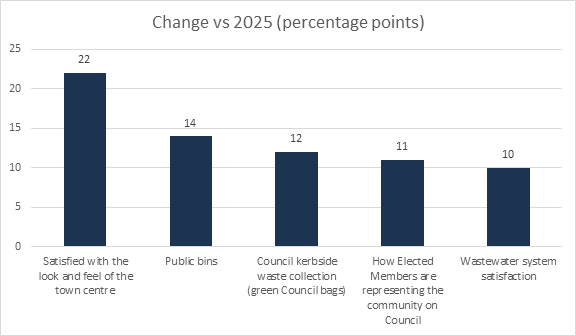
Commentary notes:
• The look and feel of the town centre has improved, with residents
noticing improved cleanliness and presentation. Commentary also reflects a
growing understanding that issues such as empty shops and poor building
condition often sit outside of Council control, even though frustration about
these impacts remains.
• Public rubbish bins are appreciated, with positive commentary around
availability, cleanliness and dog‑waste facilities, alongside requests
for more bins in parks and better servicing at peak times.
• Council kerbside waste collection (green Council bags) is viewed as
reliable and well managed, though the cost of bags remains a common concern. Some
residents would prefer alternative collection models.
• Representation by Elected Members has improved, with more residents
reporting they feel represented and informed, while others still want greater
visibility, clearer communication about councillor roles, and stronger
engagement between election cycles.
• Wastewater system satisfaction has increased, with recognition of
recent upgrades and system performance, balanced against ongoing concerns about
odour, future growth capacity and long‑term affordability.
4.5 Measures
where satisfaction declined on 2025 results
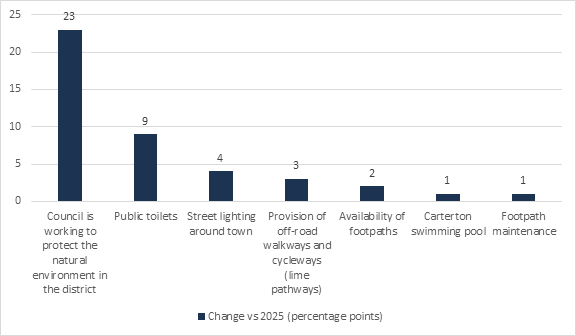
Commentary notes:
• Street lighting around town is seen as inadequate in some areas,
particularly at night, with residents raising safety concerns and calling for a
better balance between dark‑sky objectives and pedestrian and community
safety.
• The availability of footpaths is generally acceptable in the town
centre, but outside these areas residents note gaps, uneven surfaces, and
accessibility issues for mobility scooters, wheelchairs and older people.
• The Carterton swimming pool is highly valued as a community asset,
particularly by families and young people, with strong appreciation for free
summer access. However, there are calls for longer opening hours, facility
upgrades, and progress toward longer‑term indoor swimming options.
• Footpath maintenance is seen as an area needing more consistent
attention, with residents raising concerns about uneven surfaces, accessibility
for older people and mobility users, and maintenance outside the town centre.
Only seven scores declined on results from 2025. One (Open spaces, parks
and gardens) remained the same. All others (36) improved.
4.6 Long-term
Plan satisfaction measures
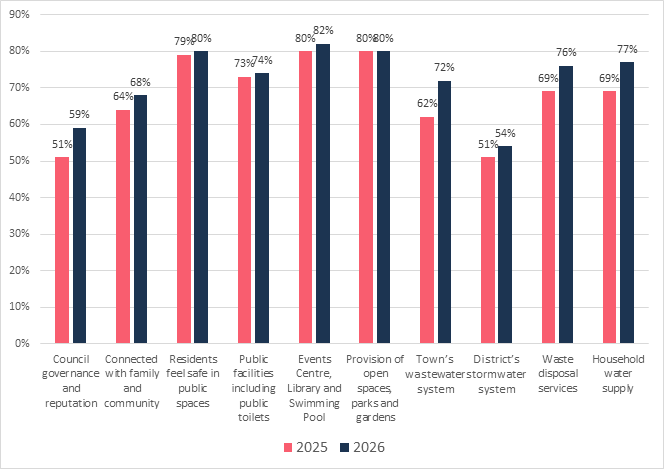
· Overall
satisfaction with Council governance and reputation: 59% - KPI is 65%
· Residents
feel connected with family and community: 68% - KPI is 65%
· Residents
feel safe in public spaces: 80% - KPI is 65%
· Residents
level of satisfaction with public facilities including public toilets: 74% - KPI
is 75%
· Residents
level of satisfaction with Events Centre, Library and Swimming Pool: 82% - KPI
is 75%
· Residents
level of satisfaction with the provision of open spaces, parks and gardens: 80%
- KPI is 75%
· Residents’
satisfaction with the town’s wastewater system: 72% - KPI is 75%
· Residents’
satisfaction with the district’s stormwater system: 54% - KPI is 60%
· Residents’
satisfaction with waste disposal services: 76% - KPI is 75%
· Residents’
satisfaction with their household water supply: 77% - KPI is 75%
4.7 Overall community satisfaction
The overall satisfaction score provided for Carterton as a place to live
improved by 2% on last year, now sitting at 80%.
4.8 PwC recommendations
and Council response
PwC
endorsed the 2025 survey methodology and provided a small number of
enhancements for consideration in 2026 and beyond. The following enhancements
were implemented in the 2026 survey:
· Implemented a ‘Don’t know’ answer option in
addition to ‘N/A’
· Included a male/female demographic identifier
· Inclusion of Te Reo interpretations for all headings and question
explainer details
· A clear pathway for disseminating results, including via a Community
Survey hub on our website
· Access
to raw data restricted to 2x staff members only. Provision of analysed data and
themed commentary only to staff, Councillors and wider community (as presented
in Appendix A)
Still
under consideration is the implementation of skip logic, noting community
feedback in person at engagement events is that the survey is long.
As
requested by CDC Youth Council we also added an additional age category of
15-17 years.
5. NEXT
STEPS
Summary
data back will be presented back to the community via website and social
channels.
6. CONSIDERATIONS
6.1 Climate
change
Community feedback
will be shared with the Climate Change Coordinator for data able to be used in
mitigation and response situations.
6.2 Tāngata whenua
Officers followed recommendations
for consideration to enhance Te Reo Māori and aim for further targeted
engagement in future years.
6.3 Financial
impact
The 2026 Community
Survey was delivered within budgets.
6.4 Risks
The following risks and mitigations have been identified:
· Validity of AI comment summaries
Two Communications and
Engagement staff members read every comment provided so that we can sense-check
the AI analysis and ensure it provides valid summaries.
· Duplicate and low-quality responses
These were automatically identified by SurveyMonkey during analysis.
· Privacy and anonymity
Exported results are immediately separated from
personal data before any analysis begins.
7. Recommendation
That the Council:
1. Receives
the report.
File
Number: 520927
Author: Sara
Renall, Communications and Engagement Advisor
Attachments: 1. Community
Survey 2026 Results Summary ⇩

8.8 Quarterly
Performance Report for the period ending 31 March 2026
1. Purpose
To present the
quarterly financial and non-financial performance results to the Council for
the period ending 31 March 2026.
2. Significance
The
matters for decision in this report are not considered to be of significance
under the Significance and Engagement Policy.
3. Background
Quarterly
reporting against the Council’s financial budgets and key performance
indicators (KPIs) enables Council to monitor progress towards the achievement
of targets, and address variations or challenges at the earliest opportunity.
The
Quarterly Report (Attachment 1) combines our financial reporting with
non-financial reporting to provide a more complete picture of the
organisation’s performance, and better reflects the link between funding
and levels of service and activities.
The
report format aligns with our commitment to more open, representative,
and cost-effective engagement, and is designed to connect
quarterly reporting with annual reporting.
Note
that the quarterly non-financial performance results against KPIs are recorded
as a cumulative score from the previous quarter/s to reflect progress towards
targets, rather than recording individual quarter results.
4. Discussion
4.1 Financial
reporting
· Overall, the Council has recorded an operating revenue of
$22.1M against operating expenditure of $20.5M resulting in a surplus of $1.7M
for the period ending 31 March 2026.
· Financial statements for the period ending 31 March 2026 include:
o Statement of Financial Performance
o Statement of Financial Position
4.2 Non-financial
reporting
The
report outlines many non-financial target achievements and highlights across
services and activities. The most notable include:
· Our annual Community Survey was completed with 760 responses
received.
· There is improved community satisfaction with the newly elected
Council, and how they are representing the community.
· Most of our community services results well exceeded targets with an
89% satisfaction in Library services.
· Our regulatory and planning results continue at 100% delivery with
building consent processing times remaining under 10 days.
· While
community satisfaction results did not quite meet the 75% target in Wastewater
at 72%, they have improved markedly on the 2025 result of 61.6%.
· Residents’
satisfaction with waste disposal services increased to 76% above the target,
with kerbside recycling collections satisfaction at 82%.
· 386 vehicles and trailers disposed green waste for free after the
severe weather event in February.
Some of the challenges included:
· Our customer service acknowledgement results improved however remain
well below our target due to staff resourcing challenges which we expect to
resolve in Q4.
· Community
Survey feedback highlights ongoing pressure on shared facilities,
particularly
public toilets, and perceptions of safety in public spaces.
· Our stormwater network continues to face increased pressure from
heavy and more frequent rainfall events but despite this, systems performed
within expected parameters for the quarter.
· Severe weather in February caused flooding and damage impacts on our
roading, parks and reserves infrastructure, and required staff to support
response coordination redirecting priorities from usual service delivery. The
frequency and intensity of adverse weather events are increasing, requiring
additional responses resourcing.
5. CONSIDERATIONS
5.1 Climate
change
There
are no climate change considerations required in relation to the decisions in
this report.
5.2 Tāngata whenua
There
are no tāngata whenua considerations required in relation to the decisions
in this report.
5.3 Financial impact
There
are no financial considerations required in relation to the decisions in this
report.
5.4 Community Engagement requirements
There
are no community engagement considerations required in relation to the
decisions in this report.
5.5 Risks
There
are no risk considerations required in relation to the decisions in this
report.
5.6 Community Wellbeings
The
quarterly report measures progress across all community wellbeing outcomes.
6. Recommendation
That the Council:
1. Receives
the report.
File
Number: 511351
Author: Geri
Brooking, Group Manager People and Corporate
Attachments: 1. Quarterly
Performance Report to 31 March 2026 ⇩

8.9 Carterton
District Trails Trust support requested for Waiohine Bridge
1. Purpose
To seek
Council’s in principle support for the Waiohine bridge project and to
obtain guidance on Councils potential future ownership of the completed bridge
asset.
2. Significance
The
matters for decision in this report are not considered to be of significance
under the Significance and Engagement Policy.
3. Background
The Carterton District
Trails Trust is developing a proposal for a landmark single‑span bridge
across the Waiohine River. The bridge would provide a safer, more resilient
crossing for walkers and cyclists and complete a key link in the local and
regional trails network.
In collaboration with
Carterton District Council, significant progress has been made, including site
confirmation, engagement of specialist designers and engineers, geotechnical
investigations, stakeholder engagement, and acceptance of a final concept design.
Approximately $190,000 has been invested to date, including funding from the
2021–24 Long Term District Plan.
The total project cost
is estimated at $2.7–$3.0 million, subject to detailed design,
consenting, and tendering.
Council is not
currently being asked to provide additional funding. However, consideration is
sought on the level of Council support for the project and whether Council
would be willing to ultimately own and maintain the completed bridge as a
Council asset.
4. Discussion
The Waiohine
River currently presents a barrier to safe and continuous walking and cycling
connectivity. Existing crossing options are limited, and there are safety
concerns specifically on the SH2 bridge, which is a narrow bridge in a high
speed area, and there are no other bridge crossings that support an expanding
trails network. Trail infrastructure is increasingly recognised as a
cornerstone of local and regional economic development, social and recreational
wellbeing, environmental outcomes and low carbon transport options. The
proposed bridge aligns with these objectives by improving safety, resilience
and access for residents and visitors.
A public workshop was
held with Councillors on 11 February 2026, where the Carterton District Trails
Trust and bridge designer Dan Crocker provided an overview of the project,
including progress to date, key design elements, and next steps. Work completed
includes confirmation of the bridge location, engagement of a specialist bridge
designer, completion of geotechnical and foundation investigations, and
finalisation of the bridge design.
The proposed structure
is a single‑span bridge, selected to minimise riverbed disturbance and
enhance resilience. Key design considerations included:
· Comparison of
swing bridge verses suspension bridge options
· Minimising
vertical and horizontal movement (bounce and wobble)
· Performance under
wind, flood and earthquake conditions
· Long term
durability and lifespan
·  Maintenance
requirements over time
Maintenance
requirements over time
The final design of
the bridge is a single span suspension bridge with an upward curve. This
design gives the bridge maximum clearance from floods and keeps the path clear
for cyclists and walkers without needing any piers in the river. The span
of the bridge will be 155meters long, with the deck width being 1.23m.
The steel masts have a height of 5m.

 Maintenance
requirements:
Maintenance
requirements:
 The
design lives for the bridge have been developed for safety and durability.
The
design lives for the bridge have been developed for safety and durability.
The maintenance
requirements include routine (annual), general, and principal inspections,
which together provide a layered approach to managing bridge safety and
condition. These range from frequent visual checks for obvious safety issues,
through periodic detailed condition assessments, to comprehensive hands-on
structural evaluations that confirm long‑term performance and inform
maintenance planning.
If Council were to
assume ownership of the bridge, officers estimate that maintenance costs would
be minimal for the foreseeable future, due to the long design life of the
foundations and structural materials. Ongoing costs would primarily relate to
general wear and tear, vandalism, inspections, and insurance. These costs are
estimated at approximately 1–2% of the total build cost per annum,
approximately $60,000 at 2% assuming a build cost of $3m.
Insurance –
there would be a few factors to take into consideration for insurance such as
hazard profile and access criticality. However, an estimate under our Material
Damage/Business interruption policy would be circa 0.3% -0.6% of value Approximately
$9,000 - $18,000 assuming a build cost of $3m.
Depreciation would
represent the most significant potential impact on rates, as it would be
calculated based on the full replacement cost of the bridge. Council may elect
not to depreciate the bridge substantially reducing the impact on rates, while
acknowledging the bridge would not be rebuilt at the end of its service life.
It is noted that if
Council agrees to assume ownership of the bridge officers will continue to be
actively involved with CDTT as they work through their next steps and progress
onto build. Officers will work with CDTT to ensure contracts include robust
builders and designer assurances such as warranties, defects liability periods,
compliance certifications and professions indemnity and public liability
insurance, providing clear accountability and recourse if issues arise
following construction.
Next Steps for
Carterton District Trails Trust will include:
· Applications for
funding
· Continued
community engagement
· Progression
through the resource consent process
· Appointment of a
contractors and construction of the bridge
· Confirmation of
long term ownership, maintenance and management arrangements.
Council is asked to
consider its in principle support for the project and whether it would be
willing to assume ownership and ongoing management of the completed bridge. The
bridge would represent a significant long‑term community asset, with an
estimated value of up to $3 million.
5. Options
Option
1 – Support the project in Principle.
Council notes the
project update and indicates in principle support. This option would
include CDC providing a letter of support to assist the trust with external
funding applications but would not commit to ownership.
Option 2
– Support in principal and Council ownership on completion.
Council provides in
principle support for the project and indicates a willingness to assume
ownership, operation, and maintenance of the completed bridge, subject to:
· Final
detailed design and construction compliance,
· Confirmation
of funding sources,
· Agreement
on asset transfer conditions and liabilities.
Under this option, the
bridge would become a Council‑owned asset upon completion.
Option 3
– Decline support and ownership
Council notes the
project update but does not provide in principle support and declines to accept
ownership of the completed bridge.
6. NEXT
STEPS
Next
steps will be determined by the outcome of the decision made in this
report.
7. CONSIDERATIONS
7.1 Climate
change
The bridge supports
climate outcomes by enabling safe, low‑carbon transport options such as
walking and cycling, reducing reliance on vehicle travel and associated
emissions. Its resilient, single‑span design also minimises riverbed
disturbance and is better suited to withstand climate‑related events such
as flooding, supporting long‑term environmental sustainability.
7.2 Tāngata whenua
Engagement
has taken place with Local hapū – Ngāti
Kahukuraawhita. CDTT will maintain engagement Ngāti Kahukuraawhita
throughout this project as it progresses.
7.3 Financial
impact
There are no immediate
financial impacts arising from this report. Should Council choose to progress
with Option 2, there would be future costs associated with ownership of the
bridge, including maintenance, inspections, and insurance. Officers estimate these
ongoing costs would be approximately 1–2% of the total build cost per
annum which would be funded from general rates.
It is noted that if
Council were to fund depreciation on the asset, this would result in a more
significant increase in annual costs.
7.4 Community
Engagement requirements
Engagement
with community has been ongoing throughout this project, this includes
engagement with Local hapū – Ngāti Kahukuraawhita,
Greater Wellington Regional Council (staff and elected members), Members of
Parliament, Five Towns Trails Trust, South Wairarapa District Council and
Affected landowners. It is noted above that CDTT intend to do further
community engagement.
7.5 Risks
If
Council agrees in principle to future ownership (Option 2), there is a risk of
ongoing financial obligations for maintenance, insurance and potential
depreciation, legal and liability exposure associated with public safety and
asset performance. These risks are considered manageable and can be
effectively mitigated through staged decision making, contractual safeguards
and continued Council oversight.
7.6 Wellbeings
Trail
infrastructure is increasingly recognised as a cornerstone of Local and
regional economic development, Social and recreational wellbeing, Environmental
outcomes and low-carbon transport options.
National data from Ngā
Haerenga – NZ Cycle Trail evaluations (2025) demonstrates that an 18%
increase in trail use, an average spend of $964 per visitor, significant public
health benefits nationally and a regional economic contribution of
approximately $1.28 billion per year.
8. Recommendation
That the Council:
1. Receives
the report
2. Agrees
to support the Waiohine Bridge project in principle only.
OR
Agrees to
support the Waiohine Bridge project in principle, future ownership and
management of the completed bridge, subject to final design compliance,
confirmation of funding, and agreed asset transfer conditions.
OR
Agrees not to
provide in principal support for the Waiohine Bridge project or accept
ownership of the completed bridge.
File
Number: 520560
Author: Glenda
Seville, Group Manager Community and Facilities
Attachments: Nil

8.10 Nuku
Ora Proposal for a Wairarapa Subregional Sport and Recreation Assets Network
Plan
1. Purpose
For Council to
consider endorsement for the Wellington Regional Spaces and Places Strategy
2025, and to commit to proceeding with the development of a Wairarapa
Subregional Sport and Recreation Assets Network Plan.
2. Significance
The
matters for decision in this report are not considered to be of significance
under the Significance and Engagement Policy.
3. Background
With the support of
Councils across the region, the Spaces and Places Regional Steering Group
recently completed the Wellington Regional Spaces and Places Strategy 2025
(the Strategy). This is a refresh of the previous 2019 Spaces and Places
Regional Strategy. A copy of the updated Strategy is in Attachment 1.
With the refresh and
support from Sport NZ, Nuku Ora brought together councils (including the eight
territorial authorities in the region) to identify issues and opportunities.
Sector organisations, schools, and community groups were surveyed and focus groups
were convened across the region.
4. Wellington Regional Spaces and Places Strategy
2025
In developing the
Strategy the following challenges faced by the sector included:
· Population and
preference changes
· Economic downturn
and available funding
· Asset condition
and quality
· Time pressures and
volunteers
· Transport
particularly in the Wairarapa
· Effects of climate
change
· Costs of
compliance
The Strategy provides
an overview of current participation, trends and challenges, and builds on
previous stocktakes of sports fields and indoor courts. This information
supports Councils when considering investment decisions around recreation,
sport and activities generally. A regional view is increasingly important
as councils consider the cost and risk of duplication of facilities, and the
potential of amalgamation.
The objectives of the
Strategy are:
· Prioritising
making the most out of existing spaces and places to meet demand through both
facility and non-facility solutions.
· Targeting
investment and resources to address the barriers some communities are facing to
participation.
· Investing in new
spaces and places where there is proof of need, and no alternative solution.
The Strategy
emphasises:
· Making the most of
existing assets before pursuing new builds. It recognises the importance of
climate resilience and calls for proactive assessment.
· Equity, advocating
for accessible/affordable opportunities to participate, increased collaboration
including with schools, and greater flexibility in how spaces and places are
used, including for different and new activities.
Region-wide priority
recommendations in the Strategy are:
1. Using
the Spaces and Places Strategy and collaborative decision-making framework
regionally.
2. Assessing
the impacts of climate change.
3. Progressing
aligned code regional facility network planning – Bowls and Racquet
Sports.
4. Assessing
improvements to mid-sized stadium provision.
5. Prioritising
improvements to supporting facilities.
6. Developing
sub-regional network plans for Wairarapa and Kāpiti.
Councils have been asked to endorse this strategy.
Officers have identified a number of risks in an endorsement without some
caveats.
Endorsement may create an expectation that council will
contribute funding to regional or subregional initiatives that are not
currently budgeted or considered high need for Carterton. The
collaborative regional decision-making framework may be perceived as
constraining councils’ independence prioritisation and asset
decisions. Successful implementation relies heavily on Nuke Ora roles; it
is likely that Nuke Ora will require council funding for resourcing.
Development of a
Wairarapa Subregional Sport and Recreation Assets Priorities Plan.
Nuku Ora has engaged
with Mayors and CEs, Council officers, sector organisations and funders on a
proposed Wairarapa subregional sport and recreation facilities and asset
priorities plan (the Plan). A presentation on a Wairarapa Subregional
strategy was recently made to the Wairarapa Combined Council Forum.
The proposal (Attachment
2) outlines a sub‑regional Spaces and Places planning approach for
the Wairarapa, led by Nuku Ora key elements are:
· Expansion of the
environmental analysis to capture Wairarapa specific trends, challenges and
opportunities
· Adoption of
planning principles that reflect the Wairarapa context
· Development of an
agreed Wairarapa wide network planning identifying local and regional facility
provision
The key outcomes
expected from this plan will include:
· A coordinated
network approach linking school, council, and private facilities across the
Wairarapa
· A clear aquatic
needs assessment identifying gaps in provision and future priorities
· A defined indoor
court provision assessment, including current capacity and future needs
· Indicative
financial resourcing guidance for subregional facilities (e.g. hockey, netball,
and rugby infrastructure)
· Recommendations
for a collaborative decision-making framework and funding policy for the
Wairarapa
· Agreement on
Wairarapa subregional priority projects and/or plans to support future
investment decisions
Nuku Ora expect to
have this work completed by October 2026 and will then help inform Long Term
Plan’s. They have received $25,000 match funding from Sports NZ and
are requesting from the three Wairarapa Council the remaining $25,000.
Officers agree with
the majority of the intent and direction of the proposal. However, the
proposal appears to incorporate shared asset management and shared delivery
elements. Officers consider this is outside the intent of the subregional plan,
and inclusion would introduce a layer of complexity around decision making, add
financial and reputational risks and potentially set expectations with local
sporting organisations that may not be met. Officers recommend these
aspects of the proposal are refined and if possible removed. The primary
focus would remain on assets and facilities, not on ownership or delivery
models. If required, further work on shared ownership and delivery models could
be considered at a later date.
The subregional plan
will help to inform future Long-Term Plans and ensure investment decisions are
made based on a coordinated regional network approach.
Financial
contribution
In total, $25,000 is
sought from the Wairarapa Councils for the development of a Wairarapa
Subregional Sport and Recreation Facilities and Asset Priorities Plan, with a
further $25,000 being provided by Sport New Zealand. Assuming an equal
share basis across the three Wairarapa Councils, CDC’s share is expected
to be approximately $8,333.00.
5. CONSIDERATIONS
5.1 Climate change
There
are no direct impacts on climate change relating to the decisions in this
report.
5.2 Tāngata whenua
There
are no impacts on tāngata whenua relating to the decisions in this report.
5.3 Financial impact
A
financial contribution of $8,333.00 is sought from CDC for the development of Wairarapa
Subregional Sport and Recreation Assets Network Plan.
The
expenditure is unbudgeted. If approved, the cost will be funded from the
Community Services activity.
5.4 Community Engagement requirements
Engagement was
undertaken with Mayors and CEs, council officers, sector organisations and
funders.
5.5 Risks
Councils
are considering the proposal from Nuku Ora individually. There has been
no collective commitment to fund the subregional plan. The potential exists
that one or more Councils may decide not to participate, leaving the other to
complete the plan with a funding shortfall.
Further
risks surround the potential that one or more Councils may commit less than an
equal share towards funding the subregional plan.
Should
one or both of these risks emerge, alternative funding sources will be sought
to cover any shortfall. If alternative funding cannot be obtained, the
scope of the plan will be reviewed to fit the available funding.
In
the event the draft scope of work is reduced, CDC will ensure priority is given
to completing a subregional aquatic strategy.
As
noted in the body of the report, there are a number of risks identified with
the endorsement of the Wellington Regional Spaces and Places Strategy. Council
may need to reinforce the messaging to Nuku Ora and local sporting and
recreational organisations that funding the sub-regional plan does not commit
Council to adopting the subregional plans’ recommendations.
Wellbeings
Recreation
supports physical, social and mental health and wellbeing. A co-ordinated
subregional plan will help ensure that funding can be appropriately targeted
and duplication can be minimised.
Using
a subregional plan can help inform Councils on a Wairarapa perspective prior to
local investment decisions being made.
6. Recommendation
That the Council:
1. Receives
the report.
2. Endorses
the Wellington Regional Spaces and Places Strategy 2025.
3. Notes
that endorsement does not constitute approval or commitment to deliver,
fund or prioritise any specific projects, facilities or initiatives identified
in the strategy.
4. Supports
the development of a Wairarapa Subregional Sport and Recreation Facilities
Assets Priorities Plan.
5. Approves
unbudgeted expenditure of $8,333 towards the development of the Wairarapa
Subregional Sport and Recreation Facilities Assets Priorities Plan.
6. Delegates
authority to the Chief Executive to amendment the Nuku Ora proposal to
ensure the scope aligns with the Councils’ priorities.
File
Number: 511353
Author: Geoff
Hamilton, Chief Executive
Attachments: 1. Wgtn
Regional Spaces and Places Strategy 2025 ⇩
2. Nuku
Ora Sub Regional Proposal ⇩
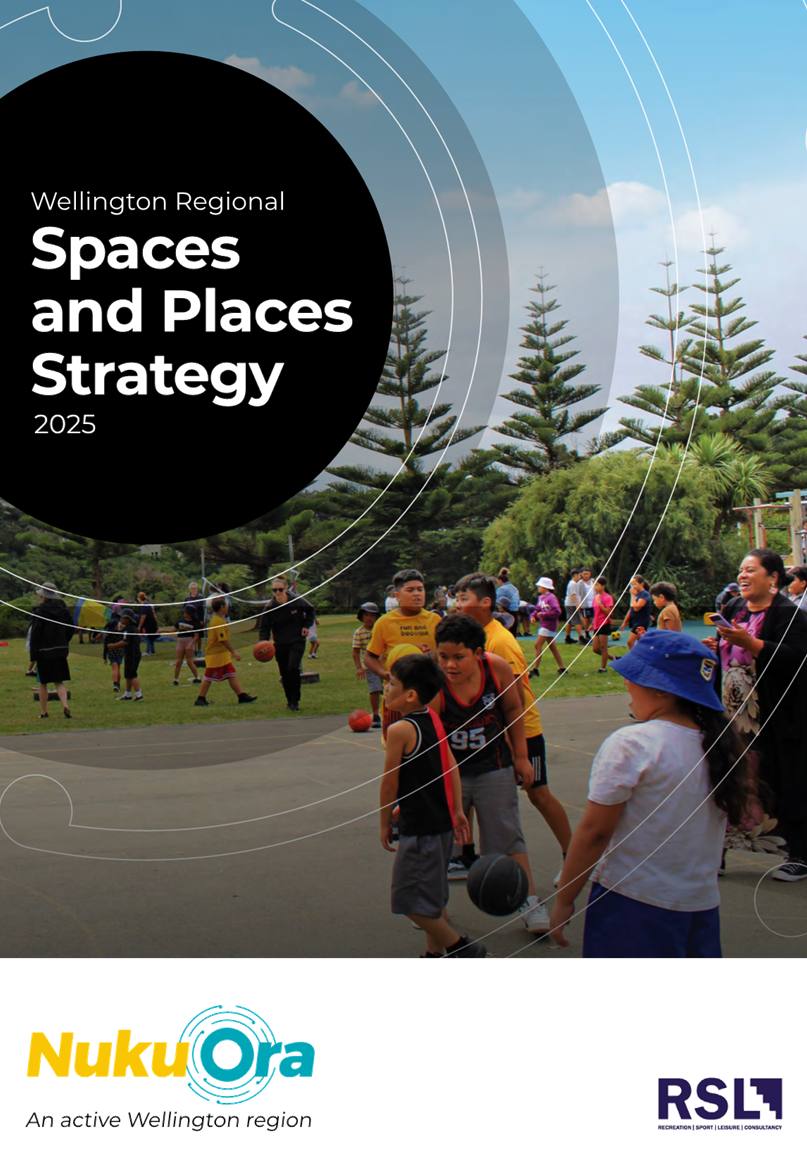

8.11 Dog
Control Fees for 2026/27
1. Purpose
For the Council to set
the Dog Control Fees for 2026/27.
2. Significance
The
matters for decision in this report are not considered to be of significance
under the Significance and Engagement Policy.
3. Background
The Dog Control Act
1996 (the Act) gives Council the power to set fees for the registration and
control of dogs. Section 37 of the Act states that fees shall be made by
resolution of Council and that the fees must be publicly advertised once they
are set. The Dog Control Act does not prescribe that the resolution to set fees
must be part of the Annual Plan process. The proposed fees for 2025/26 are
included in the table below. We are proposing an average increase in
registration fees in line with inflation at 2.3%. Some fees have more of
an increase such as the rehoming fee to better reflect the actual cost to
Council, like wise other fees have remained the same, i.e. the over $65
companion fee remains at $75.
It must be noted that
Council has not increased it fees in relation to dog control since the 2023/24
year.
The proposed fees for
the 26/27 year are set out below:
|
Dog Registration
|
Current 25/26
|
Proposed 26/27
|
|
Urban – entire dogs
|
$110.00
|
$115.00
|
|
Urban – spayed/neutered dogs
|
$85.00
|
$87.00
|
|
Over 65 canine companion
|
$75.00
|
$75.00
|
|
Rural – non-neutered and neutered
dogs – first two dogs
|
$75.00 per dog
|
$77.00
per dog
|
|
Rural – non-neutered and neutered
dogs – all remaining dogs
|
$40.00 per dog
|
$42.00
per dog
|
|
Dog classified as dangerous
|
$165.00
|
$172.50
|
|
Dog Registration
|
Current 25/26
|
Proposed 26/27
|
|
Urban application for a permit to keep
more than two dogs
|
$75.00
|
$75.00
|
|
Replacement Tag
|
$10.00
|
$10.00
|
|
Housing dog at other facilities (if
required)
|
Actual Costs
|
Actual Costs
|
|
Rehoming fee – sustenance,
administration, registration, microchip (if required) and property
suitability inspection
|
$50.00
|
$100.00
|
|
Costs associated with vet
treatment/supplementary feeding
|
Actual Costs
|
Actual Costs
|
|
Euthanise dog
|
Actual Costs
|
Actual Costs
|
|
Voluntary handover (surrender dog)
|
$50.00
|
$50.00
|
|
Impounding Fees
|
|
|
|
Dogs, sheep, goats
|
$150.00
|
$160.00
|
|
Second time impounding (dogs)
|
$200.00
|
$210.00
|
|
Third and subsequent impounding (dogs)
|
$250.00
|
$260.00
|
|
Cattle, deer, horses and all other
animals
|
$200.00
|
$210.00
|
|
Droving charge–calculated on
actual cost including labour and plant hire
|
Actual Costs
|
Actual Costs
|
|
Sustenance fee – all animals
|
$20.00 per day
|
$20.00 per day
|
4. Discussion
The Dog Control Act
1996 requires that Council to approve fees levied for dog registrations.
Section 37 provides what fees may be charged for and matters that shall be
considered prior to approving fees. Specifically, section 37(4) outlines that
Council shall have regard to the relative costs of the registration and control
of dogs. In Carterton, dog registration fees help to pay for most of our animal
services, for example:
· Dog control,
(impounding wandering dogs, investigation of dog attacks, and minimising
nuisances caused by dogs)
· Complaint response
· Operational costs
of the animal shelter
· Proactive patrols
· Administration and
maintenance of Council database including the yearly
registration process
· Dog training
advice and onsite behavioural advice
· Signage and
advertising of dog related issues
· The provision of
dog poo bags in Carterton
· Dog education
programmes in schools
· Animal control
vehicle costs
5. CONSIDERATIONS
5.1 Climate change
No issues have been identified.
5.2 Tāngata whenua
No
issues have been identified that are specific to tāngata whenua in
relation to this report.
5.3 Financial impact
The Council’s
Revenue and Financing Policy notes that dog fees are partially funded by dog
owners and partially funded by rate payers due to the distribution of benefits
between public and private goods. These fees are set based on the 70-80% private
goods and the 20-30% public goods split as per the Revenue and Financing
Policy. Recovery of exacerbator costs due to non-compliance is recovered in
full where possible.
5.4 Community Engagement requirements
The Dog Control Act
1996 (the Act) gives Council the power to set fees for the registration and
control of dogs. Section 37 of the Act states that fees shall be made by
resolution of Council and that the fees must be publicly advertised once they
are set.
5.5 Risks
No
risks have been identified.
6. Recommendation
That the Council:
1. Receives
the report.
2. Adopts
the Dog Control fees for 2026/27.
3. Gives
notice of fees for registration of dogs by public notification no less than one
month prior to the fees taking effect.
File
Number: 513117
Author: Solitaire
Robertson, Planning and Regulatory Services Manager
Attachments: Nil

8.12 Proactive
release of public-excluded reports and minutes
1. Purpose
For the Council to
note public-excluded reports and minutes for release to the public.
2. Significance
The
matters for decision in this report are not considered to be of significance
under the Significance and Engagement Policy.
3. Background
In
the Chief Ombudsman’s report Open for Business (October 2023) the
following was noted:
“There will be occasions where
there is good reason to close meetings, parts of meetings, or workshops. Where
this is the case, councils must be scrupulous in:
· ensuring that the occurrence of closed workshops are made
public (i.e. even if a workshop is closed, the public should still be aware it
is happening. If the public is unaware of a workshop, they will be unable to
request, under the LGOIMA, information about it);
· publishing their reasons for closing the meeting or
workshop;
· keeping adequate records of the content of closed
meetings and workshops; and
· releasing information about workshops and closed meetings
where possible”
(page 19).
4. Discussion
At
the Council meeting on 18 February 2026 Council Officers advised that
Democratic Services were developing a process to review and release
relevant public-excluded reports and minutes twice a year.
Attached are minutes
and reports for the period 1 July to 31 December 2025 that in Council
officers’ view can be released:
· Attachments 1
and 2 provide the list of meetings and workshops for the period, whether or
not they were open or closed, and commentary on release, or not, of documents.
· Attachment 3
provides the documents that have been released, with appropriate redactions as
necessary.
Investment
Committee
CDC’s
Investment Advisors, Eriksen Global were consulted about the timeframe for
releasing the public-excluded Investment Reports which are provided quarterly
in the closed section of meetings. Their advice is they could be viewed
by the public if requested after 12 months, subject to any grounds for
withholding the information. However, in the meantime Eriksens have now started
providing a summary Investment Dashboard Report in the open
session of the meeting.
5. Recommendation
That the Council:
1. Receives
the report.
2. Notes
the release of Council reports and minutes from 1 July to 31 December 2025.
File
Number: 519415
Author: Robyn
Blue, Democratic Services Officer
Attachments: 1. List
of meetings July - Dec 2025 ⇩
2. LIst
of workshops July-Dec 2025 ⇩
3. Proactive
release of council documents July - Dec 2025 ⇩
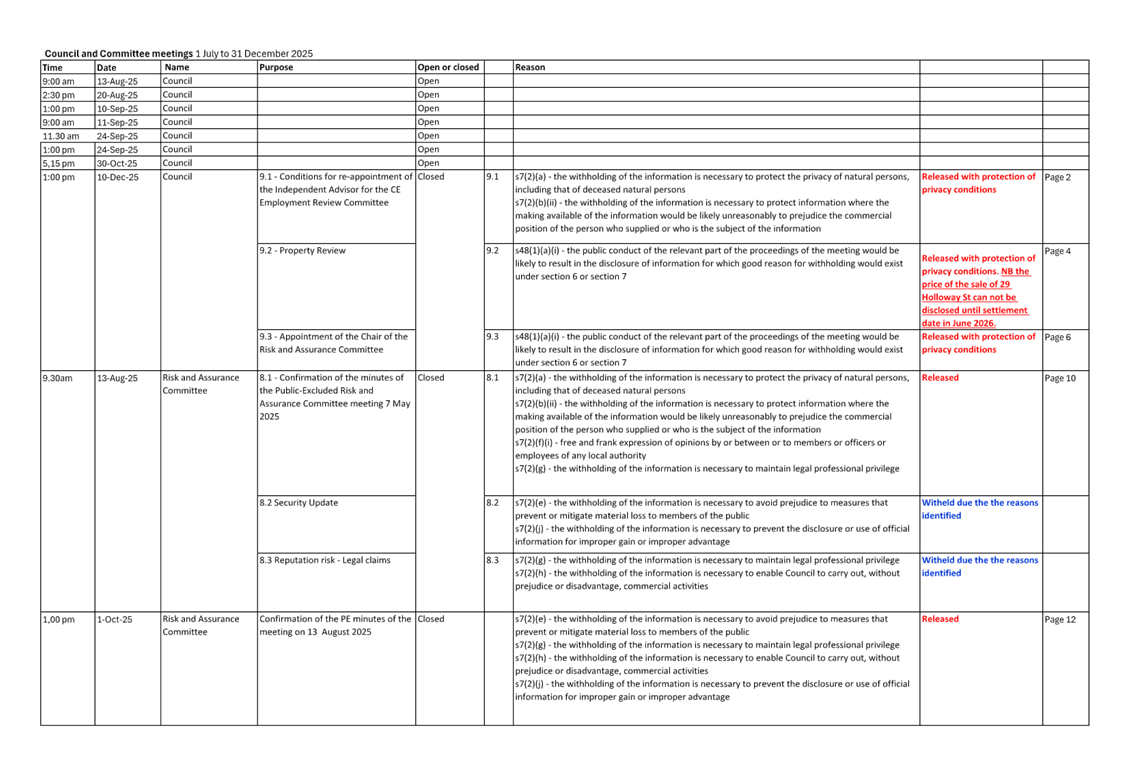
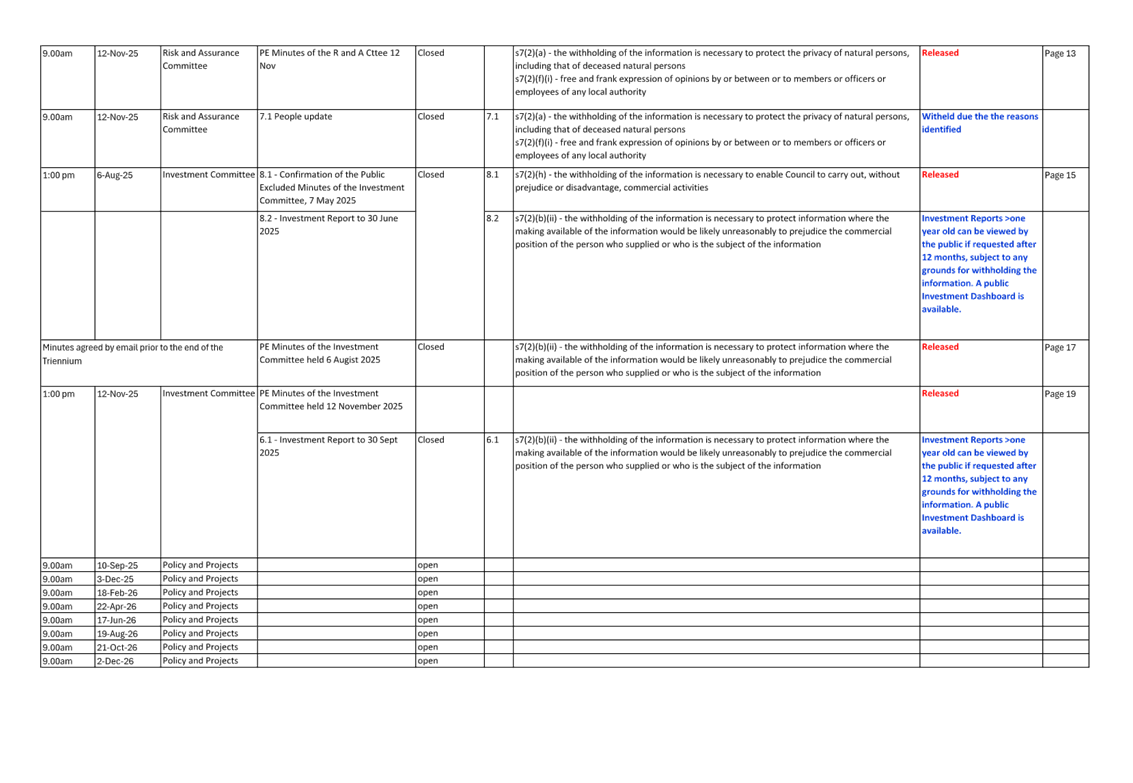
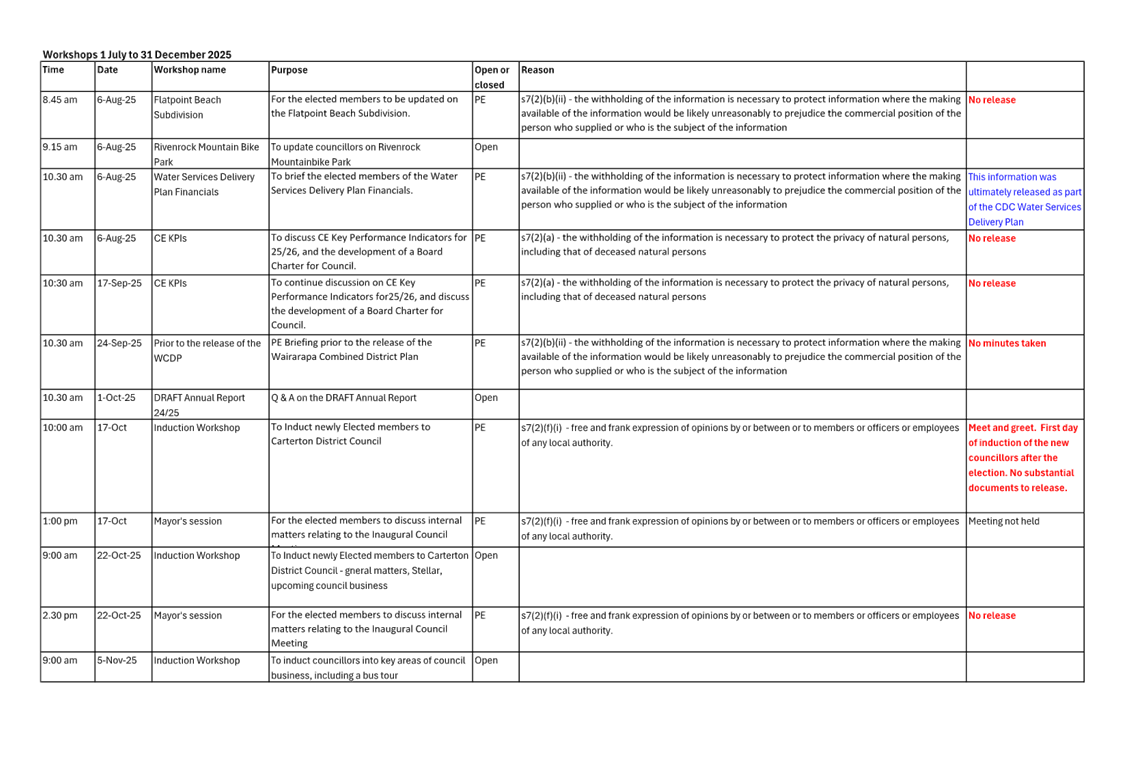
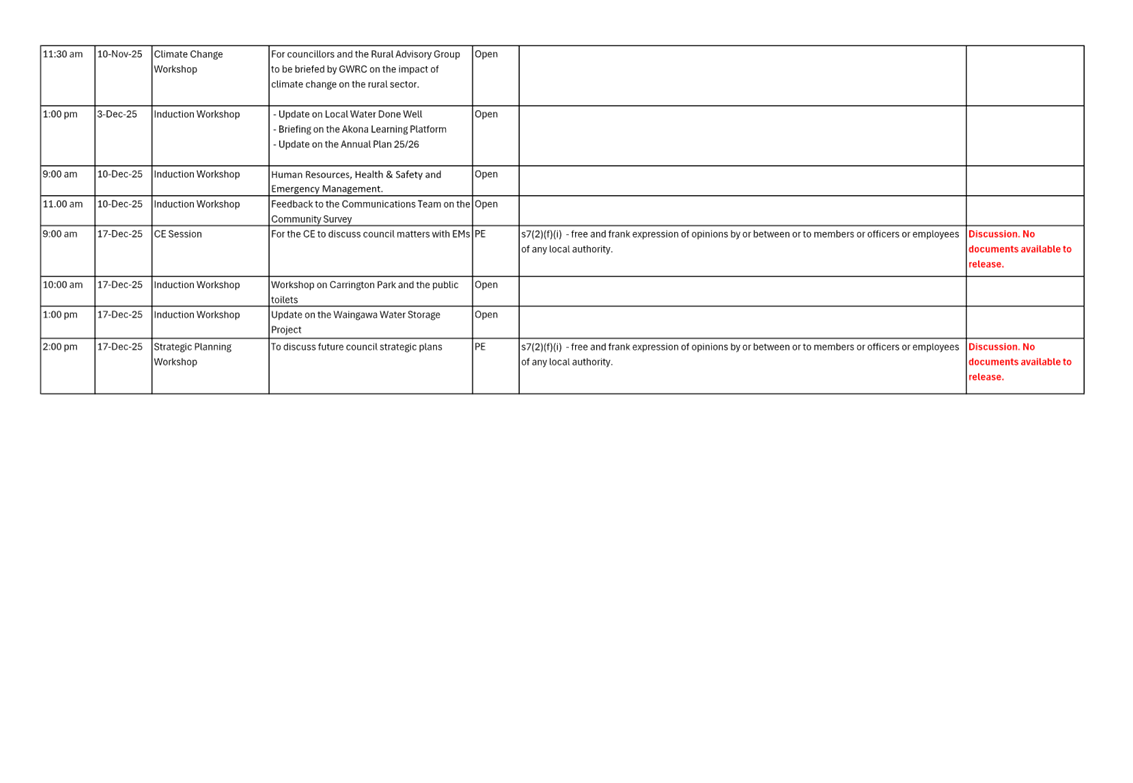

8.13 Local
Government Official Information and Meetings Act Requests
1. Purpose
To inform the Council
of the number of requests under the Local Government Official Information and
Meetings Act (LGOIMA) 1987 (the Act) 17 March 2026 to 5 May 2026.
2. Significance
The
matters for decision in this report are not considered to be of significance
under the Significance and Engagement Policy.
3. Background
The Act allows people
to request official information held by local government agencies. It
contains rules of how such requests should be handled and provides a right to
complain to the Ombudsman in certain situations.
The purpose of the Act
is to increase the availability of official information held by agencies and
promote the open and public transaction of business at meetings.
The purposes of LGOIMA
are specified in Section 4 which can be viewed here: https://legislation.govt.nz/act/public/1987/0174/latest/DLM122283.html
The
information is not limited to documentary material, and includes material
held in any format such as:
· written documents,
reports, memoranda, letter, notes, emails and draft documents
· non-written
documentary information, such as material stored on or generated by computers,
including databases, video or tape recordings
· information, which
is known to an agency, but which has not yet been recorded in writing or
otherwise (including knowledge of a particular matter held by an officer,
employee or member of an agency in their official capacity)
· documents and
manuals which set out the policies, principles, rules or guidelines for
decision making by an agency
· the reasons for
any decisions that have been made about a person.
It does not matter
where the information originated or is currently located, if it is held by the
council, it must be provided if requested, unless there is reason to withhold
the information, as specified in Section 7 which can be viewed here: https://legislation.govt.nz/act/public/1987/0174/latest/DLM122287.html
Councils must respond
to a requester ‘as soon as reasonably practicable’ and no later
than 20 working days after the day on which the request was received. Our
practice is to acknowledge receipt of the request within the first working day.
We respond promptly to requests and generally well ahead of the 20 working
days.
Where a person
requesting the information indicates urgency, we can prioritise our response
ahead of other work. This mainly relates to requests from the
media. Not all media requests for information are treated as LGOIMA
requests.
All requests are
recorded in a register and saved in our document management system.
The Council
proactively publishes official information responses on our website. As such,
the Council may publish the response on the CDC website after five working
days. The requestor’s name and contact details will be removed. Proactive
release of information to the public promotes openness and transparency and
fosters public trust and confidence in Council. There are administrative
benefits for the Council, such as reducing requests for information which is
publicly available and allowing for greater ease of handling of the requests
that are received.
Published LGOIMAs can
be viewed here: https://cdc.govt.nz/your-council/official-information/lgoima/
Most requests for
information are supplied free of charge. Councils are entitled to charge for
requests for information. Charging is based on the hours spent on a request,
which includes the processing of files or any copying that is required.
Councils charging policy is based on the Ministry of Justice Guidelines.
4. reporting
lgoima requests to council
Attachment
1 contains the requests received from 17 March 2026
to 5 May 2026, and those requests open at the time of the previous report (10
December 2025).
As of
5 May 2026, there are 5 open requests.
For
the year 2023 there were a total of 98 requests received.
The
table below shows total numbers of requests received from the year 2024 to 5
May 2026.
|
Number of requests received 2024-2026
|
|
|
2024
|
2025
|
2026
|
|
January
|
4
|
0
|
12
|
|
February
|
7
|
7
|
6
|
|
March
|
5
|
5
|
7
|
|
April
|
7
|
7
|
8
|
|
May
|
7
|
5
|
2
|
|
June
|
0
|
6
|
|
|
July
|
3
|
2
|
|
|
August
|
3
|
12
|
|
|
September
|
9
|
6
|
|
|
October
|
5
|
7
|
|
|
November
|
5
|
6
|
|
|
December
|
1
|
5
|
|
|
Total
|
56
|
68
|
35
|
5.
OMBUDSMAN
There have been no complaints to
the Ombudsman.
6. Recommendation
That the Council:
1. Receives
the report.
File
Number: 512074
Author: Serah
Pettigrew, Democratic Services Officer
Attachments: 1. LGOIMA
Requests from 17 March 2026 to 5 May 2026 ⇩
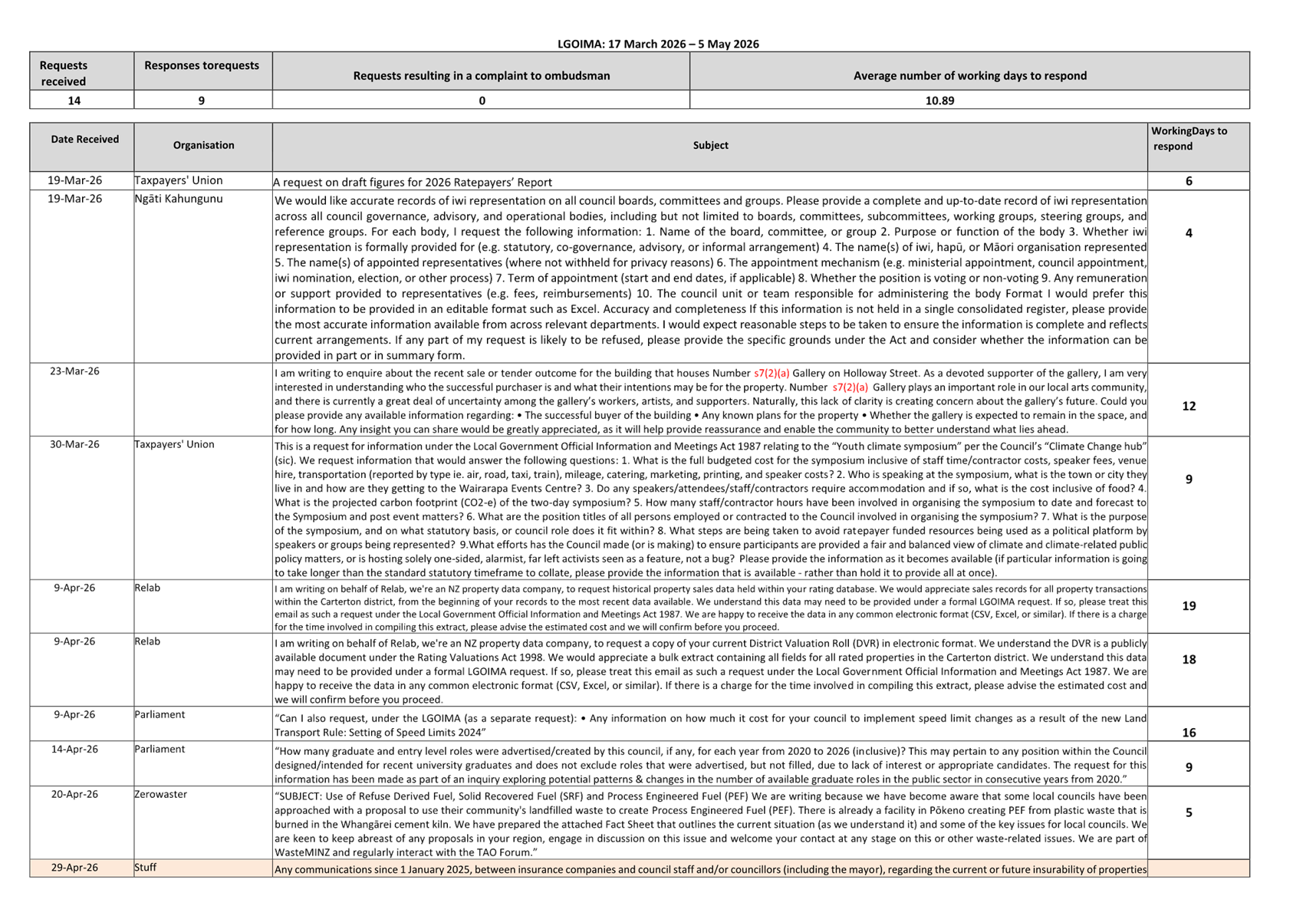
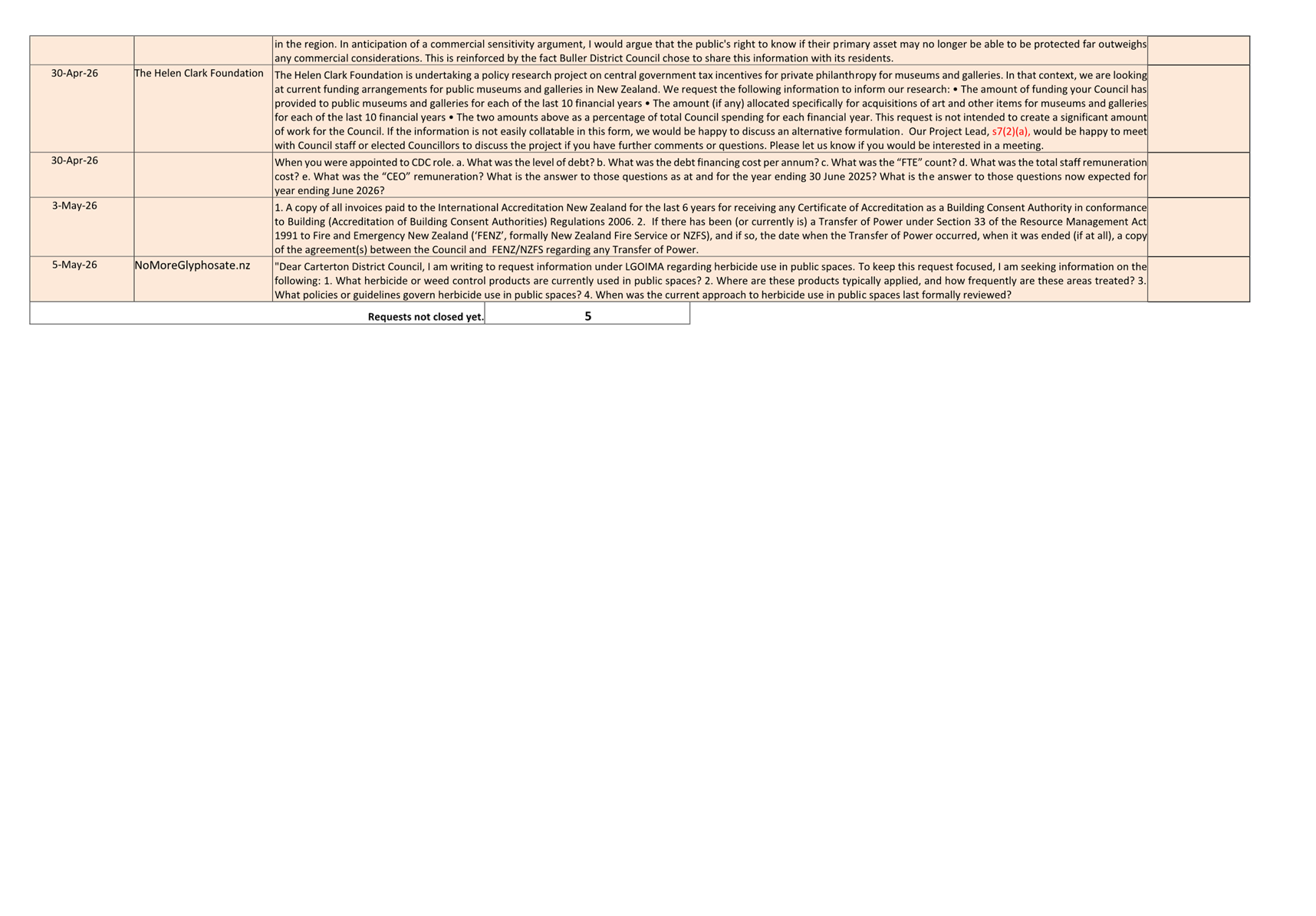

8.14 Service
Requests and Complaints
1. Purpose
For the Council to be
informed on Service Requests and Complaints received 19 March 2026 to 6 May
2026.
2. Significance
The
matters of decision in this report are not considered to be of significance
under the Significance and Engagement Policy.
3. Background
Customer
Service Requests and Complaints come to Council through many avenues. It is
preferred that the Service Requests and Complaints are in writing by formal
letter, email, or through the website service request portal, however, Council
will also accept these via telephone, in person at the Council office, and
through our social media channels.
The
local government legislation sets out specific responsibilities for functions
and activities to be delivered by Council. Council’s obligation
under the legislation is to report on the Department of Internal Affairs (DIA)
performance measures on annual basis. The key performance is to acknowledge the
Service Requests and Complaints within the first 24 hours.
Council
has an obligation to respond within 3 weeks of receiving the Service Request or
Complaint to inform if any additional time is required to resolve the issue.
All
requests are recorded in a Service Request Management system register and saved
in the Council’s document management system.
Service
Request Management is the operational system for the management of all requests
for Council action excluding information requests, progress on consent/licence
applications, and library/Event Centre activity. Such requests essentially
cover the following business activities:
· Animal control
· Health
· Parks and Reserves
· Potable Water
· Waste Water
· Storm Water
· Roading
· Rural Water
· Solid Waste
· Building Services
· Operations
· Management
· Infrastructure
· Communications Team
Council
officers consider these to be service-related, that is, Council responding to a
resident or community request.
A
Service Request is any notification received from a customer, client,
contractor or member of the public regarding a fault, a breakdown in service,
or investigation of issues and concerns.
A
Complaint is an expression of dissatisfaction with a CDC decision, process
followed, outcome, employee or contractor action, or quality of service.
A
person can log a service request or a complaint or report a fault online which
can be viewed in the Carterton District Council website on this link: https://cdc.govt.nz/service-request/ .
4. Service
request reporting
Depending
on the circumstances of the service request within each activity, some requests
may take longer to complete and, in the case of Roading and Waters, can be
affected by weather conditions.
Previous
years’ service requests
|
Number of service requests
received
|
|
Opened Tickets
|
Closed Tickets
|
|
2023
|
1243
|
1243
|
|
2024
|
1333
|
1310
|
|
2025
|
1318
|
1230
|
Current year service requests
The table below shows total numbers of
service requests received from 25 March 2026 to 6 May 2026.
|
Number of service requests
received
|
|
Opened Tickets
|
Closed Tickets
|
|
2026
|
|
|
|
Jan
|
92
|
101
|
|
Feb
|
140
|
111
|
|
March
|
100
|
111
|
|
April
|
125
|
109
|
|
May
|
15
|
11
|
|
Total
|
472
|
443
|
The table below shows a total of 135
tickets are currently open, broken down by department:
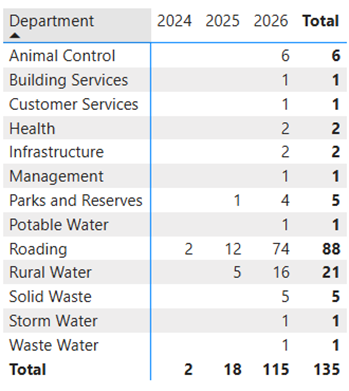
The graph below shows the number of
service desk tickets opened each day. The spike for 20 April reflects the
impacts of the severe weather event primarily on Roading, and Parks and
Reserves.
5. reporting
ON service complainTS
As
per Council’s obligations under the Local Government Official Information
and Meetings Act 1987, a complaint should be acknowledged promptly on receiving
a complaint. A complaint is an expression of dissatisfaction, from our
customers, with a CDC decision, process followed, outcome, employee or
contractor action, or quality of service.
Where
the information has been withheld under section 7(2)(a) of the Local Government Official Information and
Meeting Act 1987 (the Act), this is necessary to protect the privacy of natural
persons, including that of deceased natural persons.
The table below shows total numbers of
complaints received from 19 March 2026 to 6 March 2026.
|
Number of complaints
received
|
|
Month
|
Year
|
|
|
2025
|
2026
|
|
January
|
0
|
3
|
|
February
|
5
|
4
|
|
March
|
0
|
3
|
|
April
|
0
|
5
|
|
May
|
7
|
1
|
|
June
|
3
|
|
|
July
|
3
|
|
|
August
|
5
|
|
|
September
|
7
|
|
|
October
|
9
|
|
|
November
|
3
|
|
|
December
|
2
|
|
|
Total
|
43
|
16
|
6. Recommendation
That the Council:
1. Receives
the report.
File
Number: 512081
Author: Serah
Pettigrew, Democratic Services Officer
Attachments: 1. Service
Complaints 19 March 2026 to 6 May 2026 ⇩
|
Ordinary
Council Meeting Agenda
|
13
May 2026
|
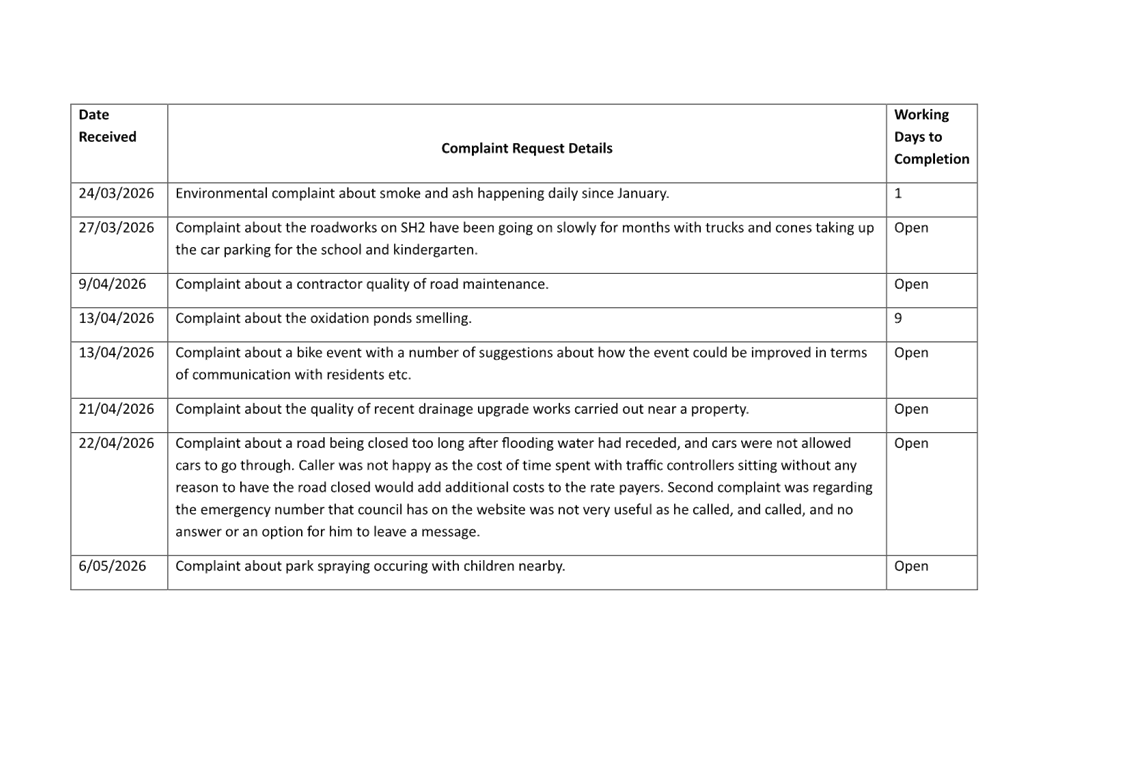
9 Exclusion
of the Public
RESOLUTION TO
EXCLUDE THE PUBLIC
|
Recommendation
That the public be excluded from the following parts of
the proceedings of this meeting.
The general subject matter of each matter to be considered
while the public is excluded, the reason for passing this resolution in
relation to each matter, and the specific grounds under section 48 of the
Local Government Official Information and Meetings Act 1987 for the passing
of this resolution are as follows:
|
General subject of each matter to be considered
|
Reason for passing this resolution in relation to each
matter
|
Ground(s) under section 48 for the passing of this
resolution
|
|
9.1 - Wastewater Reservoir Construction Project -
Information Release
|
s7(2)(b)(ii) - the
withholding of the information is necessary to protect information where
the making available of the information would be likely unreasonably to
prejudice the commercial position of the person who supplied or who is the
subject of the information
|
s48(1)(a)(i) - the
public conduct of the relevant part of the proceedings of the meeting would
be likely to result in the disclosure of information for which good reason
for withholding would exist under section 6 or section 7
|
|
9.2 - Community appointments to the Economic
Development Committee
|
s7(2)(a) - the
withholding of the information is necessary to protect the privacy of
natural persons, including that of deceased natural persons
|
s48(1)(a)(i) - the
public conduct of the relevant part of the proceedings of the meeting would
be likely to result in the disclosure of information for which good reason
for withholding would exist under section 6 or section 7
|
|
9.3 - Economic Development Providers
|
s7(2)(a) - the
withholding of the information is necessary to protect the privacy of
natural persons, including that of deceased natural persons
|
s48(1)(a)(i) - the
public conduct of the relevant part of the proceedings of the meeting would
be likely to result in the disclosure of information for which good reason
for withholding would exist under section 6 or section 7
|
|
10 Karakia
Whakamutunga
Kia
whakairia te tapu
Kia
wātea ai te ara
Kia
turuki whakataha ai
Kia
turuki whakataha ai
Haumi
ē, hui ē, taiki ē