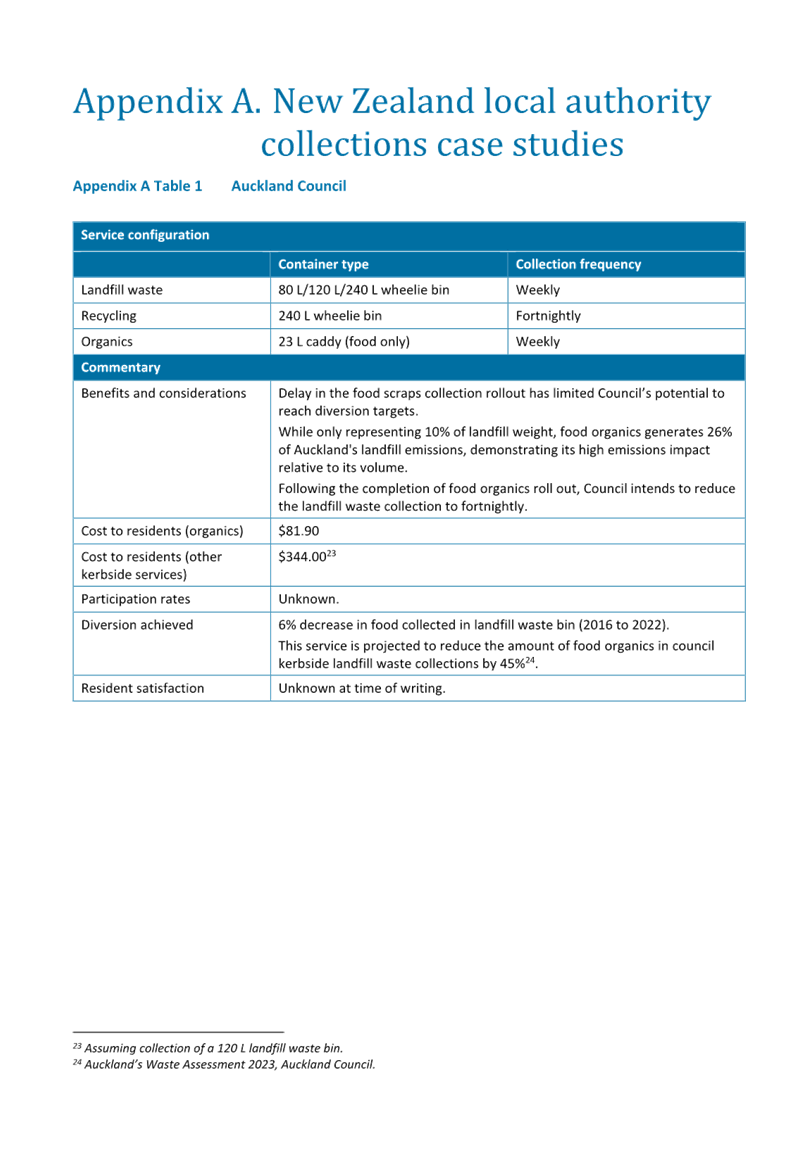
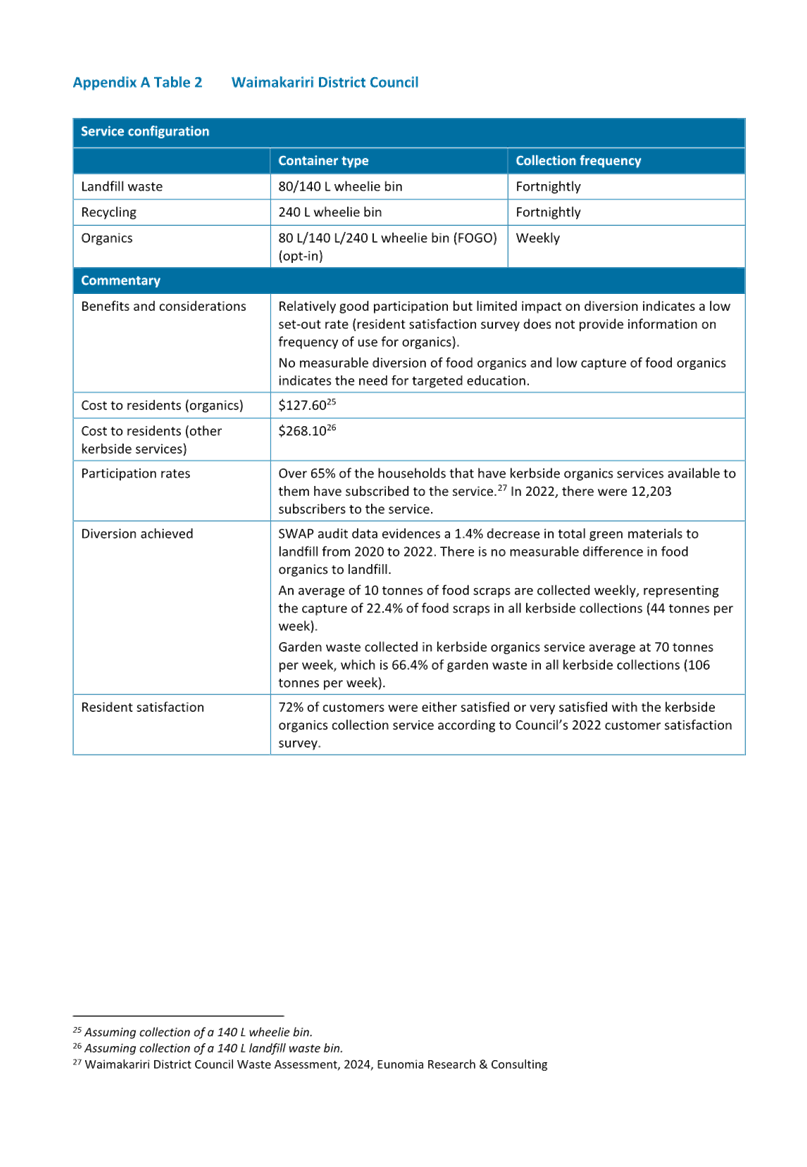
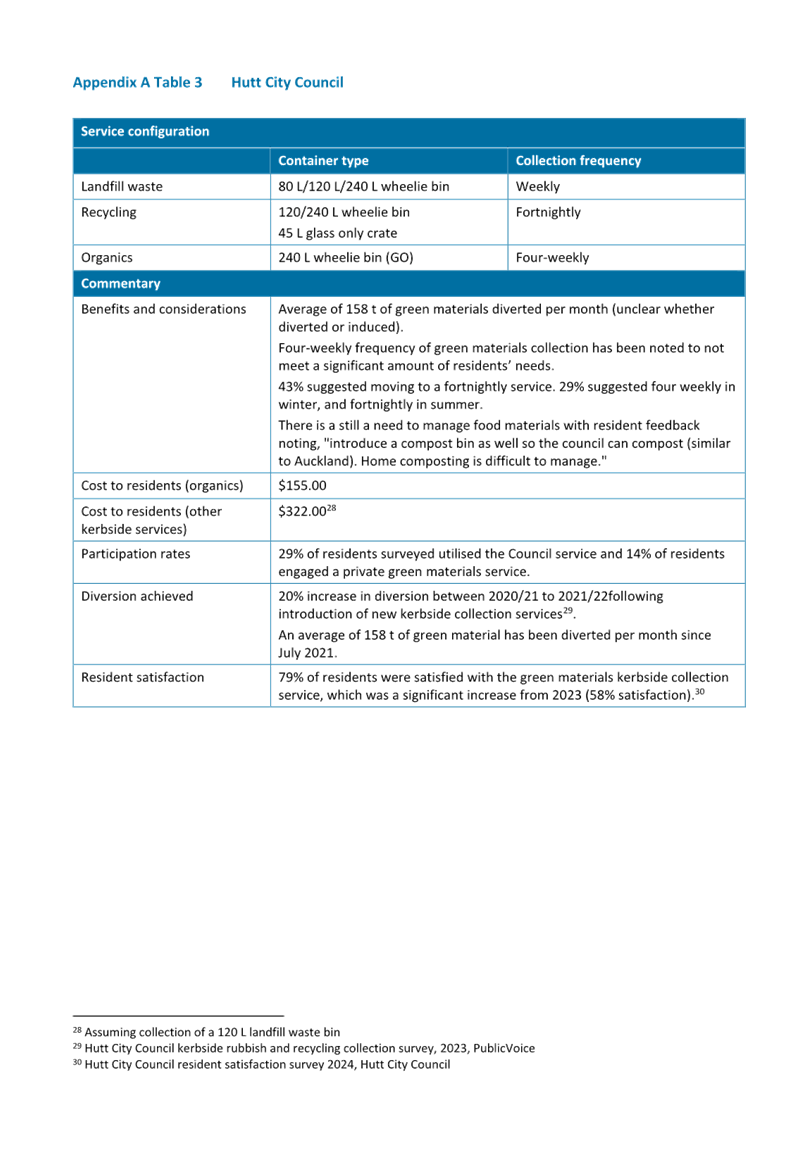
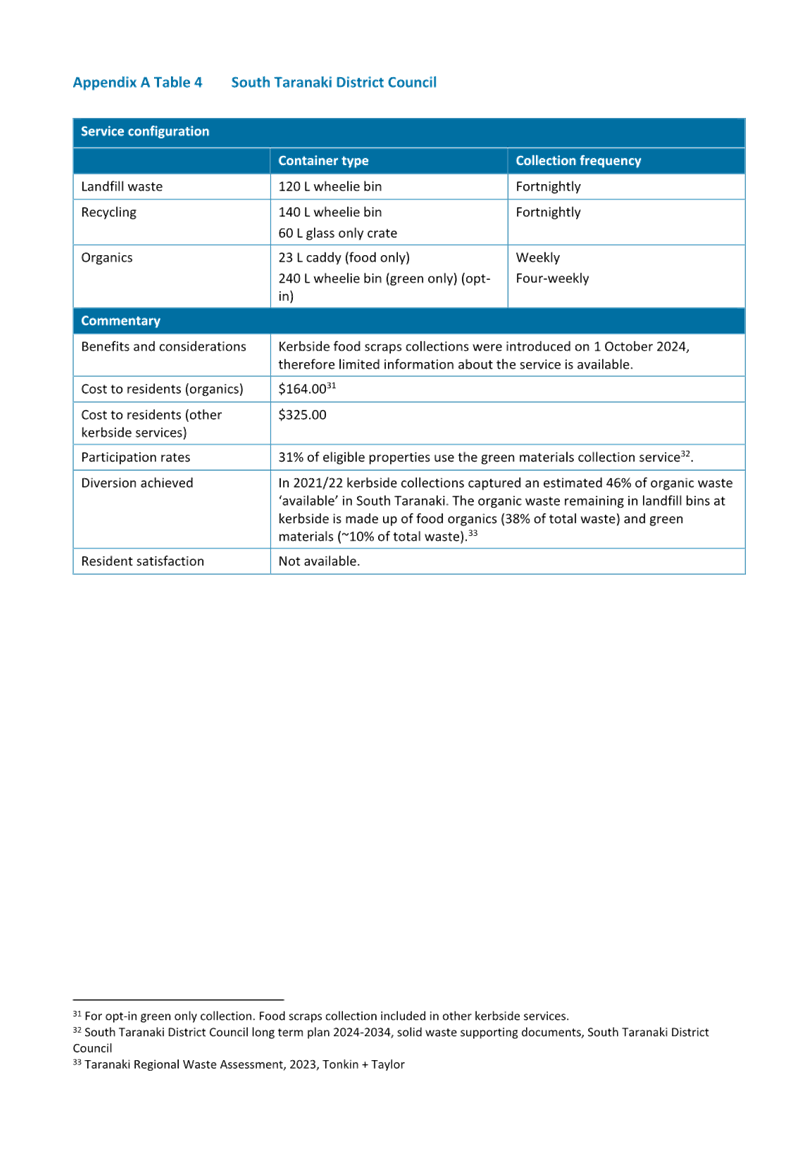
|
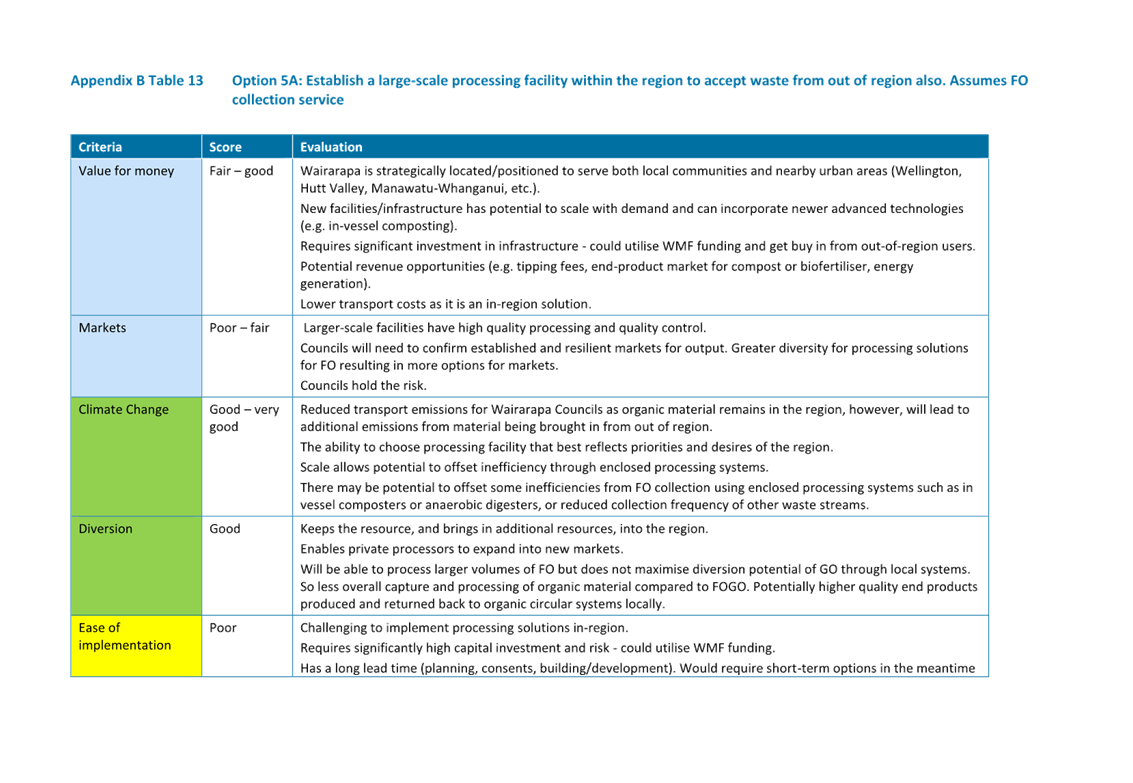
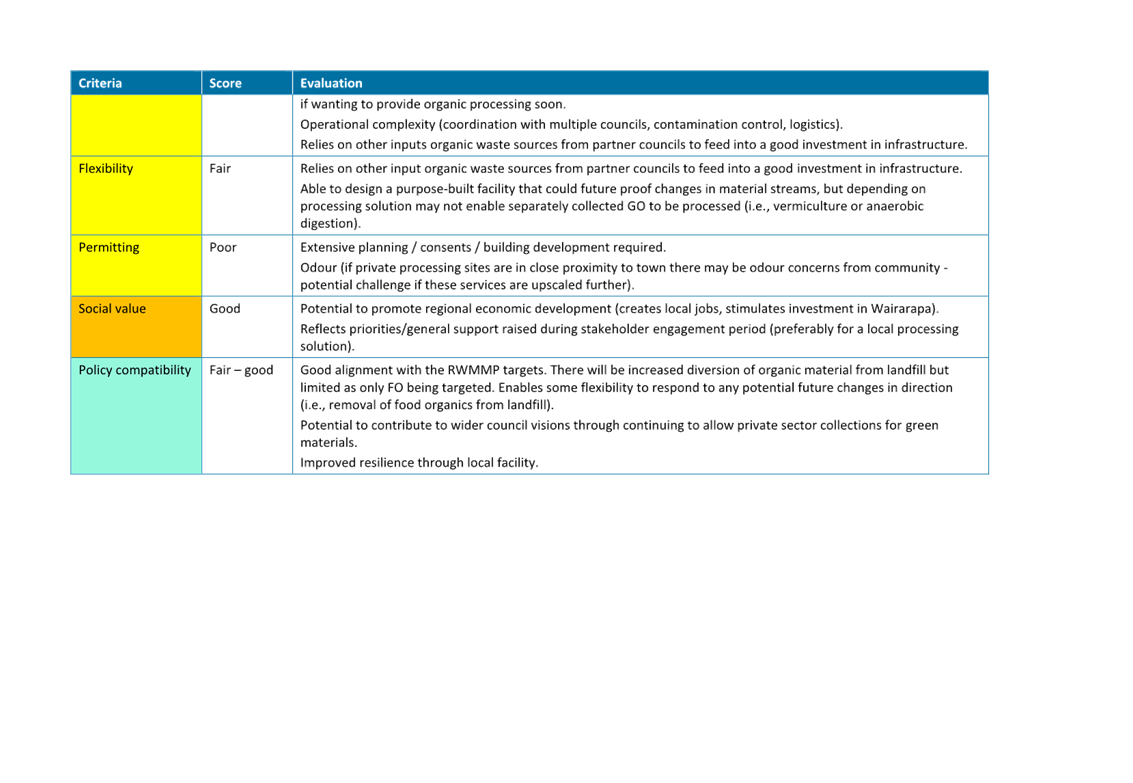
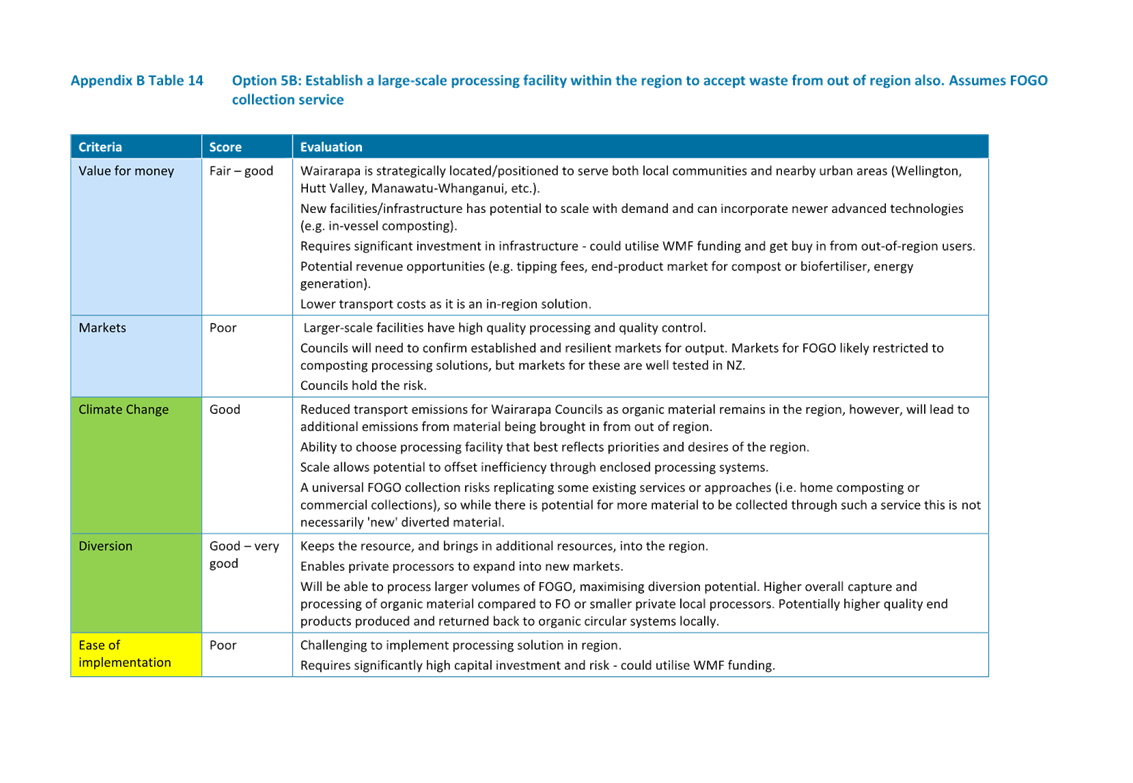
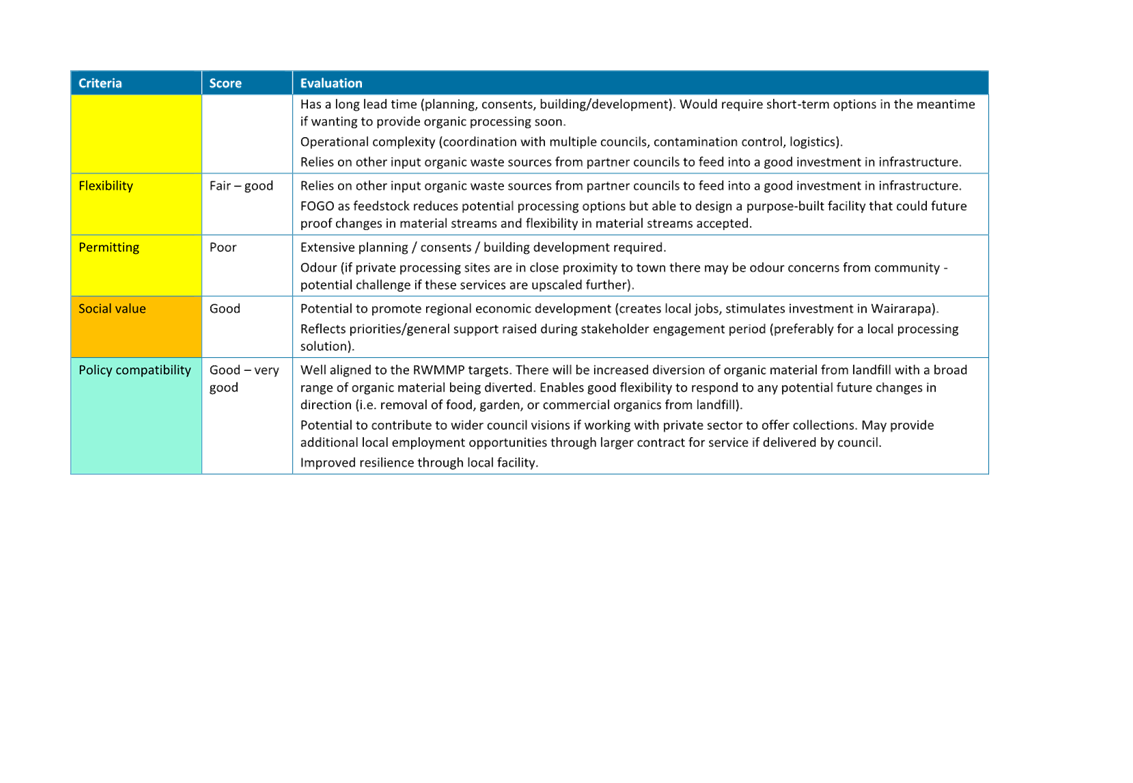
|
|
AGENDA
Policy and Projects Committee meeting
|
|
Date:
|
Wednesday, 10 September
2025
|
|
Time:
|
9:00 am
|
|
Location:
|
Carterton Events Centre
50 Holloway St
Carterton
|
|
Deputy Mayor S
Cretney
Cr S Gallon
Mayor R Mark
Cr B Deller
|
Cr R Cherry-Campbell
Cr L Newman
Cr S Laurence
Cr G Ayling
|
|
Policy and Projects Committee meeting Agenda
|
10 September 2025
|
6 Confirmation
of the Minutes

6.1 Minutes
of the Policy and Projects Committee Meeting held on 18 June 2025
1. Recommendation
1. That
the Minutes of the Policy and Projects Committee Meeting held on 18 June 2025
are true and correct.
File
Number: 465417
Author: Katrina
King, Democratic Services Officer
Attachments: 1. Minutes
of the Policy and Projects Committee Meeting held on 18 June 2025
|
Policy
and Projects Committee meeting Minutes
|
18
June 2025
|

MINUTES
OF Carterton District Council
Policy and Projects Committee meeting
HELD AT THE Carterton Events Centre, 50
Holloway St, Carterton
ON Wednesday, 18 June 2025 AT 9:00 am
PRESENT: Deputy
Mayor Steve Cretney (Chair), Cr Steve Gallon (Deputy Chair), Mayor Ron Mark, Cr
Robyn Cherry-Campbell, Cr Lou Newman (via Video Conference), Cr Steve Laurence,
Cr B Deller (from 10.50am)
IN
ATTENDANCE: Staff
Johannes
Ferreira (Infrastructure Services Manager), Geoff Hamilton (Chief Executive),
Solitaire Robertson (Planning and Regulatory Services Manager), Geri Brooking
(People and Wellbeing Manager), Glenda Seville (Community Services and
Facilities Manager), Lawrence Stephenson (Water Services Manager), Jeet Kiran
(Waters Compliance and Monitoring Officer), Sarvesh Tiwari (Waste Management
and Minimisation Officer), Becks Clarke (Community Development Team Leader),
Ricky Utting (Climate Change Coordinator),Sara Renall (Senior Communications
and Engagement Advisor) via videoconference, Katrina King (Democratic Services
Officer)
1 Karakia
Timatanga
The meeting was opened with a karakia by all members.
2 Apologies
MOVED
That an apology be accepted from
Cr Grace Ayling, Cr Brian Deller and Cr Dale Williams.
Cr R Cherry-Campbell / Cr S Gallon
CARRIED
3 Conflicts
of Interests Declaration
There were no conflicts of interest declared.
4 Public
Forum
Graham O’Dowd
Graham
provided photos from around the district of bridges and culverts that need
attention.
Jimmy
Haeata
Jimmy
Haeata of Ngāti Maahu spoke on his appreciation to the Parks and Reserves
team and Sheree Ngātuere, CDC Kaituitui, for building a strong
relationship with the Ngā Tawhai Reserve project. He acknowledged the
collective efforts to restore, regenerate, and revive the historical
significance of the area.
5 Discussion
of the Public Forum
·
Mayor Ron raised concerns around the contract with Fulton Hogan.
There shouldn’t be a need to raise a service request on a contract matter
that is routine. Mayor Ron Mark asked the Group Manager Infrastructure,
Johannes Ferreira, to monitor bridge and road maintenance.
·
Johannes acknowledged that there are issues across the wider
network, and advised he is working with the Fulton Hogan team. They deliver a
lot of work that is noticed, however, there are constrained budgets and work
must be prioritised.
6 Confirmation
of the Minutes
|
6.1 Minutes
of the Policy and Projects Committee Meeting held on 9 April 2025
|
|
MOVED
1.
That the Minutes of the Policy and Projects Committee Meeting held on
9 April 2025 are true and correct.
Deputy
Mayor S Cretney / Cr S Laurence
CARRIED
|
7 Reports
|
7.1 Community
Grants and Funding Framework and Policy
|
|
1. Purpose
For the Committee to
adopt the Community Grants and Funding Framework and Policy.
|
|
MOVED
That the Committee:
1. Receives
the report.
2. Adopts
the Community Grants and Funding Framework and Policy.
3. Notes
that minor editing and changes in formatting may occur prior to public
release of the document.
Deputy
Mayor S Cretney / Mayor R Mark
CARRIED
|
|
7.2 Carterton
District Council Climate Change Implementation Plan 2025-2026
|
|
1. Purpose
For the Committee to
endorse the 2025/26 climate change implementation plan.
|
|
MOVED
That the Committee:
1.
Receives the report.
2.
Adopts the Climate Change Strategy 2025/26 Implementation Plan.
Deputy
Mayor S Cretney / Cr R Cherry-Campbell
CARRIED
|
|
7.3 Update
on Operational Consents
|
|
1. Purpose
To update the
Committee on the status of the existing consents.
|
|
MOVED
That the Committee:
1.
Receives the report.
Cr S
Gallon / Mayor Ron Mark
CARRIED
|
|
7.4 Waste
Management and Minimisation Update
|
|
1. Purpose
For the Committee to
be updated on Carterton District’s Waste Management and Minimisation
services.
|
|
MOVED
That the Committee:
1.
Receives the report.
Mayor
Ron Mark / Cr S Gallon
CARRIED
|
|
7.5 Water
Operations Report
|
|
1. Purpose
For the Committee to
be updated on the water operations.
|
|
MOVED
That the Committee:
1.
Receives the report.
Deputy
Mayor S Cretney / Cr R Cherry-Campbell
CARRIED
|
|
7.6 Waste
Water Treatment Plant Sludge Removal Project Scope Update
|
|
1. Purpose
For the Committee to
be updated on the project scope development of the Wastewater Treatment Plant
(WWTP) Sludge removal project.
|
|
MOVED
That the Committee:
1. Receives
the report.
2. Endorses
Officers’ preferred option, namely proceeding with Option 1 –
Trial of the full process cycle.
Deputy
Mayor S Cretney / Cr R Cherry-Campbell
CARRIED
|
|
7.7 Major
Projects Update
|
|
1. Purpose
To update the
Committee on the progress of major projects.
|
|
MOVED
That the Committee:
1.
Receives the report.
Deputy
Mayor S Cretney / Mayor R Mark
CARRIED
|
|
7.8 Ruamāhanga
Roads and Corridor Access Report
|
|
1. Purpose
For the Committee to
be updated on Ruamāhanga Roads and Corridor Access activities.
|
|
MOVED
That the Committee:
1.
Receives the report.
Mayor
R Mark / Cr S Gallon
CARRIED
|
|
7.9 Changes
to the Delegations Manual
|
|
1. Purpose
For the Committee to
approve changes to the Delegations Manual for Carterton District Council.
|
|
MOVED
That the Committee:
1. Receives
the report.
2. Approves
the changes to the Delegations Manual, as outlined in Attachment 1.
Mayor R
Mark / Deputy Mayor S Cretney
CARRIED
|
|
7.10 Review
of Emergency Management Plans
|
|
1. Purpose
For the Committee to
be updated on the Business Continuity Plan and new Crisis Management Plan.
|
|
MOVED
That the Committee:
1. Receives
the report.
2. Endorses
the Business Continuity Plan and Crisis Management Plan.
Cr
R Cherry-Campbell / Cr B Deller
CARRIED
|
|
7.11 Update
on Planning Resource Consents
|
|
1. Purpose
The purpose of this
report is to update the Committee on the resource consents issued since the
previous update.
|
|
MOVED
That the Committee:
1.
Receives the report.
Deputy S
Cretney / Mayor R Mark
CARRIED
|
|
7.12 Advisory
Group Updates
|
|
1. Purpose
For the Committee to
be updated on activities and highlights from the Advisory Group meetings.
|
|
MOVED
That the Committee:
1.
Receives the draft meeting notes from the Walking and Wheels
and Rural Advisory Groups.
Cr B
Deller / Cr R Cherry-Campbell
CARRIED
|
8 Karakia
WhakamUtunga
The meeting closed with a karakia by all members.
The Meeting closed
at 11.51am
Minutes confirmed:
……………………………………
Date: ...................................................
|
Policy and Projects Committee meeting Agenda
|
10 September 2025
|
7 Reports

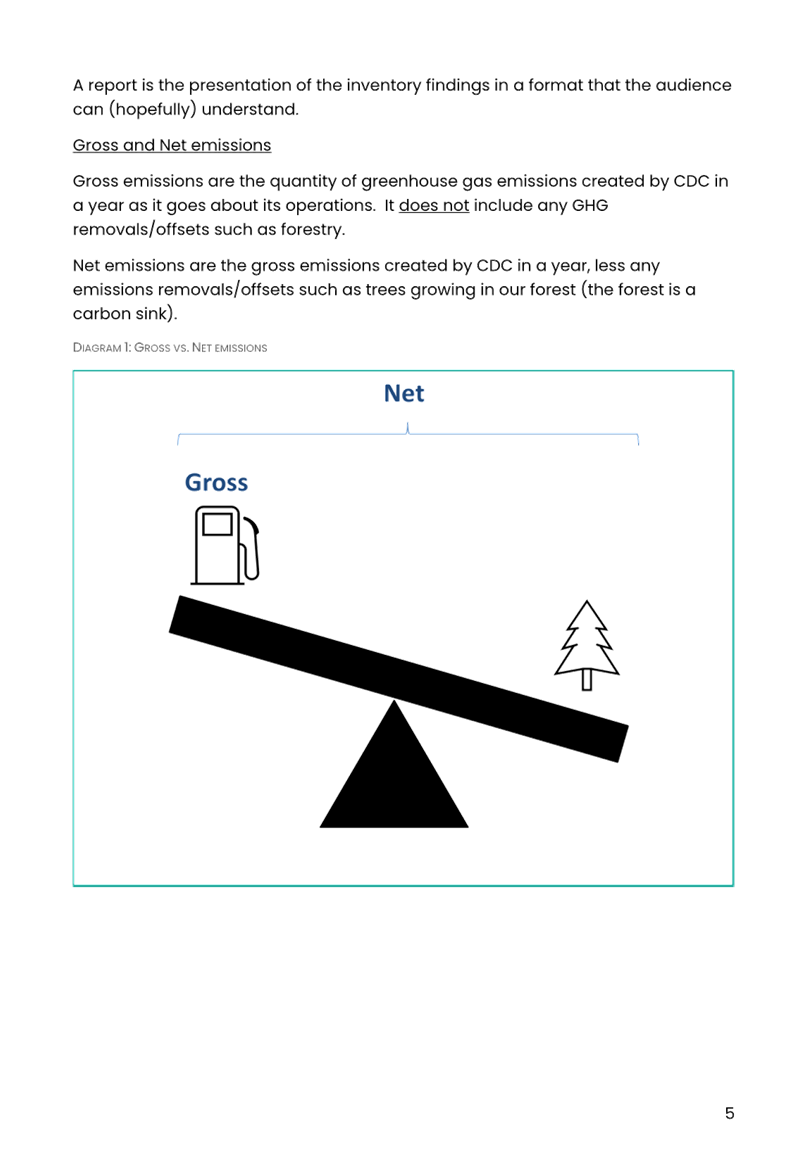
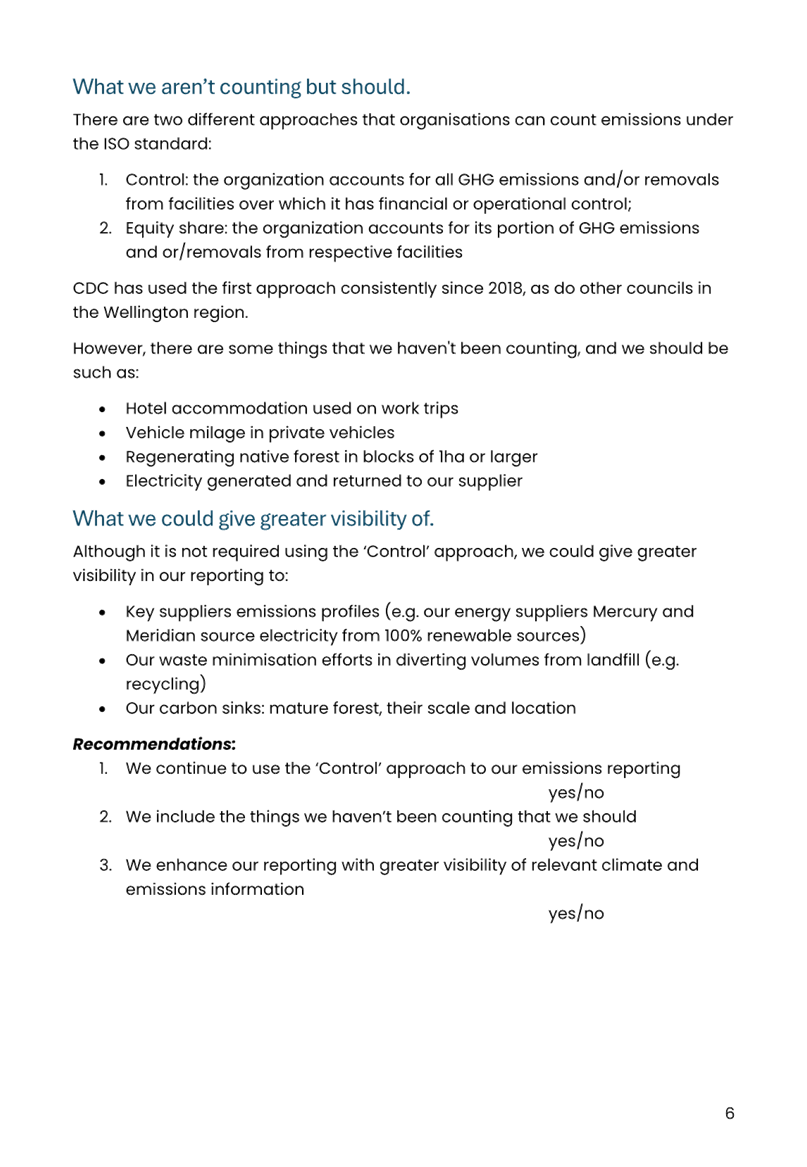
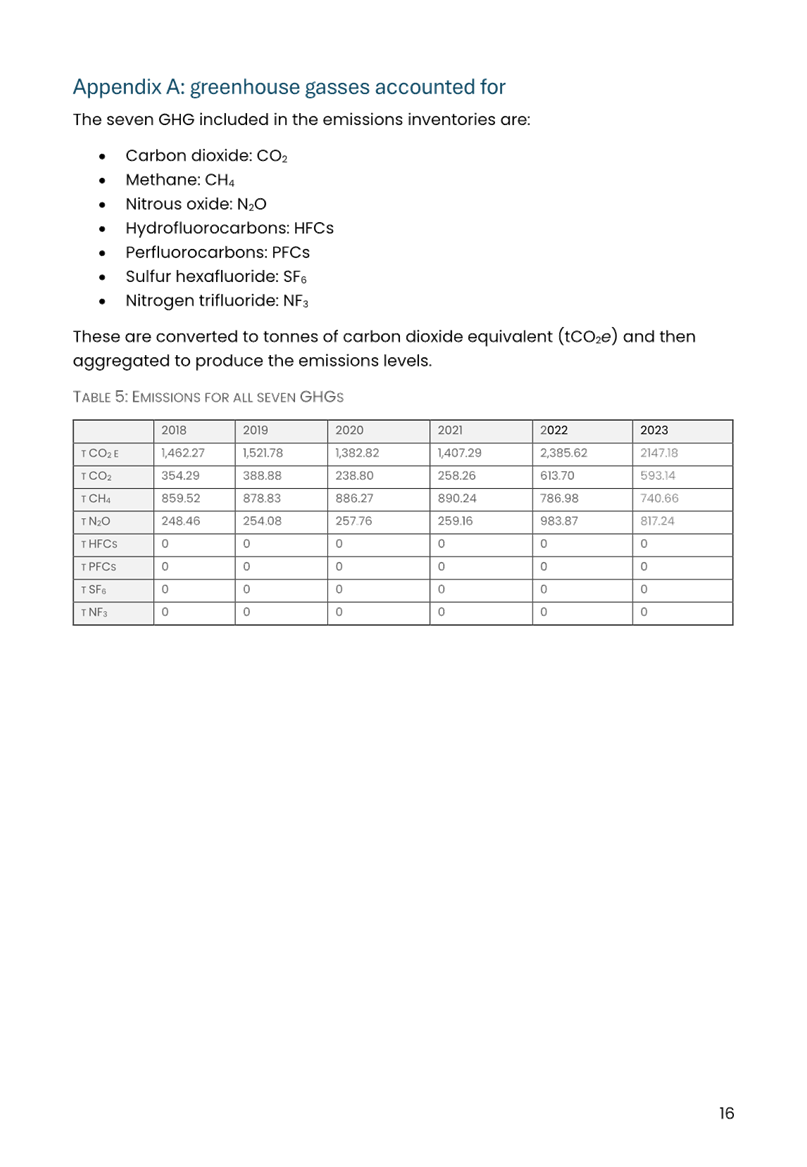
7.1 Greenhouse
Gas Emissions 6 Year Summary Report
1. Purpose
For the committee to
be updated on the analysis of Carterton District Council’s (CDC)
greenhouse gas (GHG) emissions for the six years from 2018 to 2023, and the
recommendations for managing our emissions going forward.
2. Significance
The
matters for decision in this report are not considered to be of significance
under the Significance and Engagement Policy.
3. Background
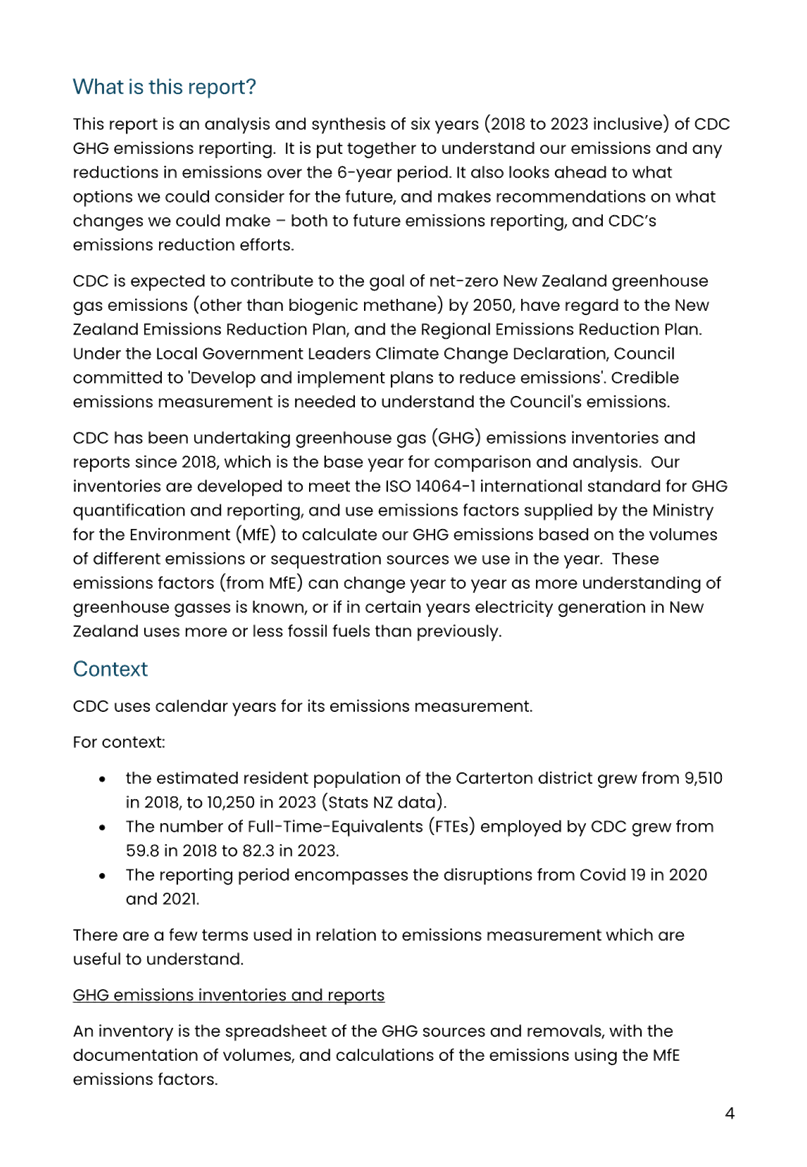
CDC is expected to contribute
to the goal of net-zero New Zealand greenhouse gas emissions (other than
biogenic methane) by 2050, and have regard to the New Zealand Emissions
Reduction Plan and the Regional Emissions Reduction Plan. Under the Local
Government Leaders Climate Change Declaration, Council is committed to 'Develop
and implement plans to reduce emissions’. Credible emissions measurement
is needed to understand the Council's emissions.
CDC
has been undertaking greenhouse gas (GHG) emissions inventories and reports
since 2018, which is the base year for comparison and analysis. Our
inventories are developed to meet the ISO 14064-1 international standard for
GHG quantification and reporting, and use emissions factors supplied by the
Ministry for the Environment (MfE) to calculate our GHG emissions based on the
volumes of different emissions or sequestration sources we use in the
year.
4. Discussion
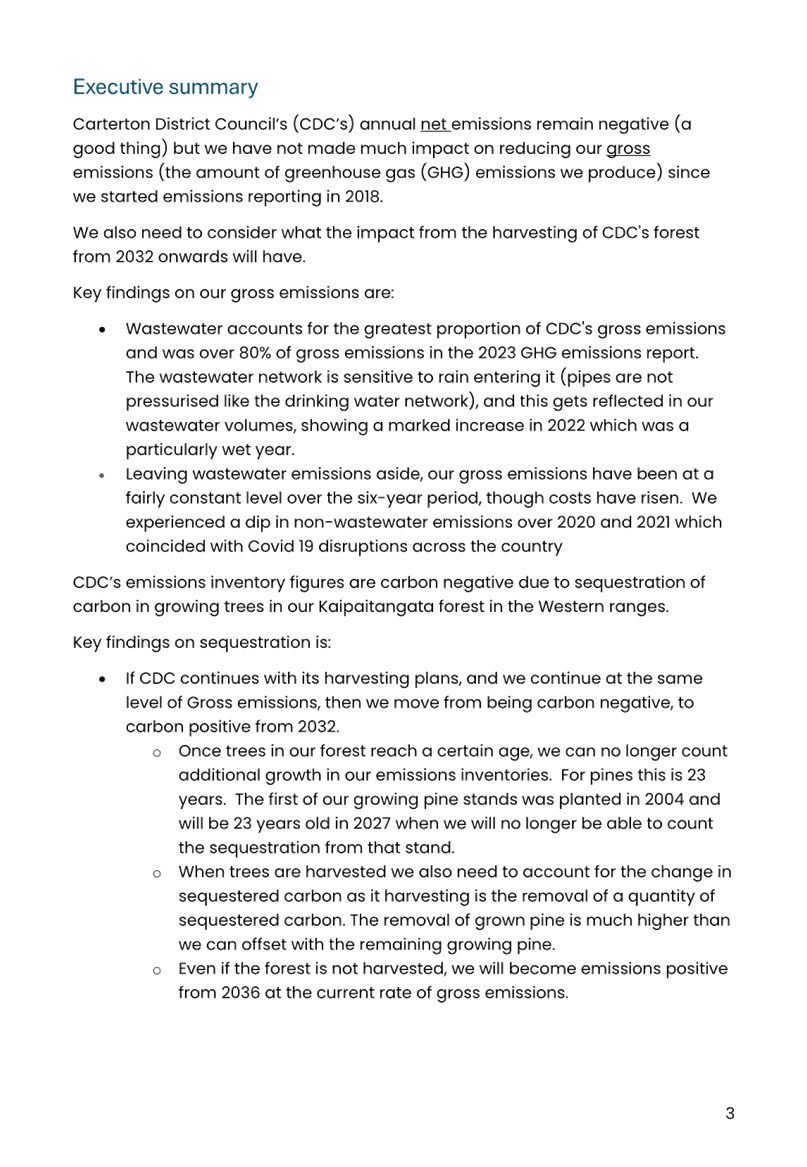
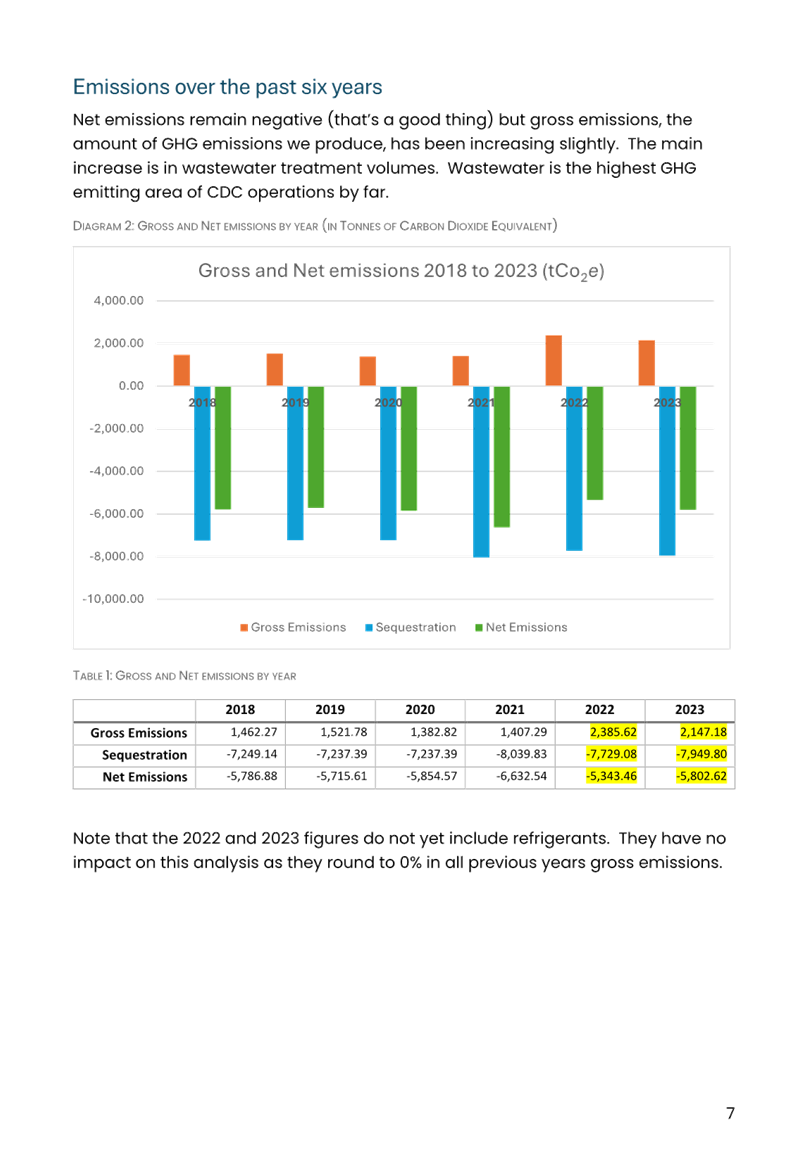
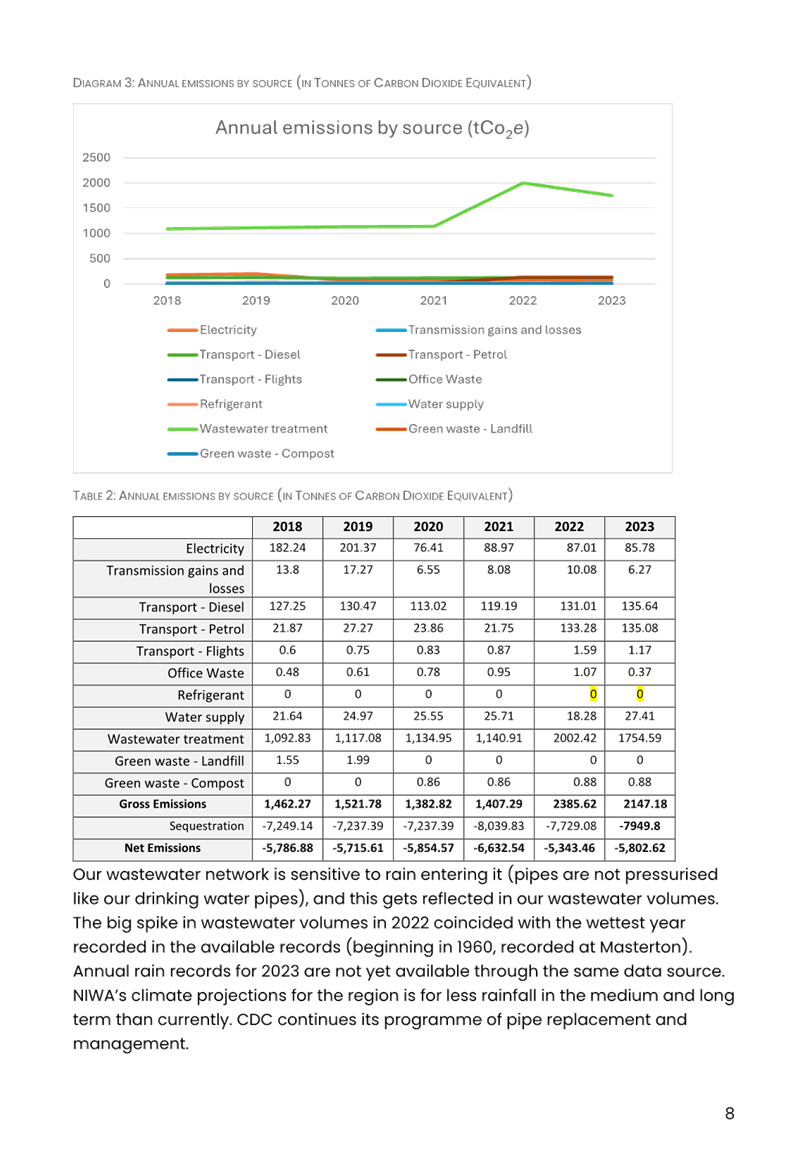
CDC annual net emissions remain negative (a good
thing), but we have not made much impact on our gross emissions (the amount of
GHG emissions we produce) since we started emissions reporting in
2018.
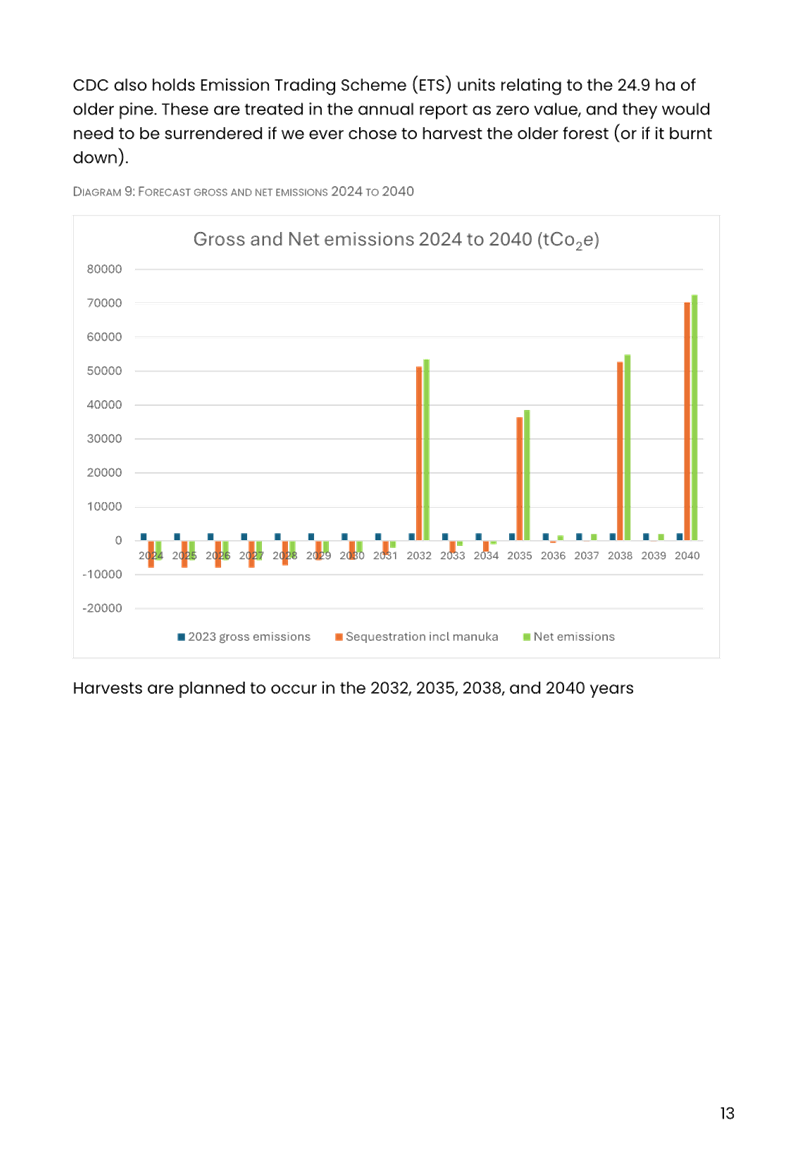
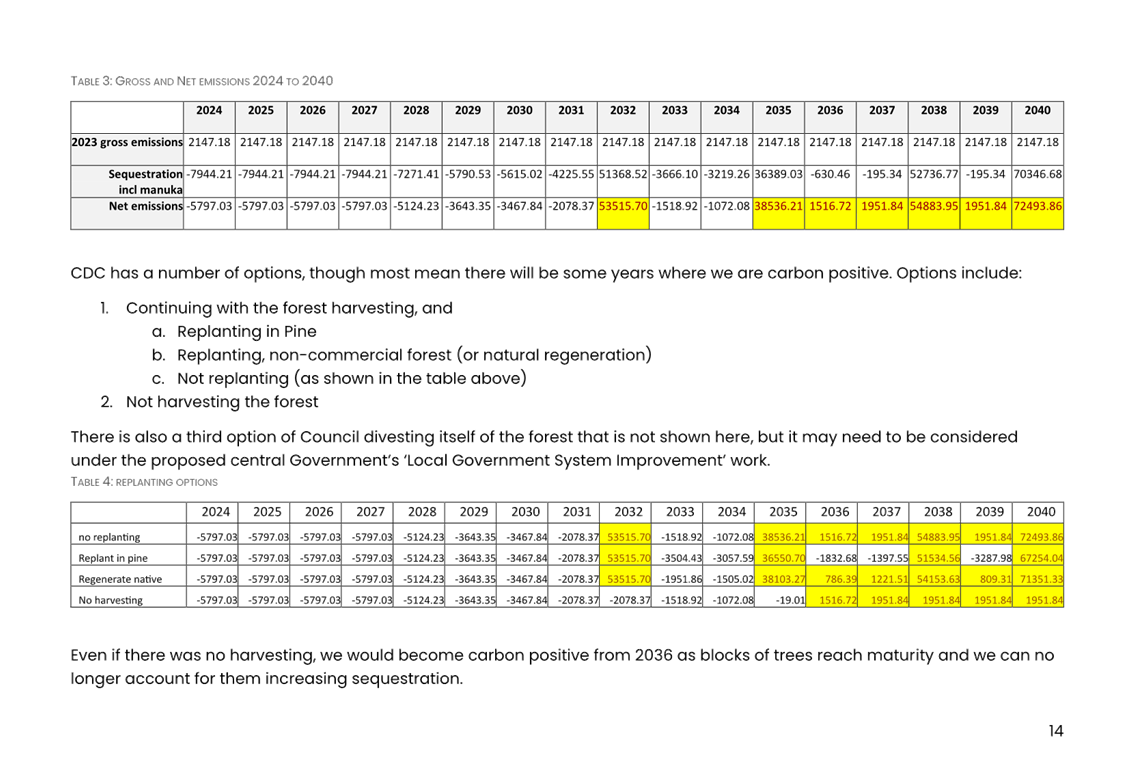
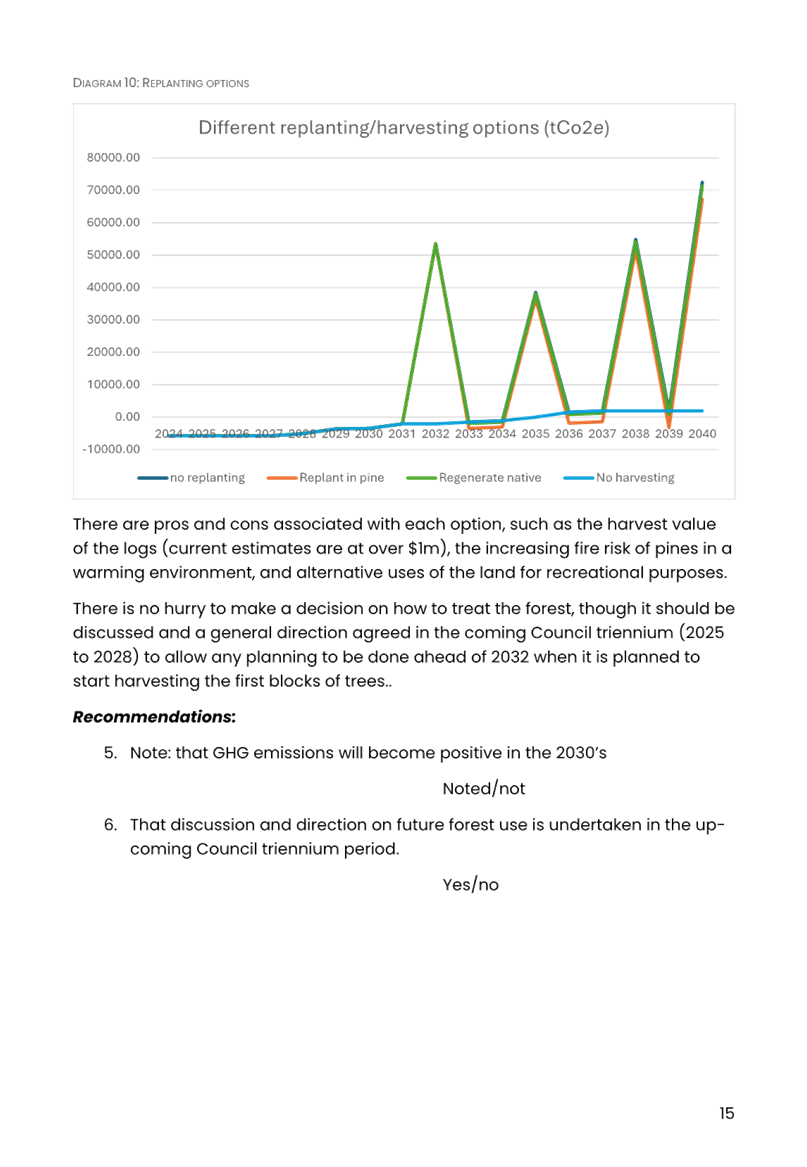
We also need to consider what the impact from the
harvesting of CDC's forest from 2032 onwards will have.
5. NEXT
STEPS
We
will begin work on the 2024 inventory taking into account the lessons and
recommendations in the 6-year summary report.
A
Climate Adaptation Plan (including emissions reduction) for CDC will be
developed by the end of the 2026/27 financial year.
Greenhouse
gas emissions and climate change will be included in the induction for the next
Council’s elected members.
6. CONSIDERATIONS
6.1 Climate
change
This
report analyses CDC’s climate change mitigation efforts, and recommends
approaches to improve performance.
6.2 Tāngata whenua
Changes
in climate impact on land, air, sea, water, flora, fauna and resources.
All of these are interconnected with mana whenua.
6.3 Financial
impact
The
report doesn’t have any direct financial impacts, though there are
potential savings, and failure to act may increase costs.
6.4 Community
Engagement requirements
This
report did not require community input.
6.5 Risks
Consideration
needs to be given on the future of the Kaipaitangata forest within the next
three years.
6.6 Wellbeings
Social
Every
degree change of climate warming increases the likely disruption to our current
lifestyles.
Cultural
Every
degree change of climate warming increases the likely disruption to our current
lifestyles.
Environmental
Every
degree change of climate warming increases the likely disruption to our local
environment, plant and wildlife.
Economic
Every
degree change of climate warming increases the likely disruption to our current
economic and financial base.
7. Recommendation
That the Committee:
1. Receives
the report.
2. Approves
the continued use of the ‘control’ approach to our emissions
reporting.
3. Approves
the inclusion of all ‘control’ approach activities in our
emissions reporting (e.g. travel accommodation, private use milage).
4. Notes
further enhancements are planned for our emissions reporting including greater
visibility of relevant climate and emissions information.
5. Notes
that CDC’s GHG emissions will become positive in the 2030’s
under current arrangements.
6. Endorses
the development of a Climate Adaptation Plan (including emissions management)
due for completion by the end of the 2026/27 financial year.
7. Notes
that Officers will brief incoming Councillors and seek guidance on the
management of CDC’s carbon offset forests in the new triennium.
File
Number: 477200
Author: Ricky
Utting, Climate Change Coordinator
Attachments: 1. Greenhouse
Gas emissions 10 year summary report ⇩
|
Policy and Projects Committee meeting Agenda
|
10 September 2025
|

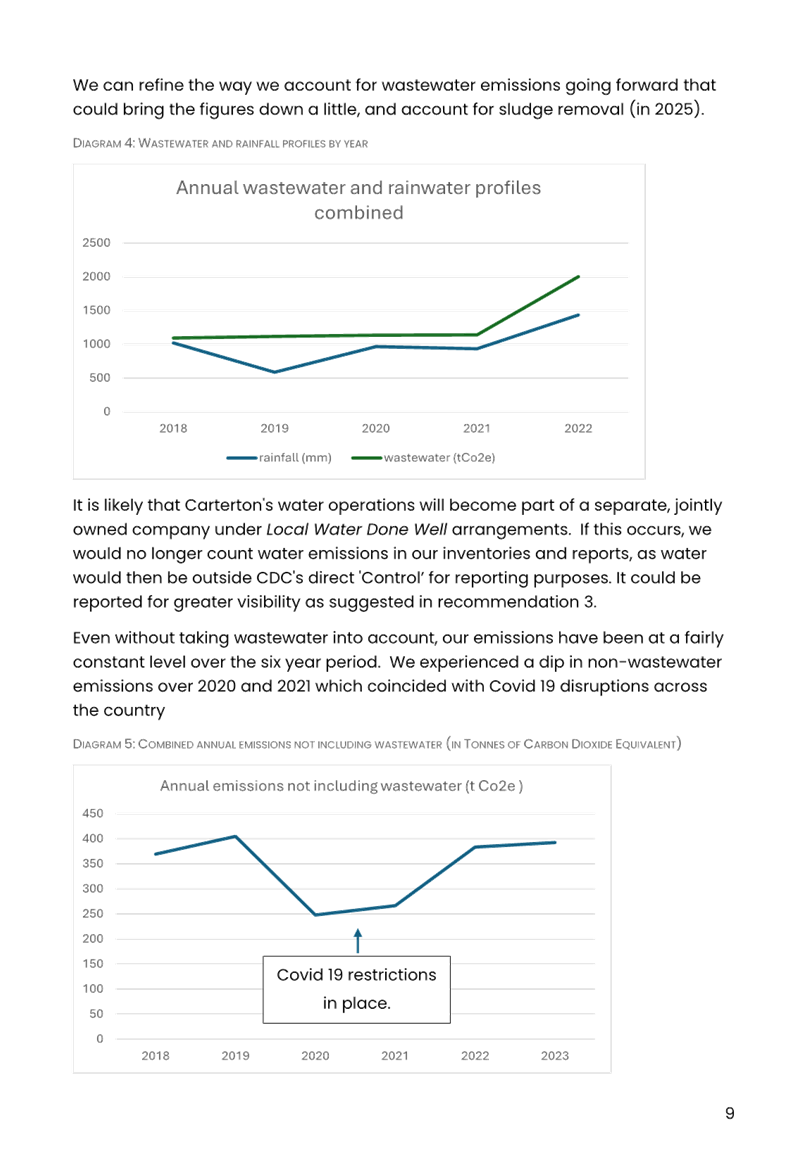
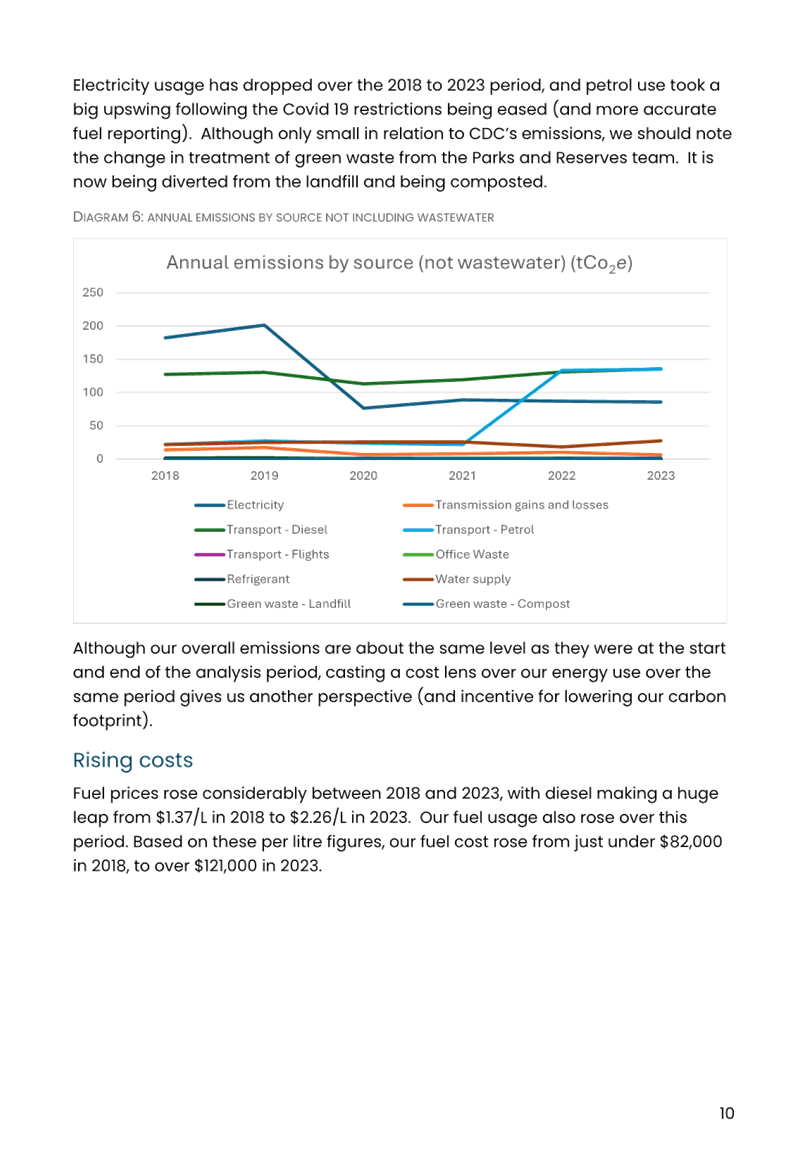
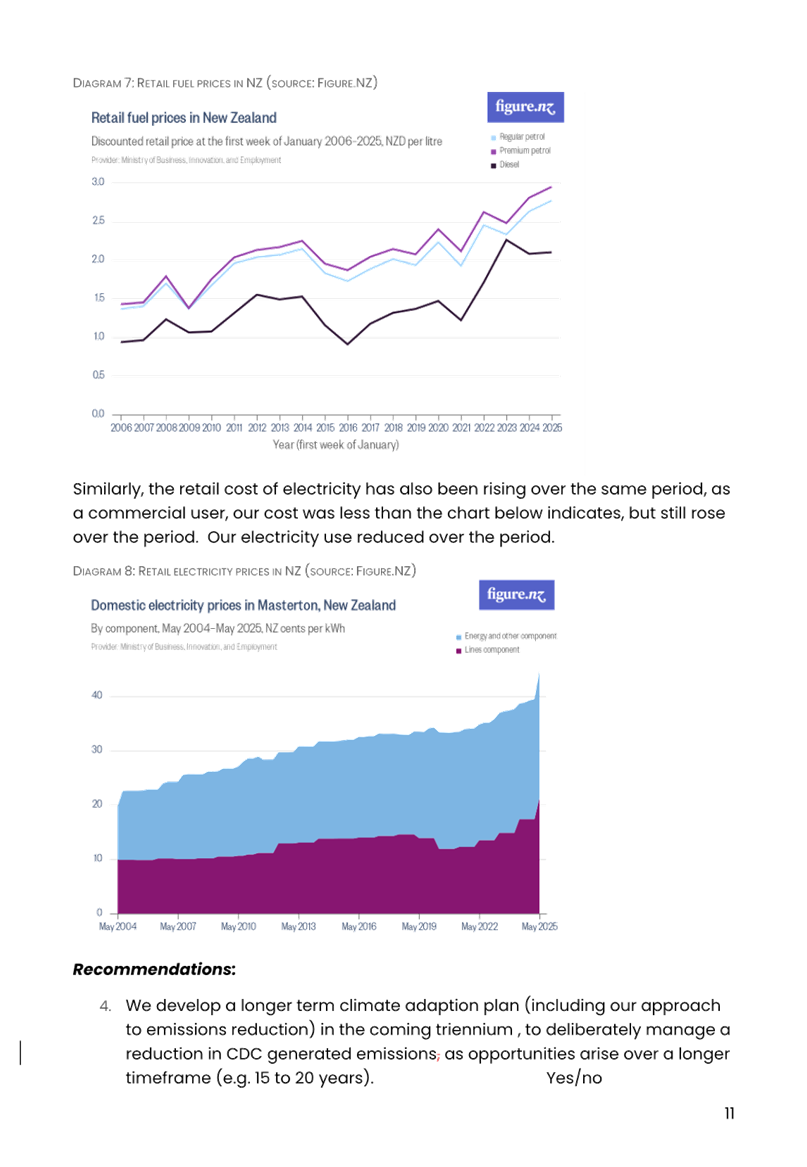
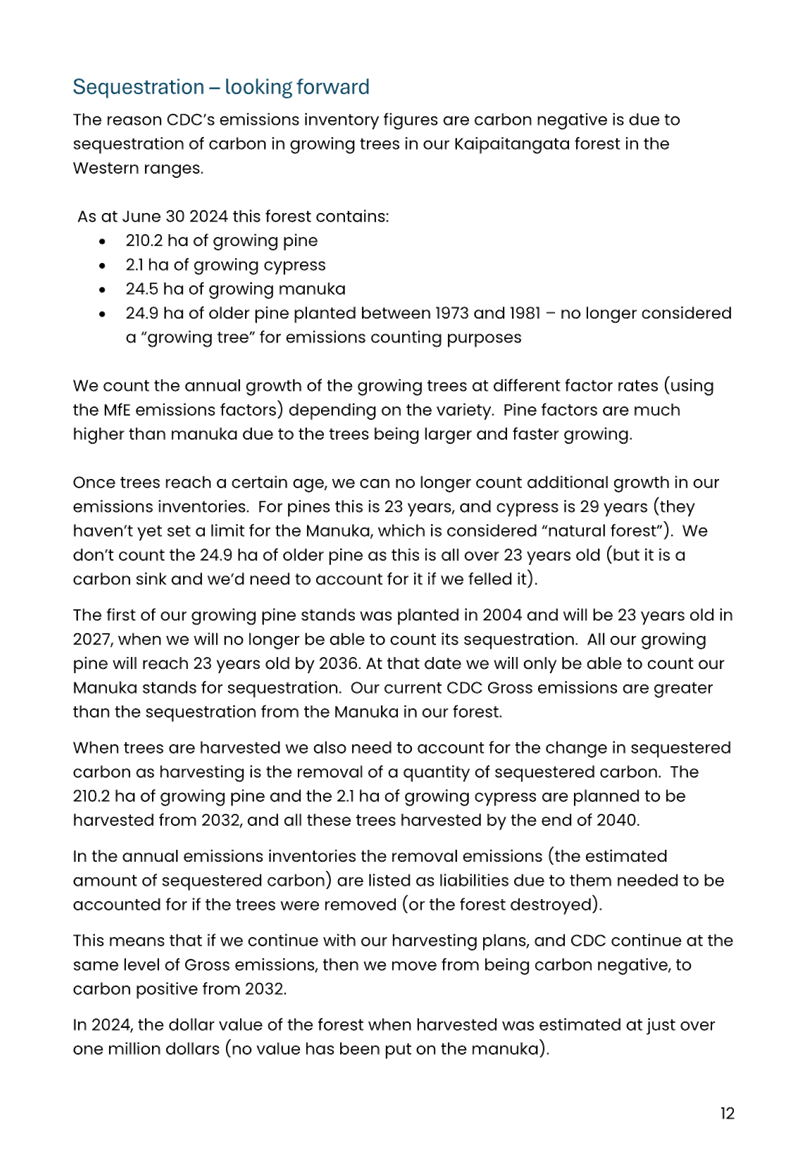
|
Policy
and Projects Committee meeting Agenda
|
10
September 2025
|

7.2 Review
of Sensitive Expenditure Policy
1. Purpose
For the Committee to
adopt the reviewed Sensitive Expenditure Policy.
2. Significance
The
matters for decision in this report are not considered to be of significance
under the Significance and Engagement Policy.
3. Background
The
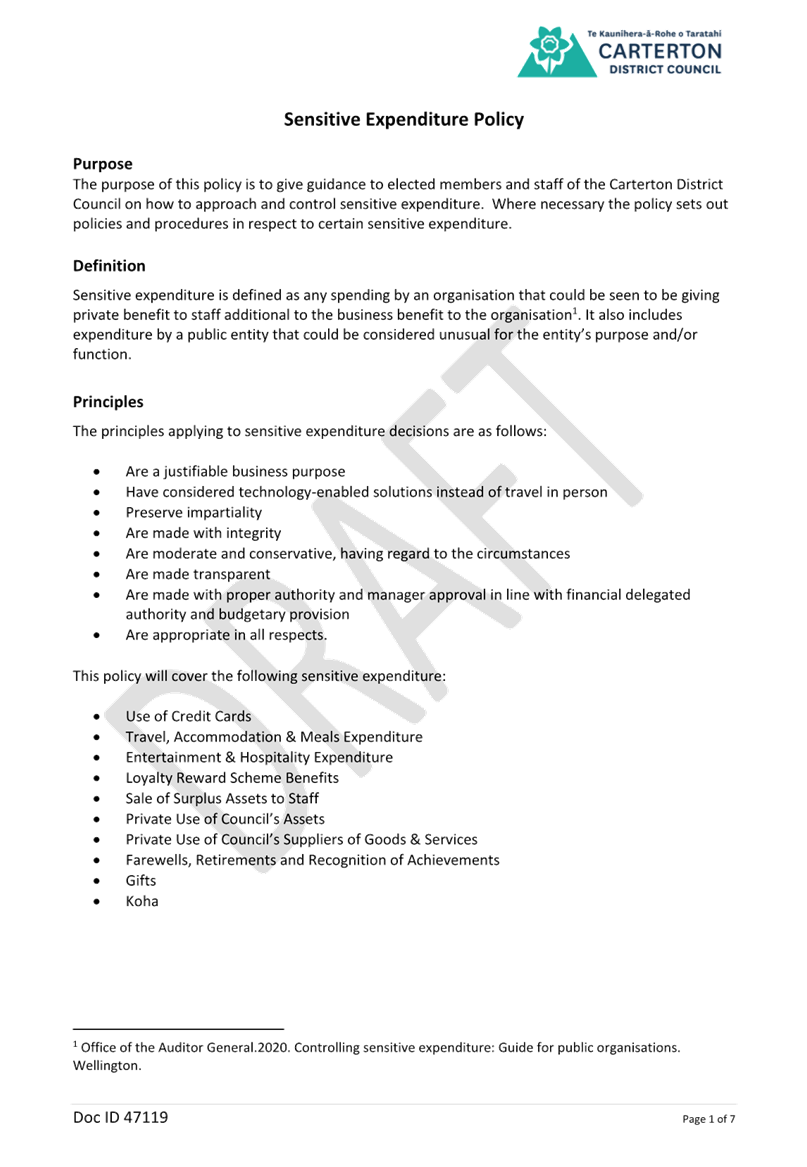
Council’s Sensitive Expenditure Policy (Attachment 1) provides
guidance to elected members and staff regarding the approach and control of
sensitive expenditure. Sensitive expenditure is any spending that could
be seen to be giving private benefit additional to the business benefit to the
council. It also includes expenditure that could be considered unusual
for the council’s purpose and/or function.
In
June, Audit New Zealand (Audit NZ) undertook a review of the Policy and
provided recommendations to improve the policy, and give clarification and
guidance managing sensitive expenditure.
The
Policy review also includes best practice guidance outlined by the Office of
the Auditor General (OAG).
4. proposed
amendments
Management
have reviewed the Policy and propose the following changes which incorporates
the recommendations of Audit NZ and guidance by AOG:
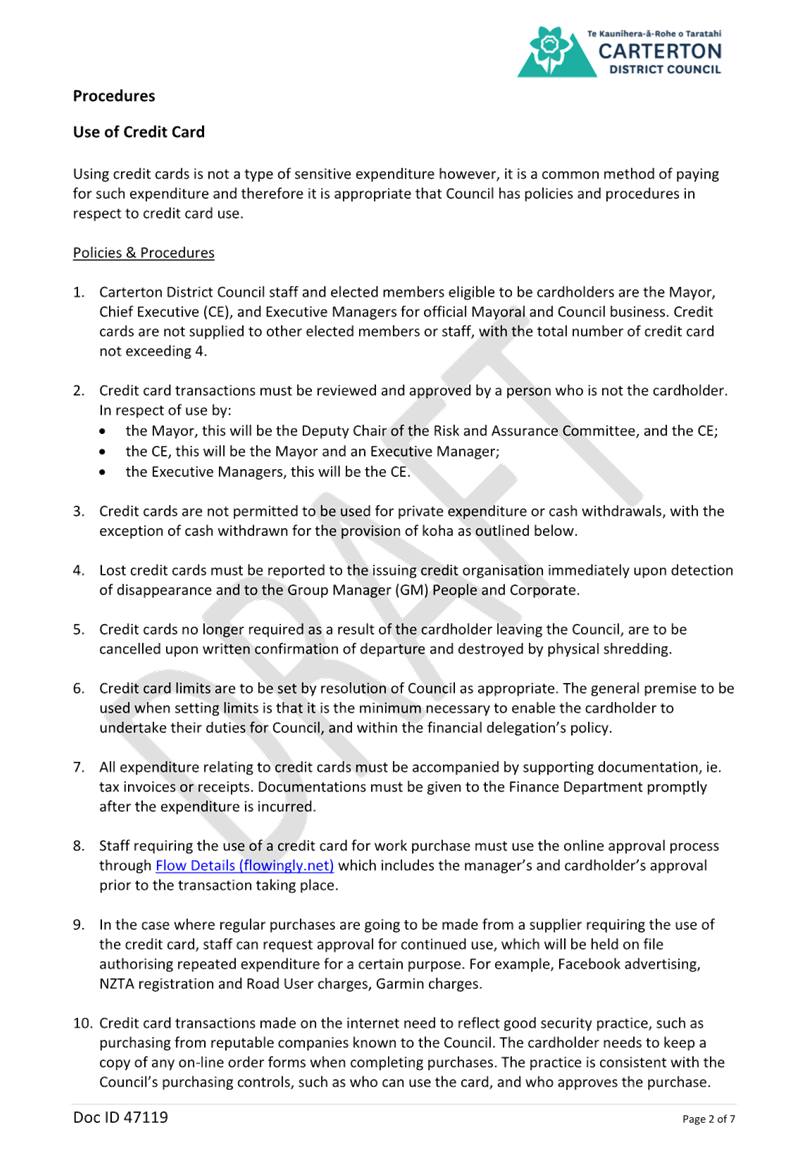
· Policy review and approval
o Specification
of the review timing, amendment process, and approval.
· Expenditure approval
o Emphasis
on ensuring expenditure should be within council’s statutory limits, and
only made when budgetary provision and delegated authority exist.
· Use of credit cards
o Inclusion
of an exception for withdrawal of cash for the provision of koha payments.
o Clarification outlining the cancellation and destruction of credit cards.
· Travel, meals and accommodation expenditure
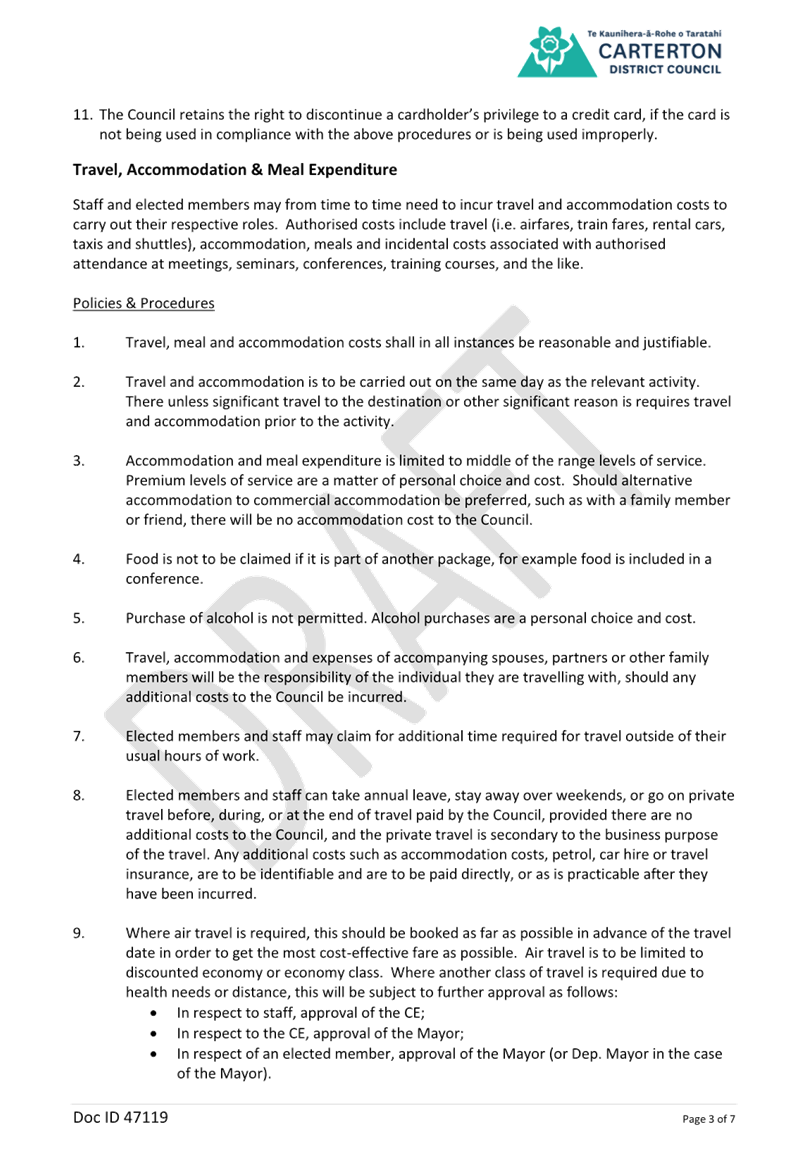
o Inclusion
of the consideration of technology-enabled solutions instead of travel in
person.
o Clarification
of how travel is undertaken and specific approval requirements for the Mayor
and CE in certain circumstances.
o Guidance
on elected members and staff taking annual leave and/or staying away over
weekends while travelling
o Clarification
of accommodation expenses for elected members or staff that elect to stay with
a friend or relative rather than in commercial accommodation.
o Clarification
that expenditure is to be made by credit card, reimbursement or
invoicing. No cash advancements are provided by council for payment of
expenditure.
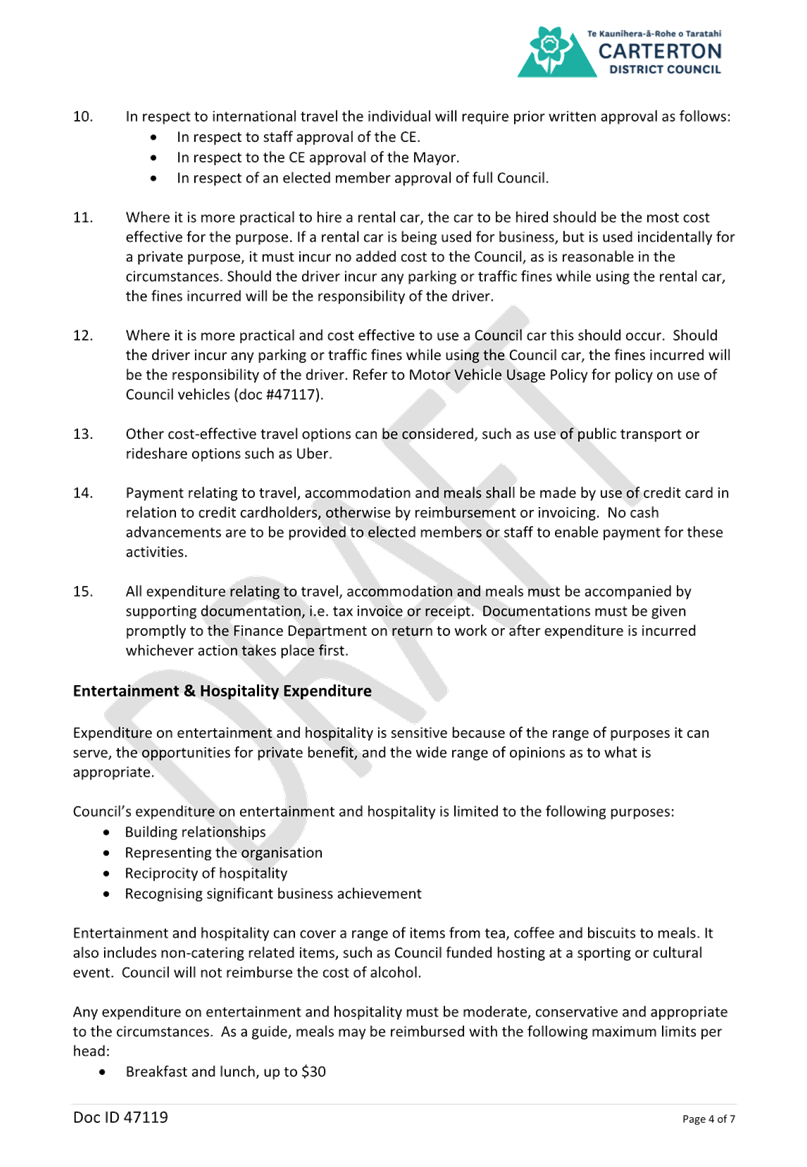
· Entertainment and hospitality expenditure
o Guidance
on the range of purposes and items included, with explicit exclusion of
alcohol.
o Clarification
of the types of meals provided and maximum reimbursement cost.
· Use of council’s assets
o Amendment
of permission requirements for the use of heavy vehicles and machinery from the
Chief Executive, to the staff member’s manager and the manager of the
equipment.
o Clarification
on the accepted level of personal use of ICT resources, and emphasis that such
usage must not be unlawful, offensive, or excessive.
· Council use of staff assets
o Inclusion
of the requirements in the unlikely occurrence that the council uses staff
private assets.
· Private use of suppliers of goods and services
o Clarification
that staff with purchasing privileges cannot make purchases from
council’s suppliers on behalf of third parties such as families and friends.
· Gift, prizes and invitations
o Clarification
that staff receiving cash gifts is unacceptable.
· Koha
o Addition of new section outlining
the description and management of koha payments.
5. CONSIDERATIONS
5.1 Climate change
There
are no climate change considerations relating to the decisions in this paper.
5.2 Tāngata whenua
The guidance for the
payment of koha has been added to the Policy and is an important and relevant
custom for tāngata whenua. Significantly, koha should be viewed as
relational, a reciprocal practice through which relationships are built, strengthened,
enhanced, and maintained.
5.3 Financial
impact
There
are no financial impact considerations related to the decisions in this paper
however the policy itself ensures council appropriately manages sensitive
expenditure, maintains the trust and confidence of the public, and
protects council’s reputation.
5.4 Community
engagement requirements
There
are no community engagement requirements related to the decisions in this
paper.
5.5 Risks
The
proposed amendments seek to improve and strengthen the approach and control of
sensitive expenditure based on guidance from Audit NZ and the OAG. The
risk of not adopting any, or all, of the amendments will reduce the
effectiveness of the Policy.
5.6 Community wellbeings
· A strong and effective council providing trusted leadership.
6. Recommendation
That the Committee:
1. Receives
the report.
2. Adopts
the revised Sensitive Expenditure Policy.
File
Number: 464252
Author: Geri
Brooking, Group Manager People and Corporate
Attachments: 1. CDC
Sensitive Expenditure Policy ⇩
|
Policy
and Projects Committee meeting Agenda
|
10
September 2025
|
|
Policy
and Projects Committee meeting Agenda
|
10
September 2025
|
7.3 Advisory
Group Structure
1. Purpose
2. To
seek endorsement and a recommendation from the current Council that the
incoming Council considers streamlining Advisory Groups by combining the
existing Walking and Wheels Advisory Group and People and Places
Advisory Group. into a single, more inclusive Community Advisory Group
(official name to be confirmed).
3. Significance
The
matters for decision in this report are not considered to be of significance
under the Significance and Engagement Policy.
4. Background
Carterton District
Council currently facilitates the Walking and Wheels and People and
Places advisory groups. There are some aspects that are overlapping in
areas of focus. For example, accessibility, public space use, placemaking, and
community led actions and initiatives.
While each has
contributed valuable insights and initiatives, maintaining separate groups
limits opportunities for wider community representation and collaboration.
There is opportunity for improvement in the effectiveness and influence of the
advisory groups.
5. Discussion
Advisory Groups are
beneficial and provide an essential bridge between the community and Council,
offering a platform for diverse voices to be heard and considered in
decision-making. They foster collaboration, support local initiatives, and
ensure that projects and policies reflect the needs and aspirations of
Carterton’s people. By bringing together community knowledge and lived
experience, Advisory Groups help create more inclusive, effective, and
responsive outcomes for the district.
Creating a single
Community Advisory Group by combining the remits of the Walking and Wheels and
People and Places advisory groups will improve effectiveness and streamline the
resources needed to support and facilitate the group’s work. The group will
also serve as a hub for community representatives to share updates, present
local projects and events, and build connections across different sectors and
interests. It will maintain a strong link between Council and the community,
while enhancing the effectiveness of engagement and reducing duplication.
Recent Advisory Group
meetings held on Wednesday 3 September considered the concept of merging the
two groups. Sitting members expressed support for the proposal, noting the
benefits of reducing duplication, creating a single community voice, and
avoiding conflicting advice to Council. Members also highlighted several risks
and considerations that will need to be addressed as part of the preparatory
work for the newly formatted group. Members emphasised the importance of
ensuring community perspectives and initiatives are not lost in the process.
Feedback from
Advisory Group Members
· The
concept was well-received, with members recognising the value of a unified
group that promotes collaboration, consistency, and alignment at the local
level.
· Acknowledgment
was made of the significant time community members contribute, and the need for
their voices to be both heard and acted upon.
· It
was noted that there needs to be staff presence from relevant departments
(e.g., Parks and Roading) to ensure technical input and timely follow-up on
community concerns.
· There
was strong support for information to be looped up to Council meetings, with
feedback provided back down to Advisory Groups to demonstrate accountability
and action.
Considerations
For the combined group to be effective, several elements must be addressed:
· Clear
Purpose and Outcomes – To be defined in updated Terms of Reference.
· Structured
Agendas – Meetings must have clear agendas, concise presentations,
and guided discussions to ensure focus on action and results rather than
prolonged debate.
· Two-Way
Communication – Regular reporting to Council, and feedback from
Council to the Advisory Group, to close the loop and maintain trust.
· Staff
Support – Ongoing attendance and input from relevant Council officers
to ensure practical advice and follow-through.
Risks
Without clear purpose and disciplined facilitation, the combined group may risk
becoming a “talk fest” with limited tangible outcomes for the
community.
Expanded Scope
could include:
· Community
initiatives
· Updates
on local projects, community events, and activities
· Representative
voices from across the district (e.g., youth, seniors, Māori,
accessibility advocates, environmental groups, representation from those with
disabilities)
· A
forum for collaborative ideas, partnership opportunities, and shared
problem-solving
· Advisory
input on relevant Council plans, strategies, and funding opportunities
Benefits:
· Broader
Representation: Opportunity to include a wider range of community
representatives
· Efficiency:
Fewer meetings, improved use of Council and community time, more
coordinated input, reduced administrative overhead
· Inclusivity:
More diverse representation and broader community voice
· Connectivity:
A shared space for updates, announcements, and collaboration
· Impact:
Stronger, more unified recommendations and community outcomes
· Stronger
Collaboration: Encourages cross-sector discussions and holistic thinking
· Streamlined
Reporting: A single advisory group will enable more coordinated and
impactful recommendations to Council.
Structure &
Membership:
Membership would be in line with Terms of Reference for both groups. These
would be reviewed by members of the current Advisory Groups prior to
endorsement of the new advisory group.
6. Options
Option One:
That the incoming Council retain the two existing Advisory Groups (Walking and
Wheels and People and Places) and continue operating under the current
structure (status quo).
OR
Option
Two: (Recommend) That the incoming Council
considers creating a single Advisory Group to represent the wider community by
combining the current Walking and Wheels and People and Places
Advisory Groups.
7. CONSIDERATIONS
7.1 Climate change
The decision to merge the
advisory groups does not directly affect climate change, but the new group
could support Council by advising on climate-related initiatives and community
resilience.
Tāngata whenua
The proposal to merge the two
advisory groups may interest Māori as it changes how community voices are
represented. There is an opportunity to involve mana whenua and Māori
community representatives in shaping the group’s Terms of Reference and
priorities to ensure their perspectives are reflected from the outset.
Financial
impact
Covered
within existing budgets.
7.2 Community Engagement requirements
Community
representatives have provided initial feedback on the proposal to merge the
Walking and Wheels and People and Places Advisory Groups, with broad support
expressed at recent meetings. Should Council wish to proceed, there will be
further opportunity for wider community input through consultation on the new
group’s draft Terms of Reference and operating model. Establishing a
single Advisory Group also creates an ongoing mechanism for
Council–community engagement, ensuring that community voices and initiatives
are heard, discussed, and reported back to Council.
7.3 Risks
The risks identified in this
report can be effectively managed through a thorough and well-structured
planning process.
7.4 Wellbeings
Social
Combining the advisory groups may strengthen community cohesion by providing a
single, inclusive forum where diverse voices can be heard and acted upon. It
also recognises and values the time and contributions of volunteers.
Cultural
The new group can provide better opportunities to incorporate local knowledge,
tikanga, and cultural perspectives, ensuring broader representation across
Carterton’s community.
Environmental
A single advisory group may improve coordination on projects that affect the
natural environment, enabling more holistic approaches to issues such as active
transport, green spaces, and resource management.
Economic
Streamlining two groups into one could reduce duplication of effort and associated
administrative costs, freeing staff resources for other community priorities.
8. Recommendation
That the Committee:
1. Receives
the report.
2. Endorses
Option Two - combining the Walking and Wheels and People and Places
Advisory Groups.
3. Instructs
the CEO to draft a purpose statement and updated Terms of Reference for the
combined Walking and Wheels and People and Places Advisory Group
for the incoming Council to consider.
File
Number: 482051
Author: Becks
Clarke, Community and Partnerships Manager
Attachments: Nil
|
Policy
and Projects Committee meeting Agenda
|
10
September 2025
|

7.4 Review
of the External Communications, Community Engagement, and Social Media Policies
1. Purpose
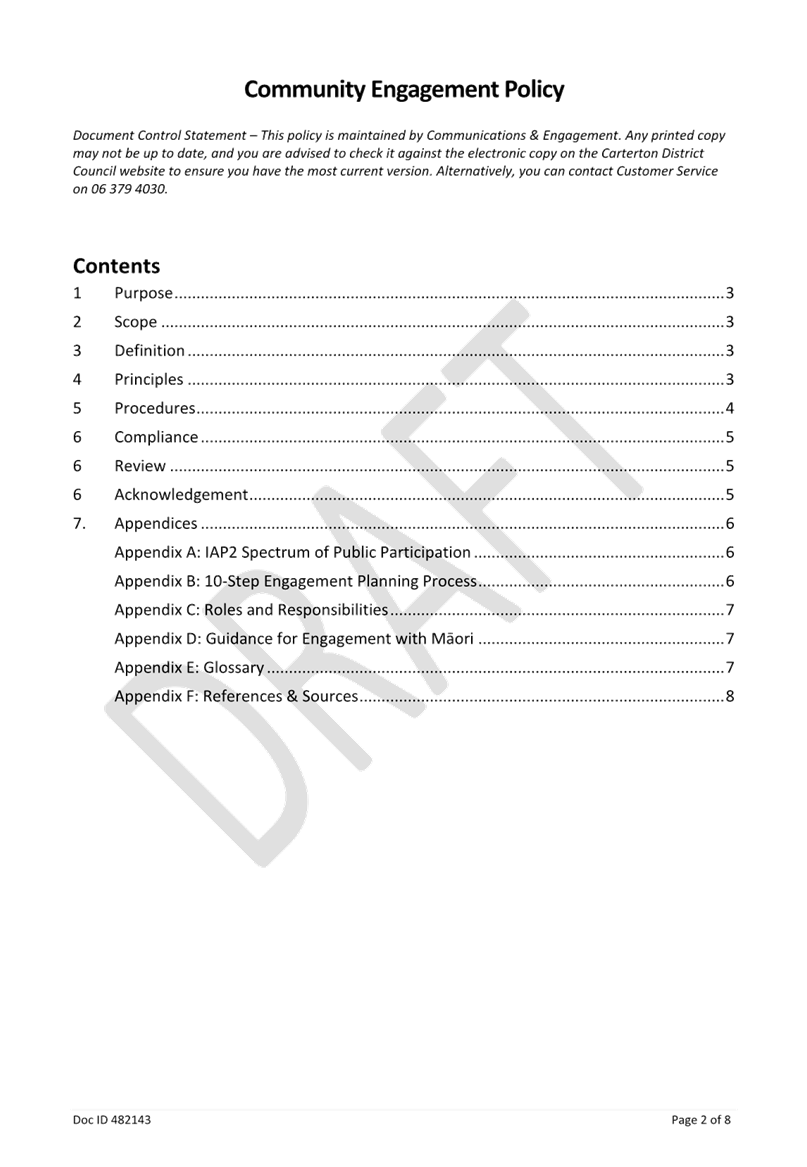
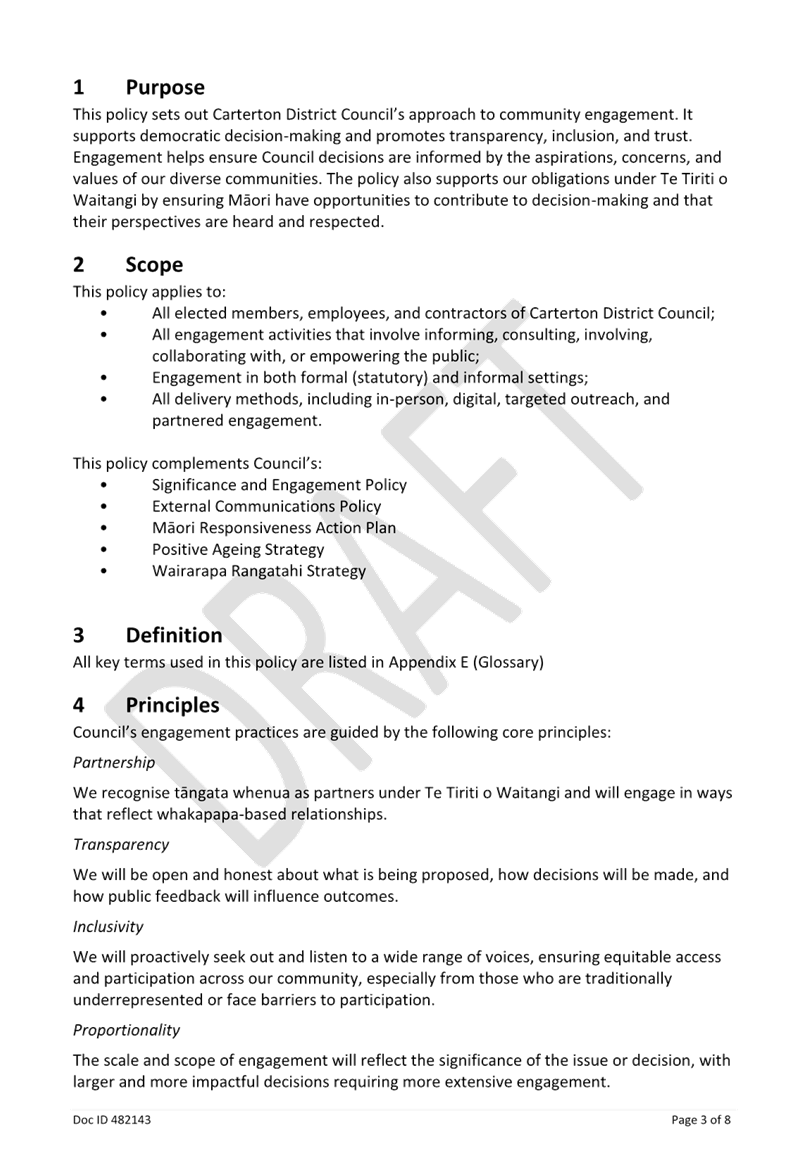
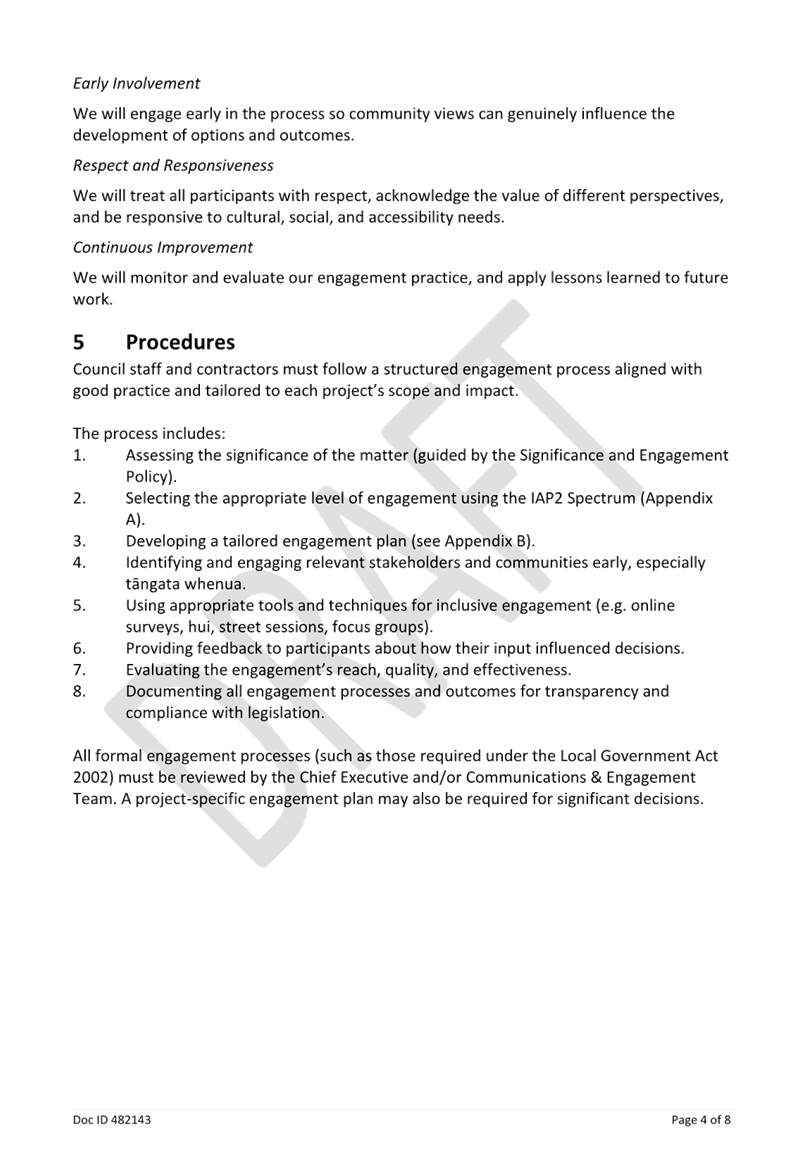
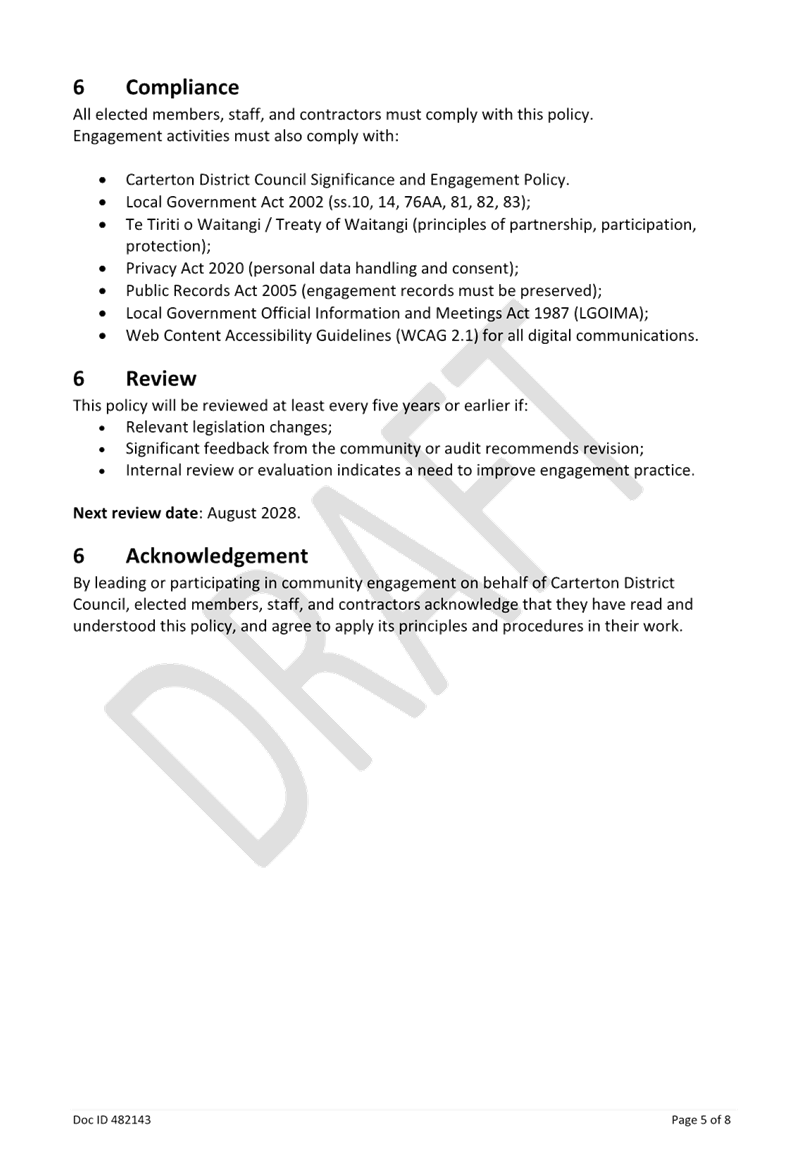
For the Committee to
receive and endorse the updated External Communications Policy, the updated
Community Engagement Policy, and the new standalone Social Media Policy.
2. Significance
The
matters for decision in this report are not considered to be of significance
under the Significance and Engagement Policy.
3. Background
Communication
and engagement are key responsibilities under the Local Government Act 2002,
which charges local authorities with enabling democratic and effective
governance that reflects the diversity of the community.
The
existing External Communications Policy was adopted in 2018 and requires
updating to reflect changes in best practice, legislation, and the growing
expectation for transparent, inclusive communications from Council.
The
External Communications Policy, Community Engagement
Policy, and the new standalone Social Media Policy form a refreshed policy
suite that ensures Council’s communications and engagement are
professional, accessible, culturally responsive, and legally compliant.
4. Discussion
Community
expectations and communication methods have evolved significantly.
Council’s communication responsibilities now extend across multiple
digital platforms, and the public expects timely, proactive information and opportunities
for meaningful engagement.
The
revised policy introduces a clearer, more structured approach to
communications, placing a strong emphasis on:
• Plain language and accessibility in all formats and channels
• Compliance with NZ Government Web Accessibility Standard 1.2 and
WCAG 2.1 (AA)
• Availability of alternate formats (Easy Read, NZSL, audio, large
print)
• Inclusiveness and cultural respect, including the use of te reo
Māori
• Defined roles and responsibilities, ensuring quality and
accountability across Council teams
• Separation of social media guidance, now detailed in a standalone
Social Media Best Practice Guide
The
update also reflects Council's commitment to ensuring that all communications
are fit-for-purpose, audience-focused, and measurable against service delivery
outcomes.
5. Options
Options
Available to the Committee include:
Option
1 – Endorse both the updated External Communications Policy and the new
Social Media Policy (Recommended)
· Provides Council with a modern, fit-for-purpose communications
framework.
· Ensures alignment with legislative requirements (Plain Language Act
2022, WCAG 2.1 AA, Privacy Act 2020, etc.).
· Strengthens cultural responsiveness and links with the Māori
Responsiveness Action Plan.
· Clarifies roles and responsibilities for staff, elected members, and
contractors.
· Establishes clear governance and compliance for Council’s use
of social media.
· Risks are minimal and implementation is within existing budgets.
Option
2 – Endorse only the updated External Communications and Community
Engagement Policies, and continue to rely on existing internal guidance for
social media
· Decision-making is simplified by focusing only on one policy.
However, this would leave social media guidance fragmented and potentially
inconsistent, as staff would continue to rely on outdated or informal rules.
· Risks are created around accessibility compliance, reputational
management, and legal obligations under the Harmful Digital Communications Act
and Privacy Act.
Option
3 – Retain the current 2021 External Communications and Community
Engagement Policies without adopting updates
· Avoids immediate work in implementation and training. However, the
2021 versions do not reflect current legislative requirements (e.g. the Plain
Language Act 2022, accessibility standards) or best practice.
· The risks are non-compliance, reputational harm, and inconsistent
staff practice.
· Does not provide a standalone Social Media Policy, leaving a key
communications channel under-regulated.
Recommendation:
That
the Committee adopts Option 1 – endorsing the updated External
Communications Policy, Community Engagement Policy, and the new Social Media
Policy, noting that this option best addresses compliance, cultural, and
operational needs while strengthening community trust in Council
communications.
6. NEXT STEPS
· Internal Dissemination
The updated policy and supporting guidance documents will be circulated to all
staff via the intranet, with an internal email and team briefings from the
Communications & Engagement team.
· Training and Induction Updates
A short training module and staff quick-reference guide will be developed to
support consistent application of the policy, particularly in relation to brand
use, social media, and accessibility obligations.
· Integration with Existing Workflows
Approval workflows, communications planning templates, and document checklists
will be updated to reflect the revised policy and procedures. These will be
integrated into the SharePoint communications toolkit.
· Monitoring and Continuous Improvement
The Communications & Engagement team will review the use and effectiveness
of the supporting procedures every 12 months, or as required by legislative
changes or organisational priorities.
· Optional Council Adoption (if required)
If the Committee deems it necessary, a recommendation to adopt the revised
policy may be forwarded to full Council for endorsement.
7. CONSIDERATIONS
7.1 Climate change
Council’s external communications will:
· Link directly to Council’s climate change plans, policies, and
emissions reduction goals.
· Build climate literacy by explaining local impacts, co-benefits, and
Council’s role.
· Use low-emission communication methods (digital-first), while
ensuring digital inclusion.
· Reflect tāngata whenua environmental values, including
kaitiakitanga, guided by Te Tiriti o Waitangi, UNDRIP, and the Resource
Management Act (Part 2).
· Highlight local climate adaptation actions and invite community
input.
· Present climate data using plain language and accessible visuals.
· Coordinate messaging with regional and national partners to avoid
duplication.
Legislative and policy frameworks include:
· Local Government Act 2002 (s10, s14)
· Climate Change Response Act 2002
· Zero Carbon Act 2019
· MfE Climate Change Communications Guide
· UN SDG 13 (Climate Action)
· NZ Emissions Reduction Plan 2022
· Wellington Regional Climate Change Strategy & NEMA guidelines
7.2 Tāngata whenua
Carterton
District Council acknowledges Te Tiriti o Waitangi and the status of Māori
as tangata whenua. The Council’s communications must reflect the
principles of partnership, participation, and protection by:
· Aligning with the Tangata Whenua Engagement Strategy – A
Māori Responsiveness Action Plan, particularly where communications relate
to whenua, wai, taonga, or shared decision-making processes.
· Ensuring that messaging is inclusive of Māori worldviews,
values such as kaitiakitanga and manaakitanga, and acknowledges whakapapa and
mauri where relevant.
· Including te reo Māori and tikanga where appropriate and
meaningful, ensuring correct use, pronunciation, and context.
· Supporting kaupapa Māori communication methods, including
kanohi ki te kanohi (face-to-face), storytelling, and visual formats.
· Working in partnership with mana whenua to co-develop and approve
content where it relates to Māori interests, aspirations, or histories.
All
staff involved in communications must seek early advice and input from the
Council’s Māori Liaison or Kaituitui to ensure cultural safety
and responsiveness in public messaging.
7.3 Financial impact
The
policies will be implemented within existing operational budgets.
7.4 Community Engagement requirements
Carterton
District Council is committed to open, transparent, and meaningful engagement
with its community. This policy supports and complements the Council’s
Community Engagement Policy by ensuring that all external communications:
· Are tailored to the level of significance and community impact of
the topic.
· Enable participation by a wide range of residents, including young
people, rural households, disabled people, and newcomers.
· Use accessible formats, plain language, and culturally appropriate
channels to remove barriers to participation.
· Inform and empower the community by clearly explaining:
o Why decisions are being made;
o How people can influence outcomes; and
o What happens next in the process.
External
communications must be coordinated with engagement planning to ensure messages
are consistent across channels, reflect the engagement method (inform, consult,
involve, collaborate), and support two-way communication.
The
Communications & Engagement team will work with relevant staff and
stakeholders to ensure communications are part of the planning process for all
significant projects and consultation
7.5 Risks
Legal
Risks
· Risk: Failure to adopt updated policies could expose Council to
breaches of the Plain Language Act 2022, WCAG 2.1 AA, Privacy Act 2020, and the
Harmful Digital Communications Act 2015.
· Mitigation: Adoption ensures compliance; The Communications &
Engagement team will monitor outputs, carry out annual audits, and update
training modules as required.
Reputational
Risks
· Risk: Outdated or inconsistent communications, or misuse of social
media, could undermine public trust.
· Mitigation: Oversight by the Communications & Engagement team,
mandatory content approval for high-impact material, and use of a Social Media
Register with monitoring protocols.
Operational
Risks
· Risk: Lack of clarity on staff responsibilities, approval processes,
or accountabilities may lead to inefficiencies, errors, or duplication.
· Mitigation: Defined responsibilities in the policies, ELT/CE
sign-off for sensitive messaging, and quick-reference staff guides integrated
into workflows.
Cultural
Risks
· Risk: Failure to embed Te Tiriti o Waitangi principles or recognise
tāngata whenua perspectives risks damaging Council–Māori
relationships.
· Mitigation: Policies require early advice from Pou Tātai Hono,
alignment with the Māori Responsiveness Action Plan, and inclusion of te
reo Māori and tikanga where relevant.
Environmental
Risks
· Risk: Communications that fail to connect to climate commitments, or
that rely on high-emission channels, risk community criticism.
· Mitigation: Policies direct digital-first but inclusive methods,
mandate climate literacy messaging, and align Council communications with
regional and national climate frameworks.
7.6 Well beings
Social
Council
has used plain-language notices, radio updates, and the Carterton Crier to
ensure residents are informed during events such as water restrictions and road
closures. Combining digital and print channels ensured that vulnerable and
rural households were not excluded. The updated policies strengthen this by
requiring Easy Read formats, NZSL captions, and accessible templates across all
communications, ensuring all residents can participate and stay informed.
Cultural
The
unveiling of the Ngā Tawhai Pou Whenua Reserve in 2024 included bilingual
signage, te reo Māori storytelling, and tikanga processes led by mana
whenua. Council’s adoption of te reo Māori headings in public
notices has become standard practice. The updated policies embed cultural
responsiveness requirements, ensuring Pou Tātai Hono advice, the
Māori Responsiveness Action Plan, and kaupapa Māori methods (such as
kanohi ki te kanohi hui) are part of all communications.
Environmental
Council
runs annual waste and recycling campaigns, including the Binfluencer
newsletter, to promote waste minimisation and household recycling. Water
conservation updates are regularly posted during summer peaks, helping to
manage demand. The policies extend this by requiring climate literacy messaging
to explain local impacts and co-benefits, a digital-first but inclusive
approach to reduce emissions, and alignment with national frameworks like the
NZ Emissions Reduction Plan.
Economic
The
2024/25 Annual Plan consultation provided ratepayers with clear, accessible
information on major investments, including water infrastructure and roading,
ensuring accountability and transparency in spending. The updated policies
ensure future financial and project communications maintain plain language,
accessibility, and transparency, supporting public confidence in
Council’s financial stewardship and in Carterton’s long-term
economic resilience.
8. Recommendation
That the Committee:
1. Receives the
report.
2. Endorses the
External Communications Policy 2025;
3. Endorses the
Community Engagement Policy 2025;
4. Endorses the new
Social Media Policy 2025 as a standalone policy governing the use of
Council-managed digital platforms;
5. Notes that Brand
Guidelines and the Māori Responsiveness Action Plan provide supporting
operational documents;
6. Acknowledges
that the adoption of these policies directly supports the social, cultural,
environmental, and economic well-beings of Carterton residents, and mitigates
identified legal, reputational, operational, cultural, and environmental risks.
File
Number: 481860
Author: Marcus
Anselm, Communications and Engagement Manager
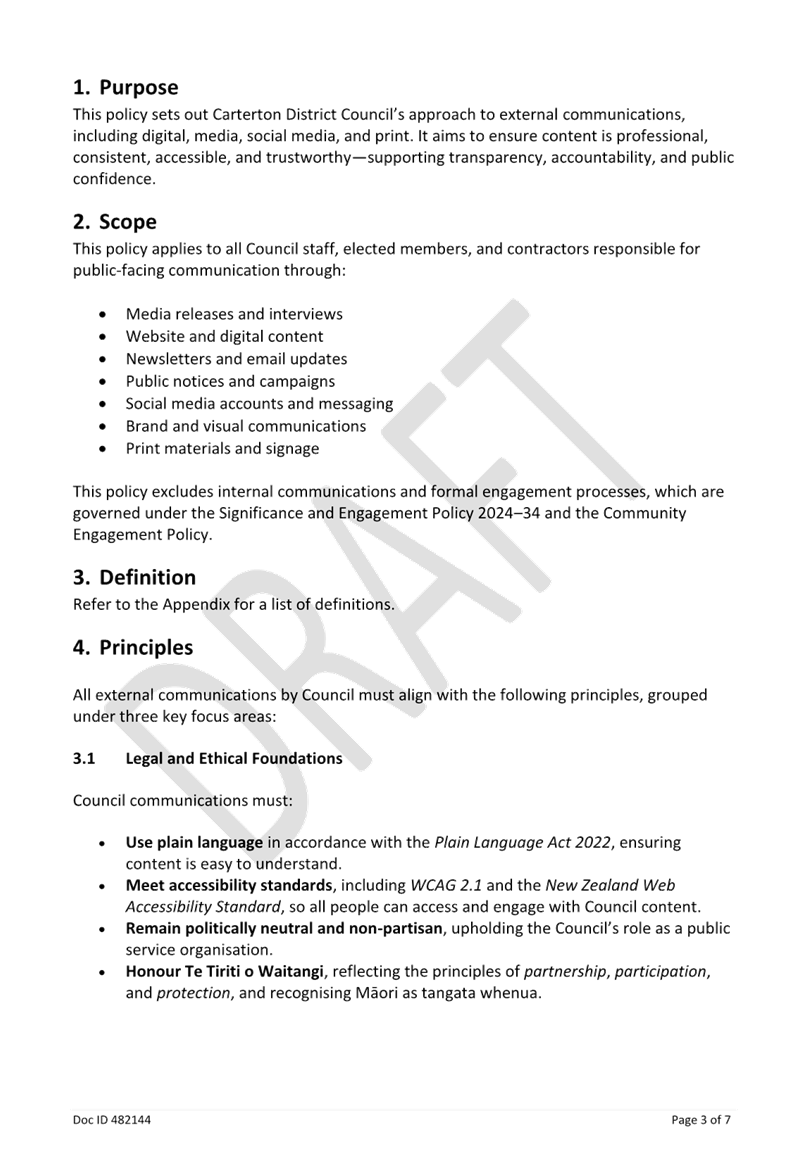
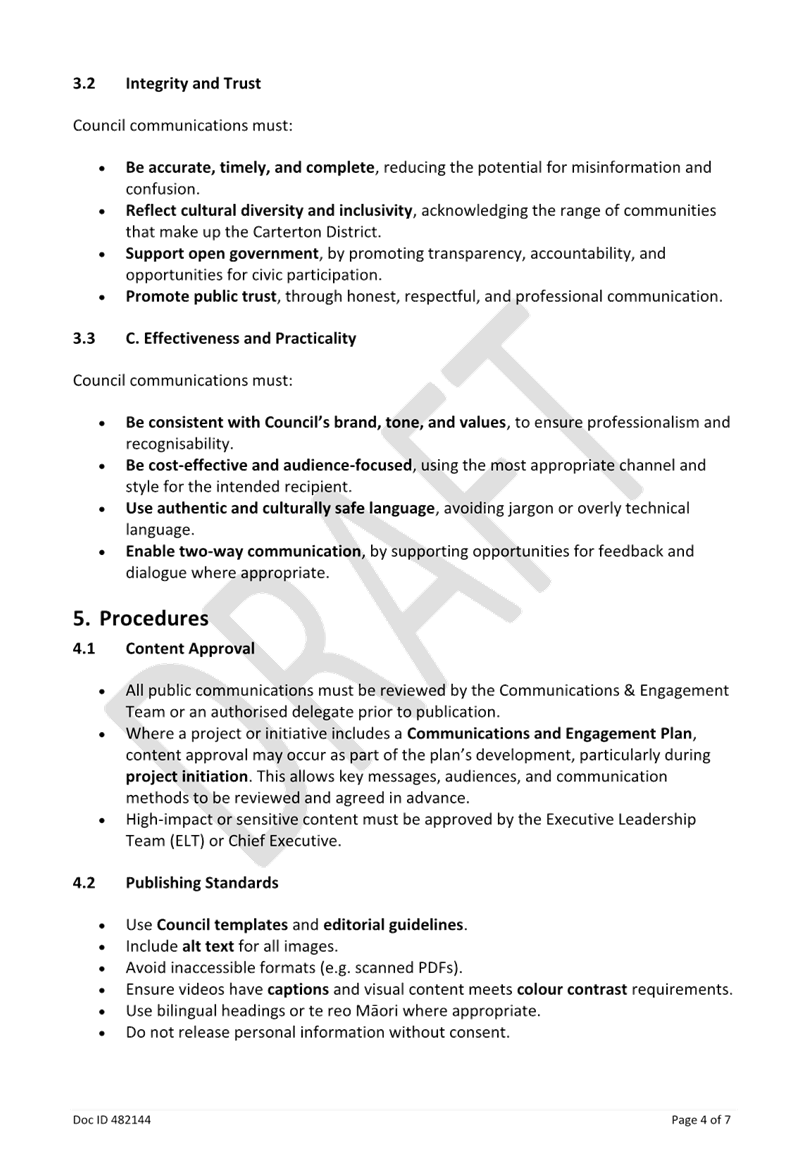
Attachments: 1. DRAFT
Communications Policy 2025 ⇩
2. DRAFT
Community Engagement Policy 2025 ⇩
3. DRAFT
Social Media Policy 2025 ⇩
|
Policy
and Projects Committee meeting Agenda
|
10
September 2025
|
|
Policy
and Projects Committee meeting Agenda
|
10
September 2025
|
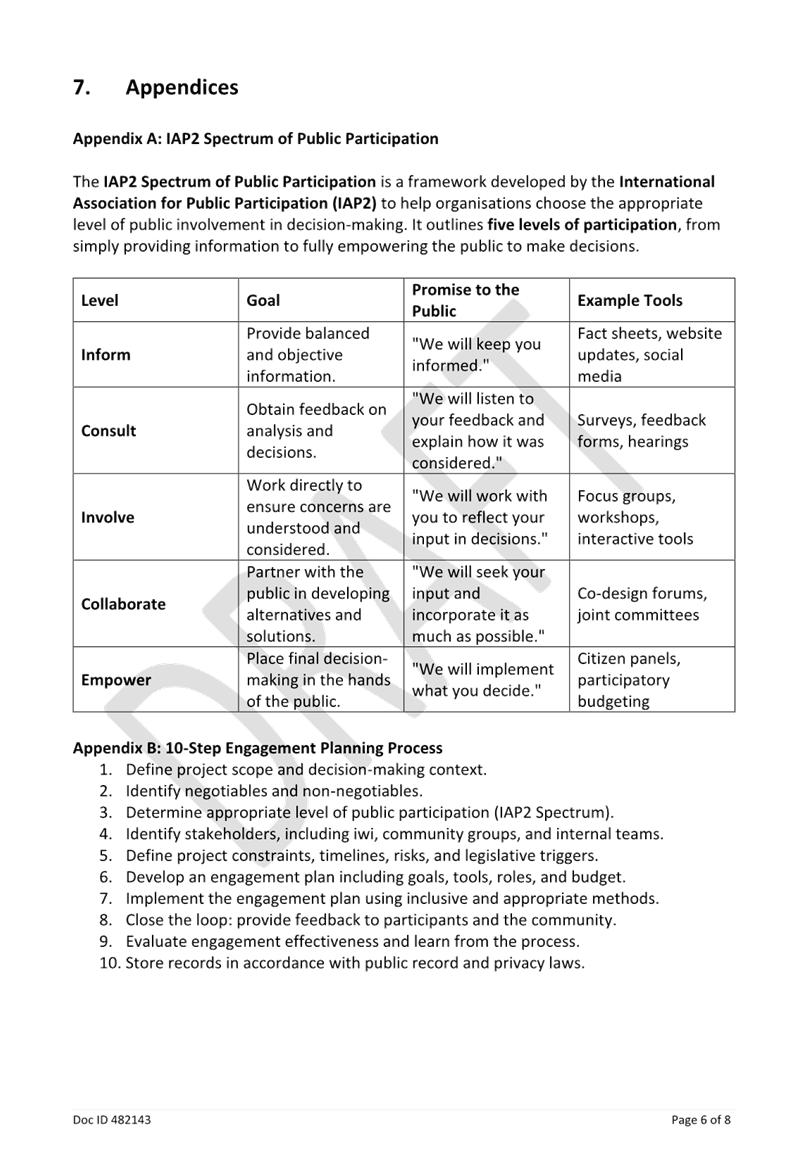
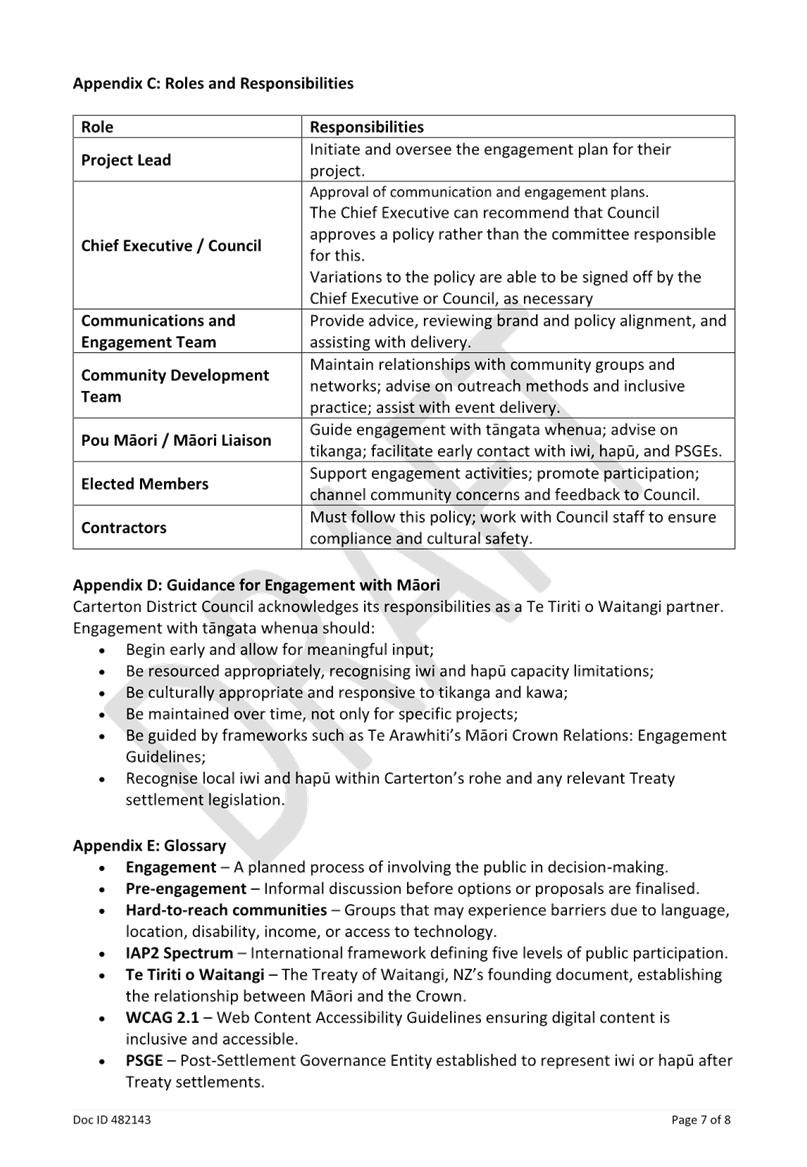
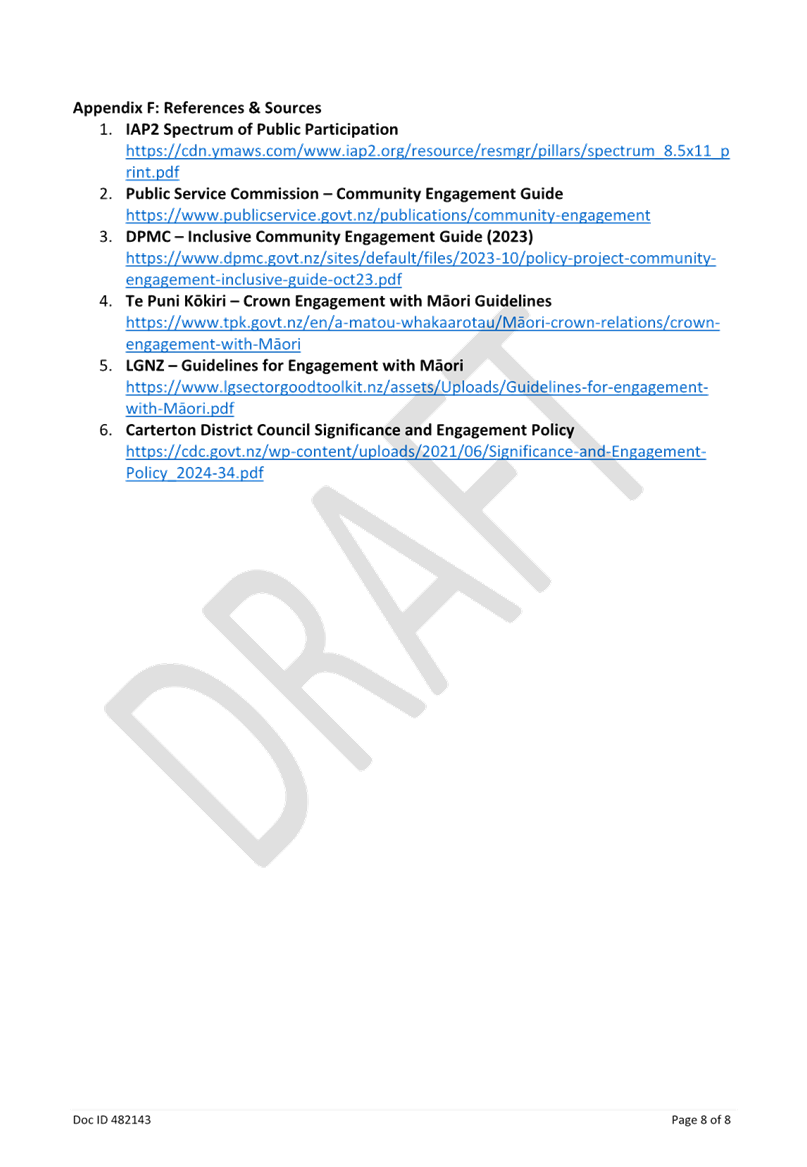
|
Policy
and Projects Committee meeting Agenda
|
10
September 2025
|
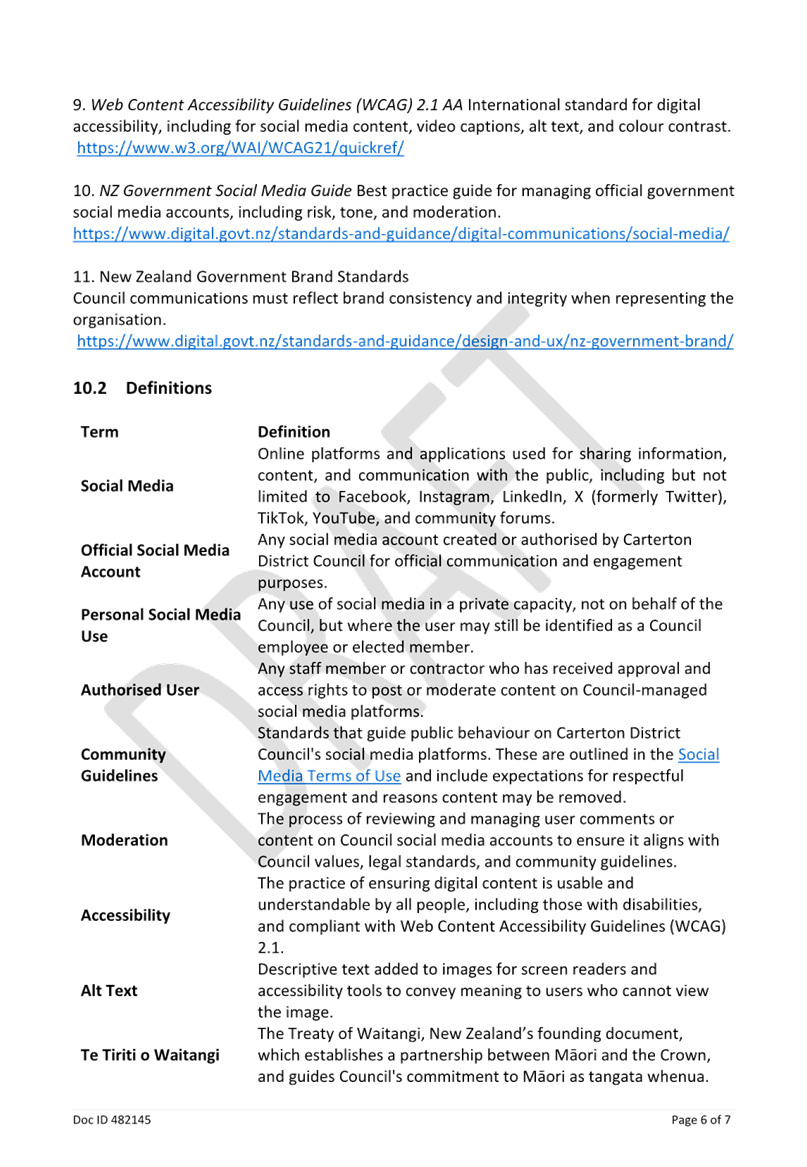
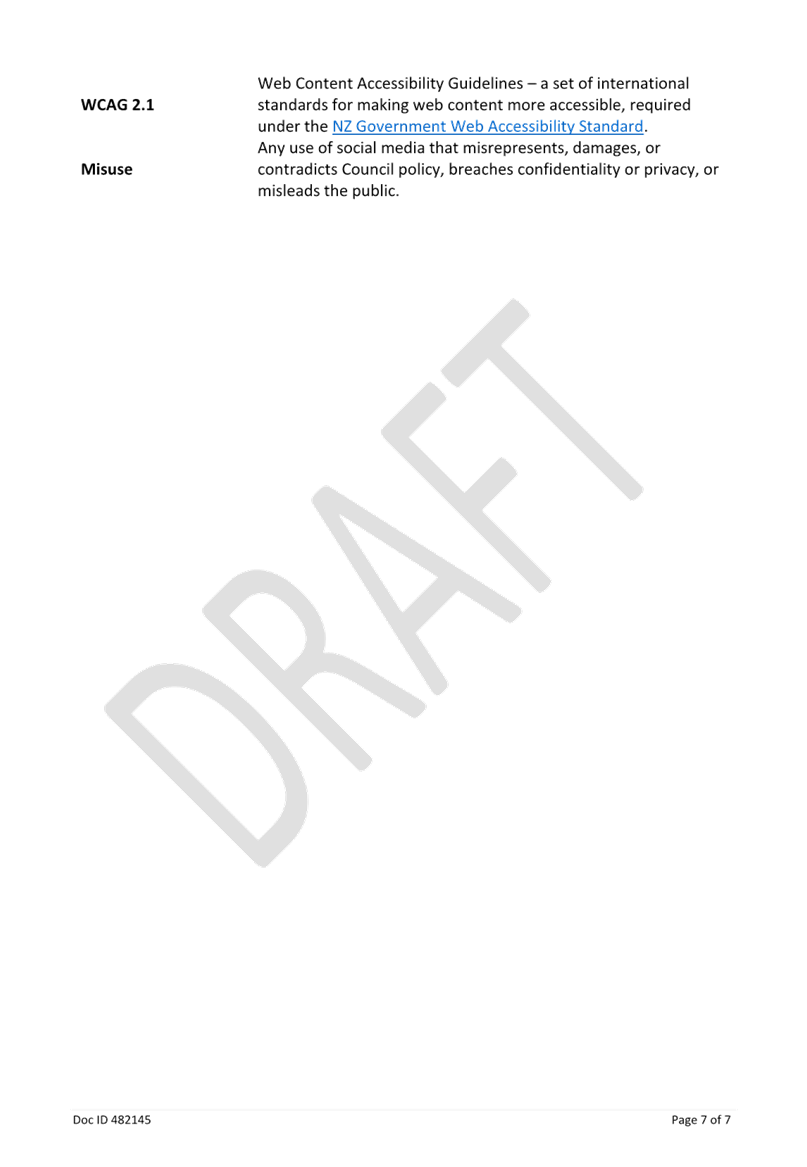
|
Policy
and Projects Committee meeting Agenda
|
10
September 2025
|

7.5 Non-Financial
Performance Data Reporting
1. Purpose
For the committee to
be updated on the enhanced data reporting approach for Council’s
non-financial performance measures.
2. Significance
The
matters for decision in this report are not considered to be of significance
under the Significance and Engagement Policy.
3. Background
Good
quality data is the backbone to robust reporting, performance improvement, and
decision making. There are issues when it comes to this. The
data must be trustworthy, the presentation of the data to decision makers must
not lead the agenda, and the data must be current and relevant to the decisions
being made.
In
reviewing data across the council, and the collation of it for the
non-financial KPIs within the annual reporting, it was determined that there
were several areas where the council could improve the collection and the
delivery of data for the decision-making process.
However,
it should also be recognised that with the presentation of the data, that it
might be revised over time. This does not mean that the underlaying data
is changed, but rather some data set holes might be filled, or some assumptions
that are required for the display of the information are changed, which can
lead to a change in numbers (for example, the number of residents of the urban
area is an educated assumption that has to be made).
4. The
Main Principles
The
main principles behind the development of this data framework are:
· The council can confirm, and show the source of the data and how it
is being ingested into the system
· Improvement of the overall transparency of the services delivered by
the council
· The data streams are from as close to the source as possible to
reduce the potential for alteration. The council needs to receive the
data, irrespective of how it might make the council look.
· The presentation of the data needs to reflect the true story, as
“bad news” data lets the council see how it can improve
· The information is for the council; it is not just within the
department. Cross department analysis of data could expose areas where
service delivery can be improved
· Data collection, processing and presentation should be automated
· The data framework itself does not replace or take ownership of data
sources from the relevant departments
· Enable early detection rather than end of year reporting.
5. DEVELOPMENT
The
starting point for the data reporting is the Performance Measures developed in
the Long Term Plan. At this point that the following can be confirmed:
· Sources of the data
· Regularity of collection
· Data collected match the KPI requirements
The
results of investigations into the above have indicated where the automation of
the data collection can occur. Some of this depends on the software
vendors and the openness of their solutions, to allow for the easy extraction
of information, but solutions will be found for the multiple routes that data
comes from.
As
this is a low budget project, the council is not spending on a complex cloud
data warehousing solution and consultants.
However,
the concepts are similar with respect to needing to work on the ingesting of
the data, the processing (removal of duplication in the data in the main), and
then the production of the visualization of the data.
Currently
the council does not have the volume of data coming in from many sources that
would warrant the complete Big Data modelling approach.
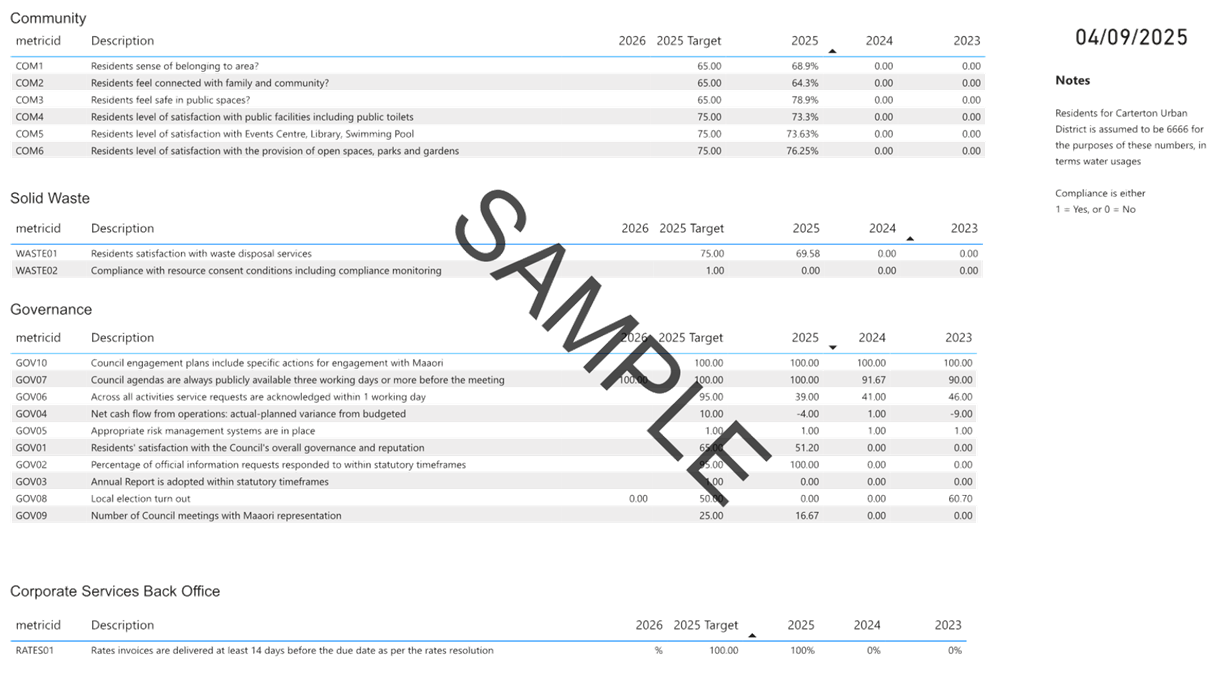
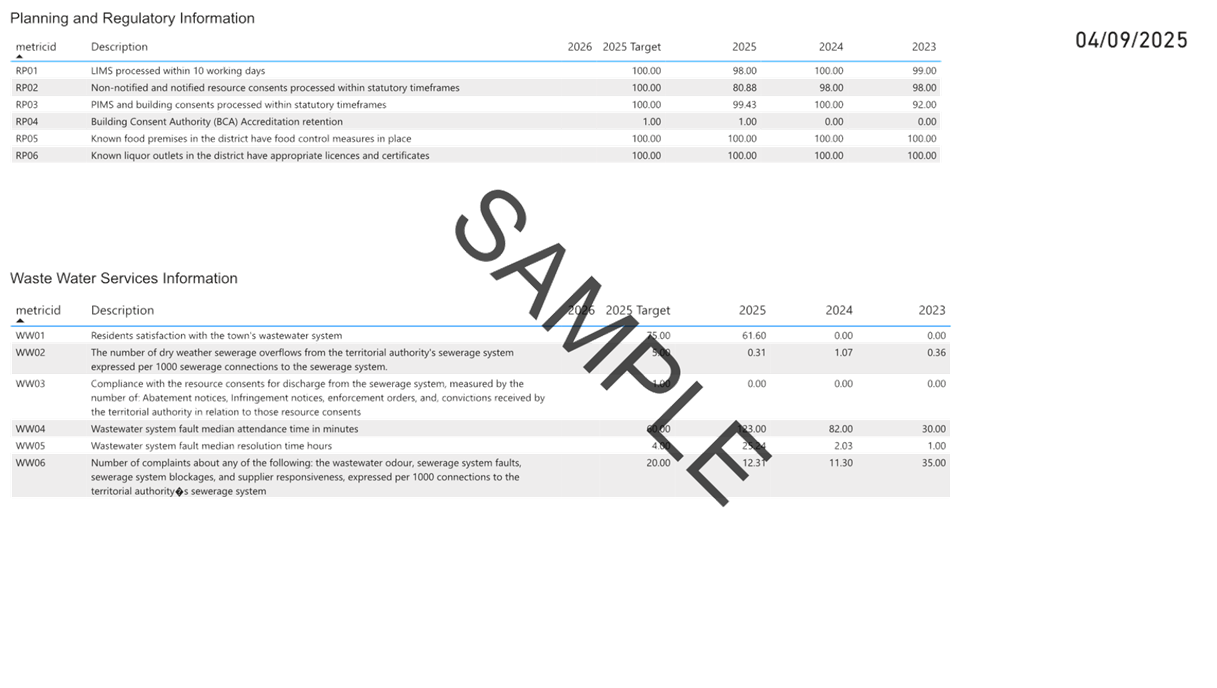
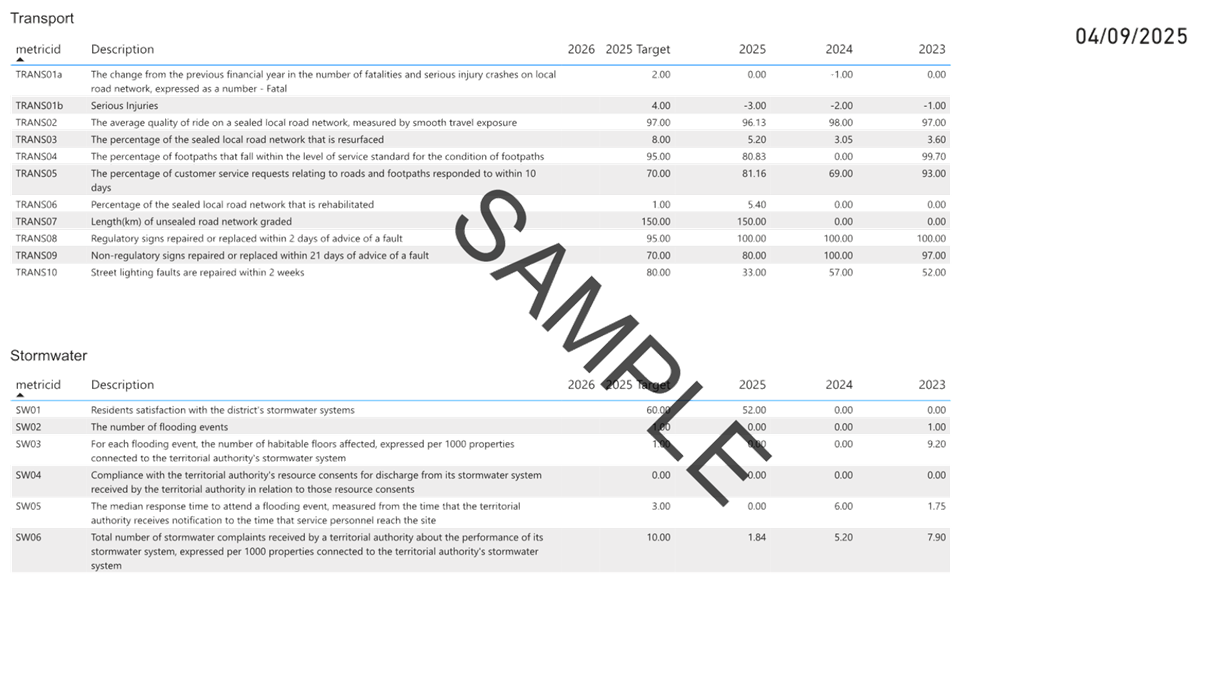
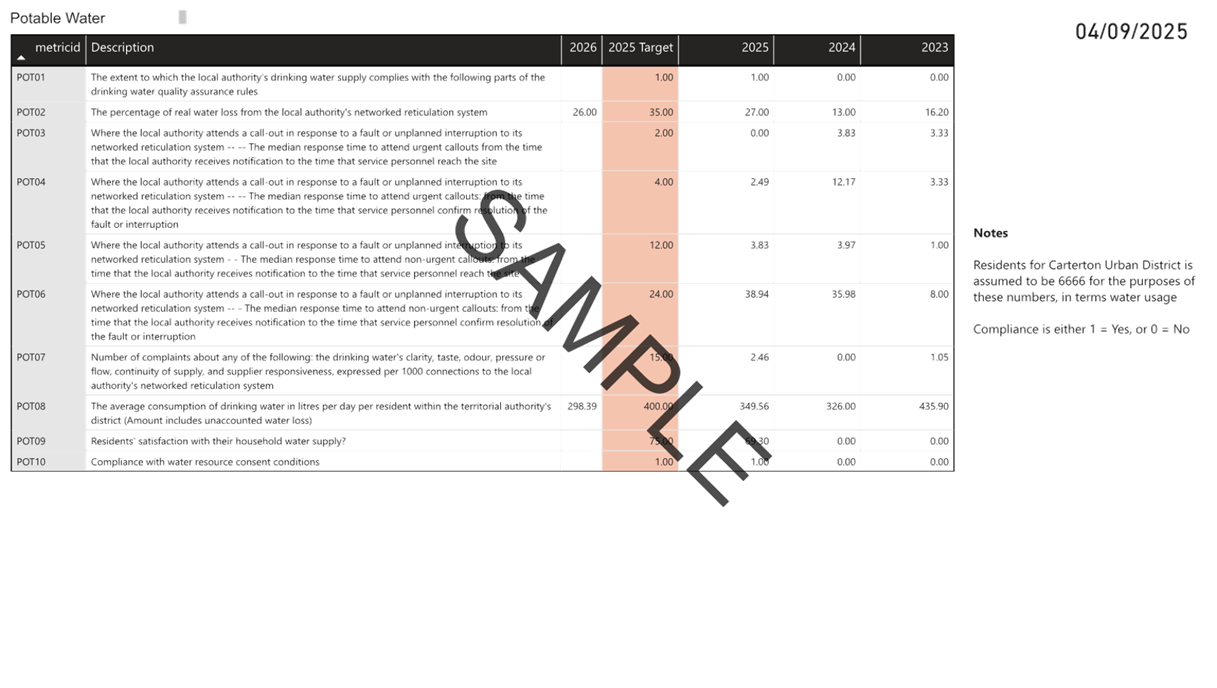
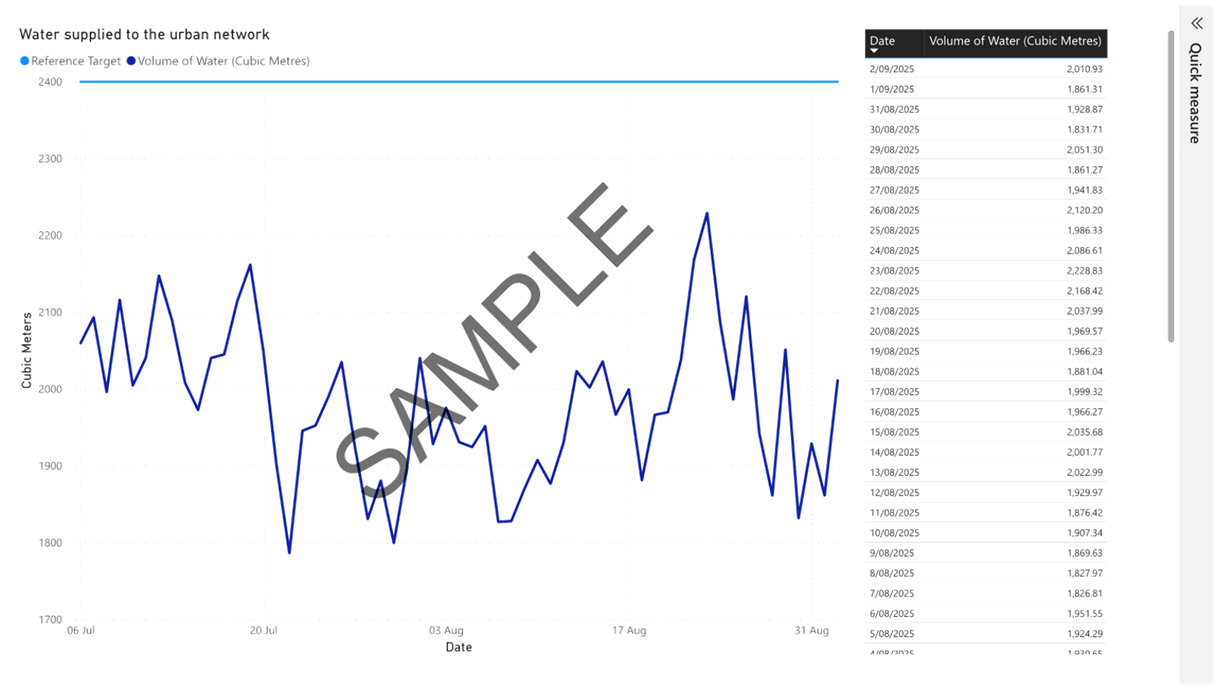
Attached
are examples of the wide range of reports that can be generated as the data
sets are collected. The figures in the reports should not be considered
as the reported numbers as there is still data checking and reviewing being
undertaken. They should be considered as a snapshot in time.
6. NEXT
STEPS
The
work continues to ingest more data from across the council and expand the
reporting across more council departments and improve the overall automation
within the data stores.
When
the data is displayed and presented to the end user, there needs to be some
documented understanding of the source data used to enable a clear
understanding of the potential errors that may exist. For example,
with trying to determine the leak level in the water network, the numbers
reported may in fact be the worst possible case situations.
7. CONSIDERATIONS
7.1 Climate change
There
are no decisions in this report requiring climate change considerations.
7.2 Tāngata whenua
Council
is cognisant of guidance around Māori data sovereignty, and the principles
within, and with respect to, access to that data.
7.3 Financial impact
All
current development work is being carried out within existing budgets.
7.4 Community Engagement requirements
There
are no decisions in this report requiring community engagement considerations.
7.5 Risks
The
development of a robust framework is designed to help improve performance
measurement and therefore improve council performance overall and reduce the
risks in decision making.
7.6 Wellbeings
Ensuring robust reporting supports
the measurement of performance towards Council’s wellbeing outcomes.
8. Recommendation
That the Committee:
1. Receives
the report
File
Number: 481826
Author: David
Johnson, Information Systems Manager
Attachments: 1. KPI
Reporting Dashboard ⇩
2. WaterLoss
Visualization ⇩
|
Policy
and Projects Committee meeting Agenda
|
10
September 2025
|
|
Policy
and Projects Committee meeting Agenda
|
10
September 2025
|
|
Policy
and Projects Committee meeting Agenda
|
10
September 2025
|
7.6 Backflow
Project Update and Policy
1. Purpose
For the committee to
be updated on the Backflow Prevention Project.
2. Significance
The matters for decision in this
report are not considered to be of significance under the Significance and
Engagement Policy and the project was in the Annual plan consultation for
2025/2026 financial year.
3. Background
The Backflow Upgrade project is
progressing, with the site surveys and the installation at identified
properties. Staff created a Backflow Management Plan in 2022 and started with a
desktop study to create a risk rating for all properties within Carterton. The
next stage is to confirm these risks and the process to upgrade these premises
with the proper devices.
The
Water Services Act 2021 was introduced after the publication of the Wairarapa
Consolidated Bylaw Part 5: Water Supply (Water Bylaw) in 2019, and is generally
in agreement. The Water Services Act states water suppliers have a duty to
protect against risk of backflow and need to produce a Backflow Prevention
Plan. It should be noted that backflow contamination was a possible cause
during the E. coli incident in 2021.
The
project for 25/26 has a budget of $500,00 to upgrade our backflow devices for
high-risk and medium-risk properties.
Following
communication with customers, staff are proceeding under the following basis
for the installation and ongoing maintenance of the devices:
· For
the installation of any devices installed all costs are recovered from the
customer; however, Council-owned properties will be addressed first.
· Property
owner will own any device installed and be responsible for maintaining devices
in alignment with the Building Act 2004 and Water Services Act 2021. Records
will be sent to the Water Authority to ensure protection of the network.
4. Discussion
Staff
are refining the risk for properties and are in the process of upgrading these
premises with the proper devices, unless the backflow risk is managed within
the property as part of an acceptable solution under the Building Act 2004.
A
summary of the risks follows:
High
Risk: Properties being used as medical facilities,
dental clinics, veterinarian practices, industrial and trade waste customers
etc can allow backflow of unwanted contaminants into the drinking water system
and cause harm to users in the district.
Medium
Risk: This includes beauty salons and hairdressers,
rainwater supplies, swimming pools, spas, and fountains
Identified
risk areas
|
High Risk Commercial properties in High Street
|
10-12
|
|
Other high-risk properties
|
87
|
|
CDC owned Pump Stations (High Risk)
|
16
|
|
Medim Risk properties
|
471
|
Relevant
Legislation:
• Water
Services Act 2021
• Building
Act 2004
• Wairarapa
Consolidated Bylaw Part 5: Water Supply (Water Bylaw)
The
Water Services Act 2021 is the primary act that now mandates that drinking
water suppliers protect a water supply from backflow risks in reticulated
systems after the repeal of the sections within the Health (Drinking Water)
Amendment Act 2007.
The
Water Service Act states that the water supply authority can require the
customer to install backflow prevention or install backflow prevention and
recover the cost from the customer. This includes all ongoing testing and
maintenance of the backflow protection.
The
Wairarapa Consolidated Bylaw Part 5: Water Supply (Water Bylaw) section 4.10
states the following:
4.10
Backflow prevention
4.10.1
Customer responsibility
It is
the customer’s responsibility (under the Health Act 1956, and the
Building Act 2004) to take all necessary measures on the customer’s side
of the point of supply to prevent water which has been drawn from the
WSA’s water supply from returning to that supply.
These
include:
a)
backflow prevention either by providing an adequate air gap, or by the use of
an appropriate backflow prevention device; and
b)
the prohibition of any cross‐connection between the WSA water supply
and:
(i)
any other water supply (potable or non‐potable);
(ii)
any other water source;
(iii)
any storage tank; or
(iv)
any other pipe, fixture or equipment containing chemicals, liquids, gases, or
other non‐ potable substances.
NOTE:
Fire protection systems that include appropriate backflow prevention measures
would generally not require additional backflow prevention, except in cases
where the system is supplied by a non‐potable source, a storage tank or
fire pump that operates at a pressure in excess of the WSA’s normal
minimum operating pressure.
4.10.2
Unmanaged risk
Notwithstanding
clause 4.10.1, the WSA may fit at the customer’s expense a backflow
prevention device on the WSA side of the point of supply where the customer
cannot demonstrate that the risk of backflow is adequately managed.
Estimate
Cost per device:
The
estimate from the contractor is that the supply and installation cost will be
$4,000- $6,000.
5. Options
Officers
are not proposing any alternative options at this time, however the Council or
the future Wairarapa Tararua Water Service Entity could consider alternative
methods to fund these devices such as a targeted. Officers also anticipate that
policies and bylaw should be aligned across the Wairarapa and Tararua in the
future.
Neighbouring supplies
Masterton
District Council is currently drafting a policy which replicates customer
installation and ownership.
South
Wairarapa District Council doesn’t have a policy and uses the current
bylaw, requiring customers to install their own backflow prevention.
In
their bylaw Tararua District Council requires the owners to install and
maintain their own backflow prevention, unless the risk is too high, then the
Council will install backflow before the point of supply.
Future
options could be based on the code of practice from Water New Zealand
considerations which are:
|
Ownership
|
Issues
|
Comments
|
|
Water Authority
|
Accepting and vesting of devices.
Customers wishing to retain ownership.
Possible access issues if existing or new
devices inside the boundary. Also, may have private supply pipe in between.
Customer resistance to paying for devices
they don’t own or where one was not previously installed
|
Water supplier arranges annual testing
and also repair and retest of failed devices.
Lower risk of devices not being tested
annually or non-compliant.
Less administration time chasing and
auditing test reports.
|
|
Customer
|
Consistent with Building Consent process/
BWoF.
Issue collecting install cost. Flat fee
is known cost and may be easier.
The collation and maintaining of accurate
records for devices and their testing is reliant on customer to provide test
reports.
Need for water supplier to remind customer
to test devices.
Non-tested, failed devices or
non-compliant devices are a risk to the water supply and enforcement will be
required.
|
Allows customer choice as per Commerce Act.
The water supplier and building control authority
need to work together. Need to reach agreement with new water entity.
There are up to 570 properties recovering about 50%
of costs at $500.
|
|
Combined – project covers installation,
customer maintained
|
Similar issues to above
Disputes may arise if the device is not tested
or the test is duplicated because the BWoF compliance schedule timeframe
differs from water supplier owned programme for testing.
|
Allows customer and water supplier
choice. The water supplier may not wish to own large devices or those with
access/shutdown issues.
|
6. CONSIDERATIONS
There are no matters in the report
relate to climate change migration or adaptation issues.
6.1 Tāngata whenua
We
believe that the principle of protecting the wider water supply network from
backflow contamination, would be of interest and supported by Maori.
6.2 Financial
impact
The project will proceed within
existing budgets with costs recovered as per the mechanism within the bylaw.
Should cost recovery become an issue, the council could consider alternative
options such as a targeted rate.
6.3 Community Engagement requirements
High-risk
properties are being surveyed by a contractor and the risk will be discussed
with property owners.
6.4 Risks
The
risks are cost over-runs, however if costs are recovered for the device
installation, then it should be minor. Delaying the project risks an outbreak
of illness, and prosecution by the regulator for not managing the backflow
hazards. Backflow for an unidentified source was a potential cause of the
E.coli incident in 2021.
6.5 Wellbeings
Social
A
strong and effective council providing trusted leadership.
A
caring community that is safe, healthy, happy and connected.
An
empowered community that participates in Council and community-based decision
making.
Cultural
A
community that fosters and promotes our character and creativity.
Environmental
Safe
and resilient water supply, wastewater, and stormwater systems.
Economic
Quality,
fit-for-purpose infrastructure, and services that are cost-effective and meet
future needs.
A
vibrant and prosperous business and primary sector investing in and supported
by the community.
7. Recommendation
That the Committee:
1. Receives
the report
File
Number: 481895
Author: Lawrence
Stephenson, Waters Operations Manager
Attachments: 1. Section
from Water Services Act ⇩
|
Policy
and Projects Committee meeting Agenda
|
10
September 2025
|

|
Policy
and Projects Committee meeting Agenda
|
10
September 2025
|
7.7 Waste
Management and Minimisation Update
1. Purpose
For the Committee to
be updated on Carterton District’s Waste Management and Minimisation
services.
2. Significance
The
matters for decision in this report are not considered to be of significance
under the Significance and Engagement Policy.
3. Background
CDC
delivers solid waste management and minimisation services and activities in
alignment with the Wellington Region Waste Management and Minimisation Plan
(WMMP), and the Wairarapa Local Action Plan.
The
WMMP outlines how Wellington Councils, mana whenua, community, industry, and
businesses can work together to transform how waste is generated, managed, and
minimised in the Region. Reflecting this collaboration is the vision for
this WMMP, which is “E mahi tahi ana ki te tiākinahia a
mātou rauemi – hei whakaiti para, ā, ki te whakanui ai te
wāhi - Working together to care for our resources - for less waste and a
greater place”.
The
objectives of the WMMP are:
1. Waste and resource recovery systems
support a reduction in greenhouse gas emissions from landfills and waste
collections.
2. There is collective responsibility
within the Wellington region for reducing our resource use and protecting our
natural environment.
3. The conditions are in place to support
everyone to use fewer resources and minimise waste.
4. Material circularity is increased
through reuse, resource recovery, waste infrastructure and services.
5. It is accessible and convenient to
reduce waste, reuse materials, and minimise disposal to landfill in line with
the waste hierarchy.
6. Waste and resource recovery data systems
are in place to track and monitor waste streams.
7. Resource recovery facilities and waste
systems are resilient and able to cope with emergency events.
8. Recovery of materials is maximised so
that landfills are used as a last resort.
9.
Waste that cannot be prevented or diverted from landfill is managed safely and
effectively in accordance with best practice.
4. Discussion
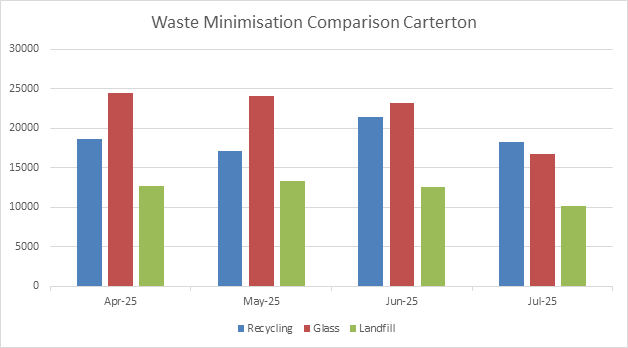
|
Month
|
Recycling
(kerbside and Transfer station)
|
Landfill
|
Glass
Recycling
|
E-waste/batteries
/other
|
Metal
recycling
|
Levy
(Exc. GST)
|
|
June ‘25
|
21,390 kg
|
12,580 kg
|
23,180 kg
|
1,500 kg
|
3,050 kg
|
$ 2526.59
|
|
July ‘25
|
18,340 kg
|
10,115 kg
|
16,700 kg
|
1,710 kg
|
10,250 kg
|
$2,056.20
|
|
Project Update
|
|
|
· Tyrewise product
stewardship scheme has now initiated at Carterton Transfer station and
residents can drop-off up to 5 tyres (per week) at no cost.
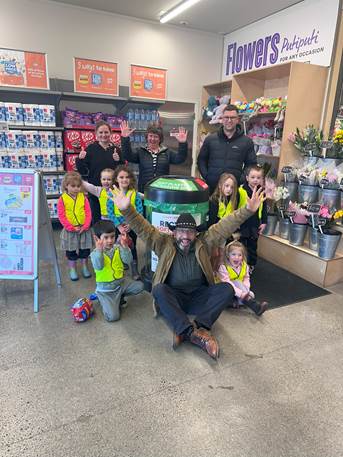
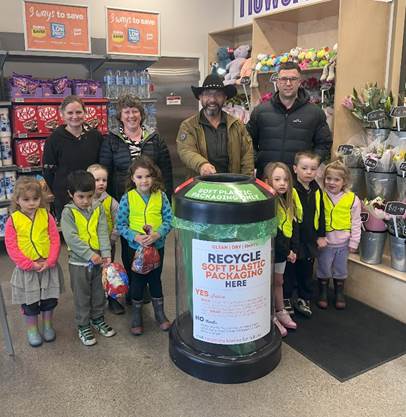
· Council has
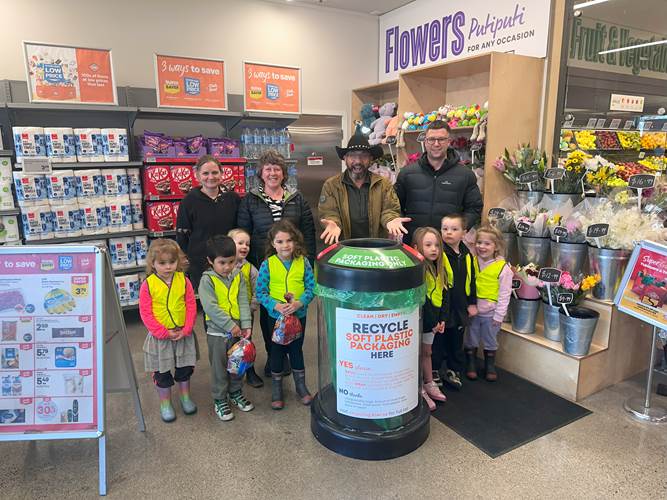
installed the Soft Plastics Recycling (SPR) bin at New World in mid-August and
the responses received from the community have been fantastic.
· New council
kerbside rubbish collection bags are out in the market.
· Toimata
foundations were no longer in the position to hold contracts for Enviroschools
and requested a workshop in August with different council officers and GWRC.
Officers agreed to have GWRC take on the TA contracts and employ/contract
facilitators for a short time (18 months) until a decision has been made.
· Desludging
biosolids trials with Composting NZ have been initiated and the processing
operations are streamlined.
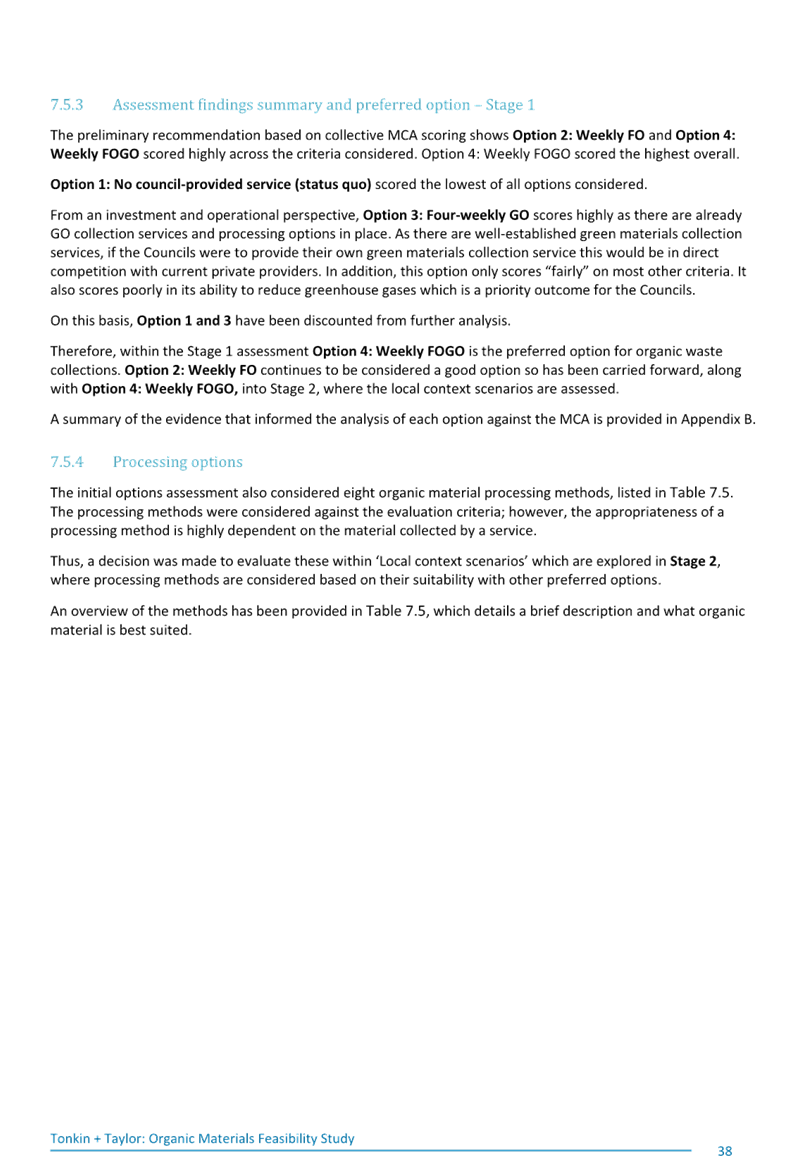
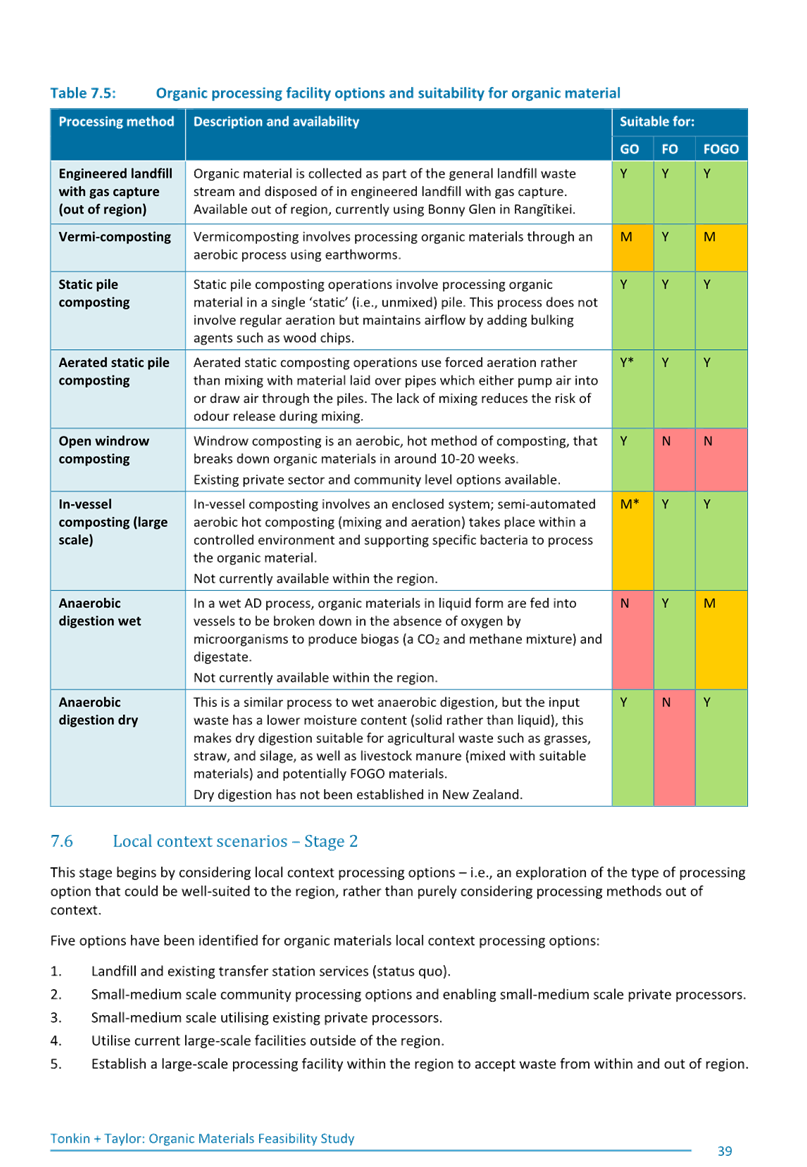
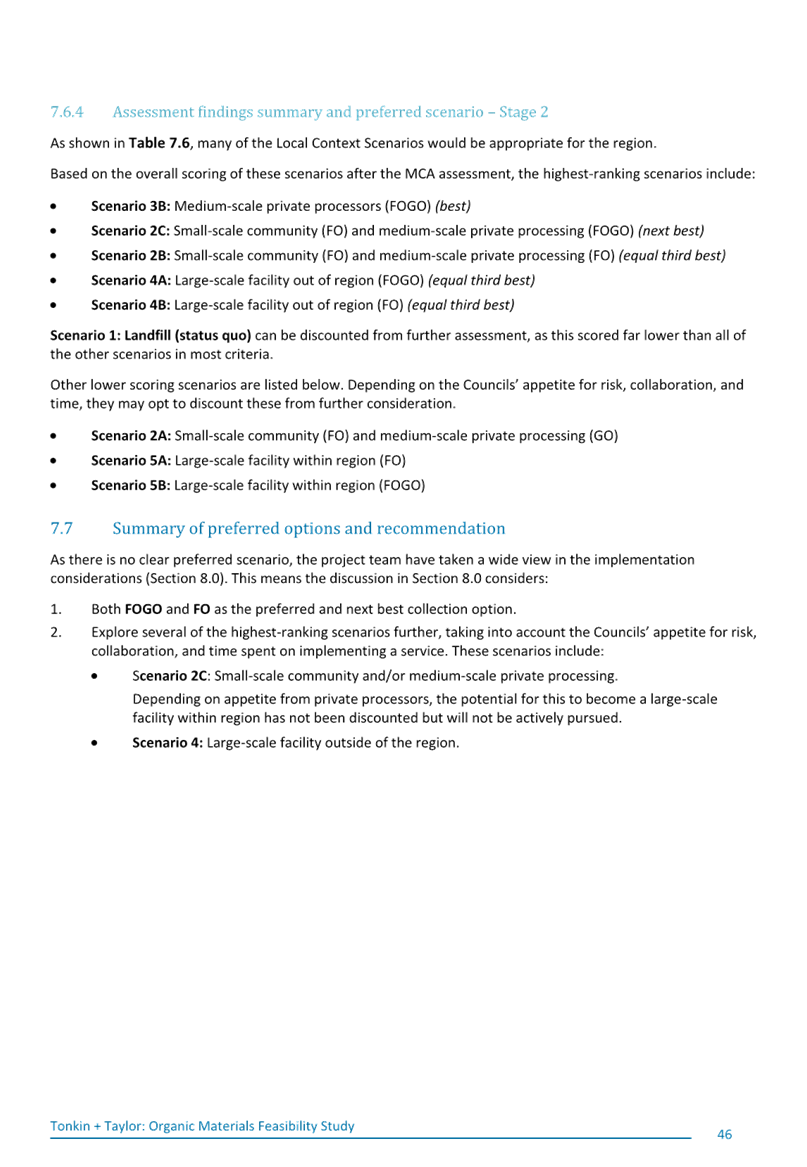
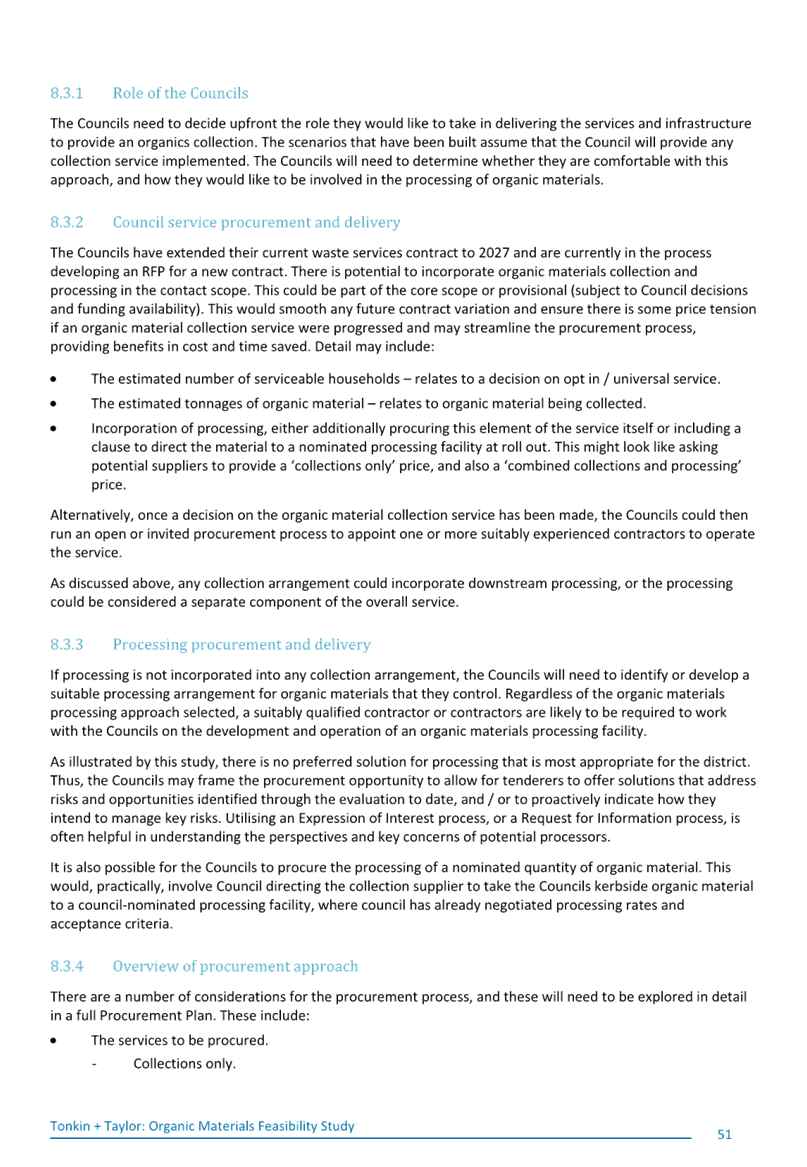
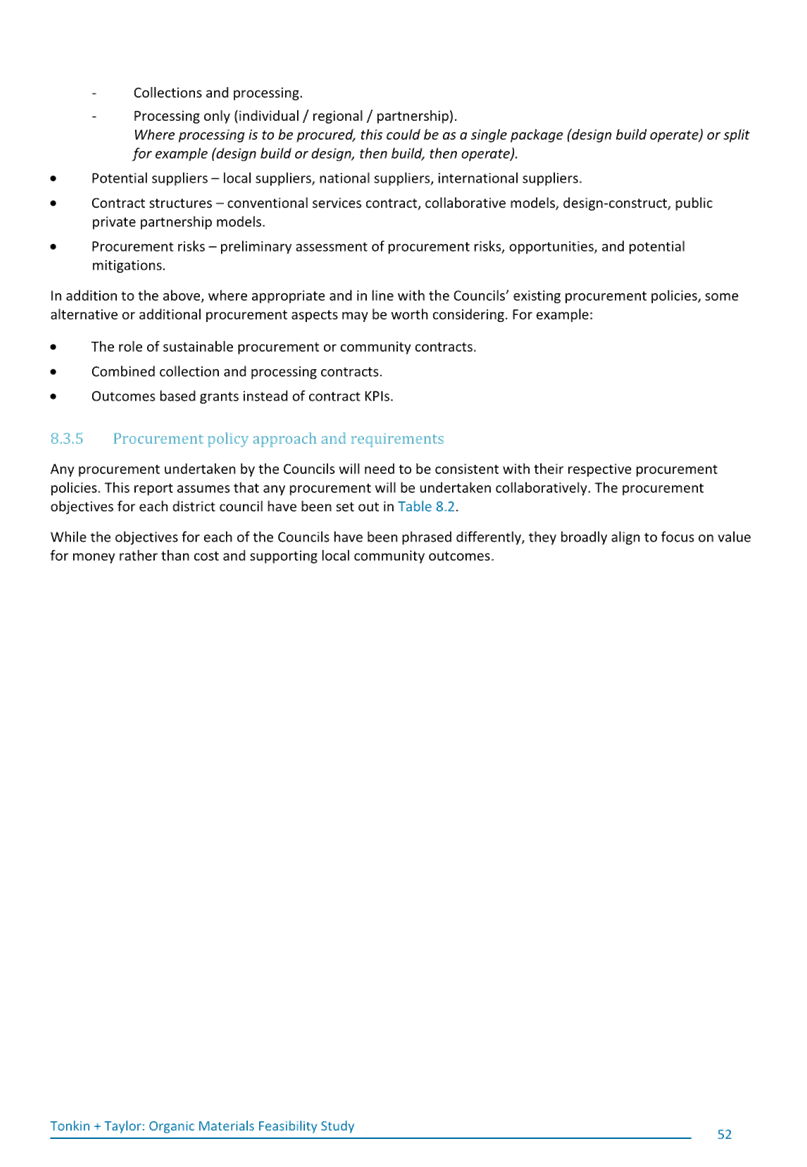
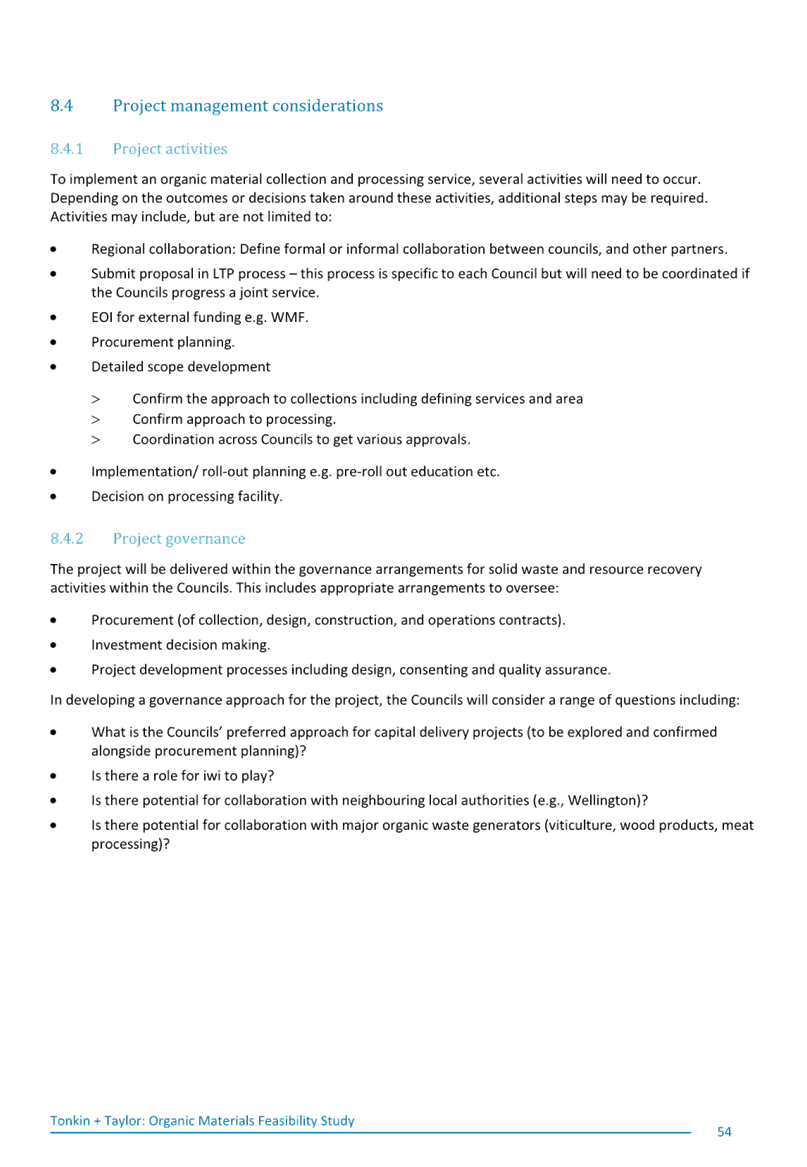
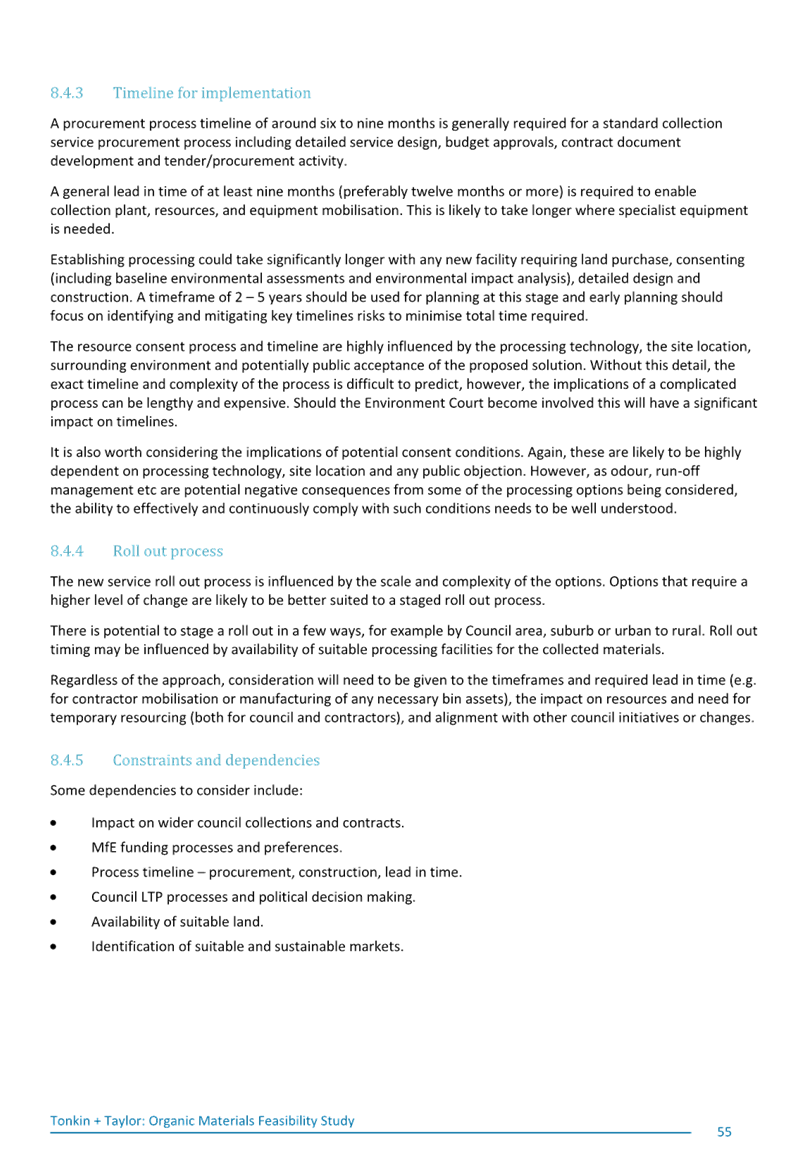
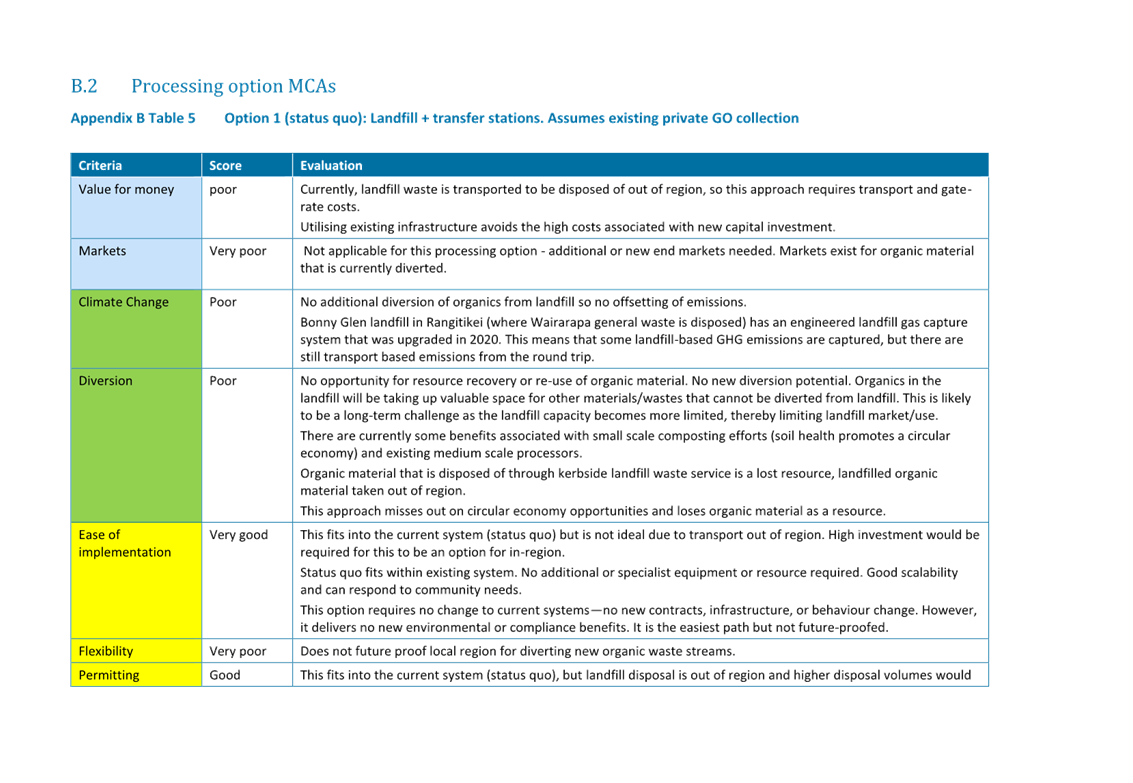
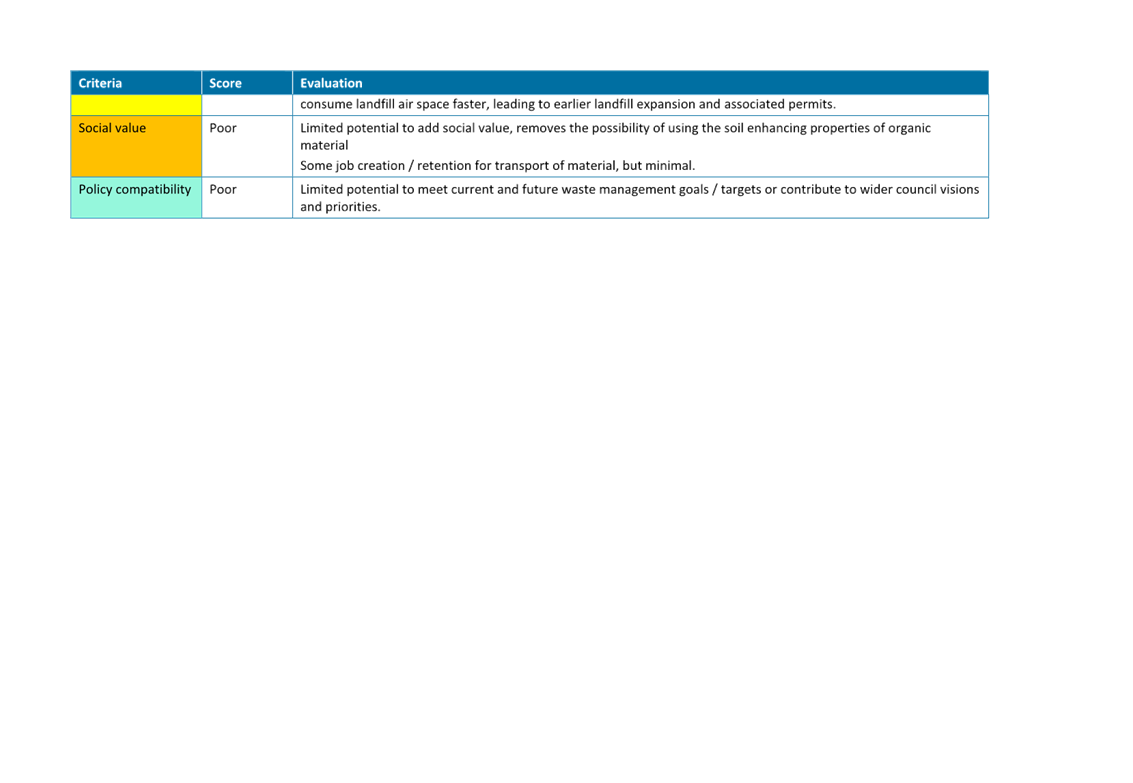
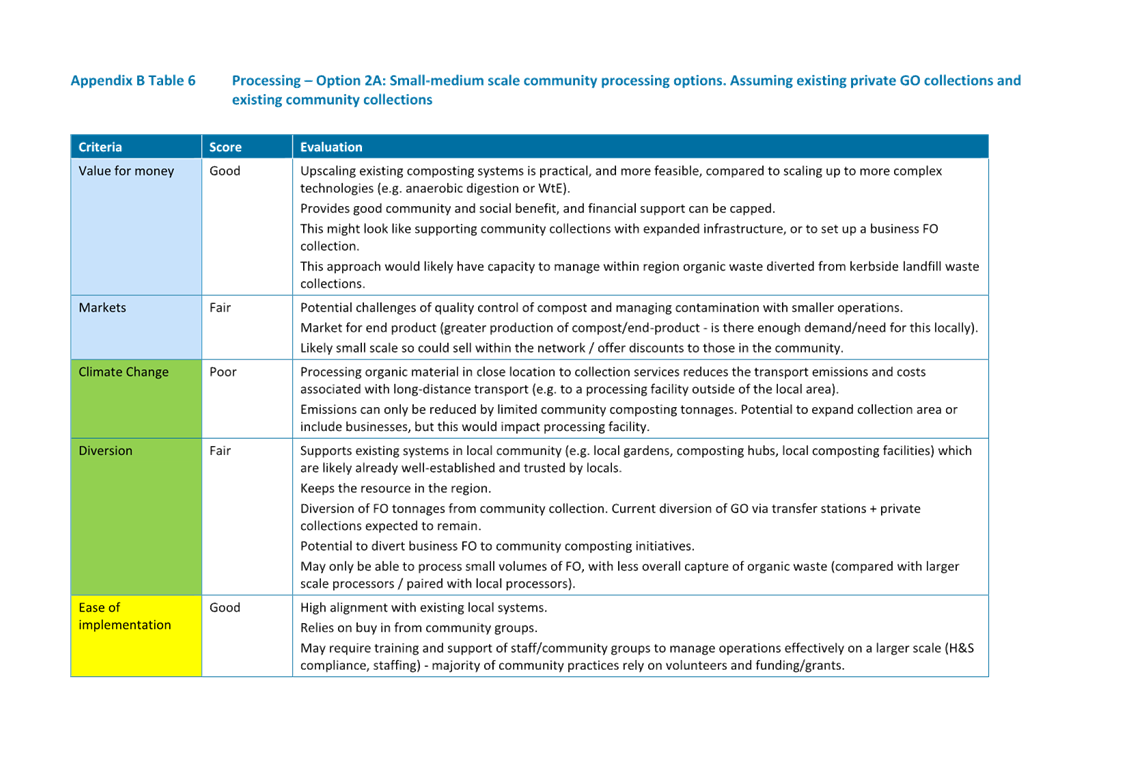
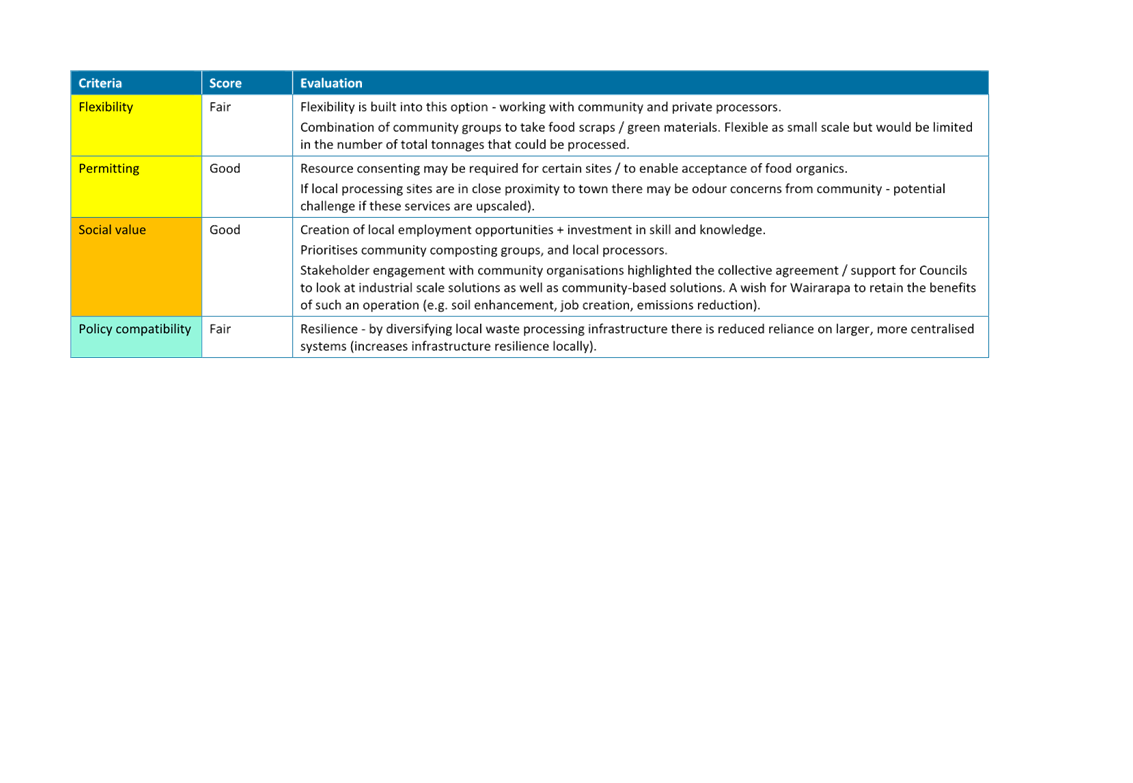
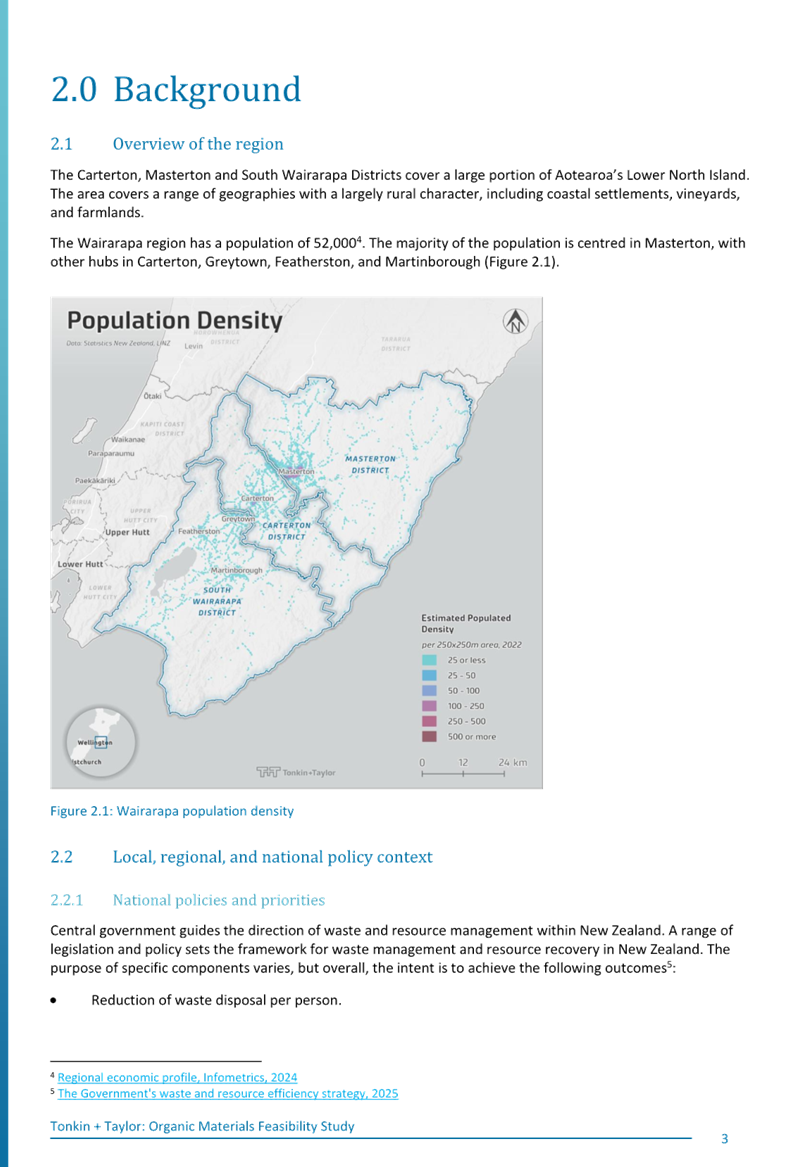
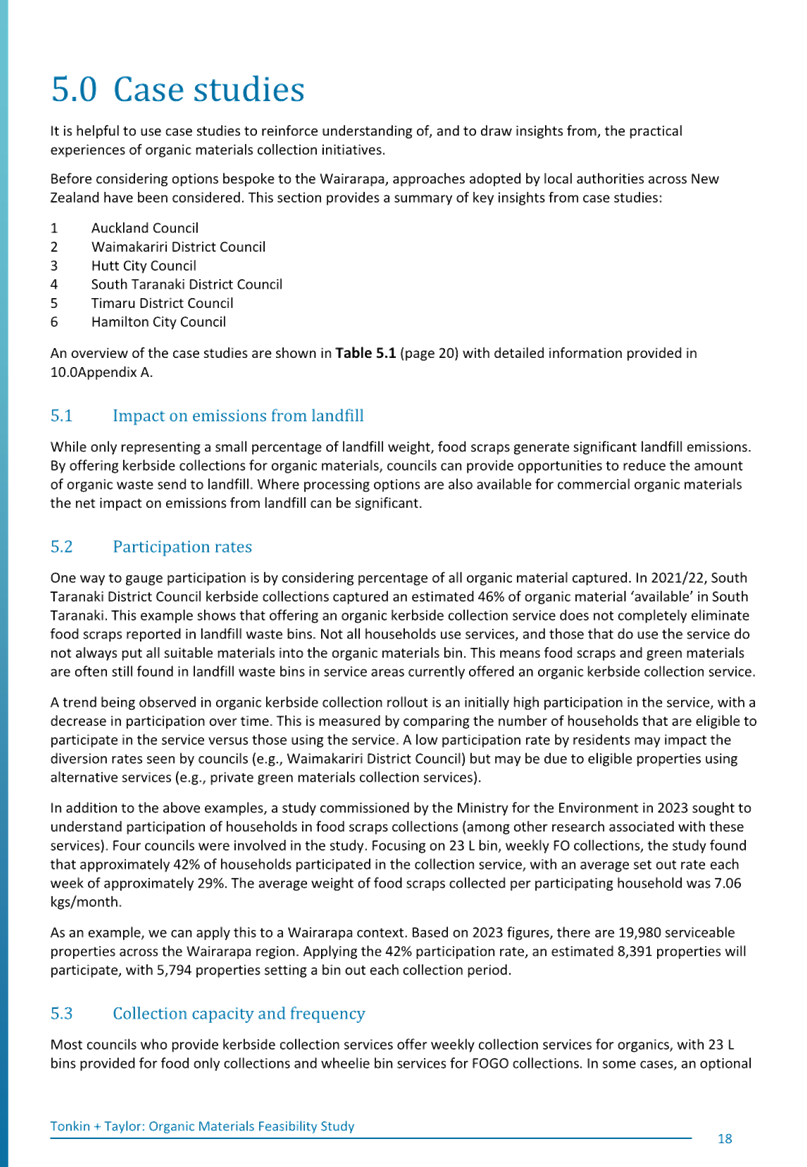
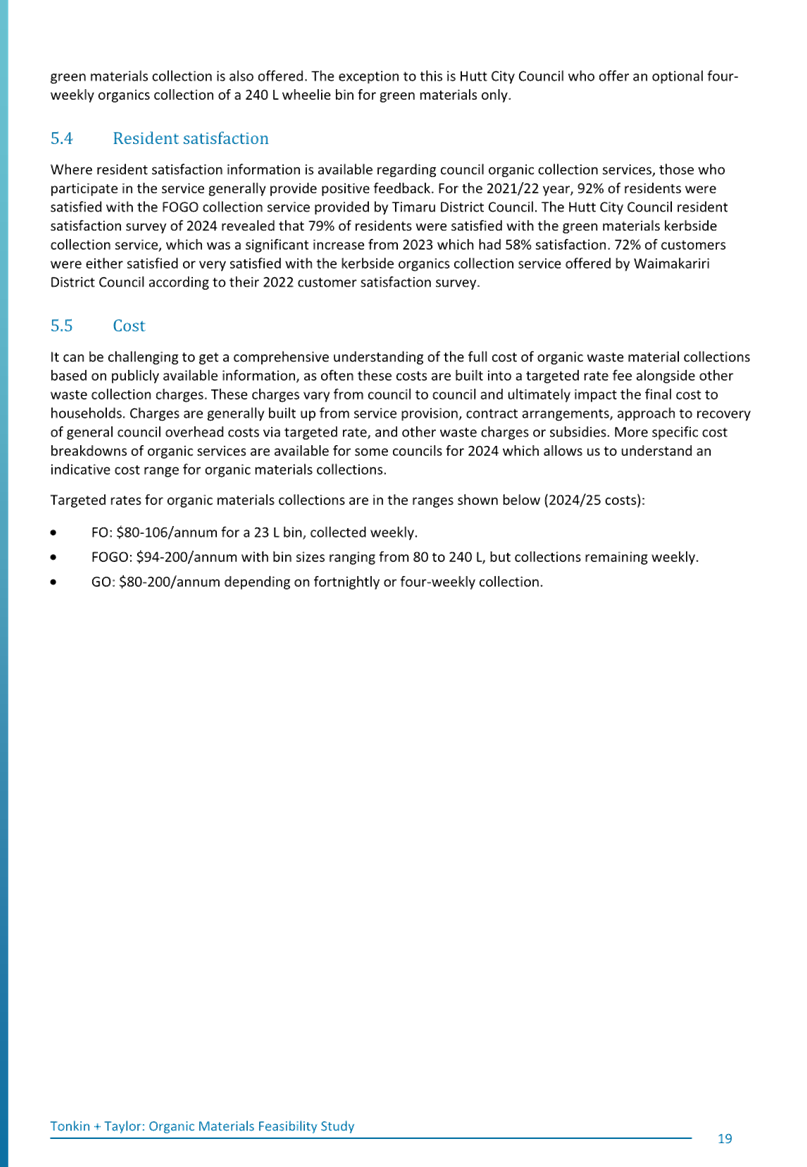
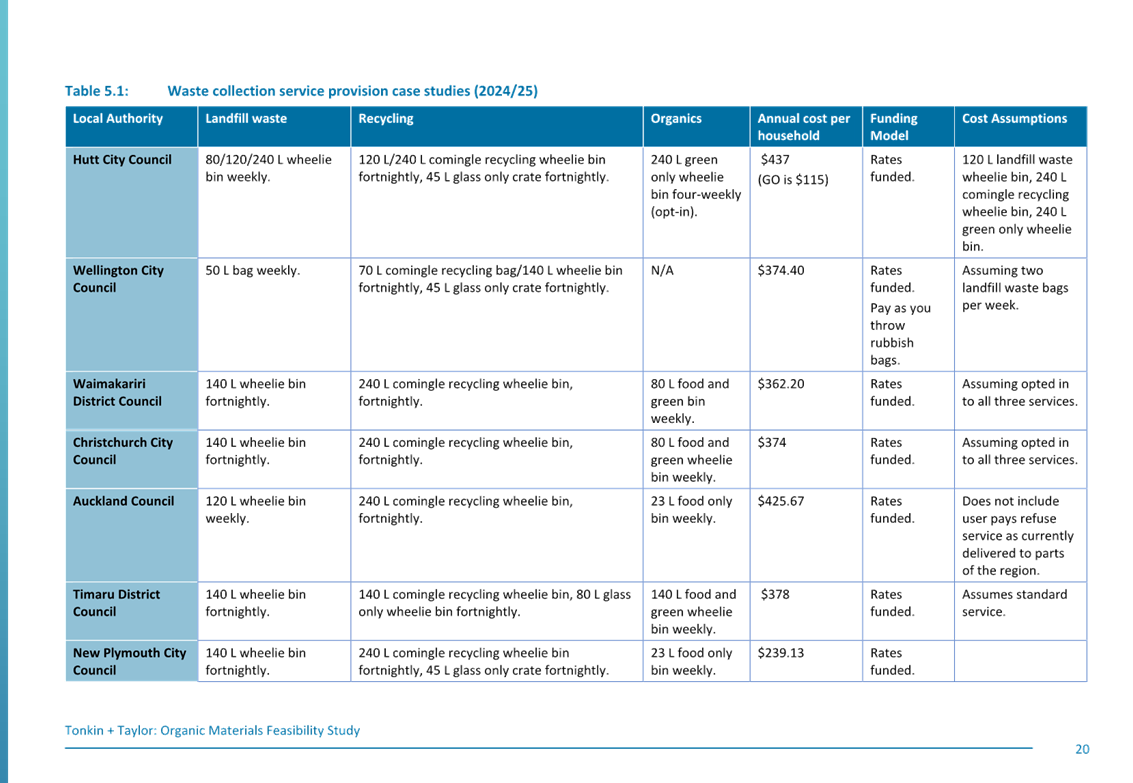
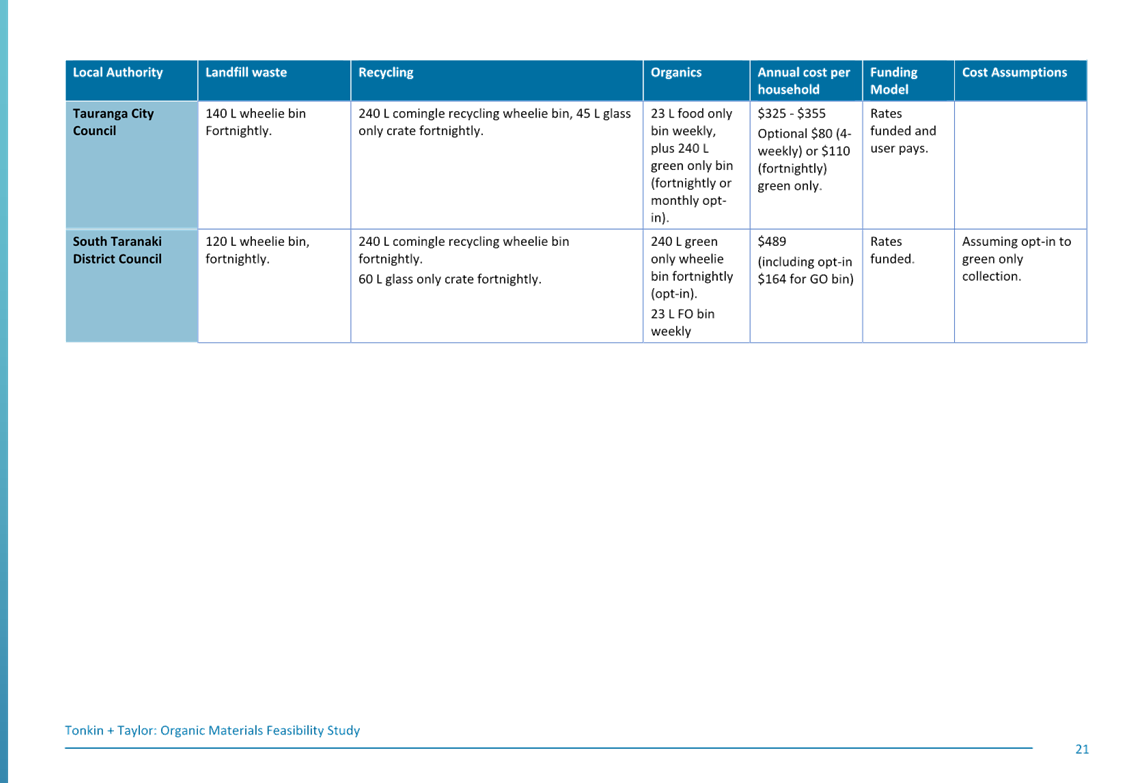
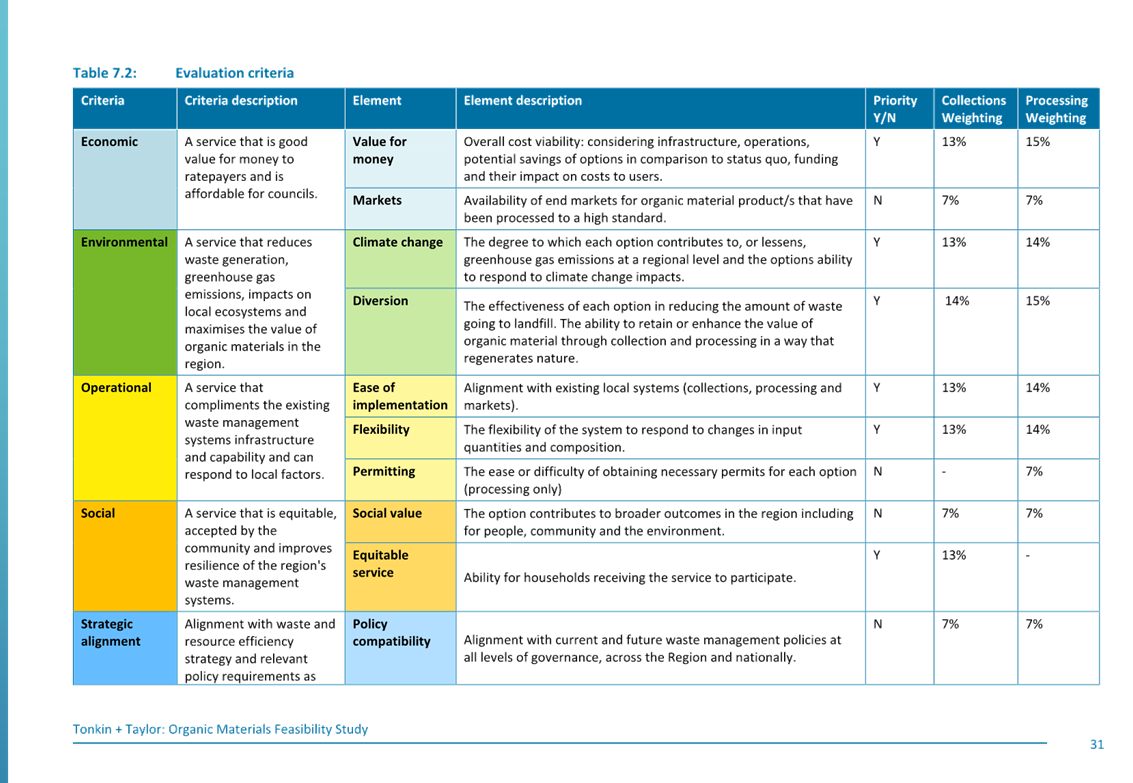
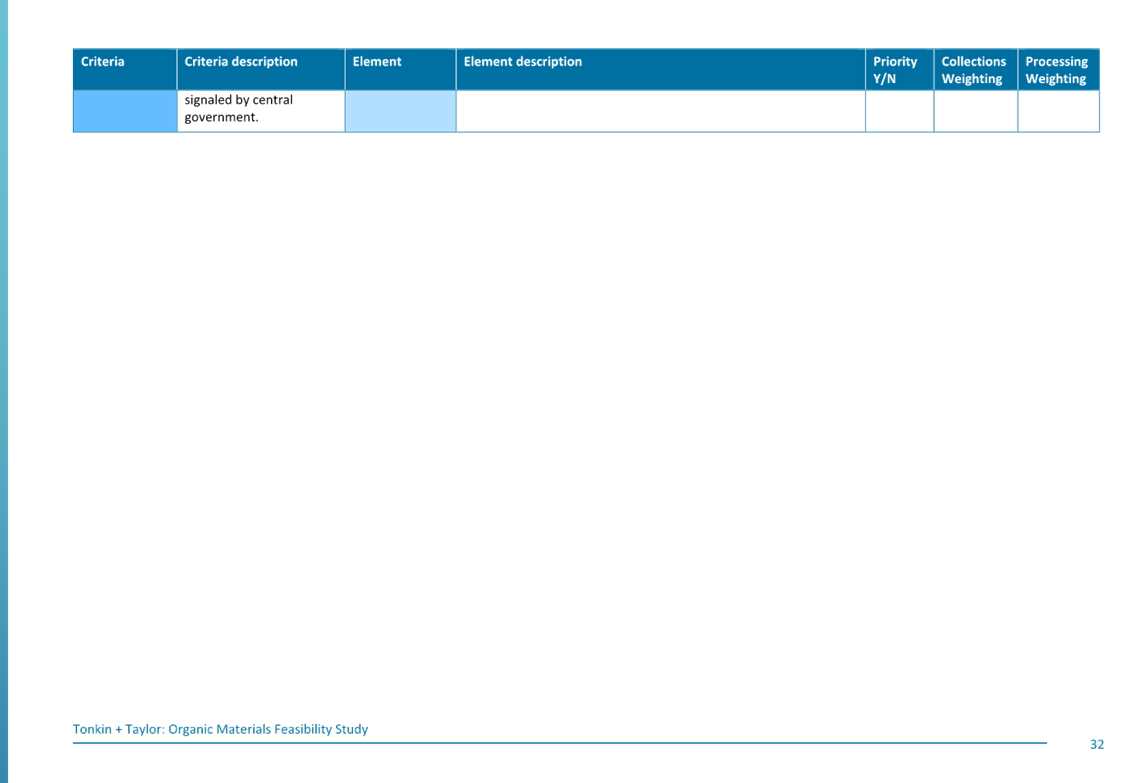
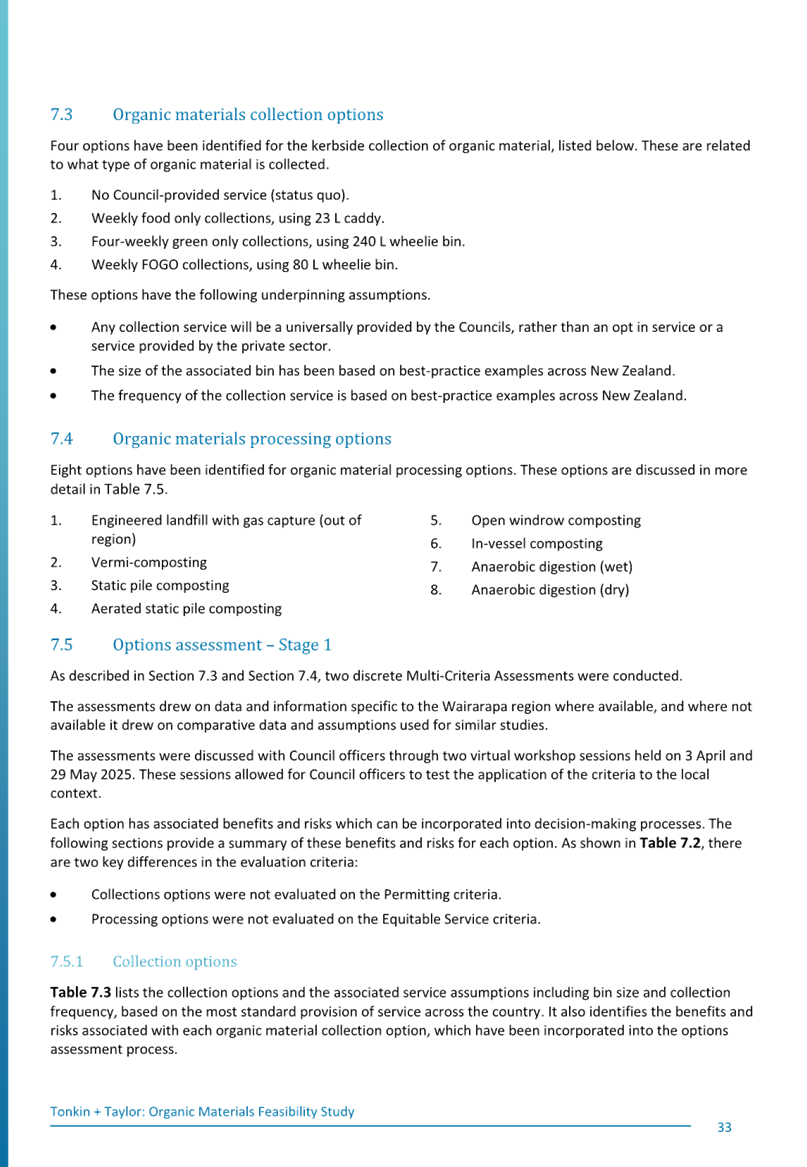
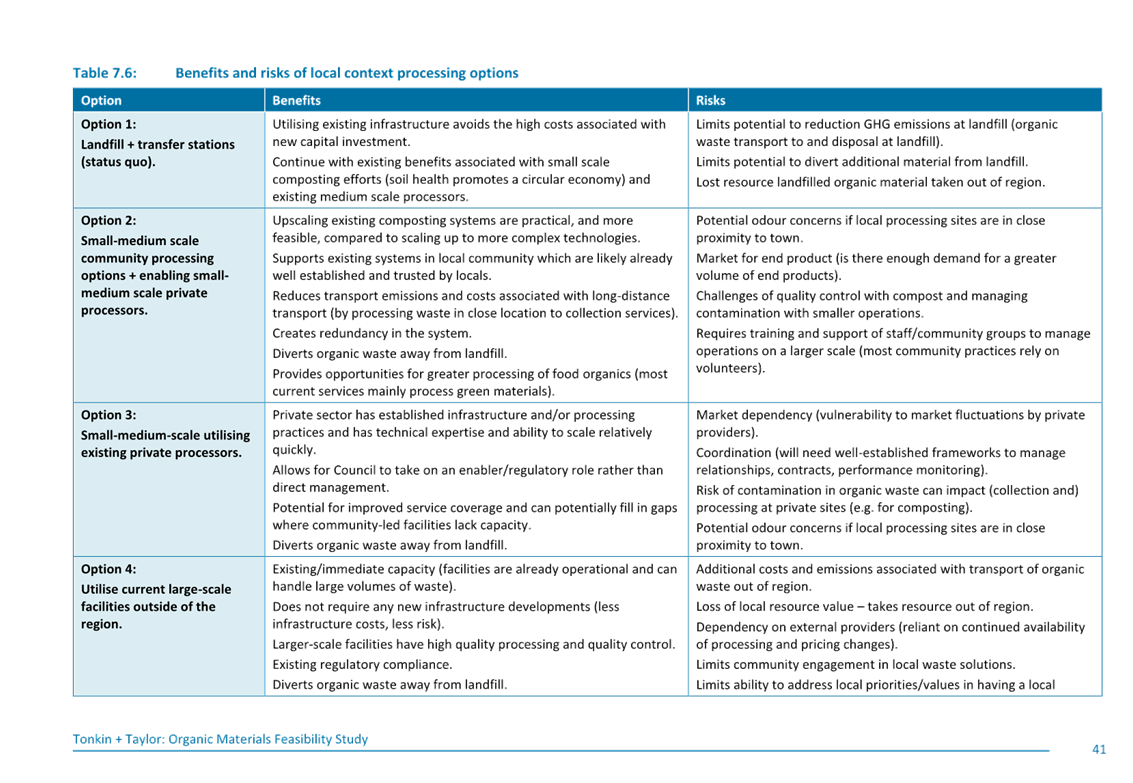
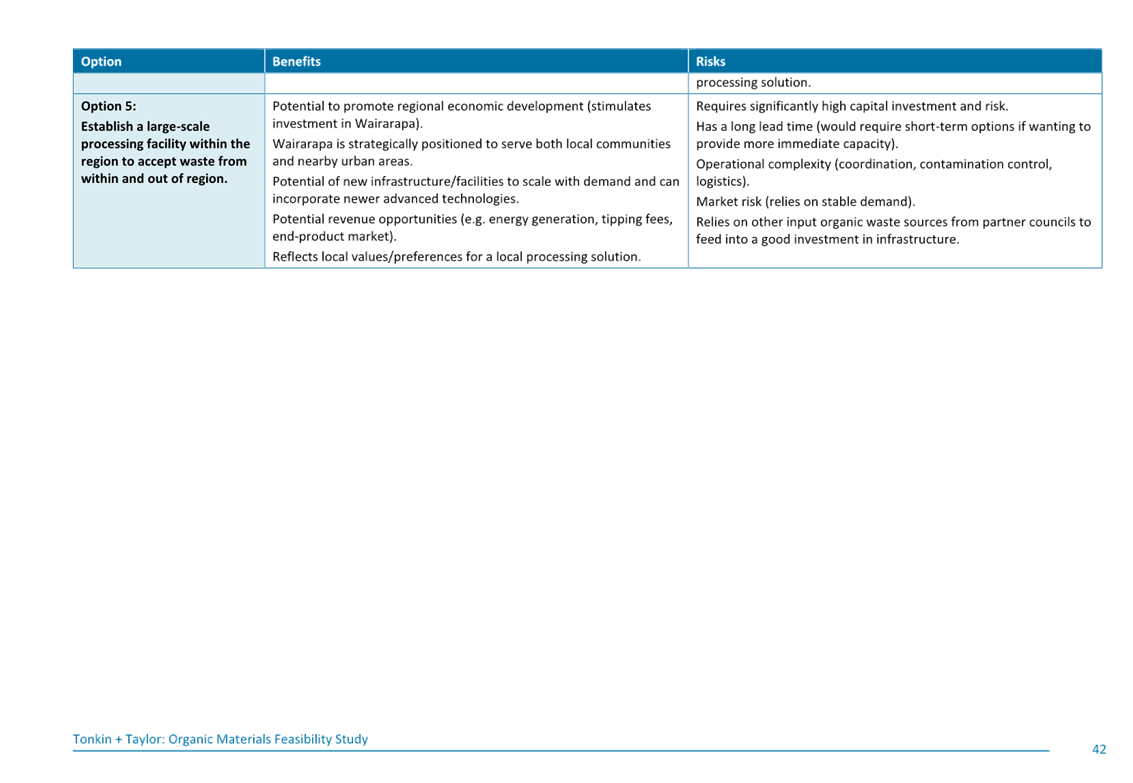
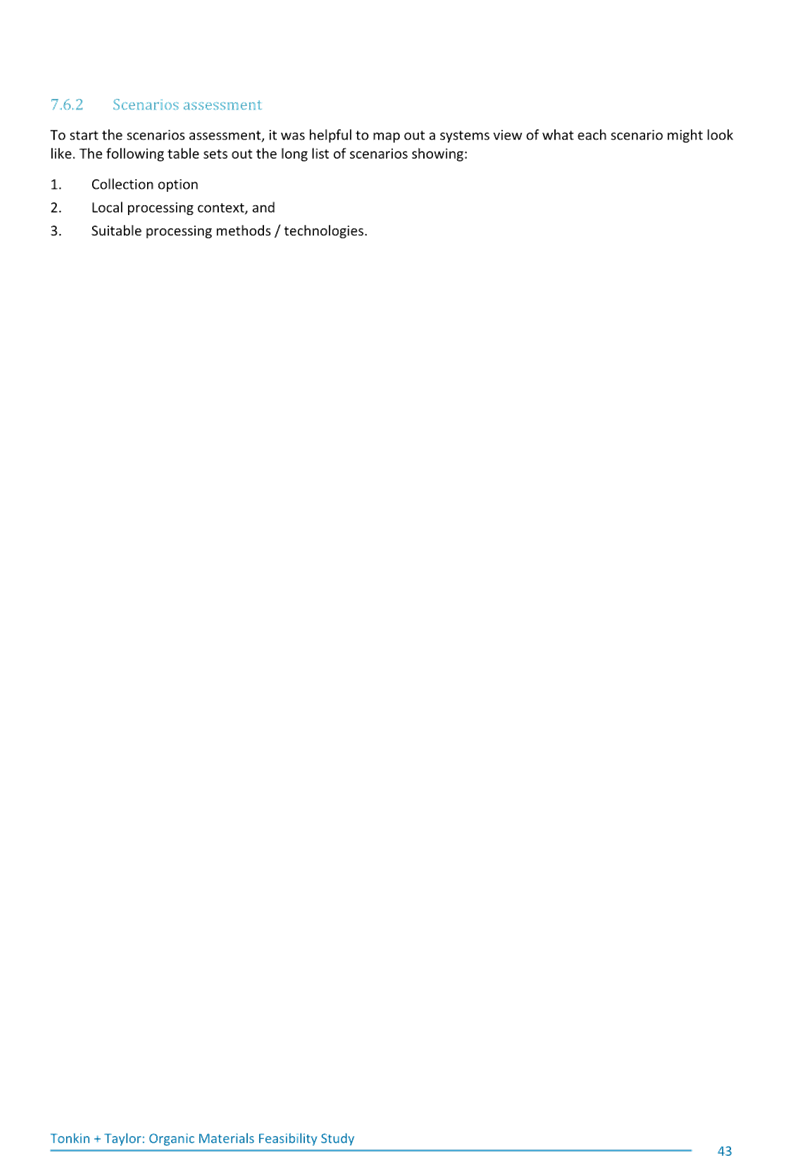
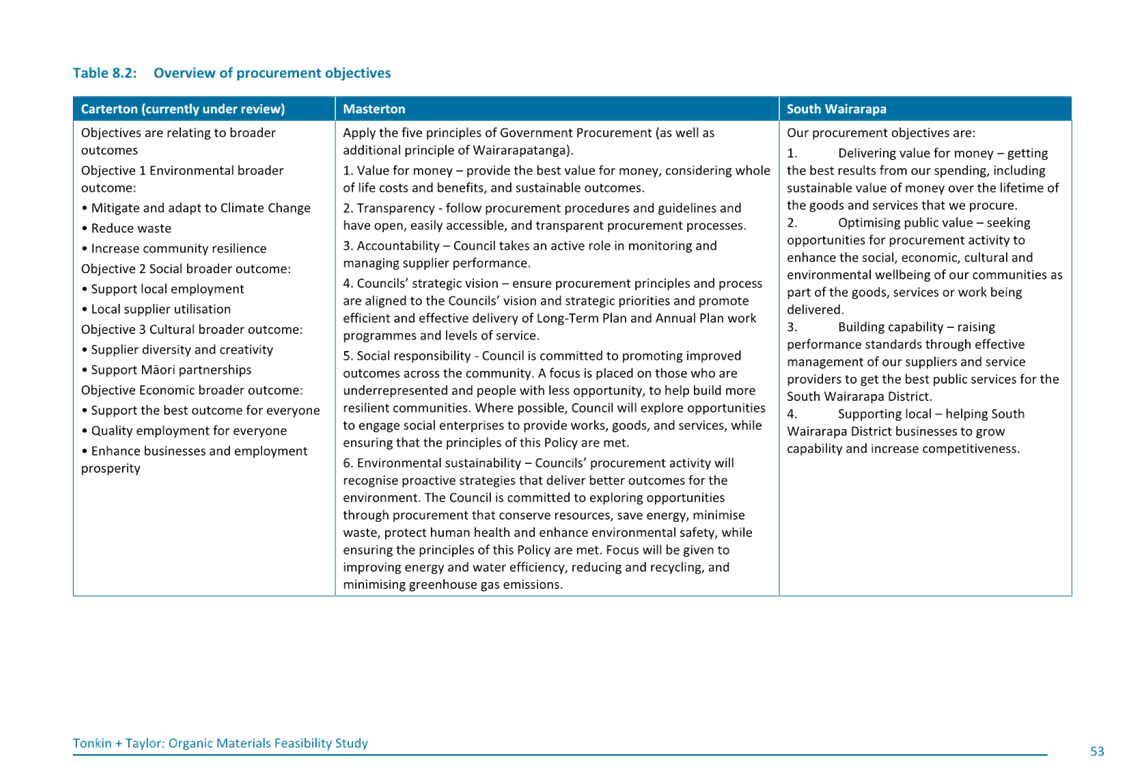
Strategic Overview: Organic Materials Feasibility Study
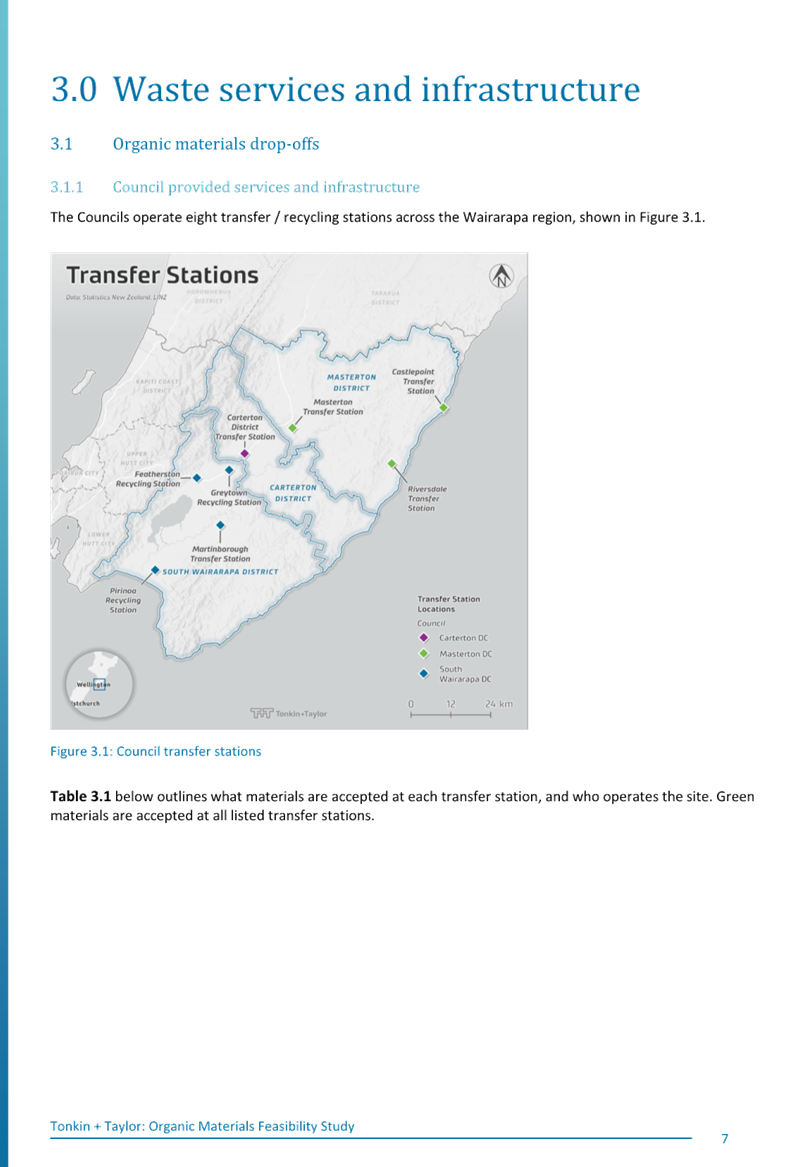
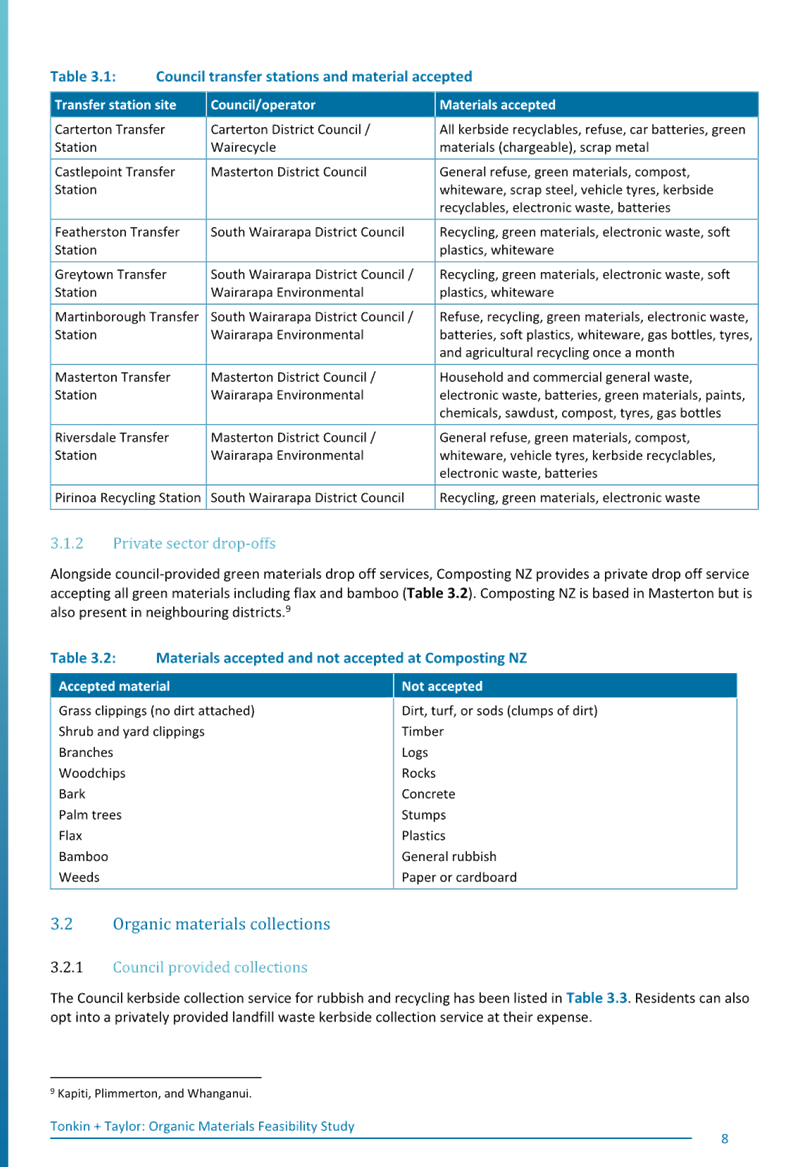
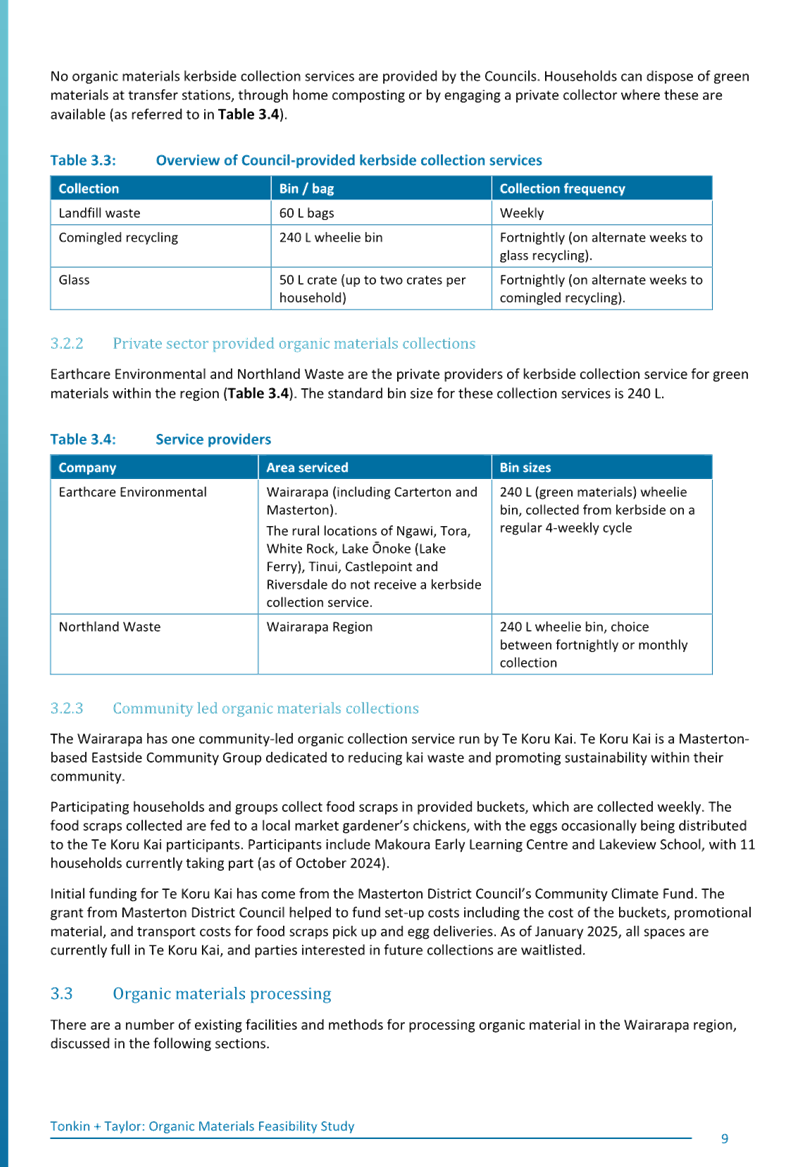
(Attachment provided)
This
feasibility study assessed the potential for introducing organic materials
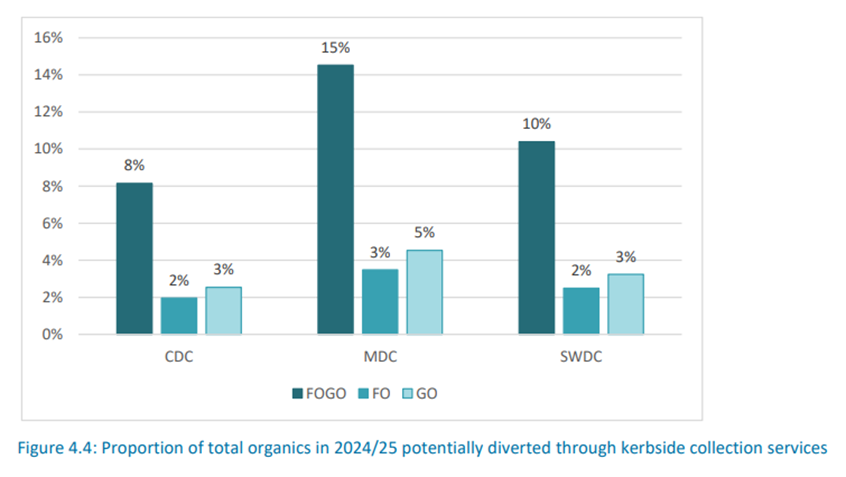
collection and processing services across the Wairarapa region. Organic waste,
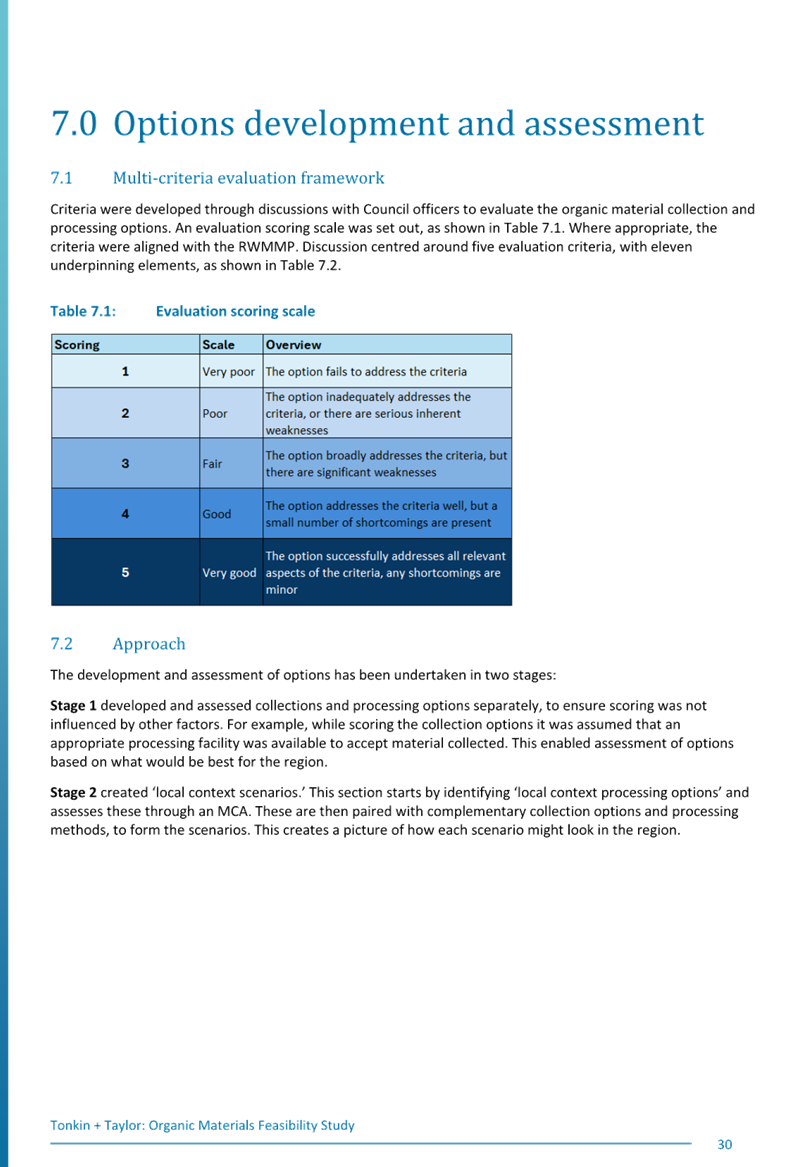
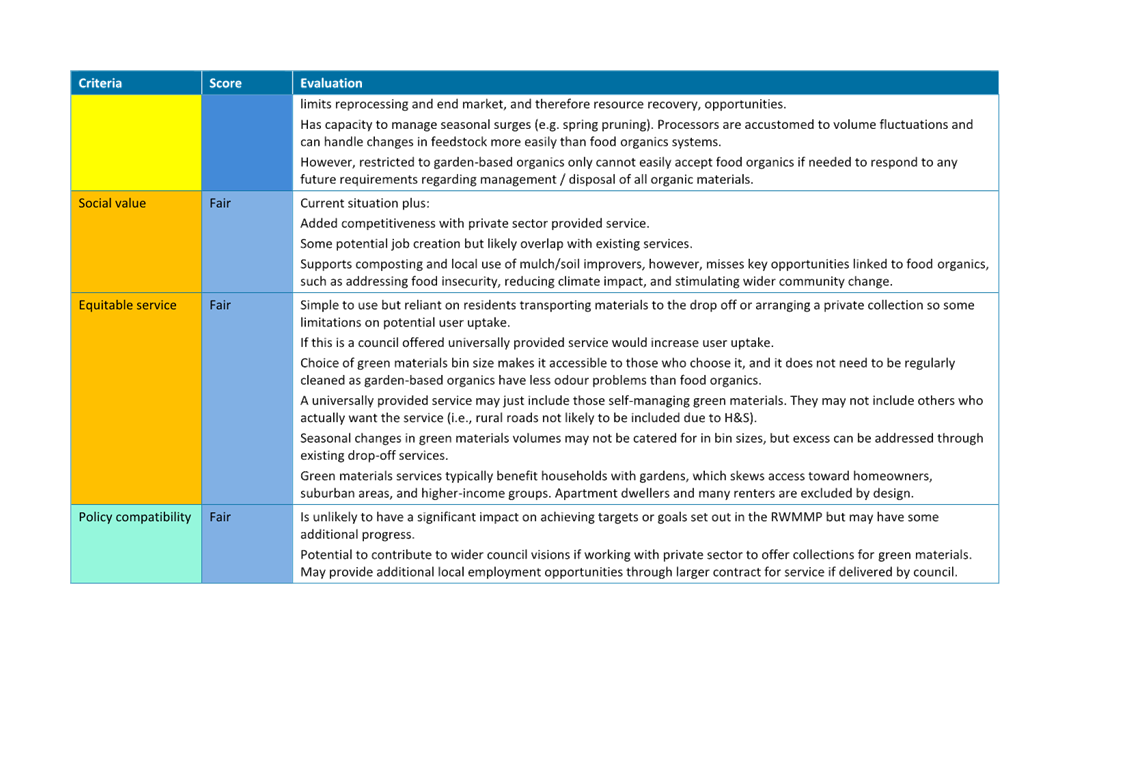
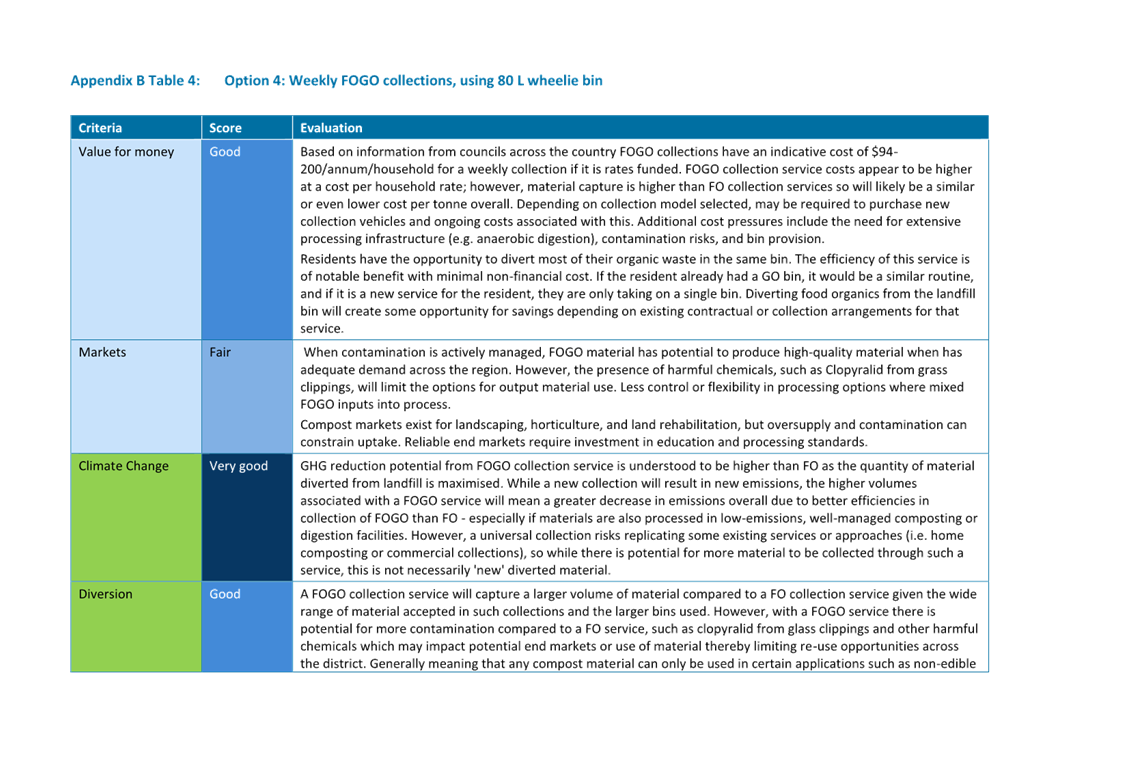
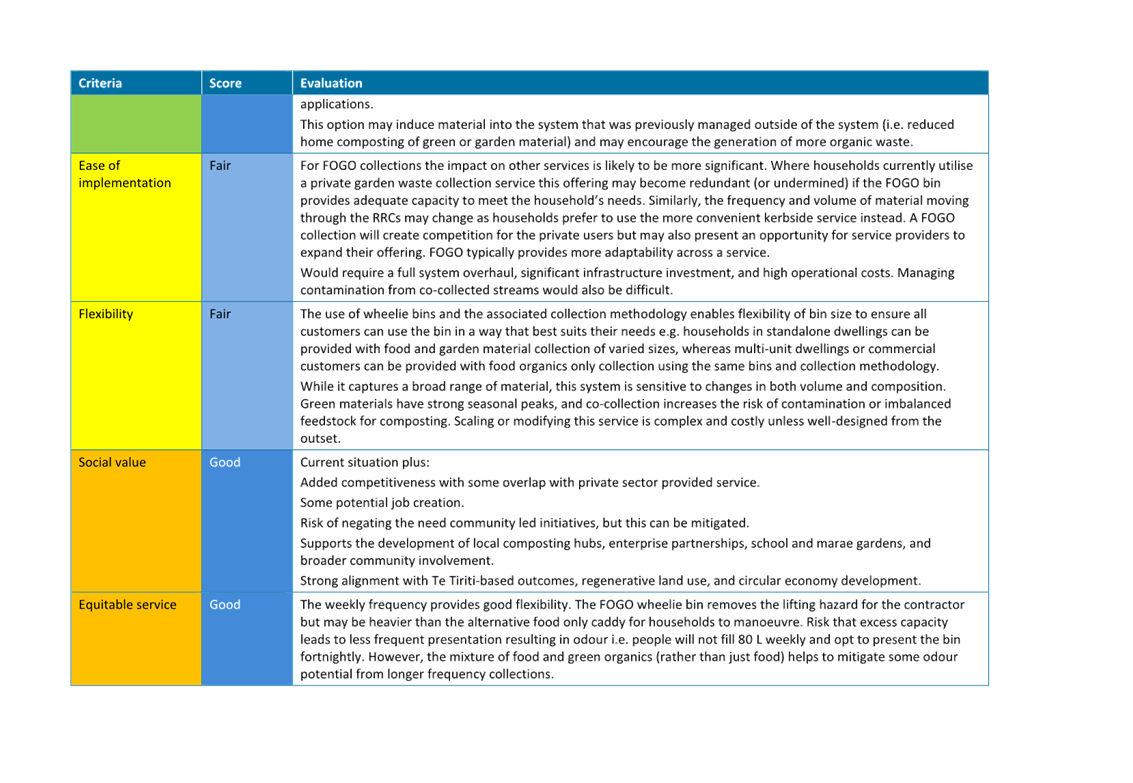
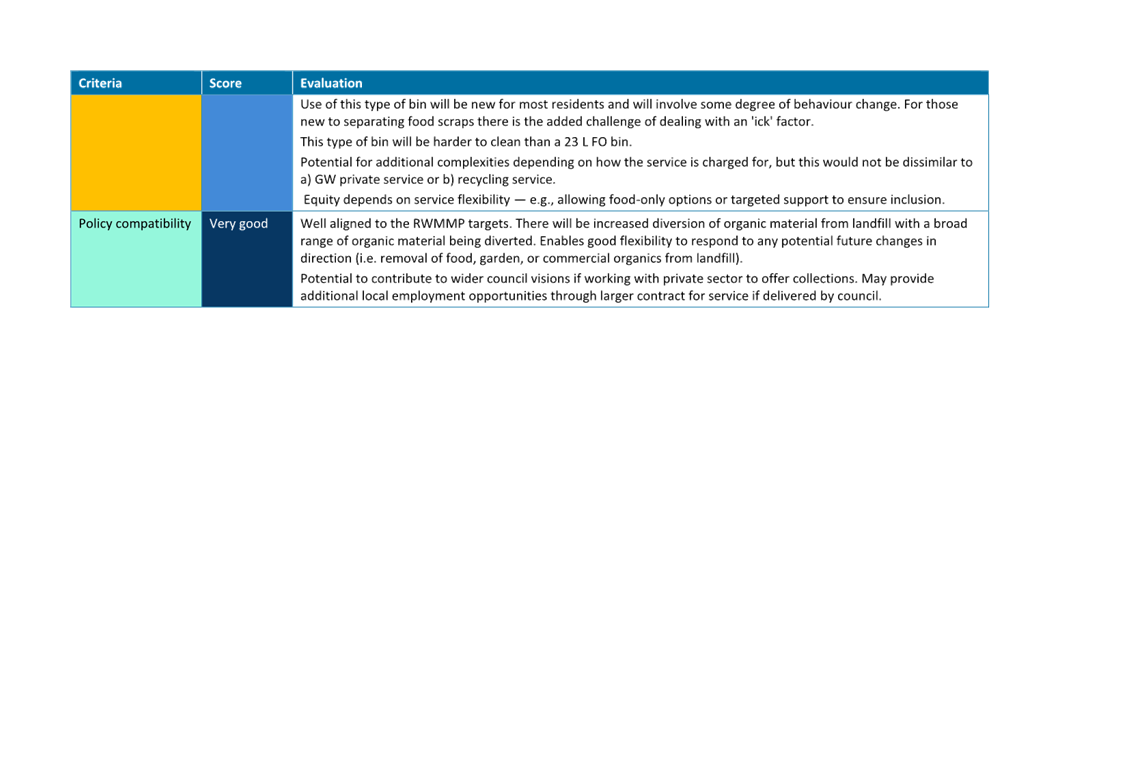
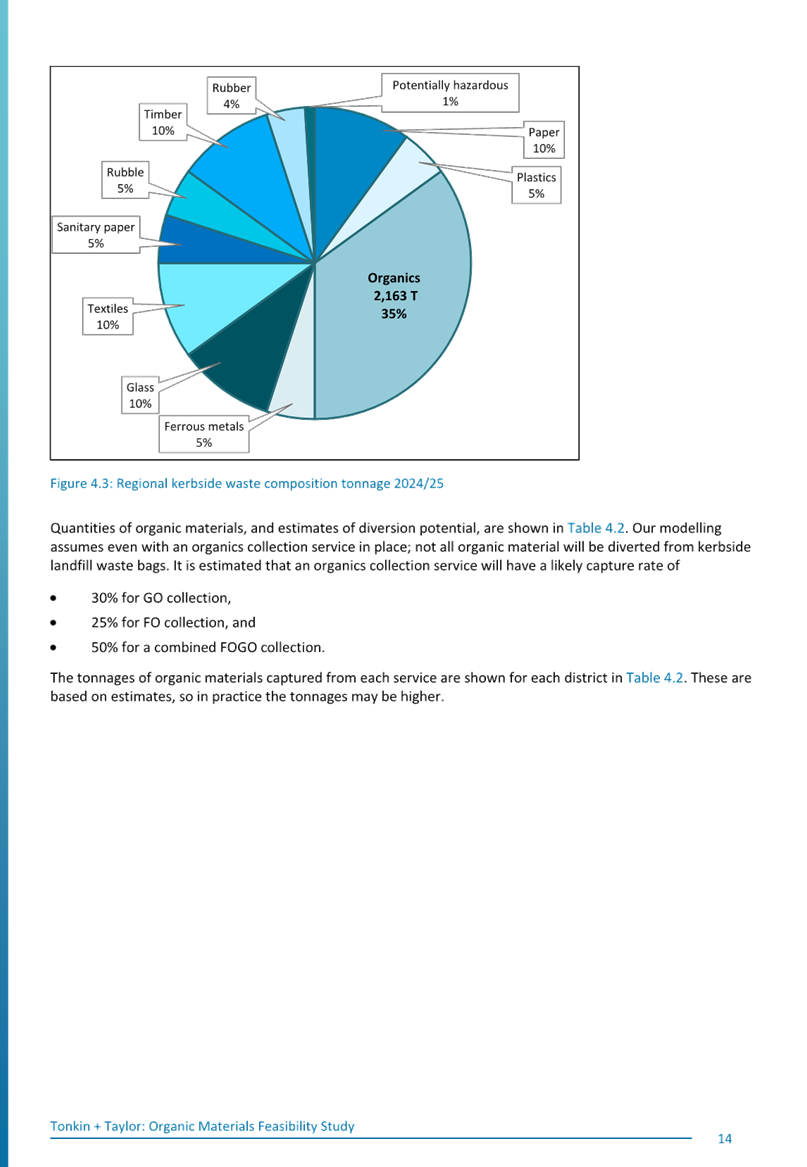
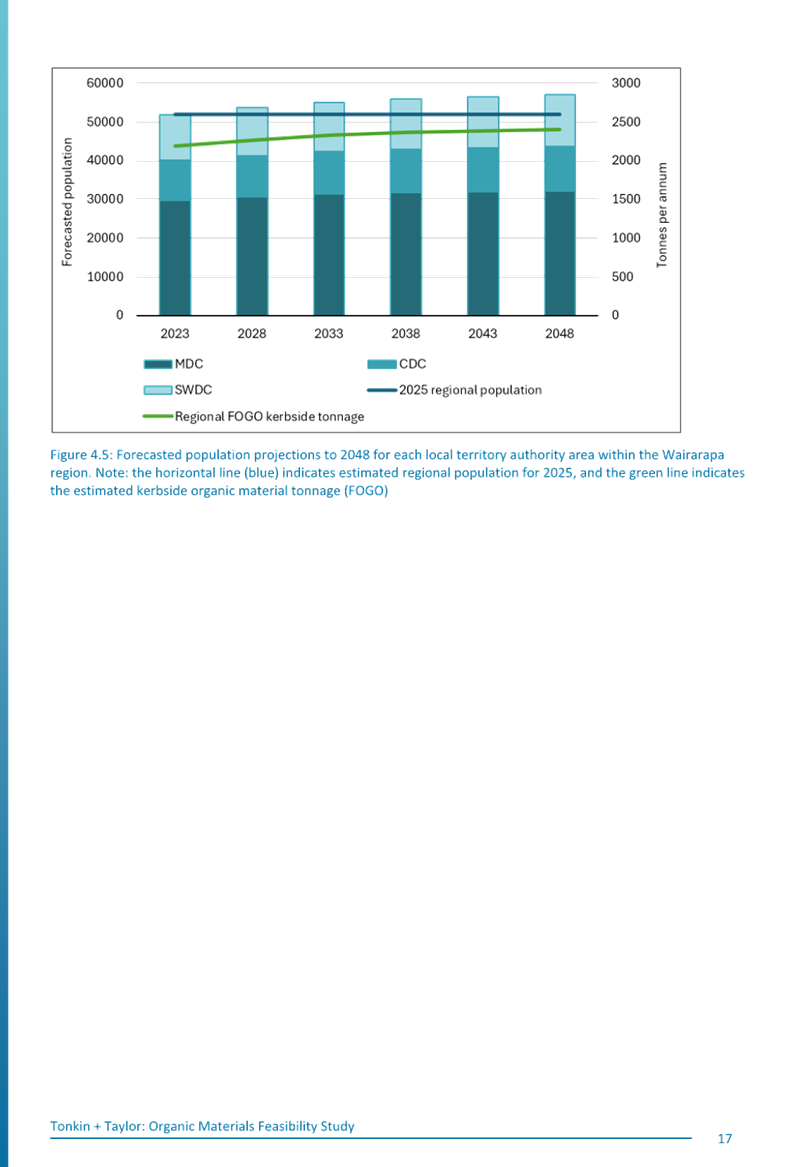
including food scraps and green waste, makes up an estimated 25% (7,700
tonnes annually) of the region’s kerbside and transfer station
waste—representing a significant opportunity for landfill diversion and
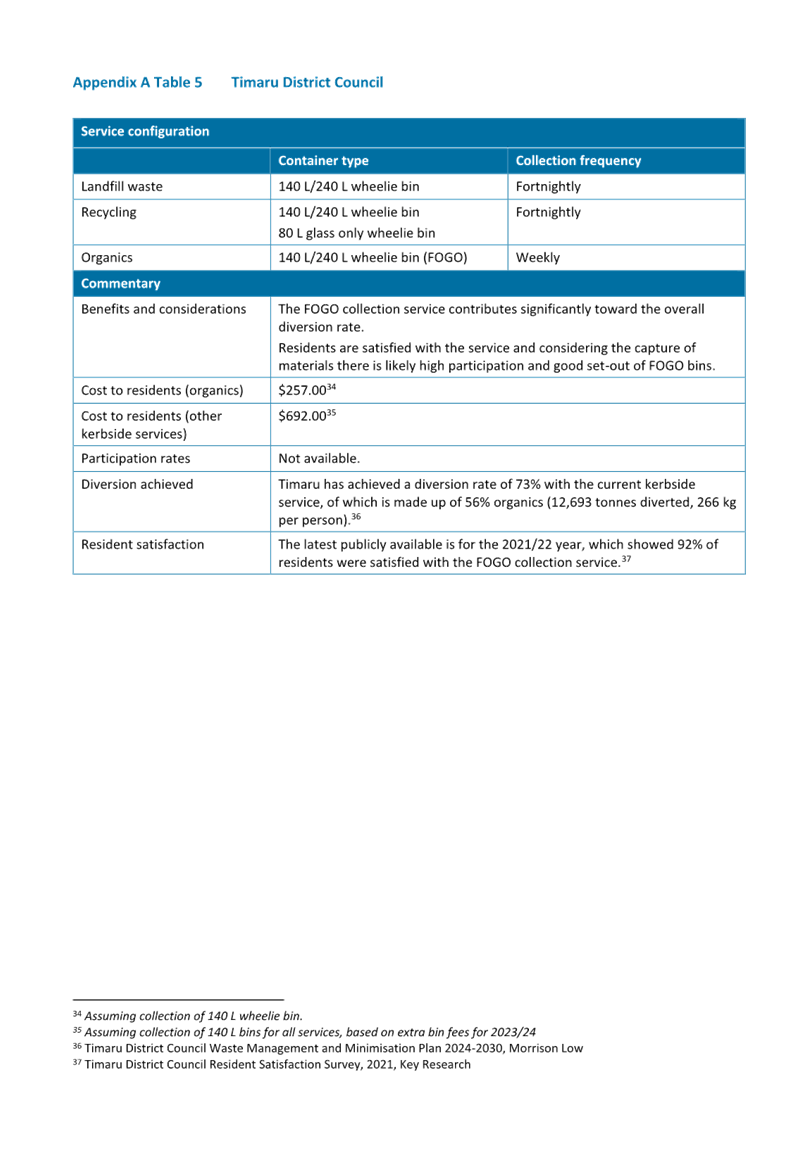
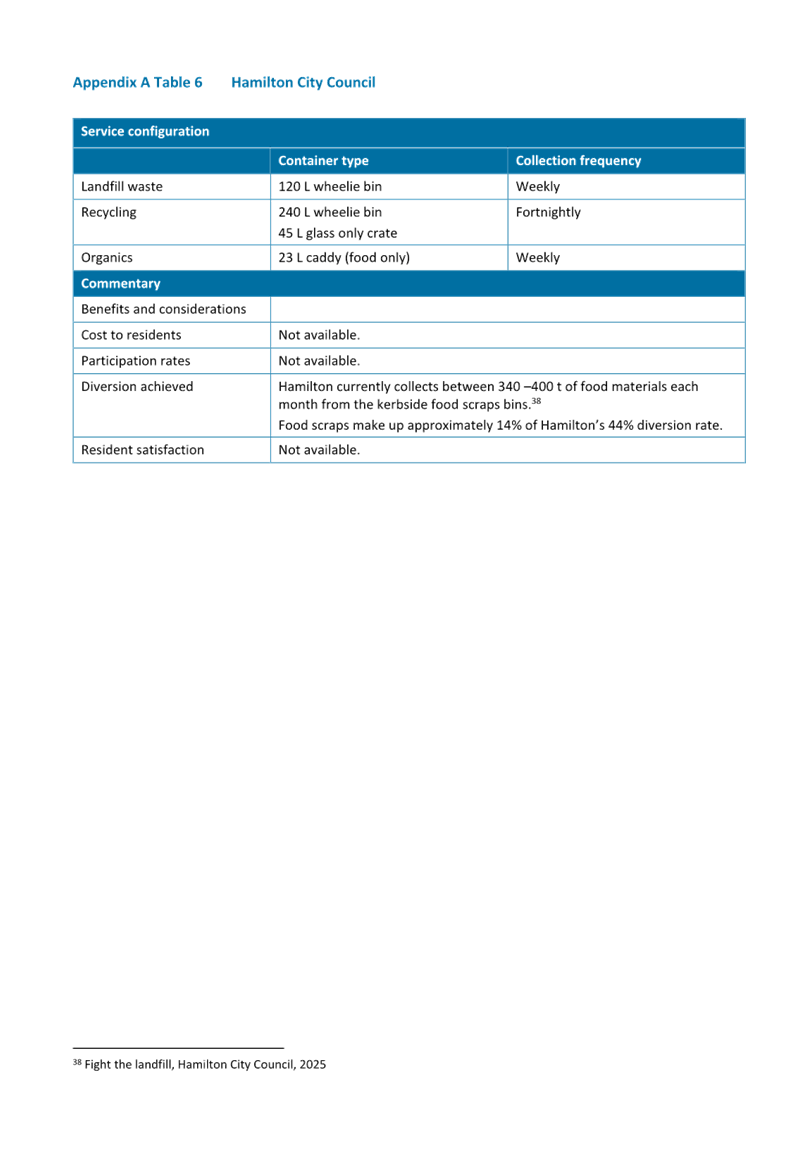
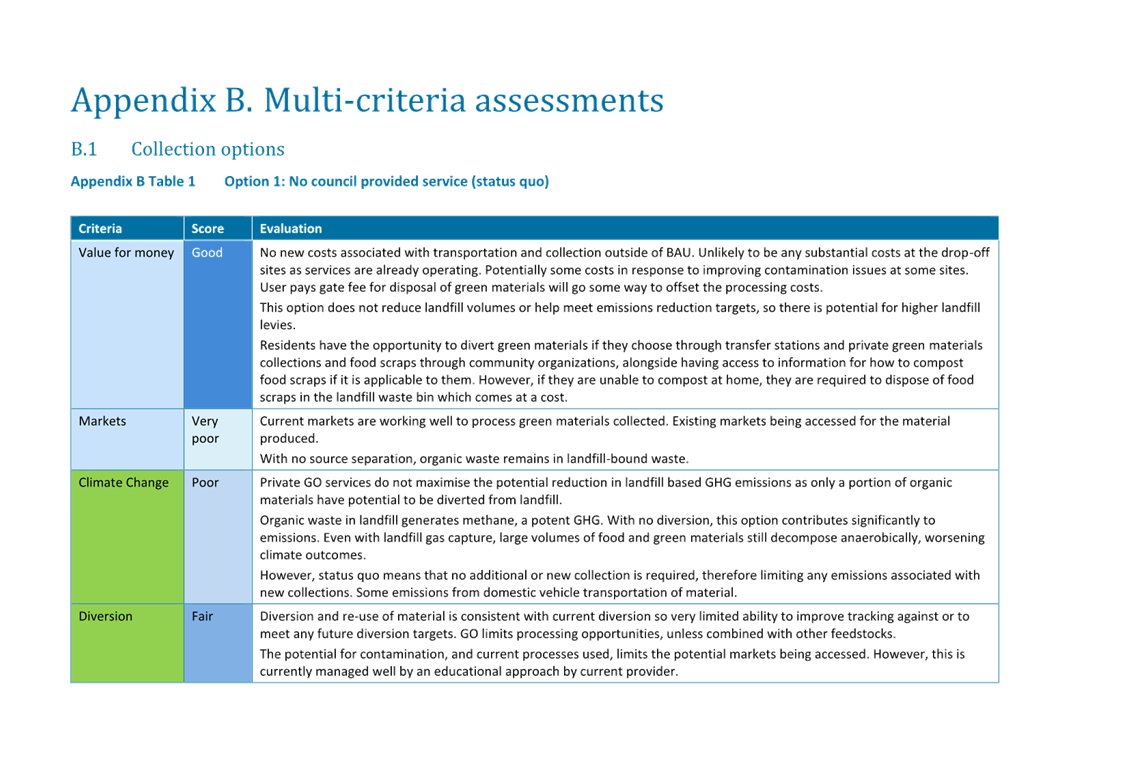
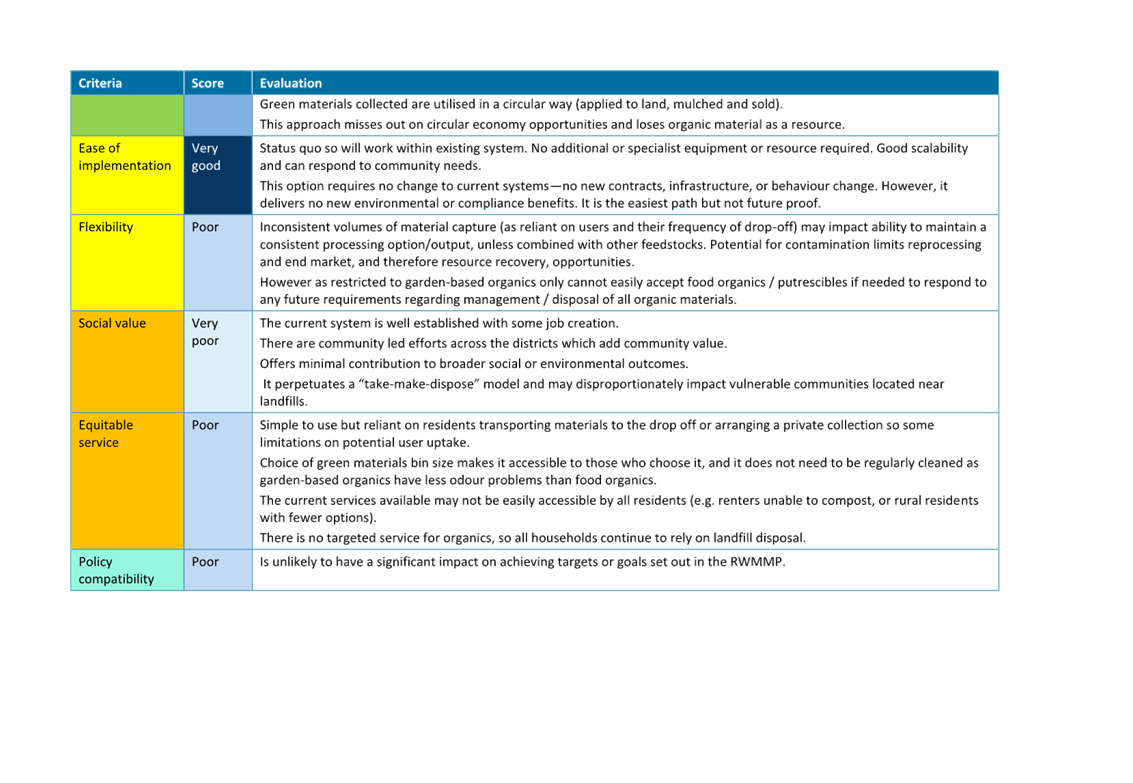
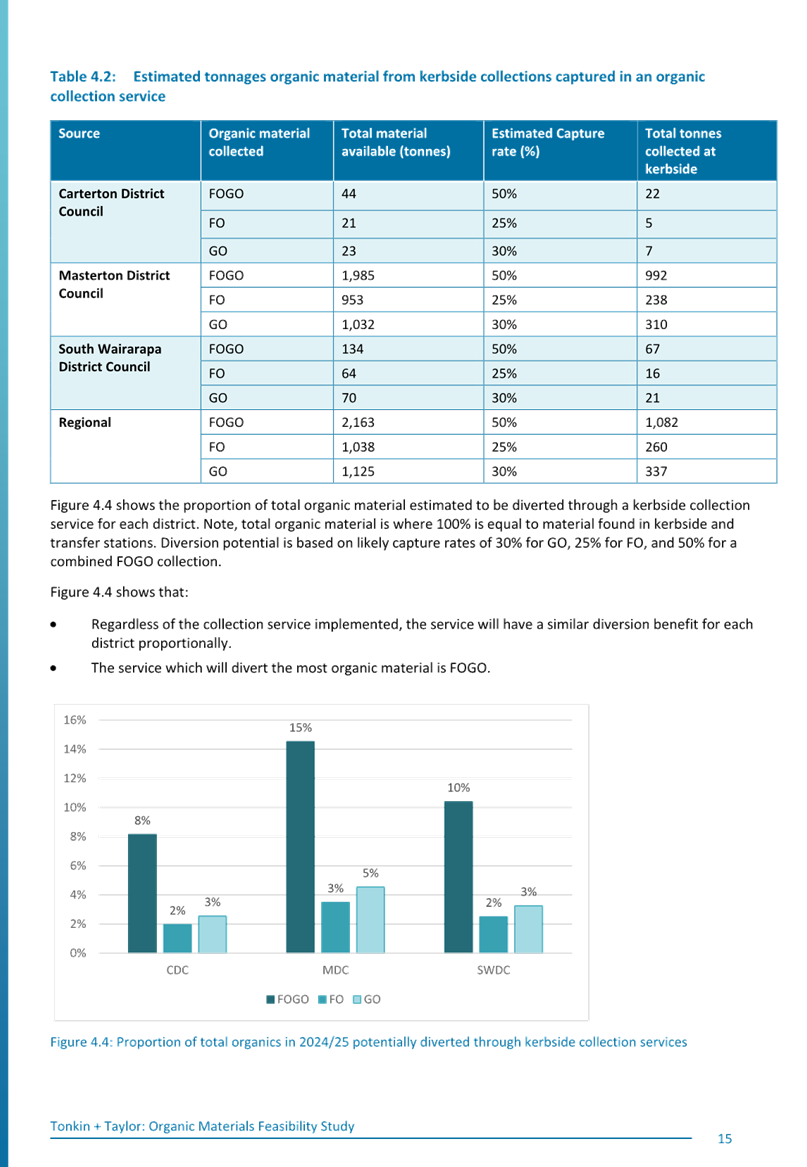
emissions reduction. Based on capture rates in Table 4.2 of the attachment,
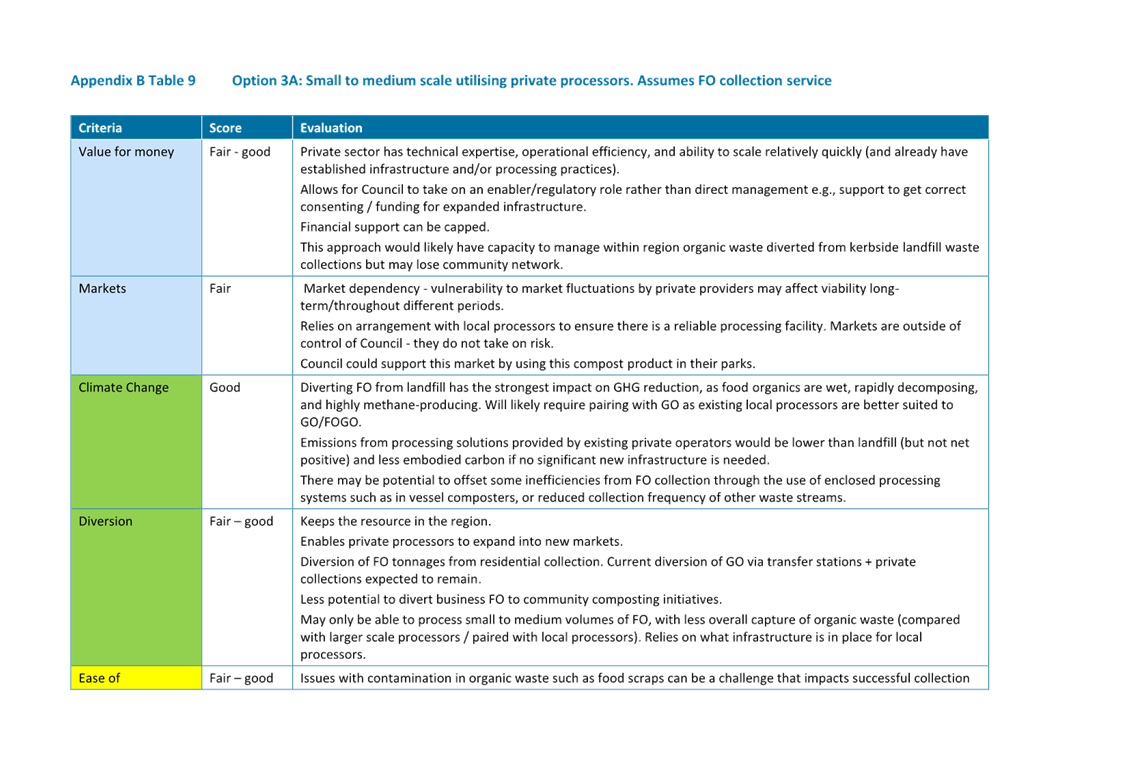
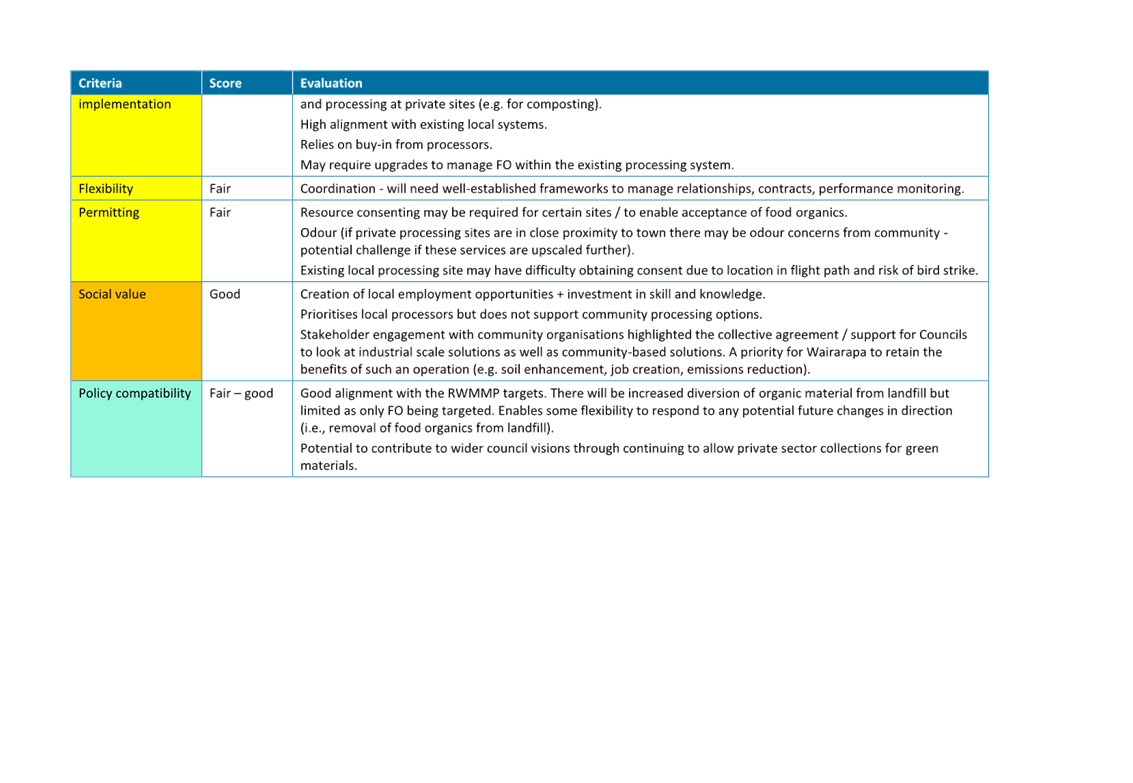
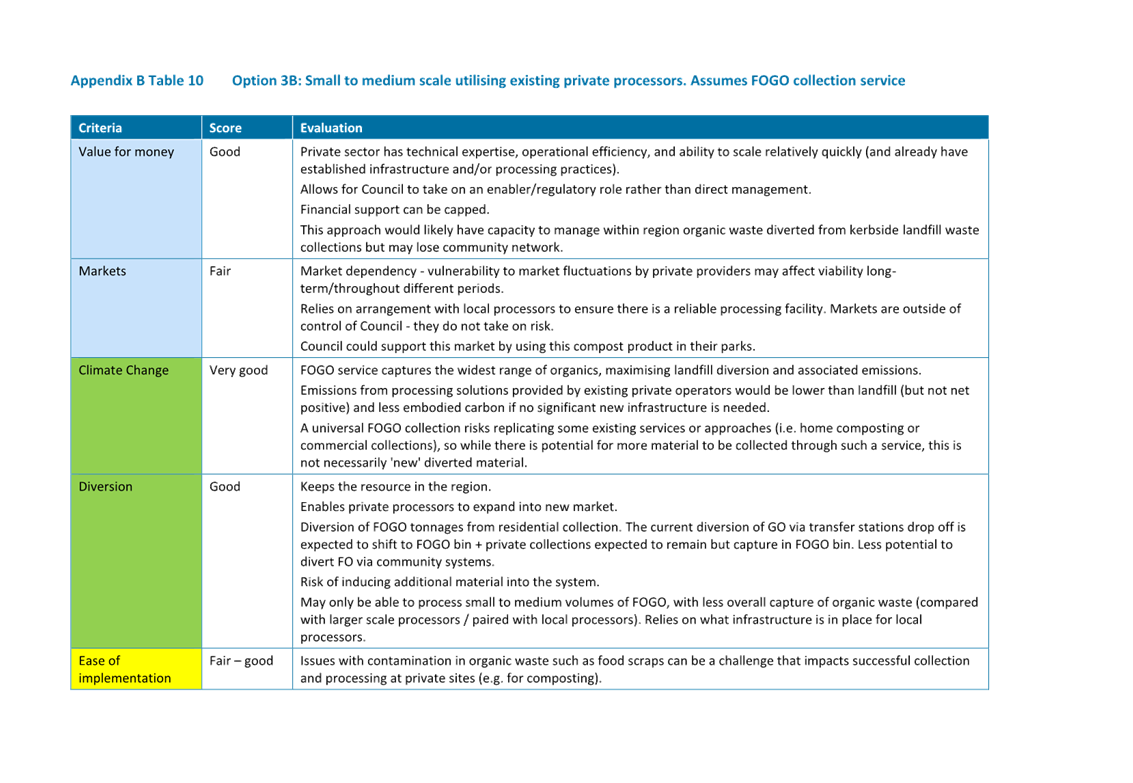
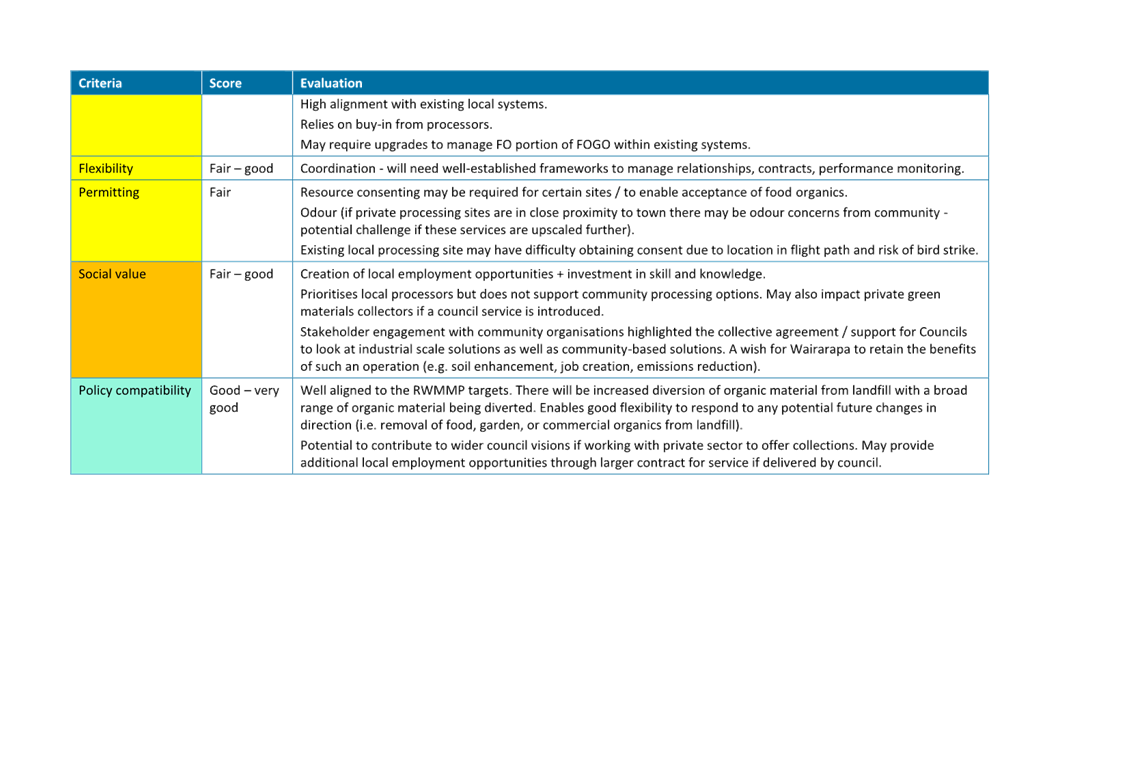
1,000 tonnes of FOGO PA is likely to be diverted from landfill in the Wairarapa;
this is in addition to the green waste already collected.
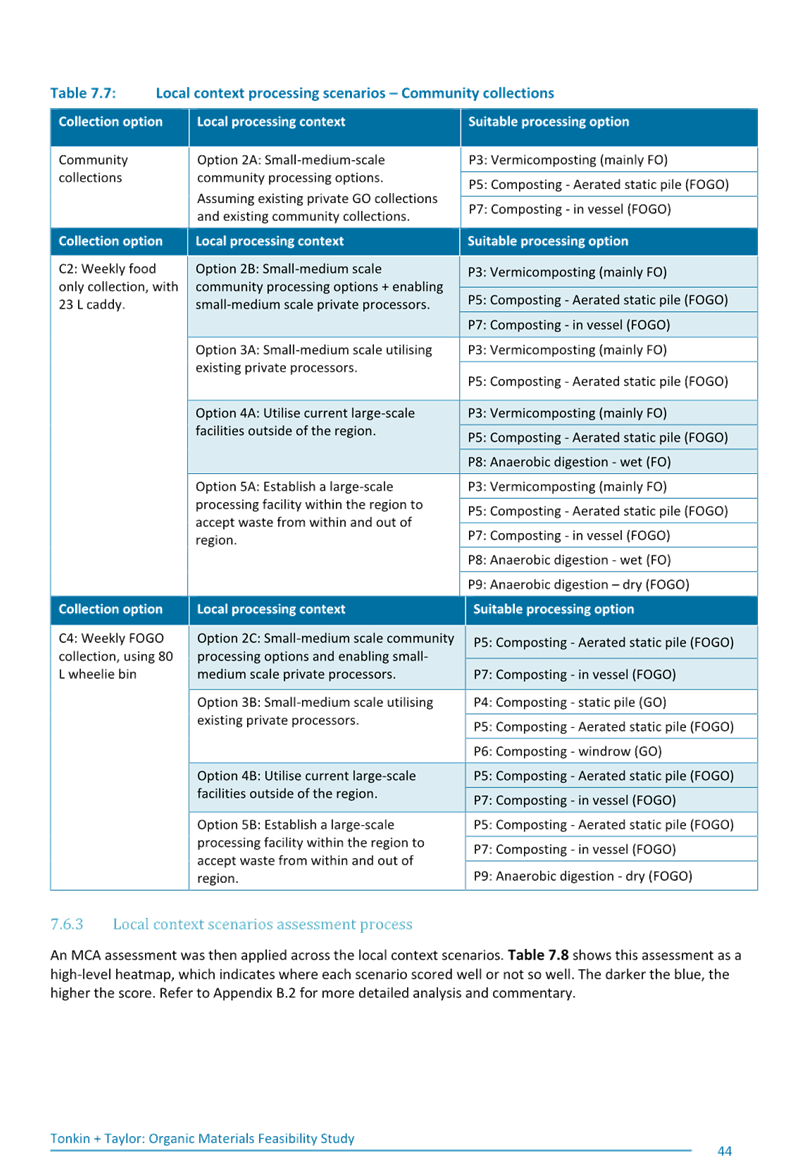
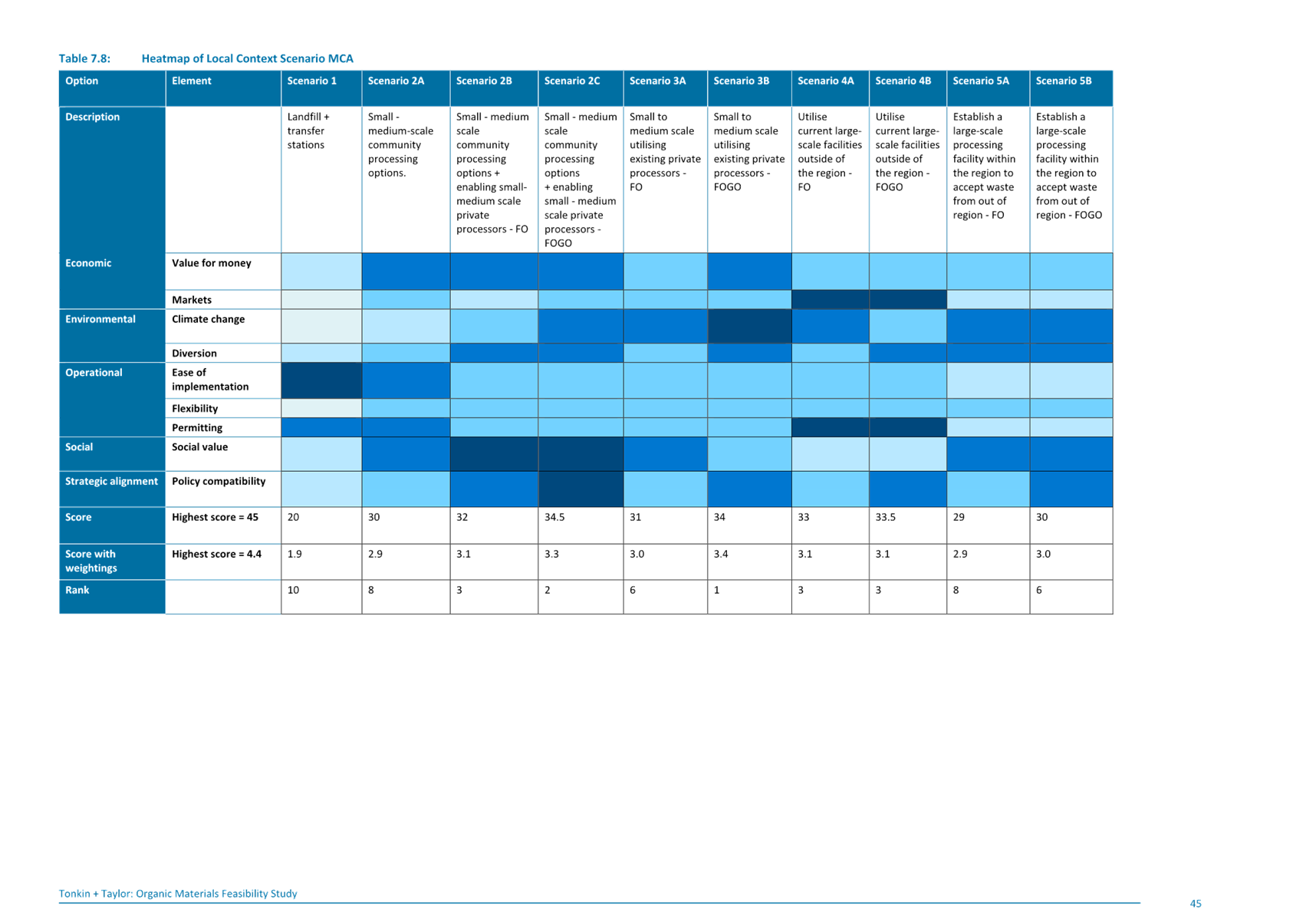
The
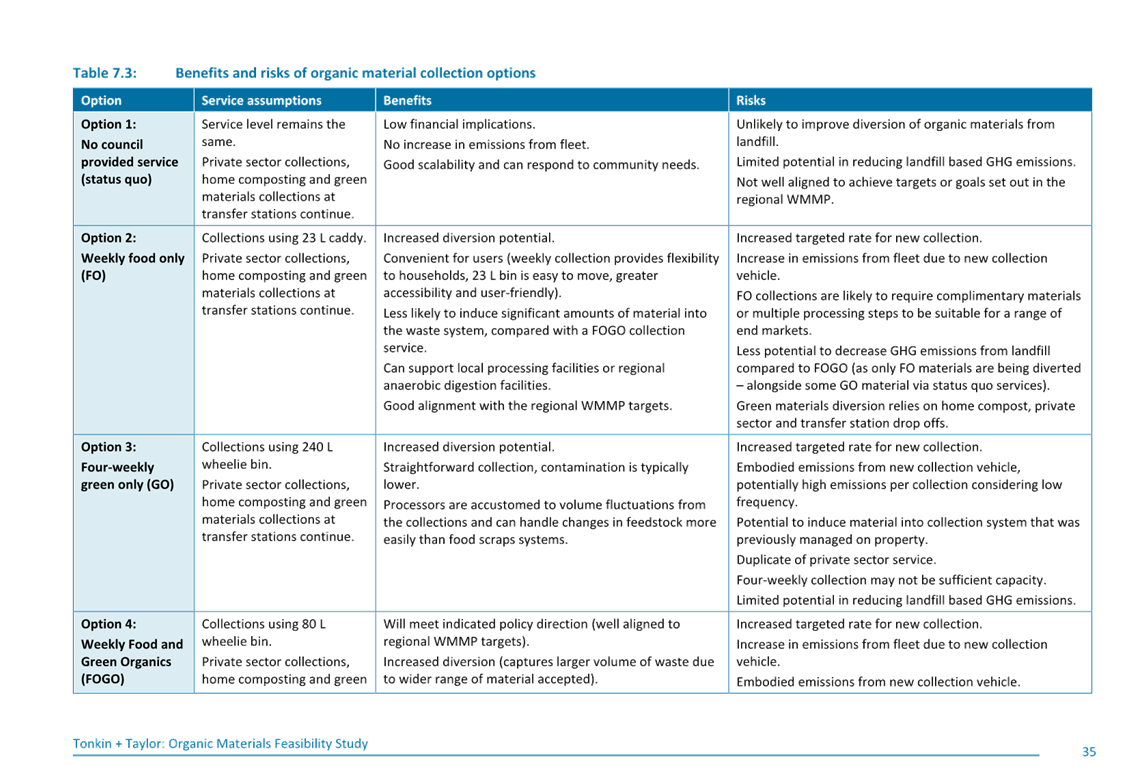
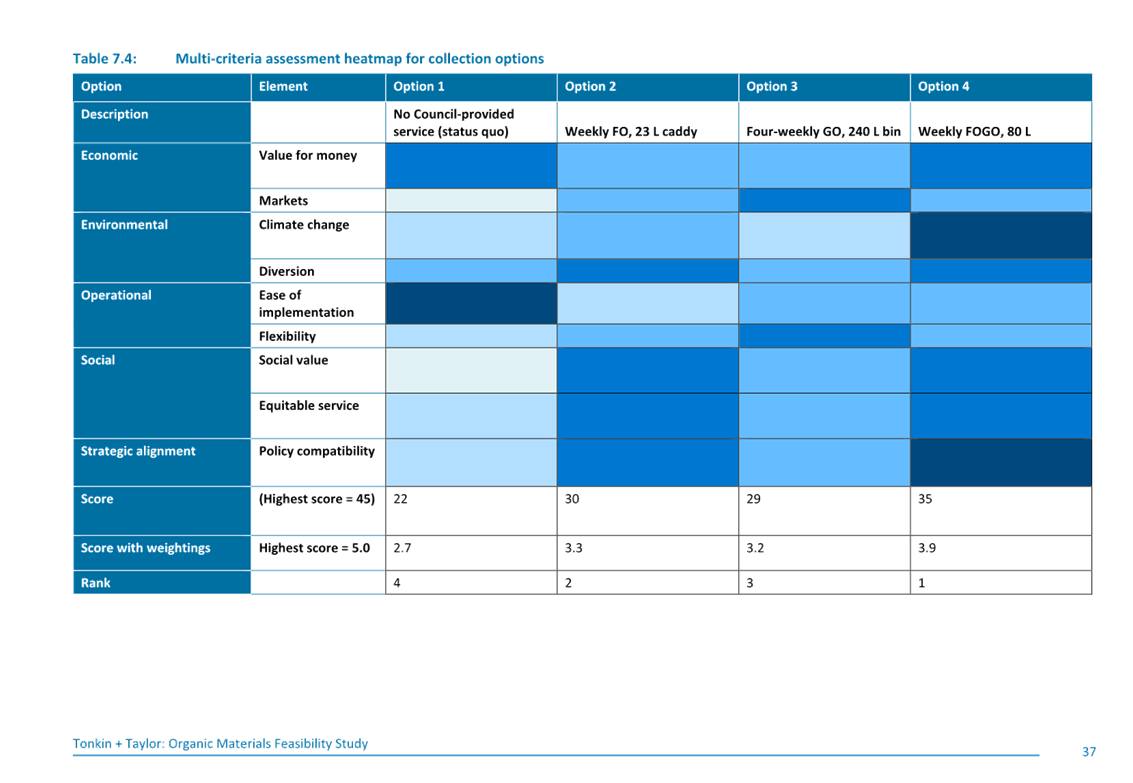
study evaluated multiple collection and processing options. A weekly
combined food and green waste collection (FOGO) emerged as the
preferred collection model, with weekly food-only (FO) as a
viable alternative. For processing, the most suitable options were:
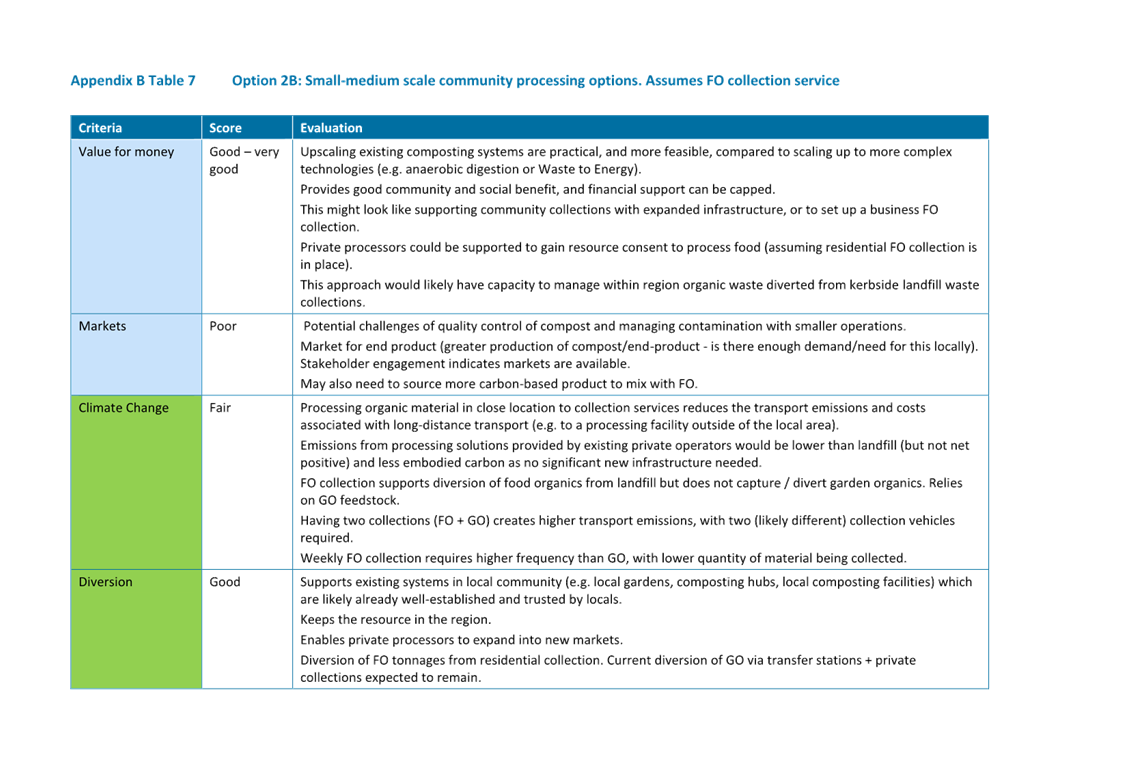
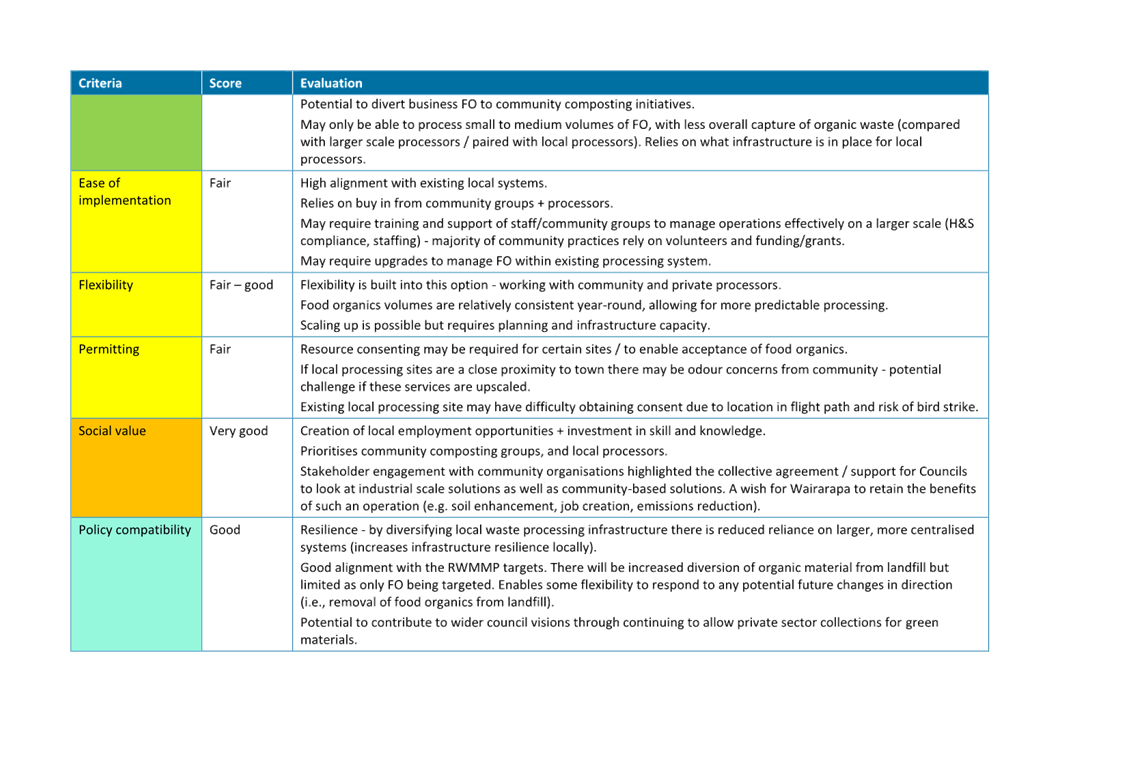
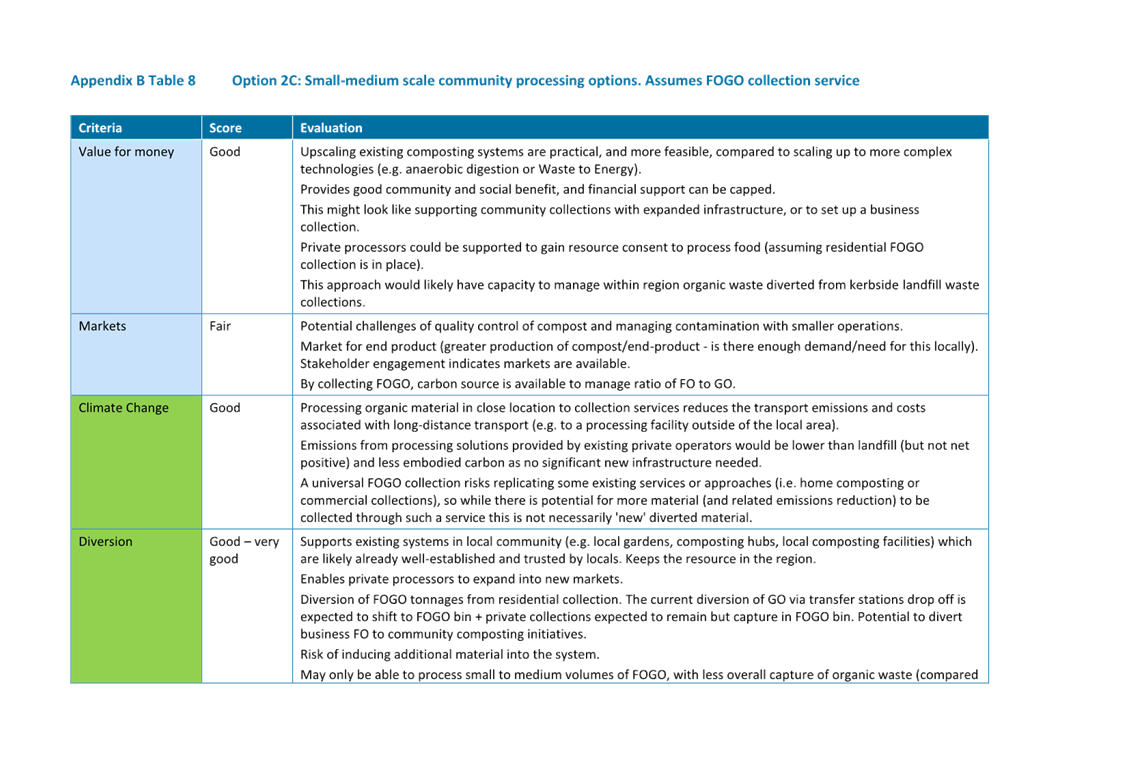
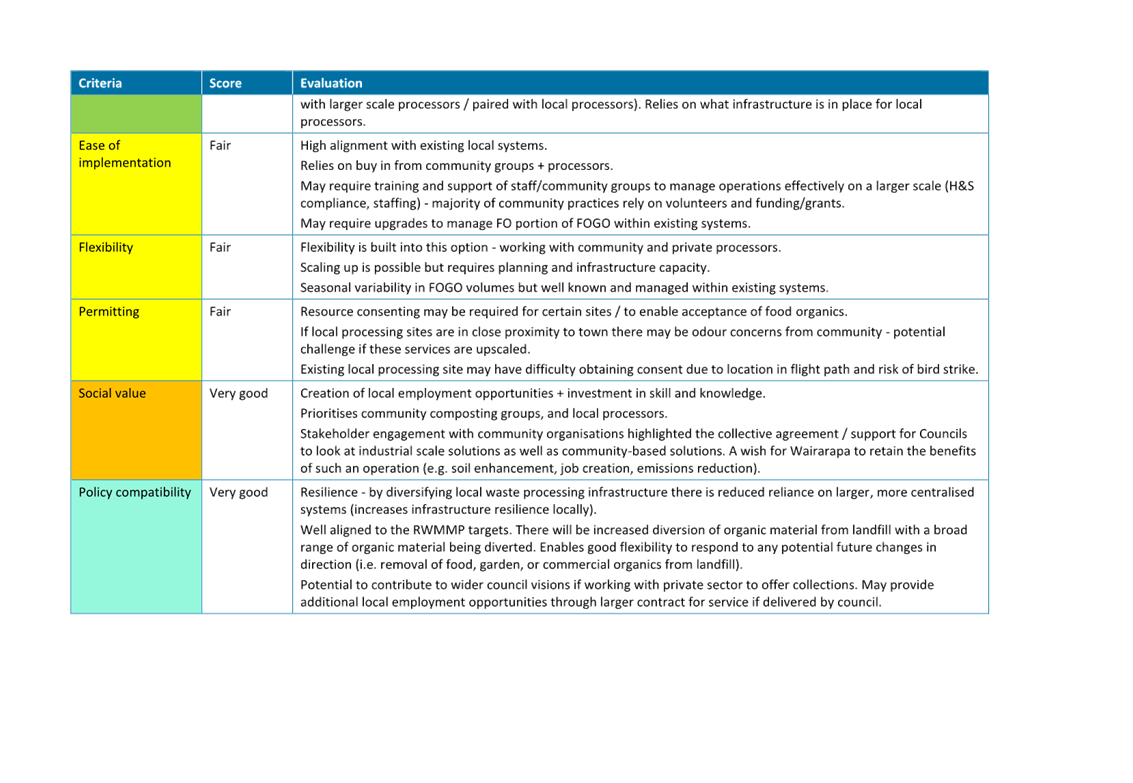
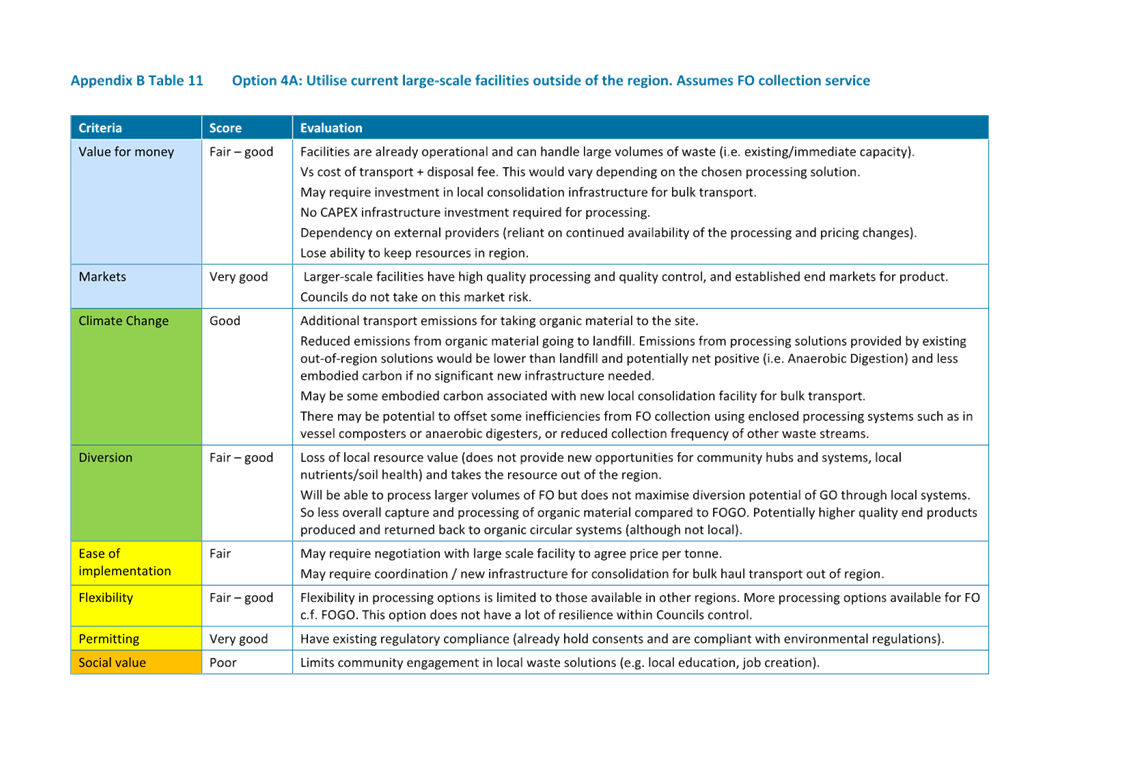
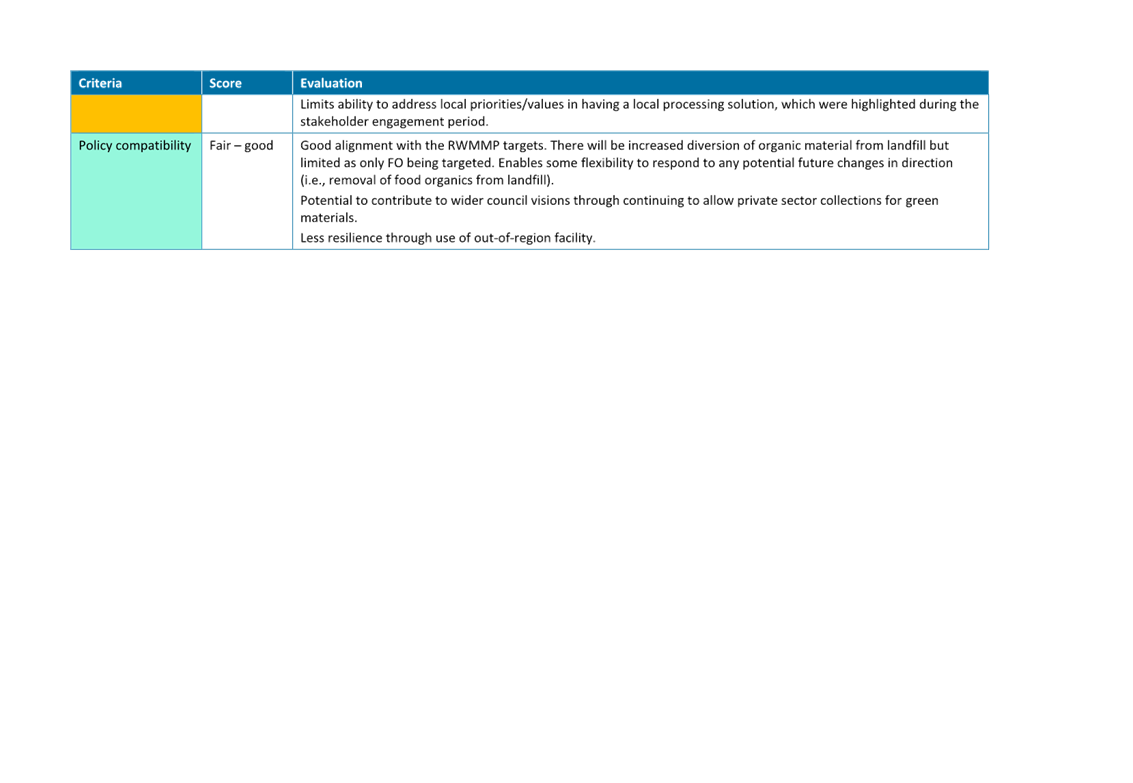
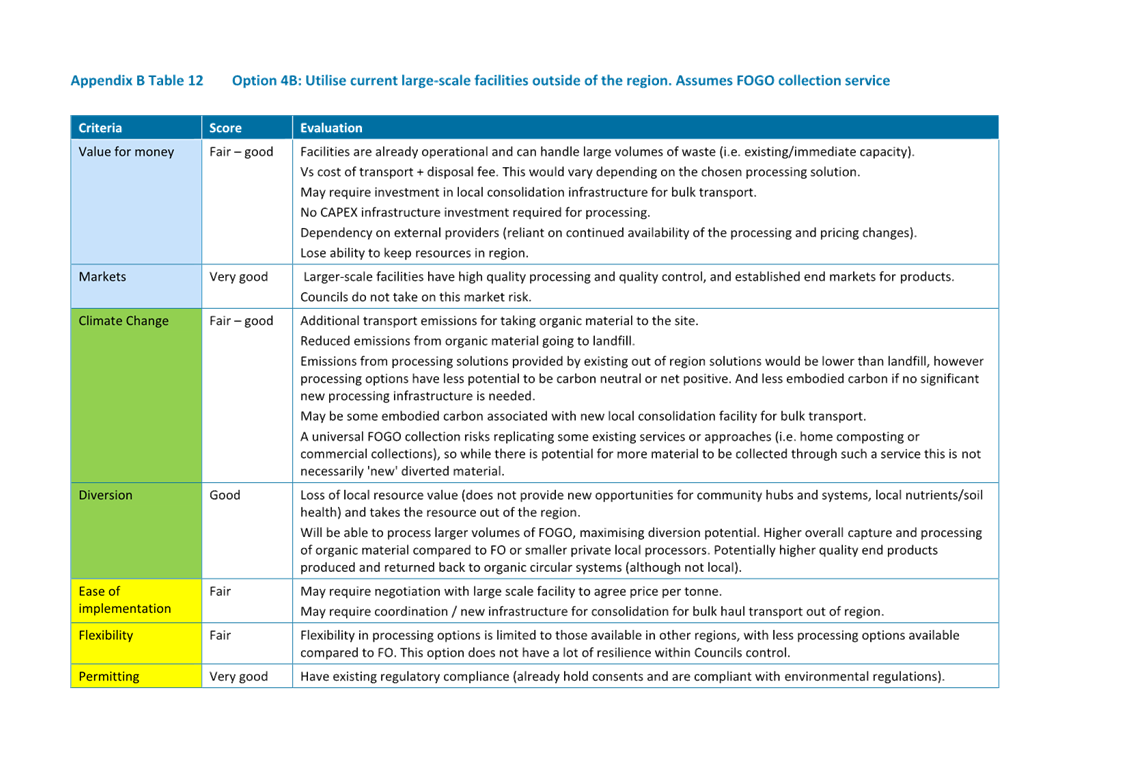
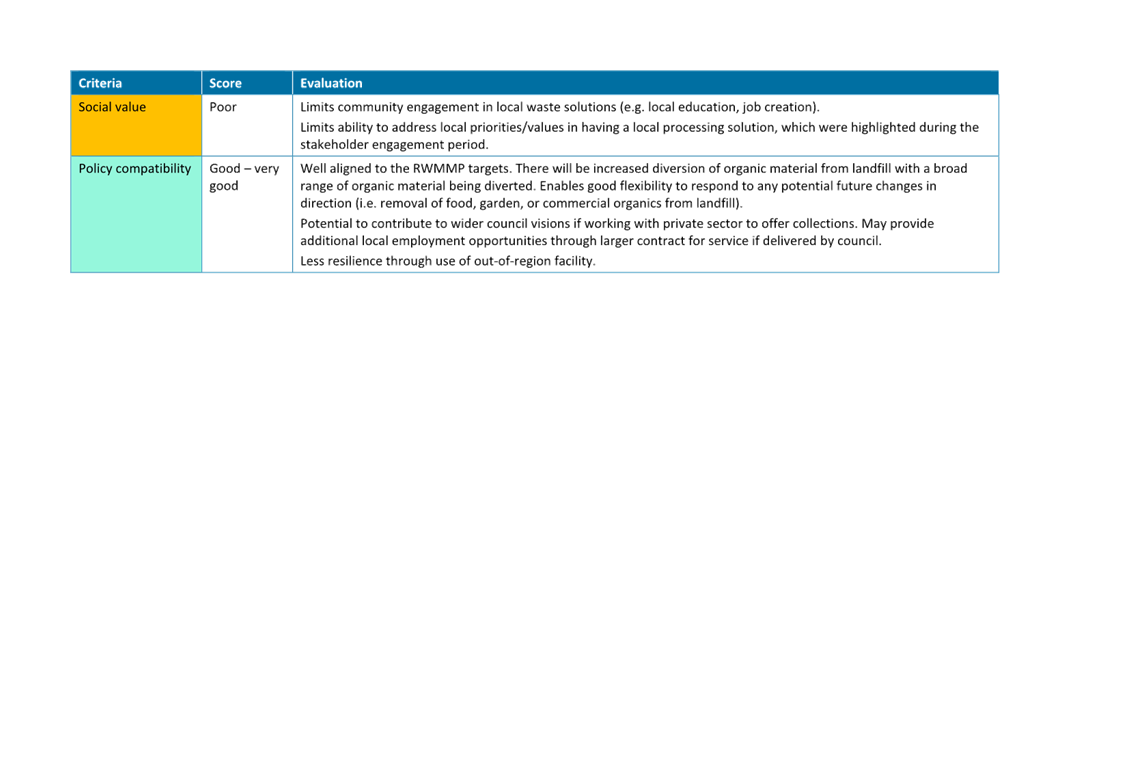
· Scenario 2C: Use
of existing private processors, with community group involvement where viable.
· Scenario 4A/4B:
Use of large-scale out-of-region processing facilities.
These options balance
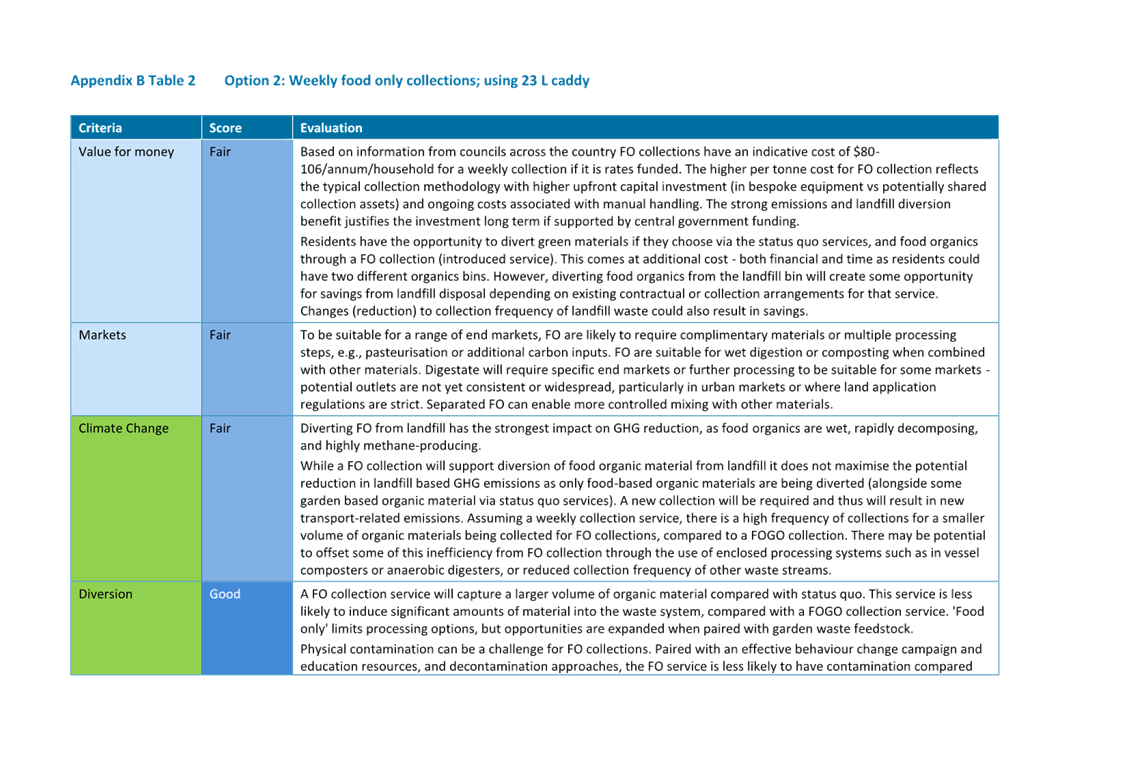
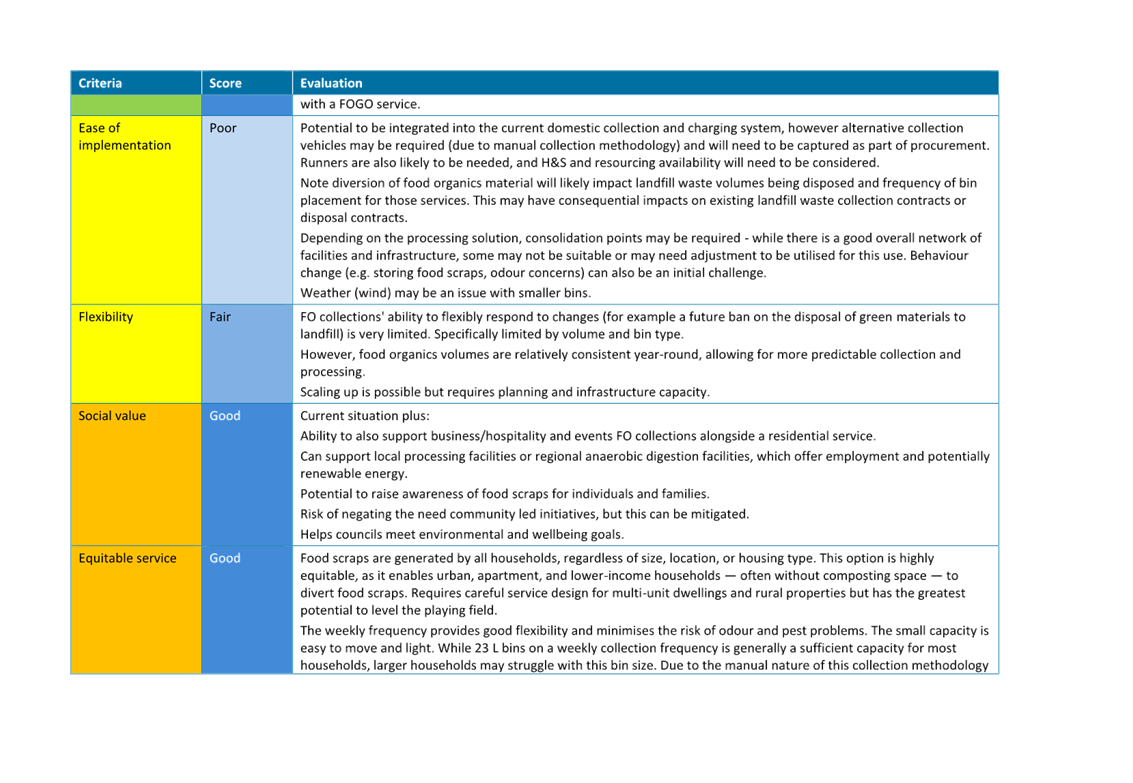
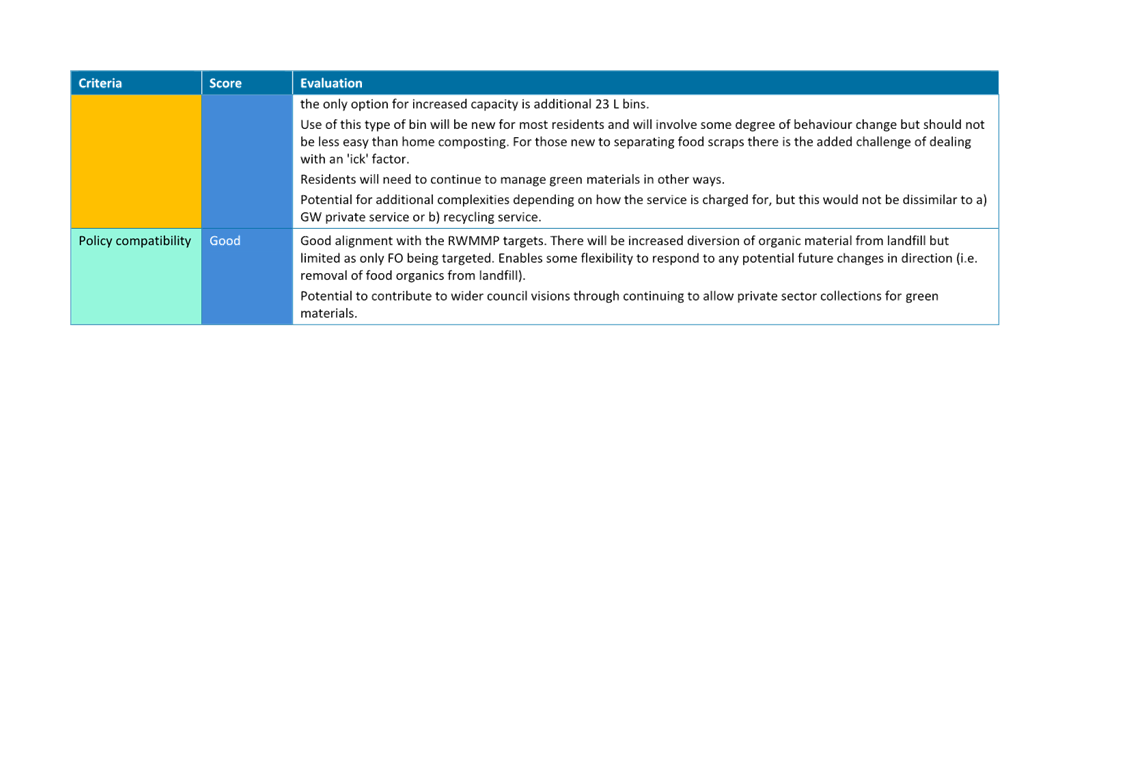
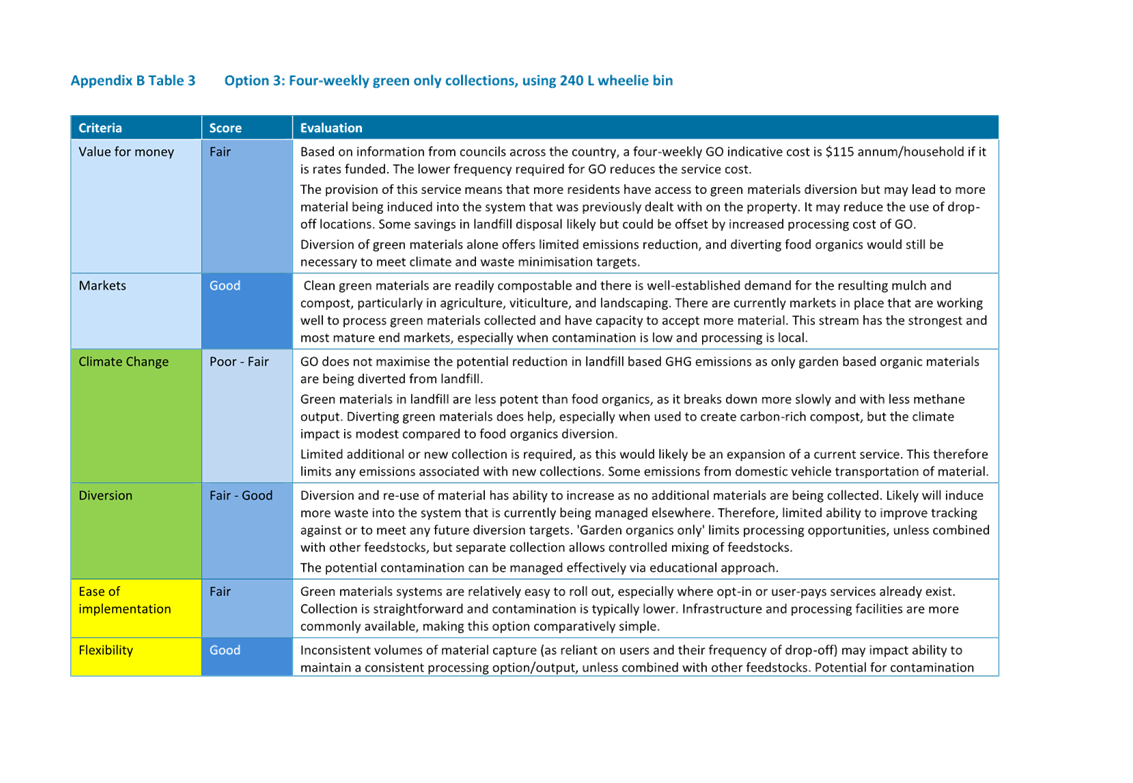
environmental impact, cost-effectiveness, and practical implementation
|
Service
Requests
|
Request
Details
|
Output
|
Date
|
|
25001001
|
6 Georgina Beyer Way: Recycle bin for
new built
|
Bin delivered
|
04/06/2025
|
|
25001003
|
22 Hereford Dr: Recycle bin for new
built
|
Bin delivered
|
05/06/2025
|
|
25001004
|
14 Hereford Dr: Recycle bin for new
built
|
Bin delivered
|
05/06/2025
|
|
25001005
|
20 Hereford Dr: Recycle bin for new
built
|
Bin delivered
|
05/06/2025
|
|
25001012
|
4 Hereford Dr: Bin wheels damaged
|
Repaired by Smart Env
|
05/06/2025
|
|
25001038
|
86 Victoria St: Bin lid damaged
|
Repaired by Smart Env
|
10/06/2025
|
|
25001076
|
9E + 9F Victoria St: Recycle bin for
new built
|
Bin delivered
|
16/06/2025
|
|
25001080
|
15 Hilton Rd: Recycle bin lid damaged
|
Repaired by Smart Env
|
16/06/2025
|
|
25001098
|
9 Tararua Cr: Recycle bin for new
built
|
Bin delivered
|
23/06/2025
|
|
25001107
|
6 Georgina Beyer: Rubbish not
collected
|
Collected later by Smart Env
|
24/06/2025
|
|
25001135
|
4 Georgina Beyer: Recycle bin for new
built
|
Bin delivered
|
27/06/2025
|
|
25001143
|
27 Kenwyn Dr: Wheelie bin wheel
damaged
|
Repaired by Smart Env
|
30/06/2025
|
|
25001195
|
27 Kenwyn Dr: Yellow bin repair
request
|
Bin wheel repaired
|
03/07/2025
|
|
25001238
|
6B Tait Pl: Yellow bin repair request
|
Bin wheel repaired
|
10/07/2025
|
|
25001271
|
469A High ST South: Yellow bin repair
request
|
Bin wheel repaired
|
15/07/2025
|
|
25001297
|
140 Belvedere Rd: Stolen yellow bin
|
Bin replaced with new one
|
18/07/2025
|
|
|
|
5. Next
Steps
The following actions are still to
be undertaken:
· Tracking waste and
data collection from Smart Environmental as per the new rules from the Online
Waste Levy System (OWLS).
· Carterton is
pairing up with KEEP NEW ZEALAND BEAUTIFUL group to promote Clean-up Week in
September 19-25 September 2025.
· Waste-ED with
Kate: 2025 Business waste education breakfast at Carterton Courthouse on 18
September, a CDC and SWDC joint session for making Wairarapa businesses
sustainable.
· Working with the
Carterton Communications Team for recycling week in October 2025.
· Waste minimisation
planning across Carterton for Daffodil Day 2025.
· Include organic
waste services as a provisional item in the upcoming waste service procurement
process.
· Engage in the
market for organics service and present findings to the councils in early 2026.
· Monitoring and
reducing illegal litter dumping.
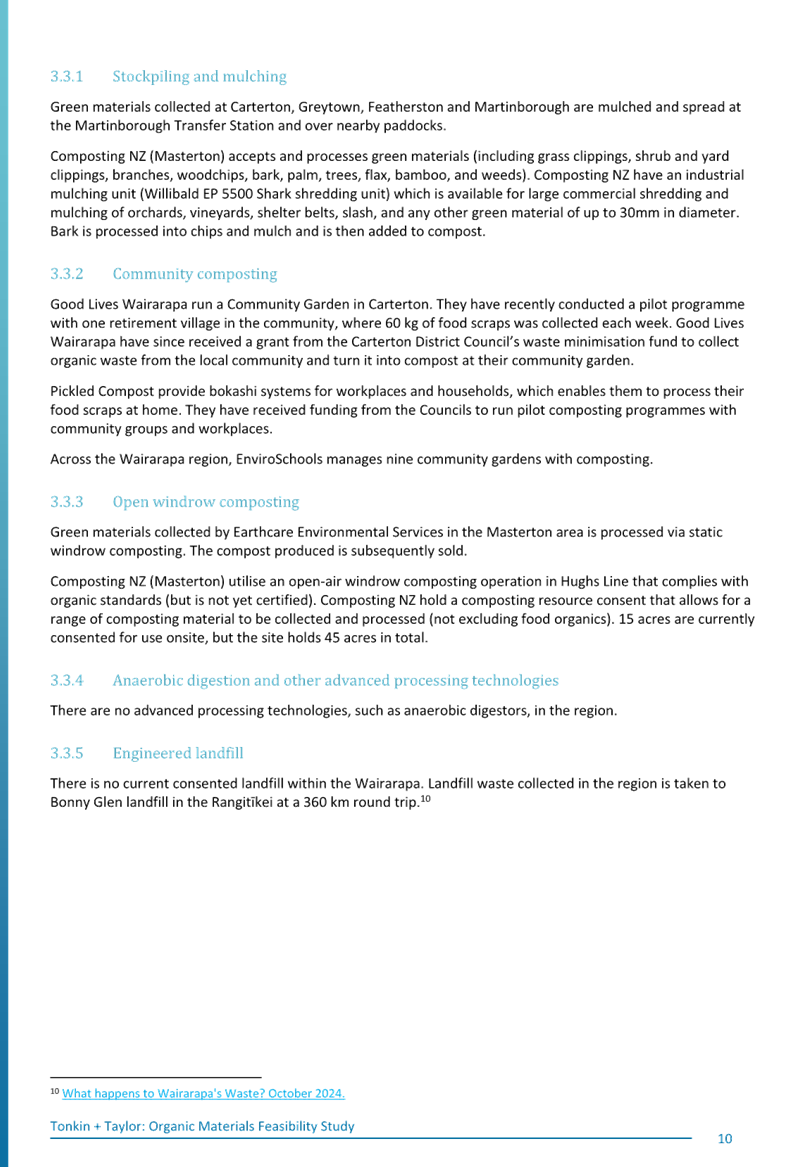
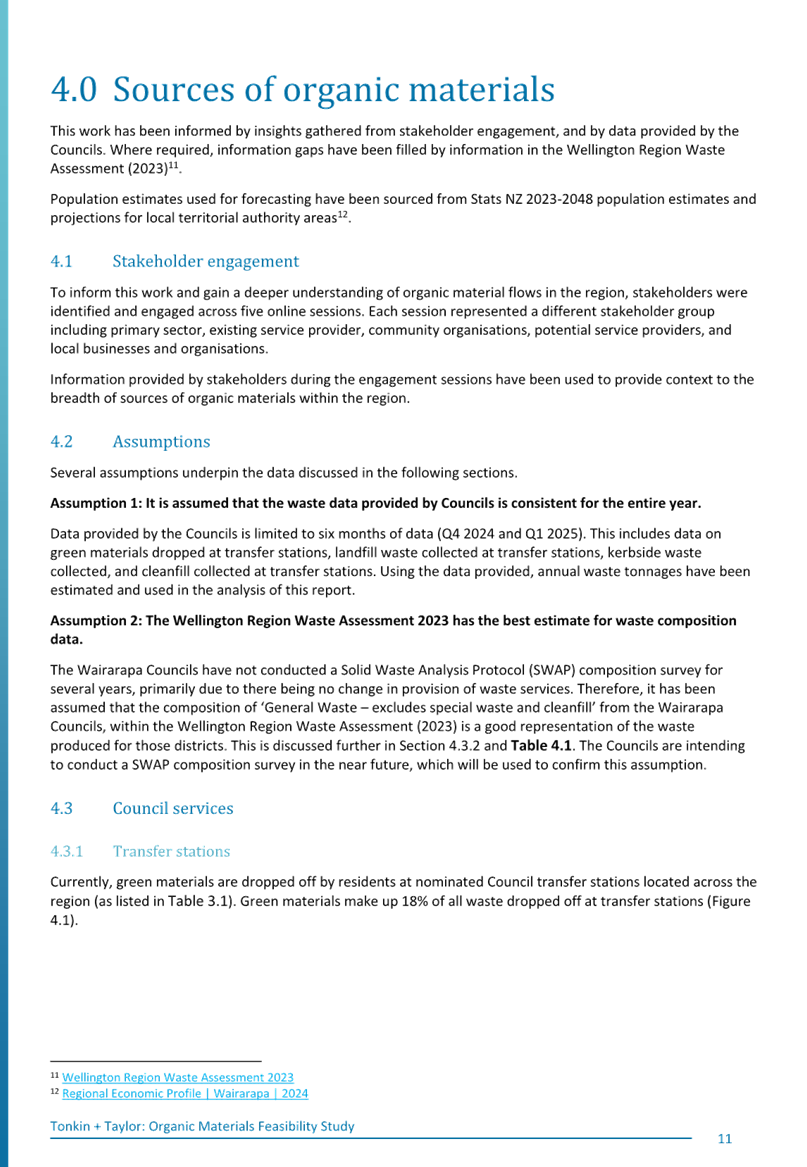
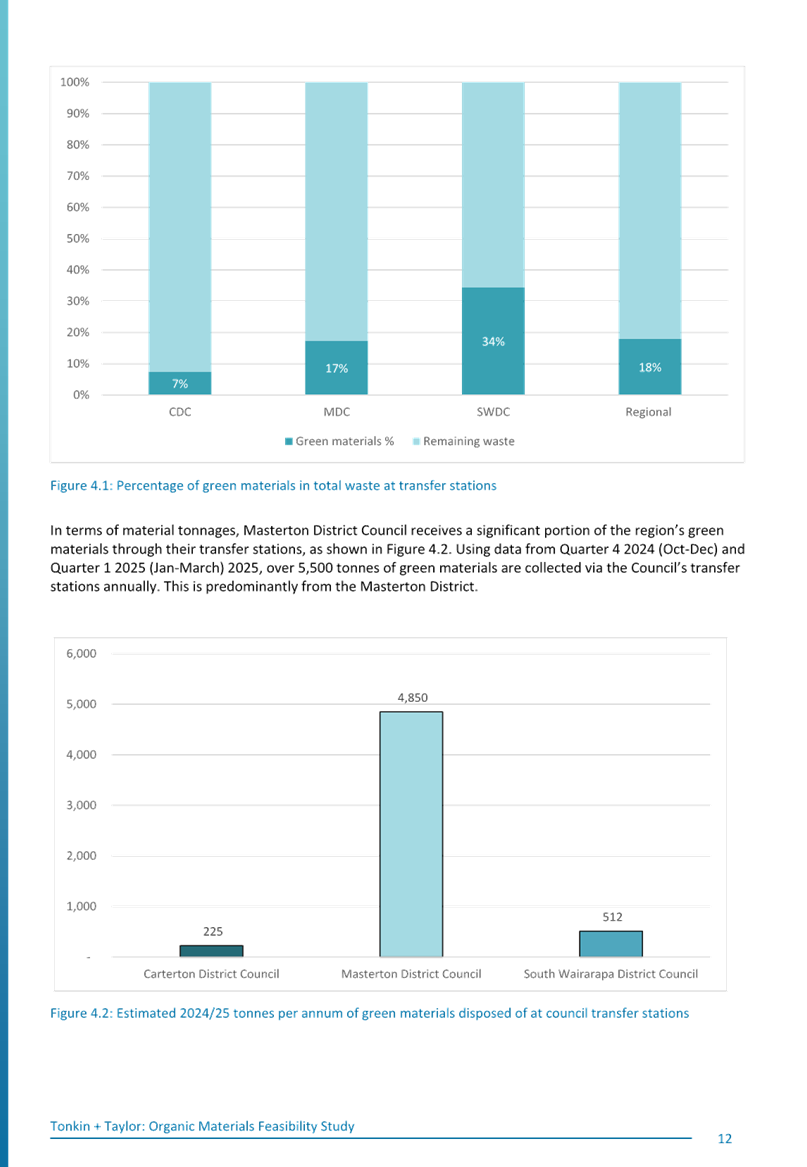
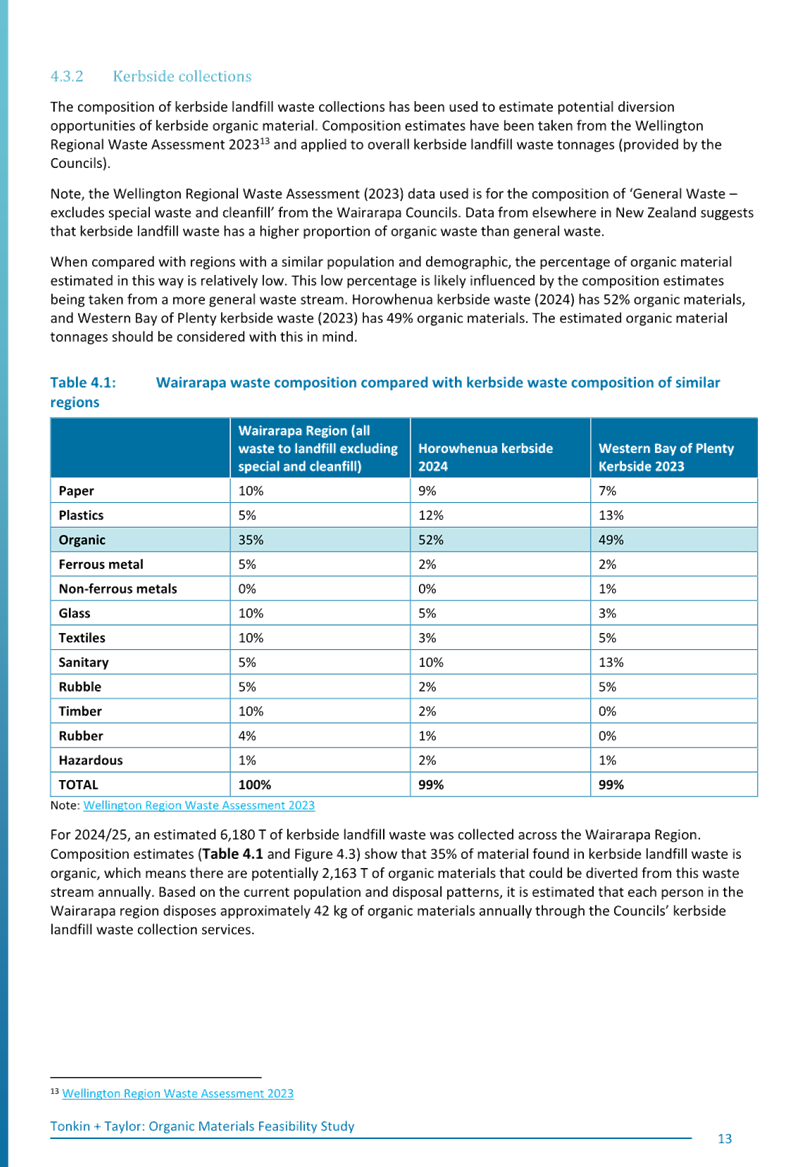
Some glimpses from
the New World Soft Plastics Bin Installation
6. Recommendation
That the Committee:
1. Receives
the report.
File
Number: 481818
Author: Sarvesh
Tiwari, Waste Management and Minimisation Officer
Attachments: 1. Wairarapa
Organics Kerbside Feasibility Study Report ⇩
|
Policy
and Projects Committee meeting Agenda
|
10
September 2025
|


|
Policy
and Projects Committee meeting Agenda
|
10
September 2025
|

7.8 Update
on Operational Consents
1. Purpose
To update the
Committee on the status of the existing consents.
2. Significance
The
matters for decision in this report are not considered to be of significance
under the Significance and Engagement Policy.
3. Discussion
A resource consent is
permission from the Regional Council for an activity that might affect the
environment or the community, and that isn’t allowed ‘as of
right’ in the regional plan. Councils are required to
have resource consents to regulate activities that could potentially impact the
environment and the surrounding community.
4. Consents
The
main consents currently being worked on are the Water Race consent renewals and
the Kaipaitangata water take consent. A new landfill consent is also required
for GWRC to process. To achieve this, the advice from GWRC is that a new
Assessment of Environmental Effects (AEE) needs to be undertaken.
The waters team
manages 8 different consents, summarised in the table below:
|
Policy
and Projects Committee meeting Agenda
|
10
September 2025
|
|
Consent
|
Expiry
|
Status
|
Risks
|
|
Kaipaitangata Surface Water Take
|
2013
|
Updated AEE discussed with GWRC and stakeholders.
Ongoing discussion. The submission is planned for this year.
Staff started to engage with various stakeholders. The 2012
application is on hold. We are reapplying with updated information for the
Natural Resources Plan.
Te Tini o Ngāti Kahukuraawhitia engagement is in progress and
awaiting response.
|
Low flow restrictions
We are requesting a 20-year consent; however are still awaiting a
decision on this.
|
|
Carterton Landfill
|
2016
|
The 2014 application is on hold.
Staff contacted GWRC to discuss the pond desludging requirements
over the next 3 years.
Communication with GWRC has indicated that an updated AEE is
required.
|
Restrictions on sludge disposal.
Unknown risk for unlined cells and what may be required for
monitoring.
Potentially, a new AEE is required, as the last AEE was undertaken in 2015.
The reasons for the new AEE are:
- Regulatory and Policy Framework Updates since 2015.
- Changes in Environmental Conditions and Risks
- Best Practice and Technical Advancements.
- Actual and potential effects are difficult to
ascertain, given the lack of information supplied and the inconsistencies
within the 2015 AEE document.
Officers have engaged
a consultant to review and update the existing Assessment of Environmental
Effects (AEE) to ensure it aligns with the now-operative Natural Resources
Plan (NRP). A meeting with the consultant has been scheduled for next week
to discuss key matters before further work is advanced. The consultant has
indicated that while initial progress has been made, some aspects of the
draft AEE require clarification and refinement to ensure accuracy and
robustness. They have also signalled that certain assumptions in the draft
may need to be reconsidered to better reflect their potential effects. The
preferred approach remains to review and update the existing AEE rather than
prepare a completely new assessment. It is expected that this will satisfy
Greater Wellington Regional Council’s (GWRC) requirement for a new AEE
while avoiding unnecessary duplication of work.
|
|
Consent
|
Expiry
|
Status
|
Risks
|
|
Taratahi Water Race
|
30 June 2023
|
The 2023 application
with updated questions has been returned to GWRC officers.
Meetings are planned
with GWRC to discuss the further information they have requested.
Currently in the
process of addressing the outstanding information and
assessment deficiencies. Discussion with experts is ongoing. A Principal
Ecologist (Consultant) has been engaged to conduct ecological surveys of the
water races for the purpose of consent renewal. This survey is scheduled to
be carried out in the second week of September.
Given that the budget
was set in the previous LTP and the increased cost of providing information,
officers will need to request a budget increase at the next council meeting.
|
Restrictions during
low flow and the amount of monitoring required.
We are requesting a 20-year
consent and are still awaiting a decision on this.
The costs for
consenting.
|
|
Carrington Water Race
|
30/6/2023
|
See above
|
|
|
Frederick St
groundwater take
|
30/9/2034
|
Current
|
Nitrate levels are
still within limits. However, a change in legislation could compromise this.
|
|
Waingawa swamp
cleaning
|
3/9/2023
|
Expired; included in
the Water Race consent application
|
|
|
Wastewater discharge
|
17/1/2053
|
Current; multiple
consents
|
· Capacity for population growth
|
|
Stormwater
|
15/8/2027
|
Current; Monitoring
consent to create stormwater management strategy
|
Roading run-off
treatment
|
|
Policy
and Projects Committee meeting Agenda
|
10
September 2025
|
5. REnewal
Progress
There are currently four
consents progressing that are in different stages:
· The water race consents (which are consented separately but being
processed concurrently) remain on hold under Section 92. The 2023 application,
which includes updated questions, has been returned to GWRC officers, and
meetings are planned with GWRC to discuss the further information they are
requesting. GWRC officers have indicated that the effects of the takes from
streams and groundwater are likely to be more than minor, and the AEE submitted
contains deficiencies and is considered insufficient. The process of addressing
the outstanding information and assessment deficiencies is underway, with
ongoing discussions involving technical experts. A Principal Ecologist
(Consultant) has been engaged to conduct ecological surveys of the water races
to support the consent renewal process. The survey is scheduled to be
carried out in the second week of September 2025.
· The
updated application for the Kaipatangata has been on hold since 2015 while
different strategies were considered by the Council on the use of the Frederick
St Water Treatment Plant and the Kaipatangata supply. Council staff have
drafted a replacement AEE that is evaluated against the objectives, policies,
and rules of the Natural Resources Plan. Preliminary discussions with the
Regional Council were encouraging, however the last email correspondence
indicated the GWRC policy team had advised that because the Mangatārere
Stream is over-allocated, that only a 5-year consent is possible. Te
Tini o Ngāti Kahukuraawhitia engagement is in progress and we are awaiting
aresponse.
· The
landfill consent for the closed landfill requires renewal, with GWRC advising
that a new AEE is needed. Officers have engaged a consultant to review and
update the existing AEE in line with the operative Natural Resources Plan
(NRP). Work is underway, with a meeting scheduled next week to progress key
matters.
· As storage volumes
approached capacity, CDC was required to consider emergency discharge options
in the absence of rainfall sufficient to lift the Mangatārere Stream to
the consented flow rate. Officers proactively engaged with GWRC in advance,
outlining the operational constraints and seeking advice on the appropriate
course of action should an emergency discharge become necessary. GWRC confirmed
that land irrigation was the preferred initial option, with discharge to water
permissible if site conditions gave rise to adverse effects such as ponding or
odour. Acting on this guidance, CDC commenced land irrigation in a controlled
manner while closely monitoring conditions on site. Following significant
rainfall, flows in the Mangatārere Stream subsequently rose well above the
required dilution threshold, enabling discharge to water to resume in full
compliance with consent conditions.
6. CONSIDERATIONS
6.1 Climate
change
N/A.
6.2 Tāngata whenua
One important stakeholder is mana whenua. Council officers are engaging
with Ngāti Kahukuraāwhitia to arrange a cultural impact assessment
for the diversion of water from the Kaipatangata Stream for the town supply.
6.3 Financial
impact
All work relating to the renewal and maintenance of the consents is
provided for within approved budgets in the LTP and carry forwards.
7. Recommendation
That the Committee:
1. Receives
the report.
File
Number: 480945
Author: Jeet
Kiran, Waters Compliance and Monitoring Officer
Attachments: Nil
|
Policy
and Projects Committee meeting Agenda
|
10
September 2025
|
7.9 Update
on Major Projects
1. Purpose
To update the
Committee on the progress of major projects.
2. Significance
The
matters for decision in this report are not considered to be of significance
under the Significance and Engagement Policy.
3. Background
The
Infrastructure Services Team delivers multiple projects as part of the delivery
of the Long-Term Plan.
4. Discussion
4.1 Waingawa
Process Water
4.1.1
Finance
Total Budget $2,767,679
actual
cost $2,725,000
All major construction has been
completed, and practical completion was achieved on Wednesday, 20/08/2025 and
pumps were commissioned on the same day. The grand opening and ribbon-cutting
ceremony is planned for the 22nd of September 2025.
Officers are very pleased with the
performance of all suppliers involved in delivering this landmark project on
time and on budget.
There are already 4 process water
connections in the Waingawa Industrial Park. The completion of this project
opens many opportunities for the future of the industrial park.
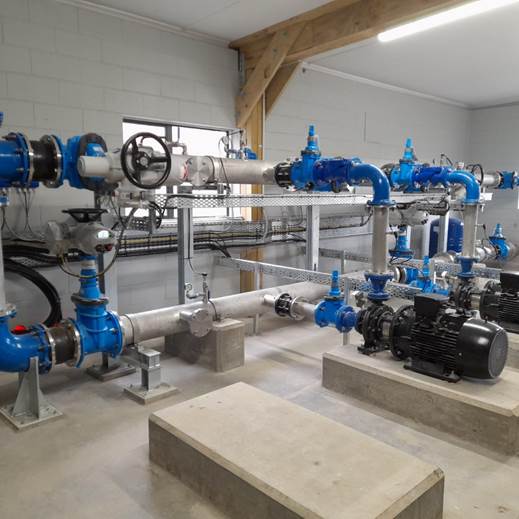
Image 1 - Pump Station (1)
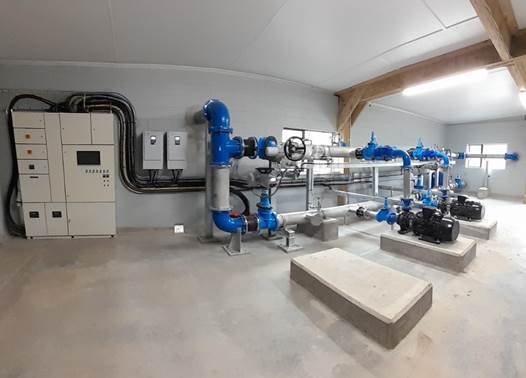
Image 2 –
Pump Station (2)
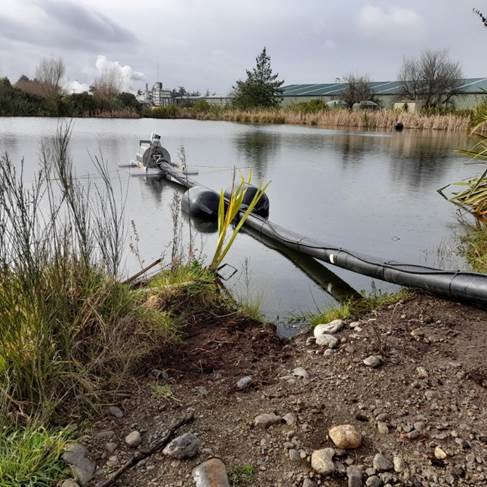
Image
3 - Pump Inlet System (3)
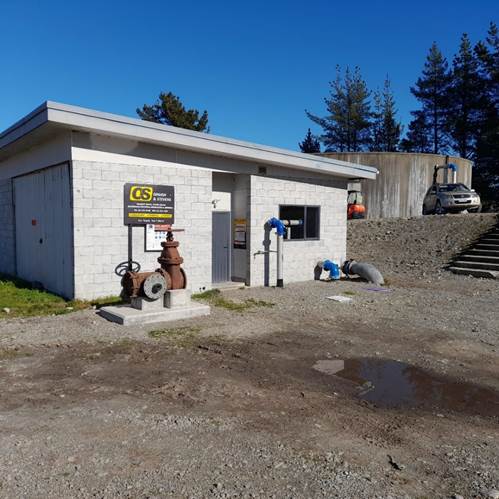
Image
4 - Pump House
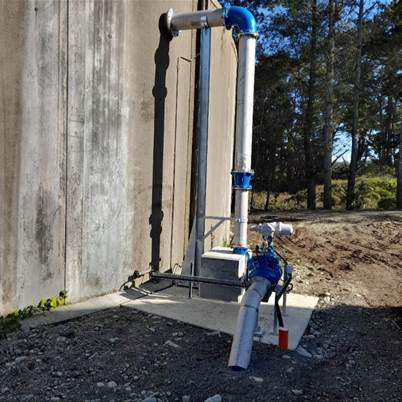
Image
5 - Inlet pipe to reservoir
4.2 Brooklyn
Road Watermain Replacement
4.2.1
Finance
Total
Budget $2,430,000.00
cost
to date $2,039,014.16.
Officers are waiting for final claim, however is confident, that the
work was completed withing the approved budget.
Progress
This
contract has been completed and Practical Completion achieved on Thursday,
28/8/2025.
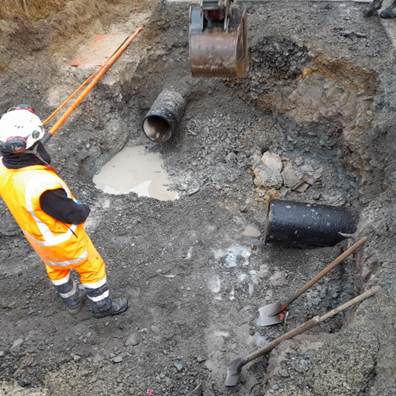
Image
6 - Brooklyn Road Water Main Replacement Linking to old main
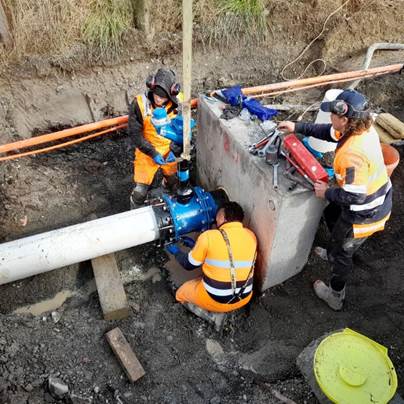
Image 7 - Brooklyn Water Main Replacement – Linking to old main
4.5
Depot Ablution Block
The old toilets in the
depot offices have been removed.
We await a quote to
refurbish the inside to create more office space.
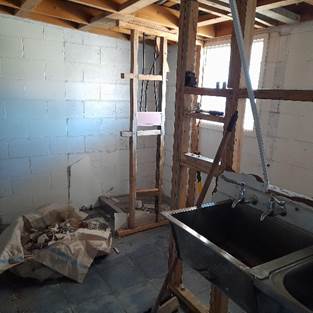
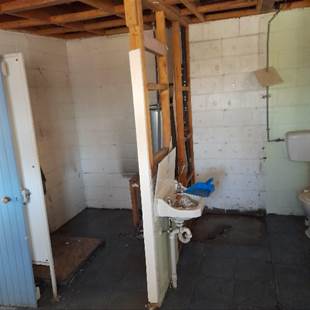
Image 8 -
Demolition Process
4.6
Frederick Street Treatment Plant Building Upgrade
The
foundations and floor have been installed, and the wall construction is in
process.
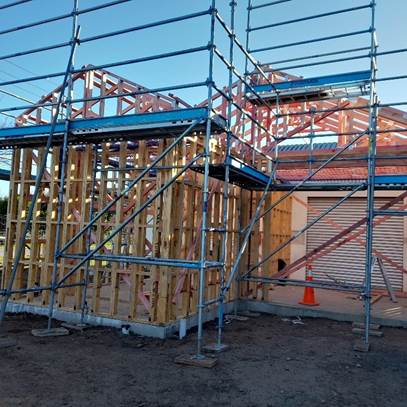
Image
9 - Frederick Street Treatment Plant Building Upgrade (1)
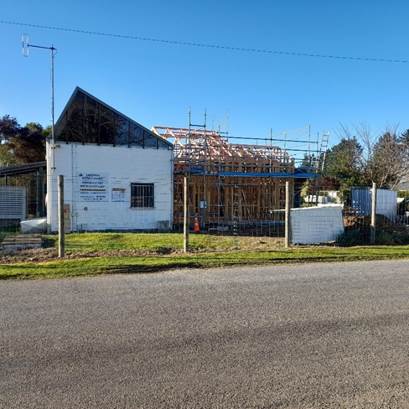
Image
10 - Frederick Street Treatment Plant Building Upgrade (2)
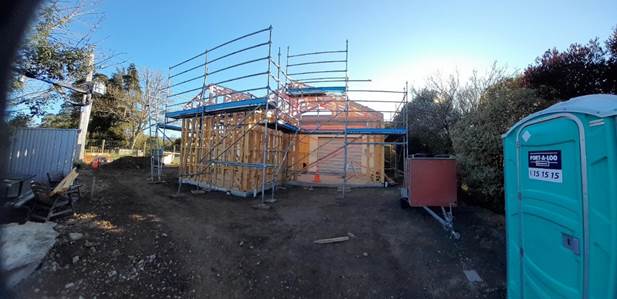
Image
11 - Frederick Street Treatment Plant Building Upgrade (3)
4.7
Waste Water Treatment Plant: Sewage Sludge Composting Pilot Programme -
Pond 3
The
first Phase of the Sludge Removal has been completed. 600 Tonnes of
sludge were removed from Pond 3 and mixed with 500m3 mulch.
This material was stacked into windrows on site and is now in the process of
being allowed to compost. This is a three month process whereafter testing will
be done to establish the progress and feasibility of the composting process.
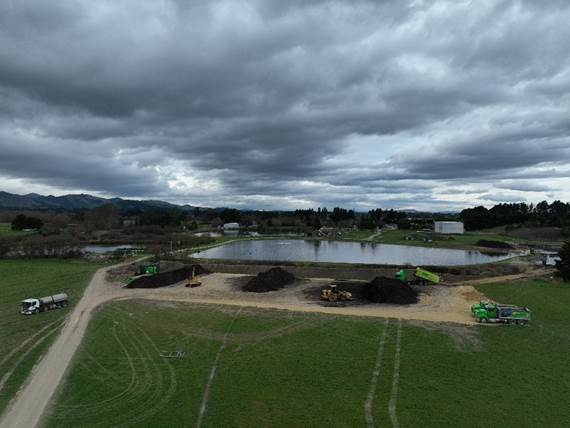
Image
12 - Sludge Removal (1)
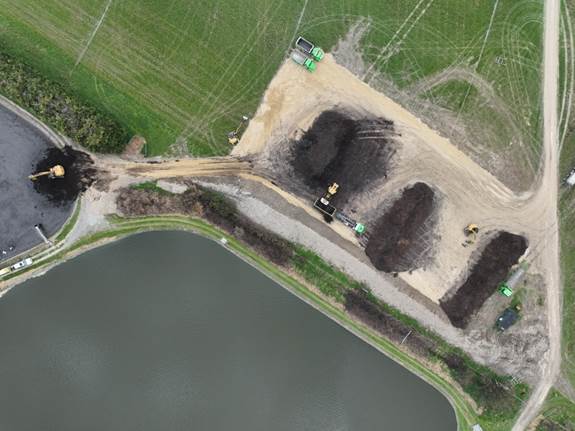
Image
13 - Sludge Removal (2)
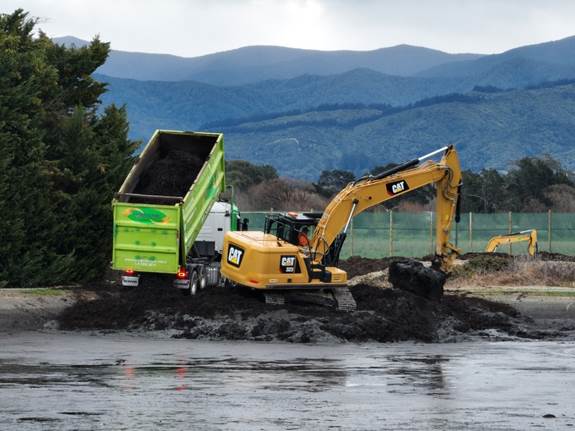
Image
14 - Sludge Removal
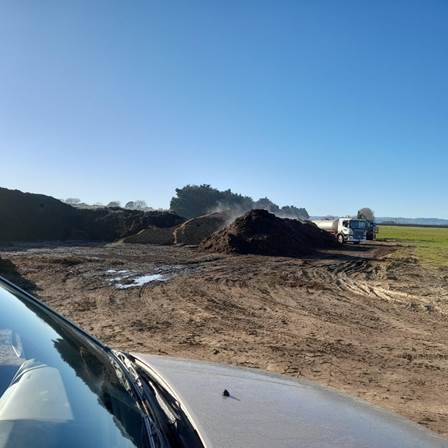
Image 15 -
Composting Process
4.8
Backflow Prevention
G&C
Diggers is about to start installing backflow preventers in the area to bring
CDC in line with The Water New Zealand Backflow Prevention for Drinking Water
Supplies Code of Practice.
The
council has to decide how the backflow preventers will be funded.
4.9
New Toilets
A
Streamline roof canopy was successfully installed in the depot between the old
office building and the new toilet block. We are also in the process of
demolishing the old toilets to create more office space. All of these works are
being delivered under the approved budget for the toilet upgrade.
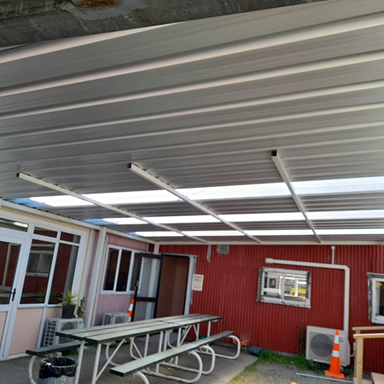
Image 16 - Canopy over the backyard
4.10
High Street South Water Renewal
Egis
has been instructed to start the design for the renewal of the water main and
rider main in High Street South.
Construction
of the replacement main is planned for January 2026.
If
the work is undertaken based on the current yearly budgets (stop-start
fashion), the pipework will be completed in 2030.
If
budgets can be brought forward and construction executed continuously, the
pipework can be completed in 2027.
4.11
Brooklyn Road Waste Water Renewal
Egis has been requested to
quote for the sewer pipe design on Brooklyn Road.
5. CONSIDERATIONS
5.1 Climate
change
This
report is a regular update which is of interest to all members of our
community, including iwi and hapū.
5.2 Tāngata whenua
This
report is a regular update which is of interest to all members of our
community, including iwi and hapū. However, there are no areas of interest
or concern contained within this report that require specific iwi or hapū
consideration.
5.3 Financial
impact
The financial matters in the report are
covered within existing budgets.
5.4 Community
Engagement requirements
There
are no community engagement requirements required for this report.
5.5 Risks
Project risks are
being managed and mitigated as and when required.
6. Recommendation
That the Committee:
1. Receives
the report.
File
Number: 480781
Author: Christo
Heyns, Project Manager
Attachments: Nil
|
Policy
and Projects Committee meeting Agenda
|
10
September 2025
|
7.10 Ruamāhanga
Roads and Corridor Access Report
1. Purpose
For the Committee to
be updated on Ruamāhanga Roads and Corridor Access activities.
2. Significance
The
matters for decision in this report are not considered significant under the
Significance and Engagement Policy.
3. Background
Ruamāhanga Roads is a shared service
between CDC and SWDC to deliver the Land Transport Programme in partnership
with the New Zealand Transport Agency Waka Kotahi (NZTA).
4. discussion
The
attached report relates to activities undertaken across the Carterton and South
Wairarapa Districts for May to July 2025.
5. CONSIDERATIONS
5.1 Climate change
Roading
activities have an impact on climate change however through the road
maintenance contract, efficiencies are strived for which relate to climate
change mitigation. This report does not have any climate change decision
implications.
5.2 Tāngata whenua
This
report is a regular update which is of interest to all members of our
community, including iwi and hapū. However, there are no particular areas
of interest or concern contained within this report that require specific iwi
or hapū input.
5.3 Financial
impact
All of
the roading activities are completed under approved budgets, and this report
does not have any additional financial impacts.
5.4 Community
Engagement requirements
There
are no additional community engagement requirements resulting from this report.
5.5 Risks
This
report is a regular update. It contains no specific or identified
decision risks which would require further attention or action.
6. Recommendation
That the Committee:
1. Receives
the report.
File
Number: 482016
Author: Graham
Carson, Roading Manager
Attachments: 1. Ruamahanga
Rd Report Sept 2025 ⇩
|
Policy
and Projects Committee meeting Agenda
|
10
September 2025
|
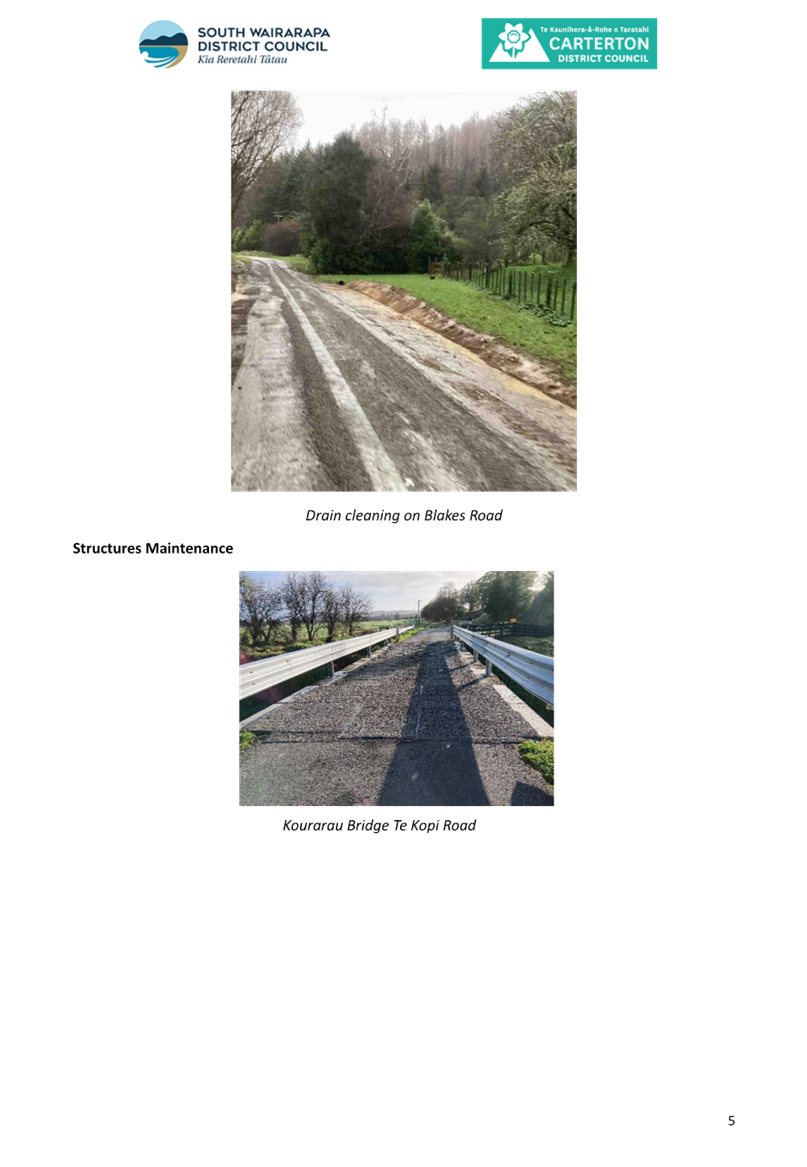
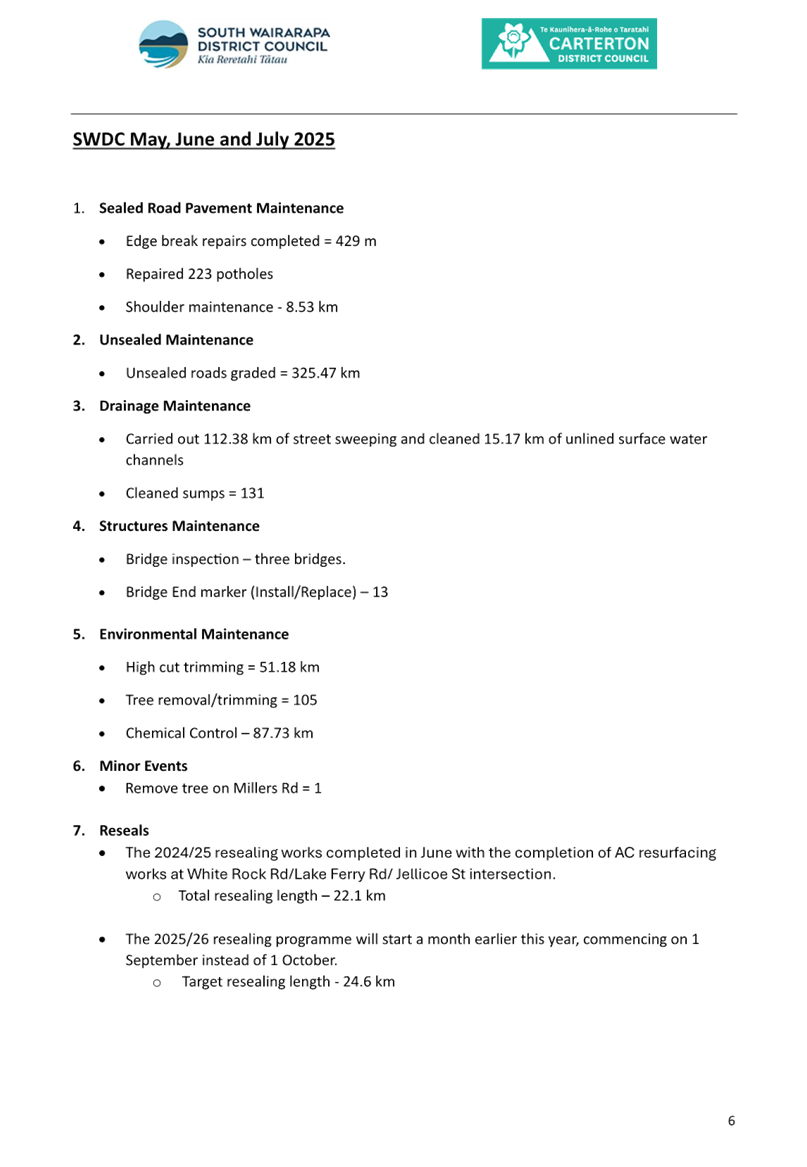
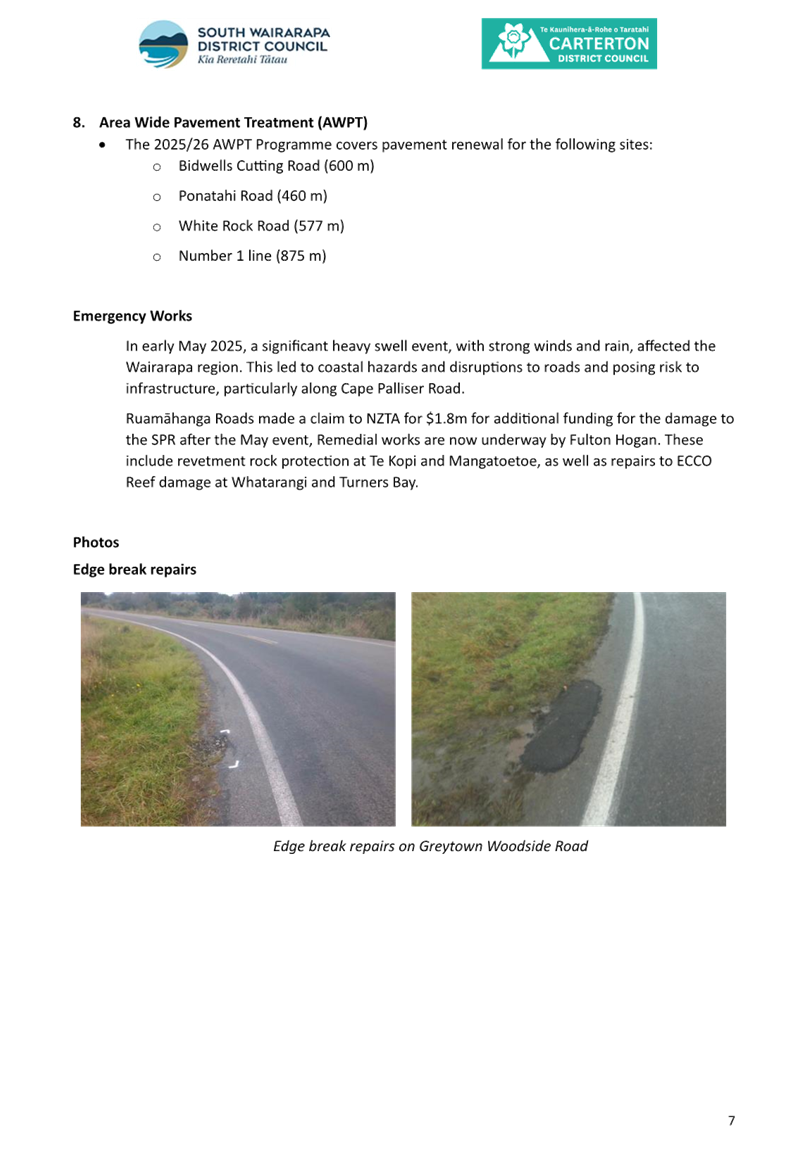
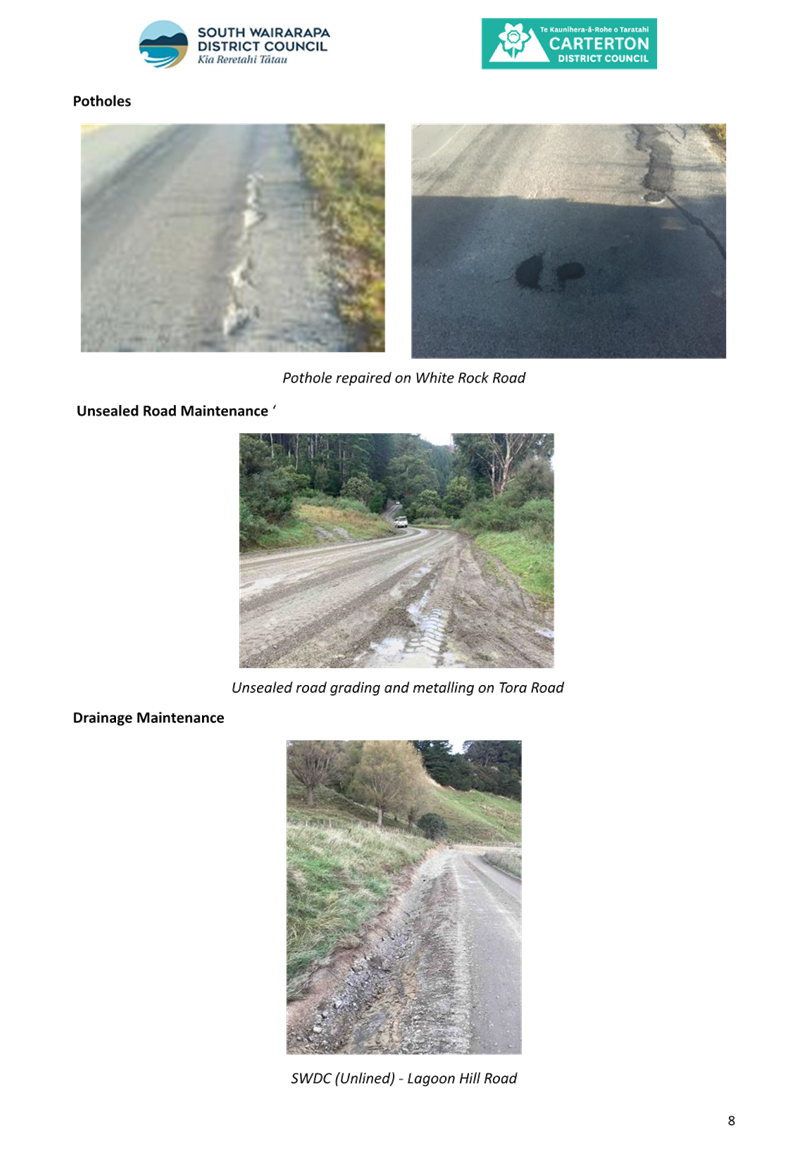
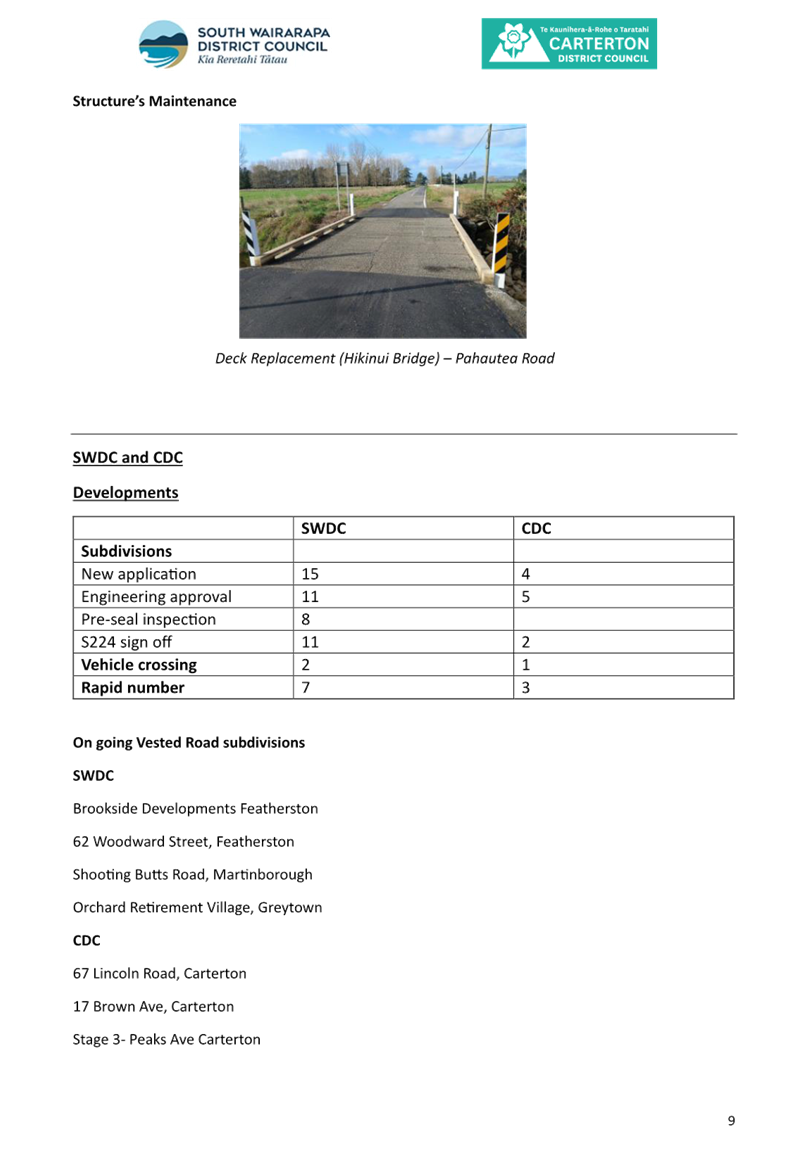
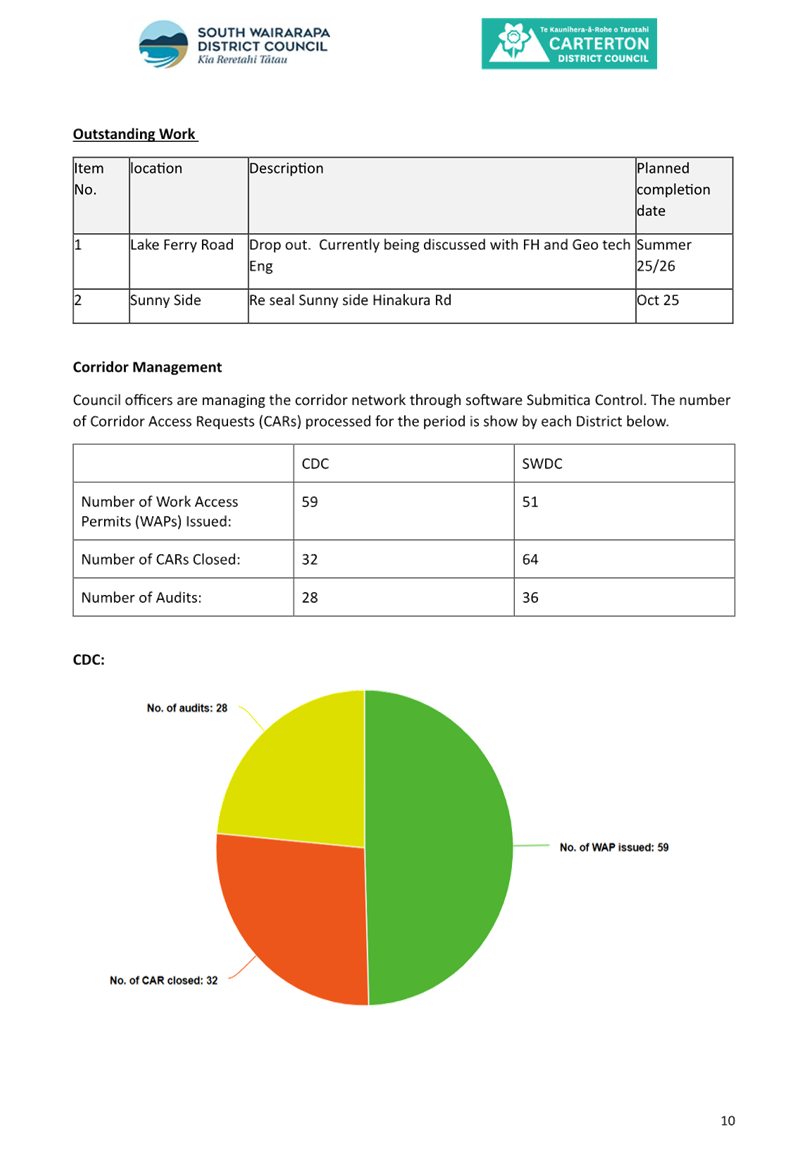
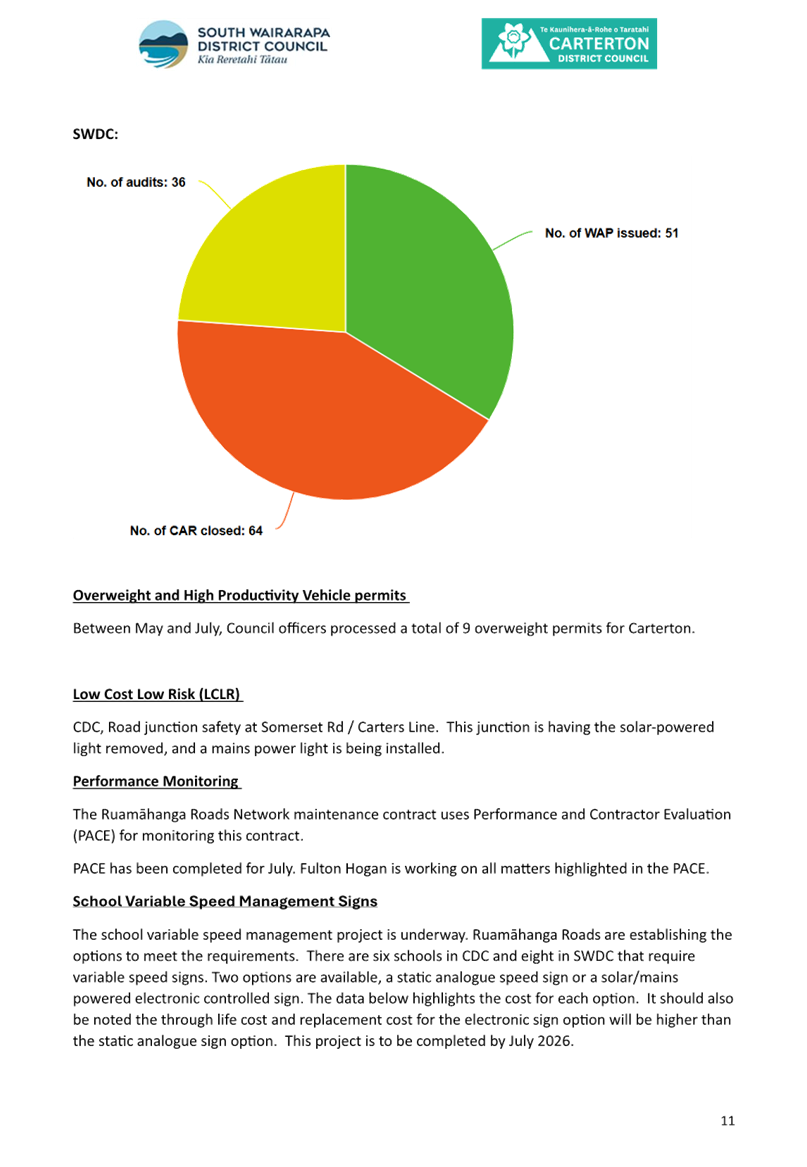

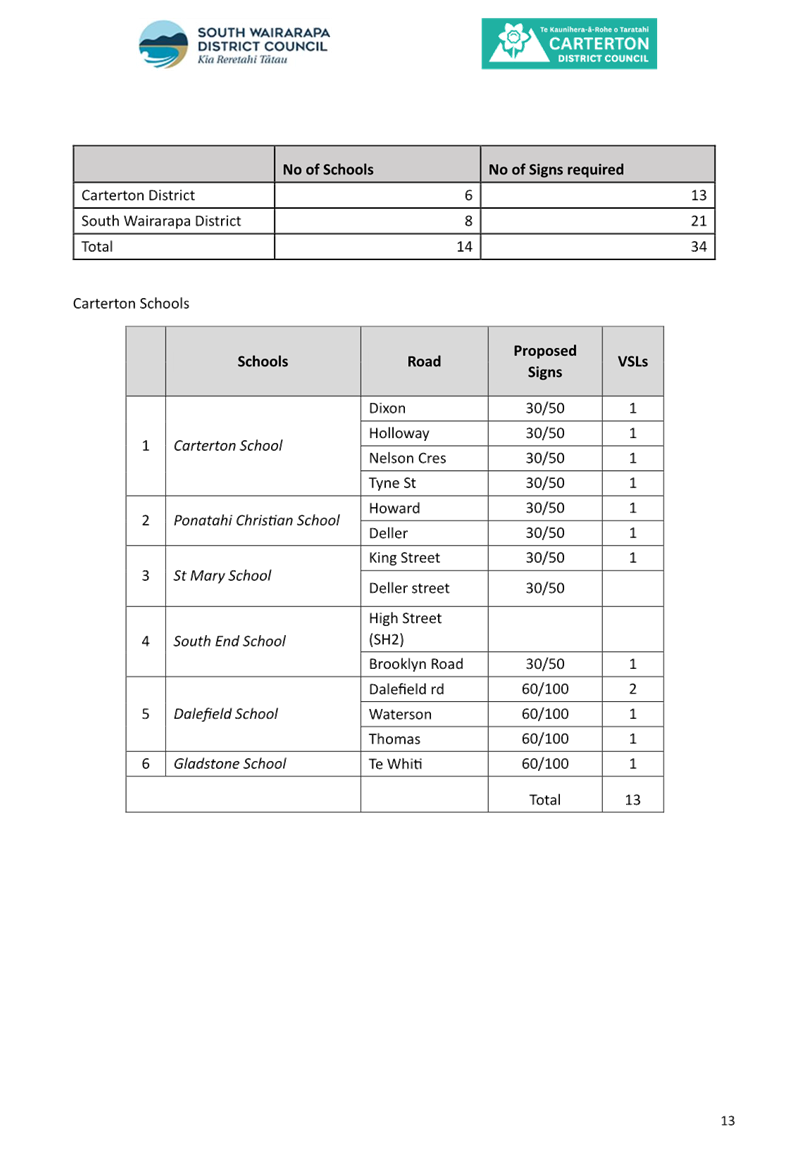
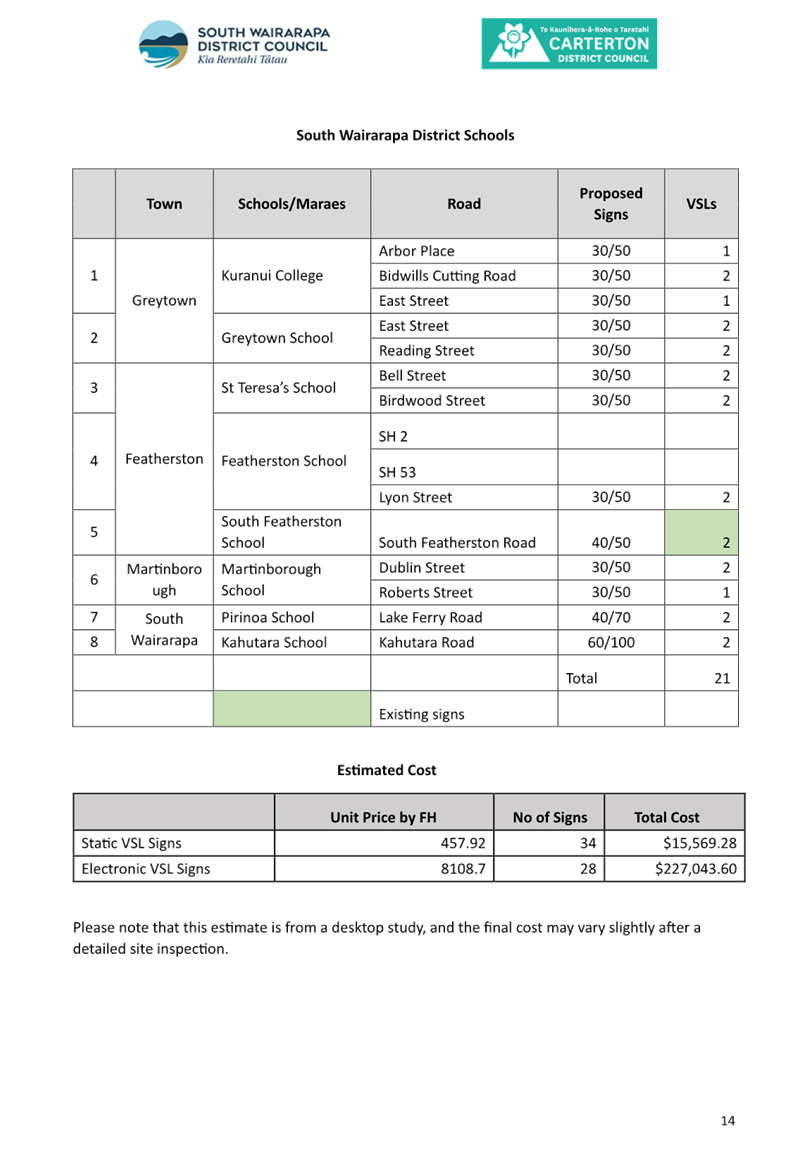
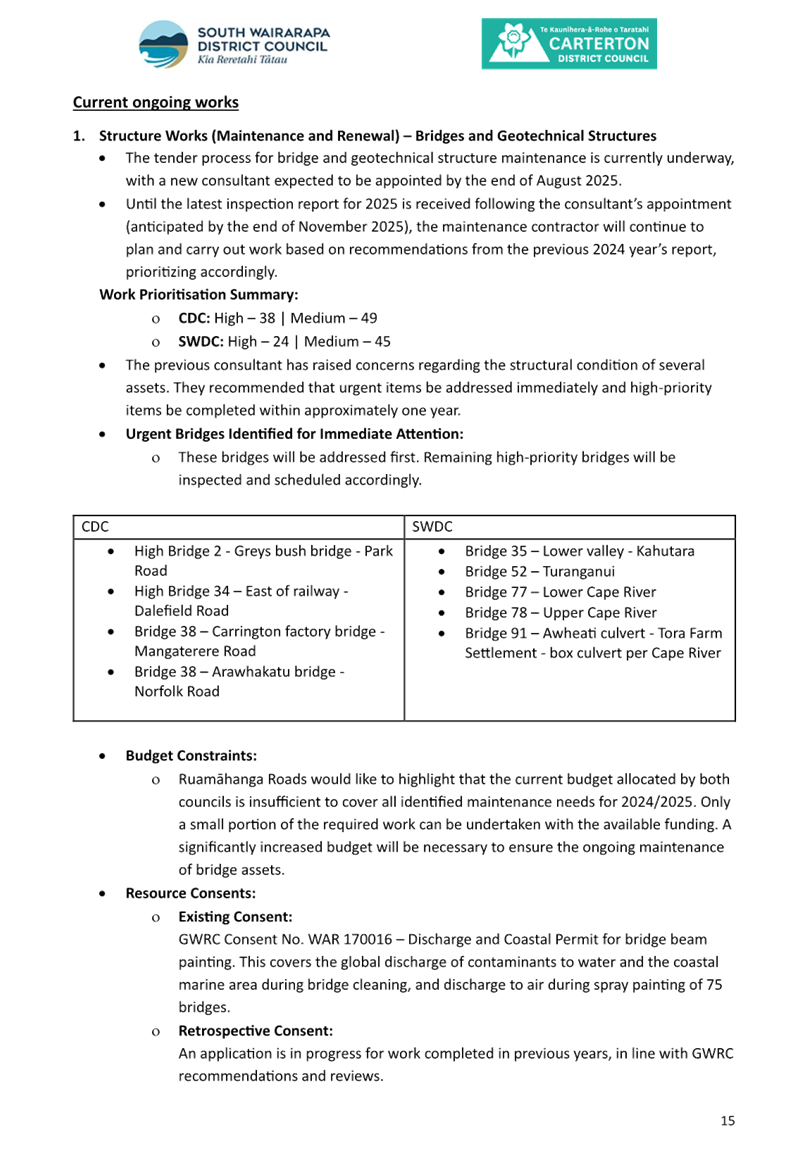
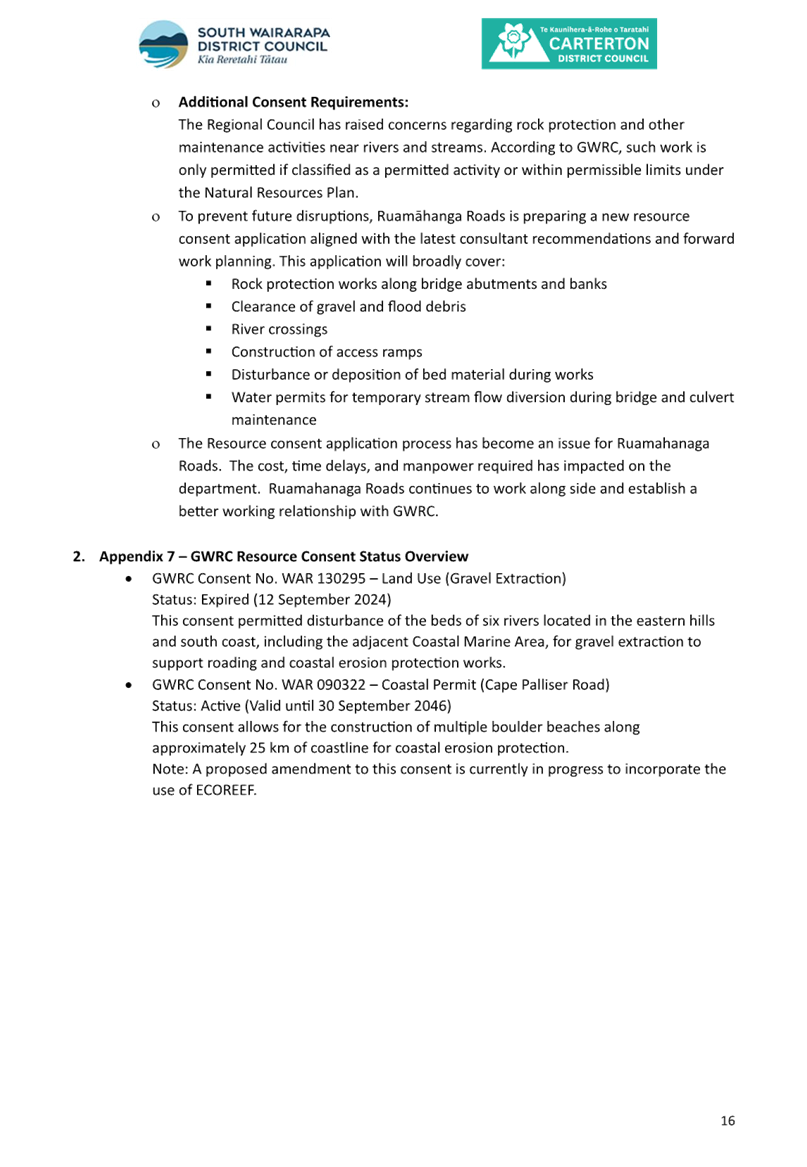
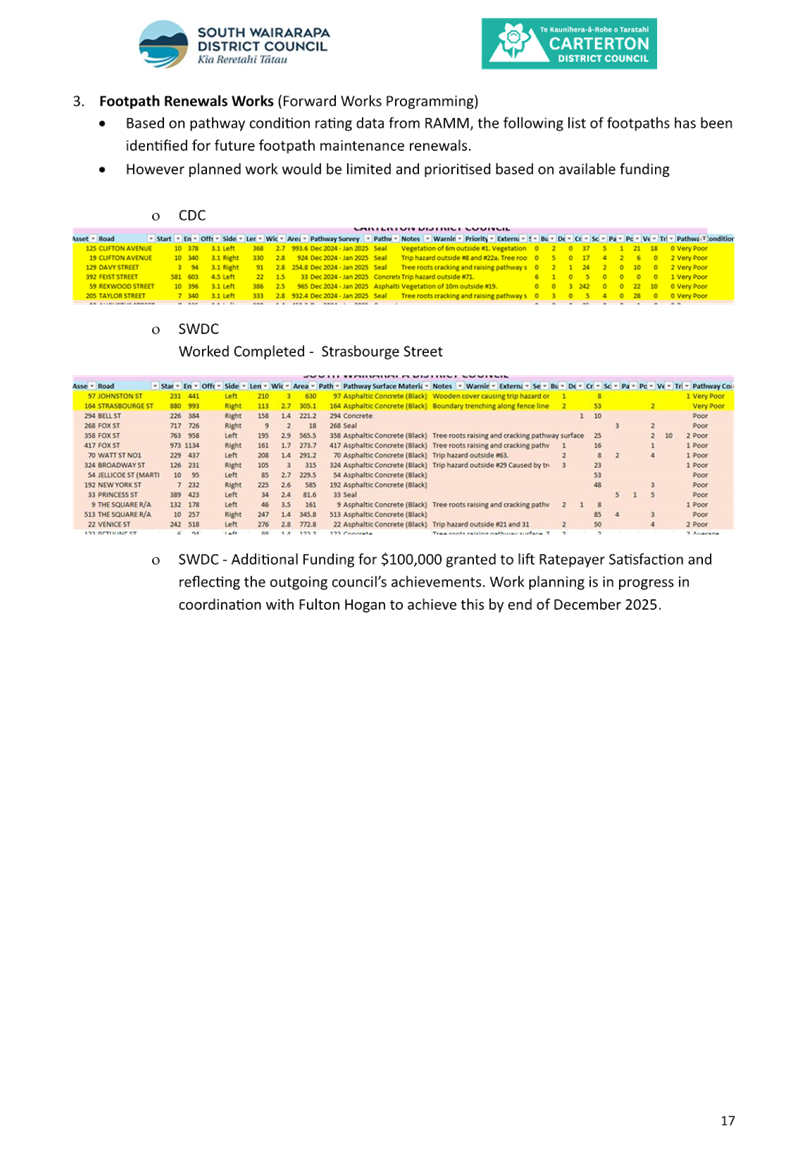
|
Policy
and Projects Committee meeting Agenda
|
10
September 2025
|

7.11 Update
on Planning Resource Consents
1. Purpose
The purpose of this
report is to update the Committee on the resource consents issued since the
previous update.
2. Significance
The
matters for decision in this report are not considered to be of significance
under the Significance and Engagement Policy.
3. Background
The
Terms of Reference for the Policy and Projects Committee include oversight of
implementation of the Wairarapa Combined District Plan. The resource
consents issued since the last report to 3 September 2025, are included in Attachment
1.
4. CONSIDERATIONS
4.1 Climate change
N/A
4.2 Tāngata whenua
N/A
4.3 Financial impact
N/A
4.4 Community Engagement requirements
Not applicable as
consultation requirements for resource consents are prescribed under section
95A-95B of the Resource Management Act 1991.
4.5 Risks
N/A
5. Recommendation
That the Committee:
1. Receives
the report.
File
Number: 481965
Author: Solitaire
Robertson, Planning and Regulatory Services Manager
Attachments: 1. Consent
update ⇩
|
Policy
and Projects Committee meeting Agenda
|
10
September 2025
|
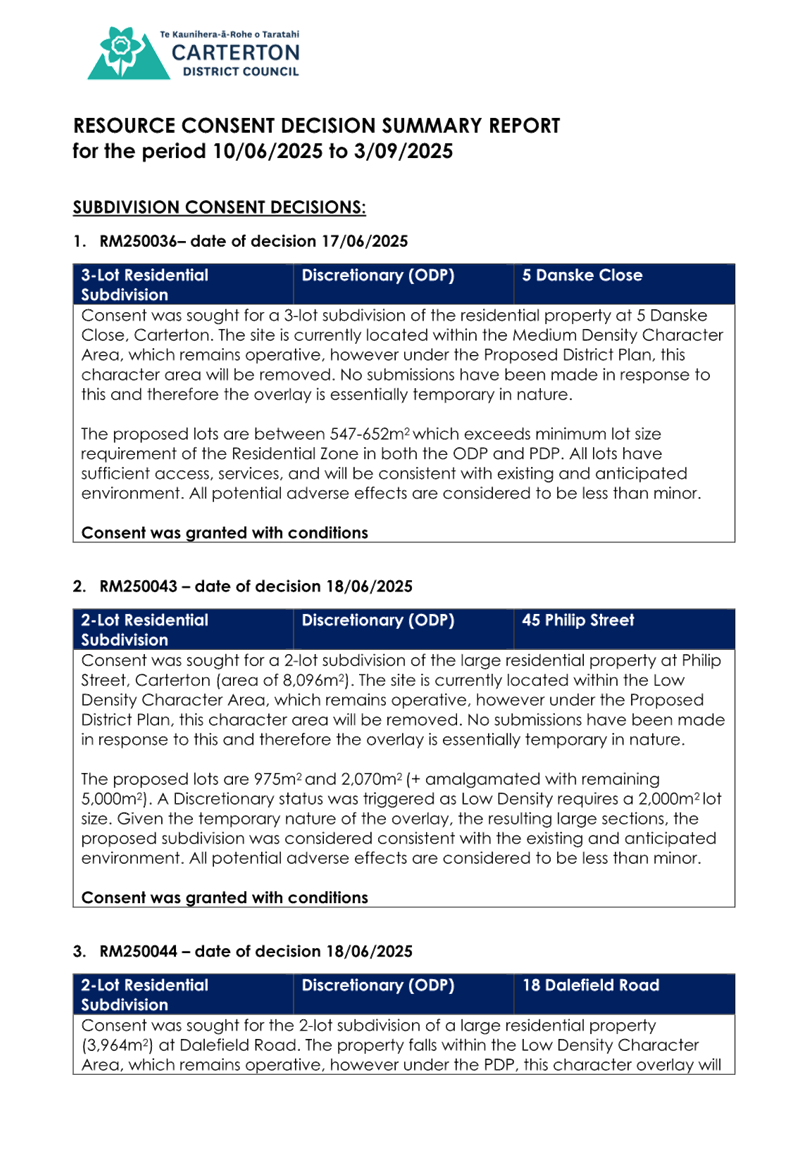
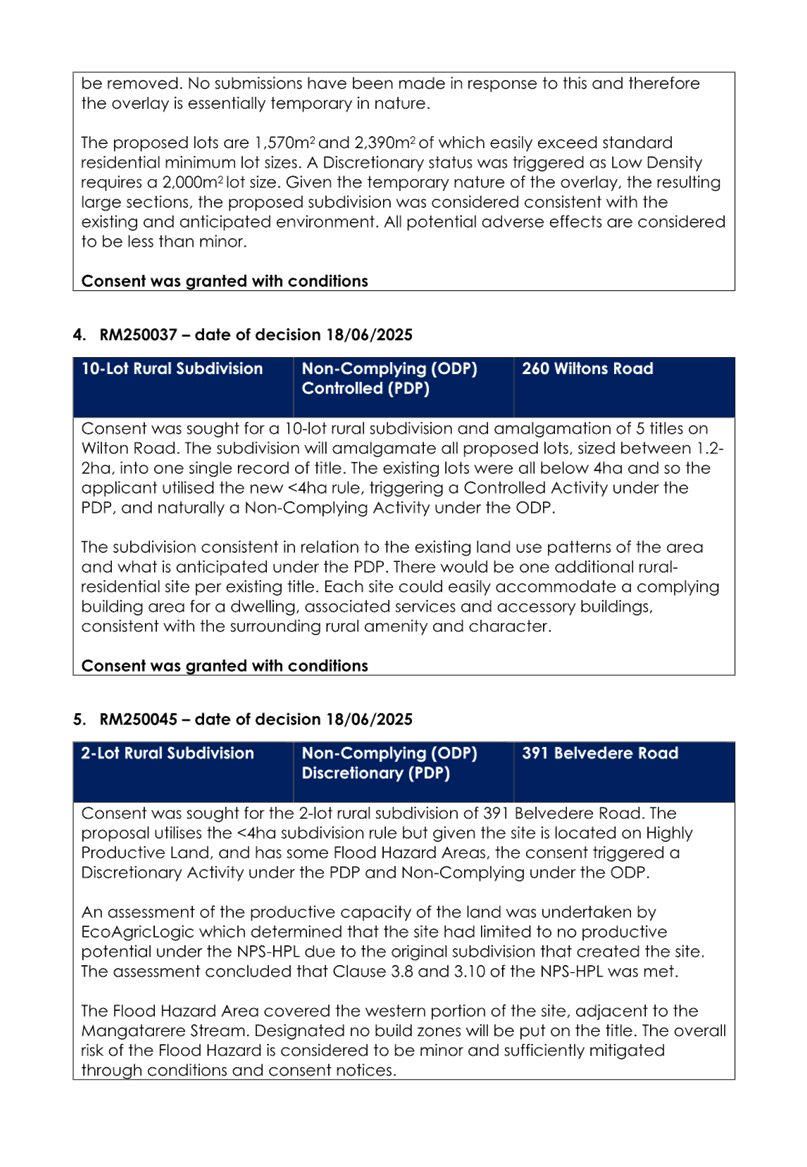
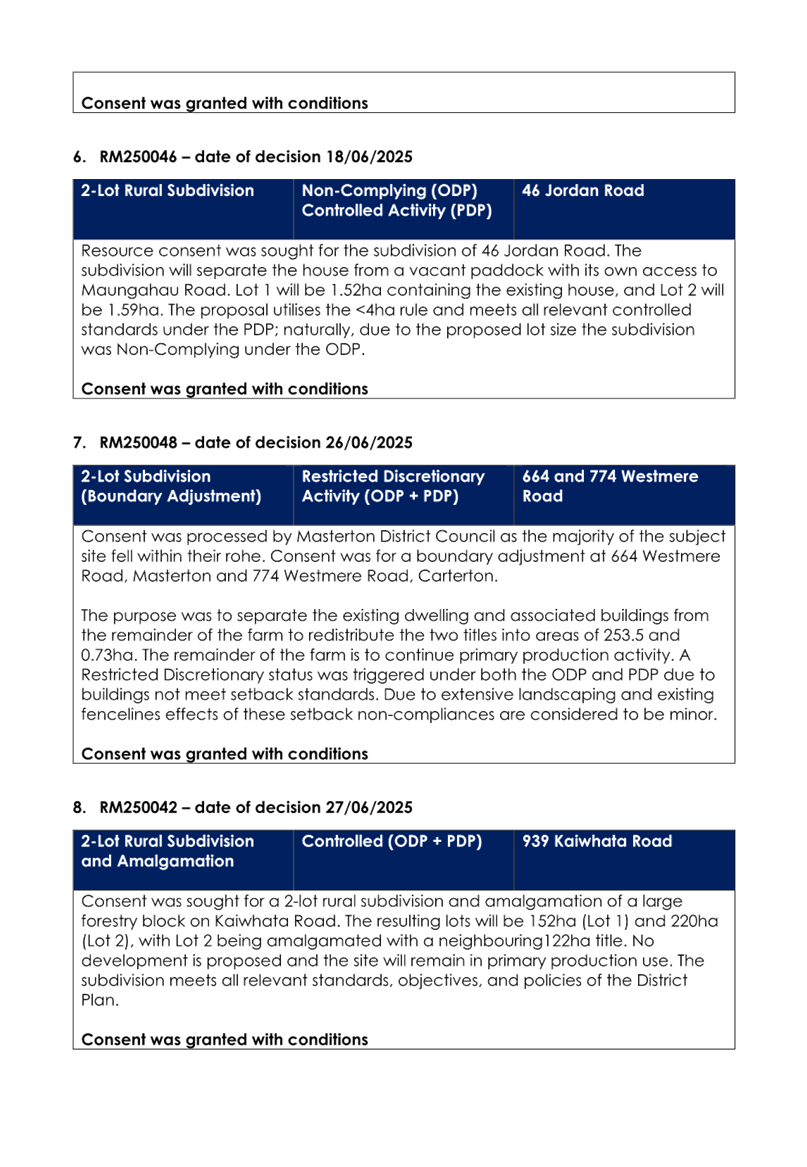
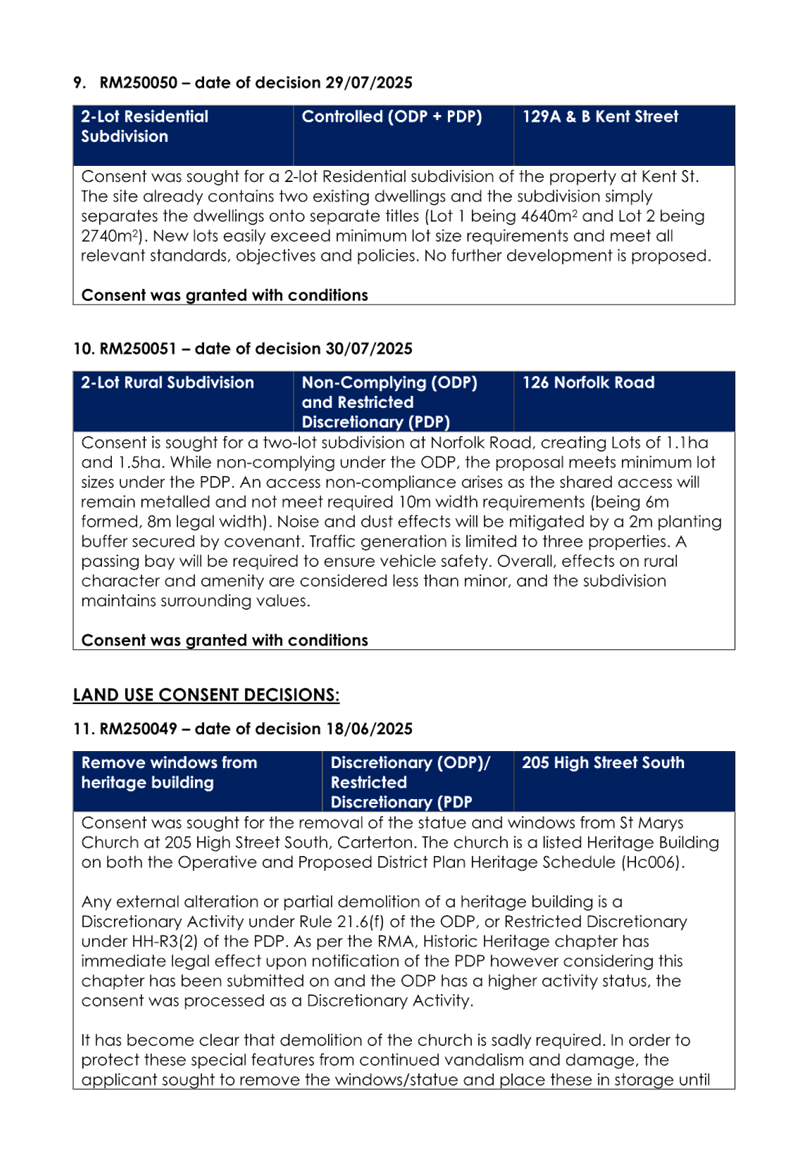
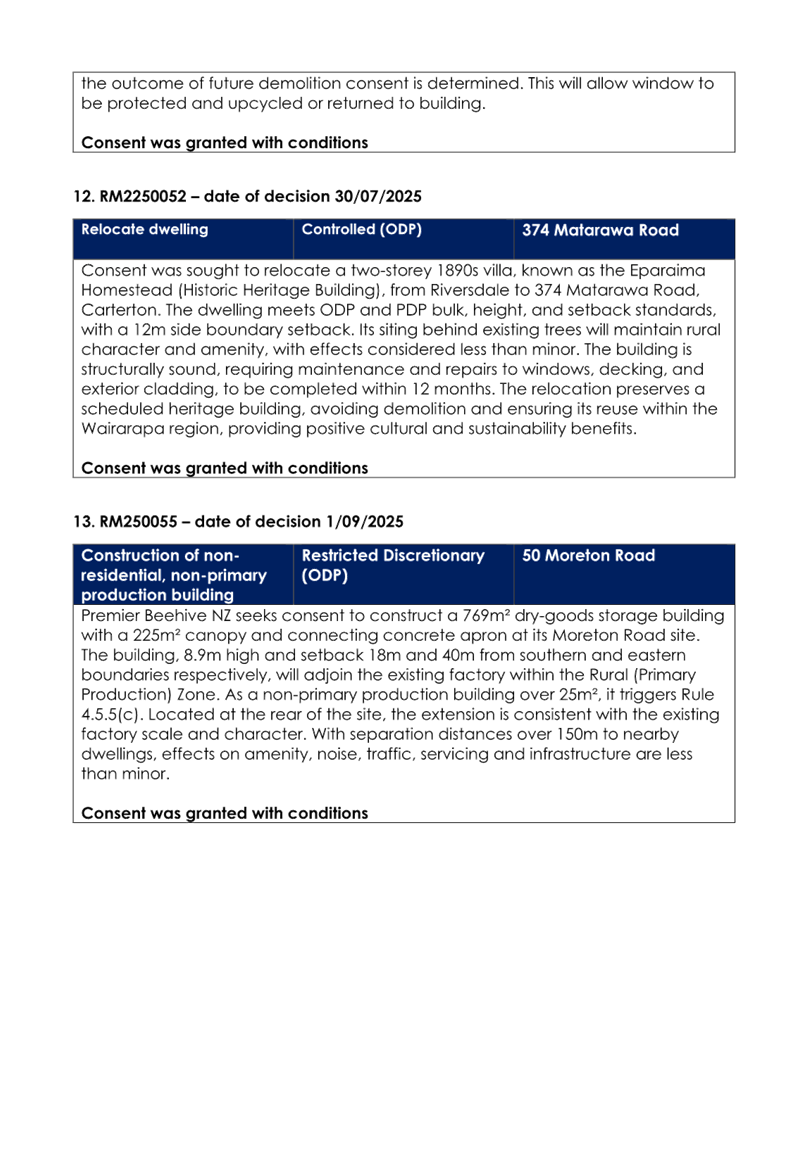
8 Karakia
Whakamutunga
Kia
whakairia te tapu
Kia
wātea ai te ara
Kia
turuki whakataha ai
Kia
turuki whakataha ai
Haumi
ē, hui ē, taiki ē